
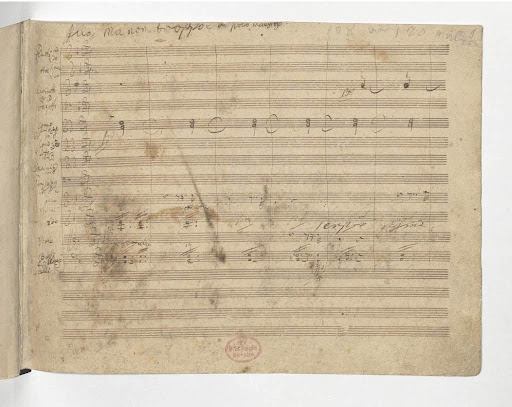
Primordial fragments emerge from the sotto voce murmur of trembling strings. Other voices join in the still formless rustling, ambiguous yet bristling with anticipation. At last a rupture: melody and harmony forcefully materializing, the Big Bang itself seemingly captured in sound. So begins the final orchestral utterance of Ludwig van Beethoven, his monumental Symphony No. 9 in D minor.
View author's page
Reading time estimated : 14 min
In the two centuries since its premiere, the Ninth Symphony and its creator have attained an unrivalled mythical status. Rivers of ink have been spilled analyzing, exalting, and demystifying the Ninth. It is a work written during a time of revolutions as well as conservative backlash and political repression; indeed, the author of the text featured in its groundbreaking choral finale was widely banned at the time of the symphony’s premiere. In keeping with this music’s political roots, it has become one of the most politicized artworks of all time, trumpeted everywhere from Nazi rallies to anti-authoritarian protests. More than a musical masterwork, Beethoven’s Ninth is a canvas onto which centuries of listeners have imposed meaning.
A Tale of Two Symphonies
When the Philharmonic Society of London approached Beethoven in 1817 to compose “two grand symphonies,” it had been years since the premiere of his Symphony No. 8 in F Major. He had fallen into a creative slump exacerbated by illness, the death of his brother, and a bitter custody battle for his nephew.
Years passed without the Philharmonic Society seeing so much as a first draft. For the first part of the 1820s Beethoven labored over his Missa solemnis, the 33 Diabelli Variations, and his final piano sonatas (Nos. 30, 31, and 32). In 1822 he asked his assistant, Ferdinand Ries, to write to the Philharmonic Society for a commission to instead compose a single symphony. They agreed, and Beethoven began work in earnest on what would become the Ninth.
Beethoven completed the symphony in February 1824. Though it had been commissioned for London, a contingent of Austrian devotees convinced him to premiere the work in Vienna. Neither did the Philharmonic Society receive the work’s dedication. That honor was given to King Frederick William III, who had led Prussia through the tumult of the Napoleonic Wars.
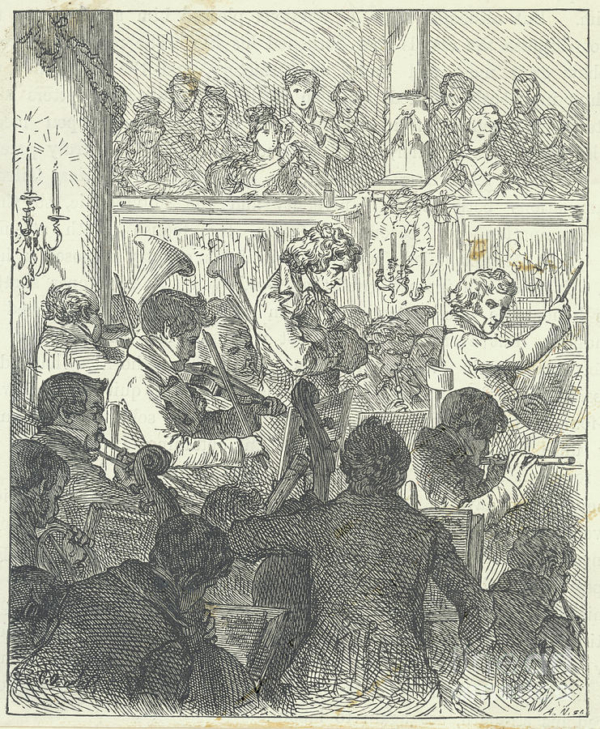
The Ninth premiered on May 7, 1824. After decades of progressive hearing loss Beethoven was unable to conduct, so the orchestra was instead led by Michael Umlauf; the composer insisted on remaining onstage to beat time. The ensemble, a mix of amateur and professional musicians, was underrehearsed, and some of the vocalists found it unsingable. Nevertheless the work was greeted with enthusiasm, and the contralto soloist had to turn Beethoven around to acknowledge the audience’s thunderous applause.
Revolution
Beginning with the stirrings of the American Revolution in 1765, five years before Beethoven’s birth in Bonn, revolutionary fervor swept across Europe and its colonies for nearly a century. The republican ideals of the Enlightenment fueled backlash against absolute monarchies and imperial oppression. Soon after the United States won its independence a violent revolution in France abolished the ancien régime and installed a constitutional monarchy. Numerous other uprisings, notably in Haiti and Latin America, soon followed. As Beethoven put the finishing touches on the Ninth, Simón Bolívar marshalled his forces to fight in the Peruvian War of Independence. In Greece, mere weeks before the symphony’s premiere, the British poet and archetypal Romantic figure Lord Byron died while making plans to liberate the Greeks from the Ottoman Empire. These uprisings continued well after Beethoven’s death in 1827. Revolutions roiled Belgium, France, and Poland in 1830, and an even greater wave of unrest spilled over in the revolutions of 1848.
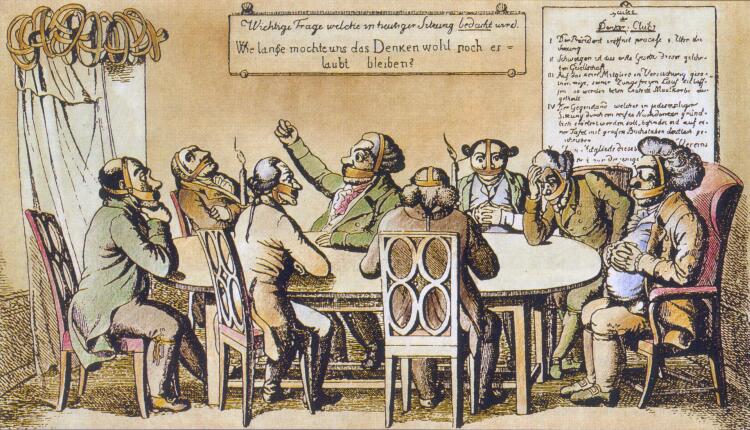
The unrest which roiled Europe and the Americas ushered in a conservative backlash. The German Confederation, the successor to the Holy Roman Empire, enacted a series of repressive laws known as the Carlsbad Decrees. Artists were censored and citizens arrested; the Vienna in which Beethoven spent his final decade effectively became a police state. Despite this, he deliberately incorporated the poetry of one such artist, a revolutionary writer whose works had drawn the particular ire of the oppressive Confederation, into the Ninth’s groundbreaking finale: Friedrich Schiller.
“Joy, Bright Spark of Divinity”
Of Beethoven’s symphonic innovations, the most notable is his inclusion of a chorus and vocal soloists in the fourth and final movement of the Ninth Symphony. It was the first symphony by a major composer to include the human voice. For this powerful merging of instruments and voices, Beethoven turned to the “Ode to Joy” by Friedrich Schiller, one of Germany’s greatest classical playwrights. Schiller published the poem in 1786, three years before the storming of the Bastille. Beethoven was introduced to the Ode as a teenager in Bonn; even then he sought to set it to music. Schiller’s text extols the Enlightenment ideals of utopian brotherhood and social equality. Beethoven wasn’t the first composer to set the “Ode to Joy.” By the time the Ninth premiered at least half a dozen composers had already written songs with Schiller’s text, including a teenage Franz Schubert.
“Joy, bright spark of divinity,
(…)
Thy magic power reunites /
All that custom has divided; /
All men become brothers /
Under the sway of thy gentle wings.”
The Music and Interpretations
Beethoven scored the Ninth Symphony for orchestra, a quartet of vocal soloists, and SATB. The orchestration, unusually large for the time, requires the addition of a fourth horn; all of Beethoven’s previous symphonies required only three. One of the variations in the finale recreates the sound of a Turkish Janissary band with triangle, cymbals, bass drum, and piccolos. The symphony’s length pushed both musicians and audiences to its limits. At well over an hour long it far exceeds the length of other Classical-era symphonies; the finale alone is longer than many earlier symphonies.
I. Allegro ma non troppo, un poco maestoso
Beethoven casts the first movement in the expected sonata form (exposition, development, and recapitulation). The symphony opens in a hushed reverie, horns and violins intoning perfect fifths, almost as if the orchestra hasn’t finished tuning. The pianissimo dynamic combined with the lack of thirds imbues these first bars with ambiguity and mystery. In Nathalie Stutzmann’s performance with the Atlanta Symphony Orchestra, the steady pulse of the second violins and cellos provides a surer sense of tempo; Sir Simon Rattle, on the other hand, keeps these instruments as quiet as possible, heightening the music’s uncertainty. Rattle takes a more flexible approach to the opening, using rubato to create a more majestic atmosphere.
“We should remember how astonishing and outstanding and dangerous the music is now. We know it so well, but we should never get used to it.”
From the onset this music is very different from earlier symphonies, including those by Beethoven. Most composers introduce a motive and thread it throughout, but here Beethoven works in reverse: he starts from inchoate stillness and only in the finale do we finally receive the “Joy” theme in its entirety (listen for hints of the “Joy” theme in the first three movements). Beethoven contrasts the primary theme, a forceful, almost militaristic tune, with a gentle woodwind-dominated melody.
A powerful fugue dominates the development. In his late period Beethoven turned to eighteenth-century masters like George Frideric Handel and Johann Sebastian Bach, incorporating Baroque techniques like fugue into his masterpieces. Much of this section is in C minor, a key Beethoven used for some of his stormiest, most heroic music. Notes across bar lines become a signature throughout this symphony, producing a sense of rhythmic instability. Thundering timpani usher in the dramatic recapitulation, which gives way to an extended coda. The movement concludes with a last restatement of the militaristic primary theme.
II. Molto vivace
While scherzos are typically playful or even humorous, this music is instead a dark and intense fugue. Leonard Bernstein commented, ““It is playful, I suppose, as the gods must be when they’re playing with human lives. … The laughter in it, such as it is, is the laughter of demons, and we poor mortals are the victims.”
The Insula Orchestra, led by Laurence Equilbey, uses historically-informed performance practices including period instruments (note the wooden flutes and natural horns). Equilbey takes a more restrained approach, reducing the contrast between the scherzo’s slashing opening and the pastoral music which follows. The Staatskapelle Berlin, with modern instruments, has a fuller sound, allowing for greater dynamic variation in the movement’s opening bars.
III. Adagio molto e cantabile
Beethoven loved theme and variation form, especially in his late period; his work on the Diabelli Variations even kept him from working on the Ninth! Here Beethoven composed a double variation (two themes with alternating variations on each); its grander scale stands in proportion to the two lengthy movements which preceded it.
Beethoven’s slow movements are renowned for their sheer beauty and depth of expression; this one is no exception. Save for two abrupt fanfares in the fourth and final variation, the music remains tranquil, slowly building in intensity. Claudio Abbado takes the third movement faster than many other conductors; his performance is roughly three minutes shorter than Lahav Shani’s. This imparts a dance-like quality to these slow melodies that can disappear at slower tempi.
IV. Presto—Finale
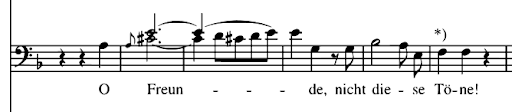
Richard Wagner called the blistering opening of the fourth movement the “Terror Fanfare.” Following an instrumental recitative and the brief restatement of music from the first three movements, the low strings present the first complete statement of the “Joy” theme. Amid variations on this theme a bass soloist appears, declaring, “Oh friends, not these sounds!
Let us instead strike up more pleasing and more joyful ones!” Vocal soloists and a chorus join in the joyful noise, presenting several additional variations including fugues and the famous “Turkish march.” The movement concludes with prestissimo ecstasy, voices and full orchestral forces united in triumph.

Both Riccardo Muti and Claudio Abbado display their affinity for opera in the string recitatives and vocal sections (Muti succeeded Abbado as music director of La Scala in Milan). Where Abbado chooses a livelier tempo in the finale, Muti directs the ensemble with a slower, statelier tempo.
First Shockwaves
Initial reactions to the Ninth Symphony ranged from ecstatic praise to bewilderment and pity. “Art and truth here celebrate their most brilliant triumph, and one would be justified in saying: non plus ultra!” one reviewer raved. Another gushed, “Like a volcano, Beethoven’s power of imagination tears the earth asunder when it tries to check his fiery progress….” This fiery image of the composer as a Romantic Prometheus, descending from heaven to bring the divine spark of inspiration to the grateful masses, became a common trope in Beethoven’s mythos. Others found the work incomprehensible. Rather than critique the composer himself, they attributed the symphony’s faults to his deafness.
At the same time, the piece cemented Beethoven’s legacy as the paragon of symphonic composition. Critics heralded his middle- and late-period symphonies as the symphonic ideal, capable of conveying a sense of victory through struggle. Many composers saw the work as the culmination of an entire genre: to quote Franz Schubert’s famous response to one of Beethoven’s late string quartets, “After this, what is left for us to write?” Franz Liszt, for example, abandoned the four-movement symphony, instead cultivating programmatic works called “symphonic poems.” Later composers including Richard Strauss followed in Liszt’s footsteps.
French composer Hector Berlioz was among the first to address the crisis of the Ninth. He wrote, “Now that I have heard this terrifying giant Beethoven, I know what stage musical art has reached, and the aim is to take it from there and push it further… not actually further, that is impossible, he has reached the limits of art, but as far in another direction.” Indeed, Berlioz was touted by many as Beethoven’s successor. Six years after the premiere of the Ninth Symphony, Berlioz premiered his Symphonie fantastique. Like Beethoven’s Symphony No. 6 in F Major, it includes a dramatic representation of a thunderstorm. In contrast to the Ninth’s joyful finale, Berlioz concludes with a twisted take on the “Dies irae” from the Latin Requiem mass.
Composers contended with Beethoven’s legacy for the rest of the nineteenth century and well into the twentieth. Most famous of these was Johannes Brahms, who spent decades struggling to complete his Symphony No. 1 in C Minor. “You have no idea how it feels to hear the tramp of a giant like him behind us,” he lamented. When someone told Brahms they noticed similarities between his symphony and the Ninth, Brahms responded testily, “Any ass can see that.”
Legacy
Beethoven and his final symphony have continued to maintain a powerful hold over classical musicians and the world writ large. The legend of the “Curse of the Ninth,” an inability to complete more than nine symphonies, has been said to afflict numerous composers including Antonín Dvořák and Gustav Mahler. Another legend claims that the original size of the compact disc was determined by the length of the Ninth Symphony. Supposedly, a vice president at Sony insisted that a single CD be able to contain an entire 74-minute recording of the symphony.
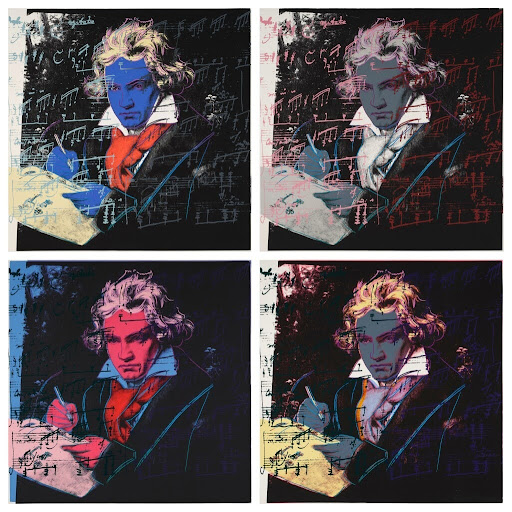
Largely because of the “Ode to Joy” finale, the Ninth Symphony has been one of the most politicized pieces of all time. One early writer even called the tune “the Marseillaise of humanity.” Figures and movements from across the political spectrum have co-opted Beethoven’s music over the past two centuries. The symphony was conducted at one of Adolf Hitler’s birthday celebrations and at the 1936 Olympic Games in Berlin; it was later performed at the Mauthausen concentration camp to honor victims of the Holocaust. In the 1980s the Joy theme was adopted as the anthem of the European Union. Later that decade the symphony was broadcast over loudspeakers in Tiananmen Square, and on Christmas Day 1989, Leonard Bernstein conducted the Ninth at the Brandenburg Gate to celebrate the fall of the Berlin Wall.
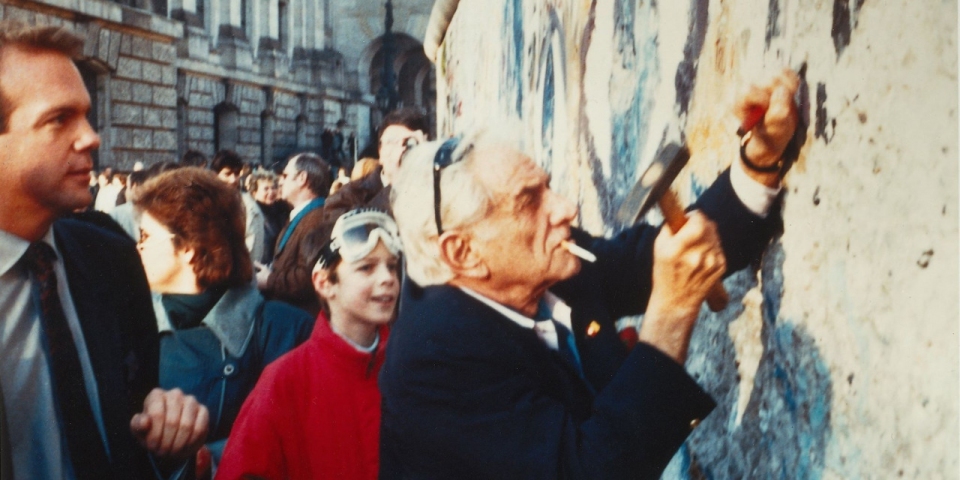
“The dubious cliché about music as the universal language, almost comes true with Beethoven. No composer who has ever lived speaks so directly to so many people, the young and old, educated and ignorant, amateur, professional, sophisticated, naive, and to all these people, of all classes, nationalities, and racial backgrounds, this music speaks a universality of thought, of human brotherhood, freedom, and love…”
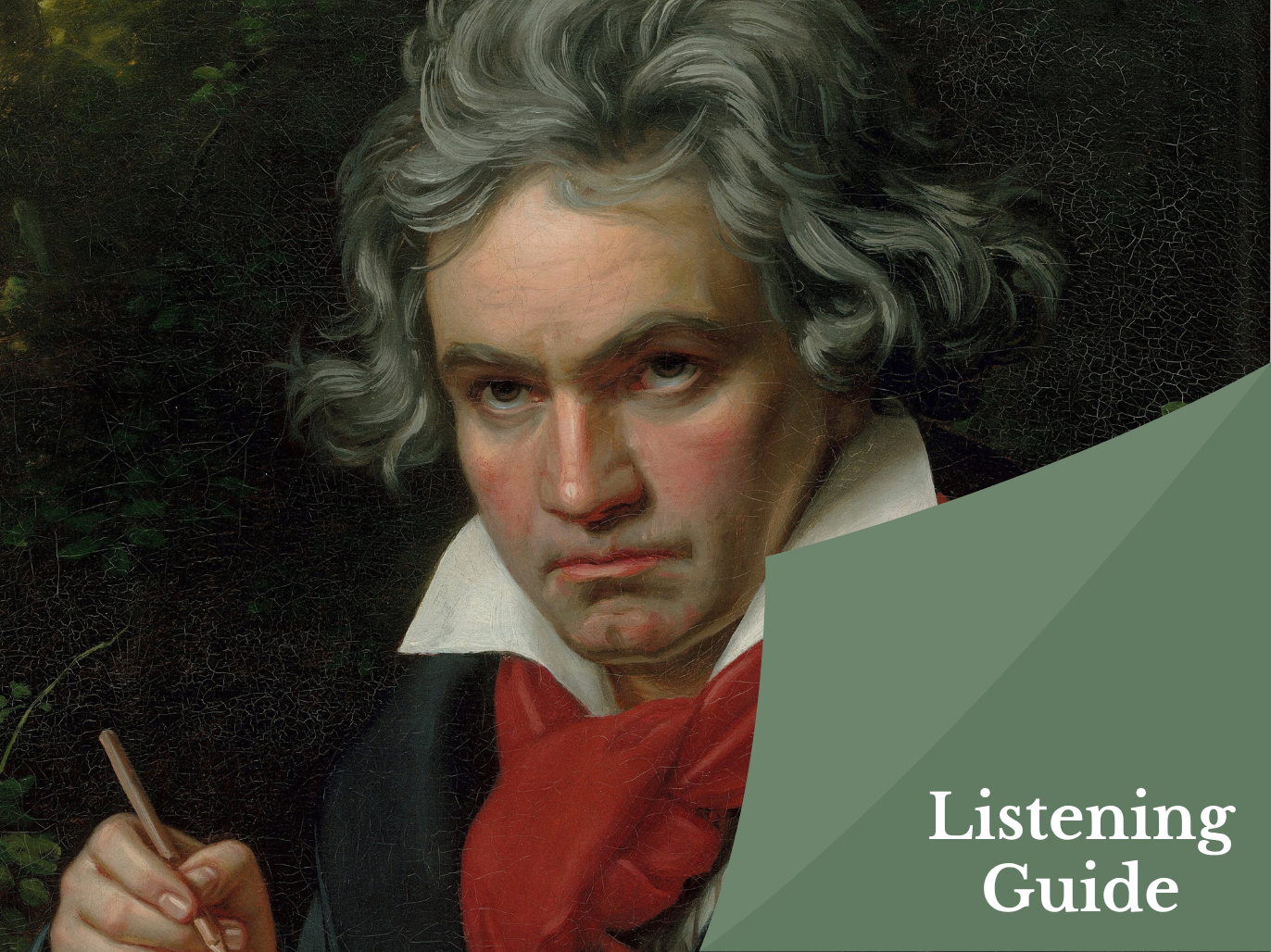
The incalculable weight of the Ninth Symphony grows heavier with each passing year. Never merely a sonic experience, this music has been permanently stamped with the image of its creator, the surly, wild-haired Romantic genius. Myth, legend, culture, and politics have deposited countless unseen layers onto this work, an accretion of preconceived ideas about what the music should be. Perhaps Otto Klemperer said it best nearly a century ago: “What can be said? It is a sacrilege to talk about the Ninth! It must be heard.”
