
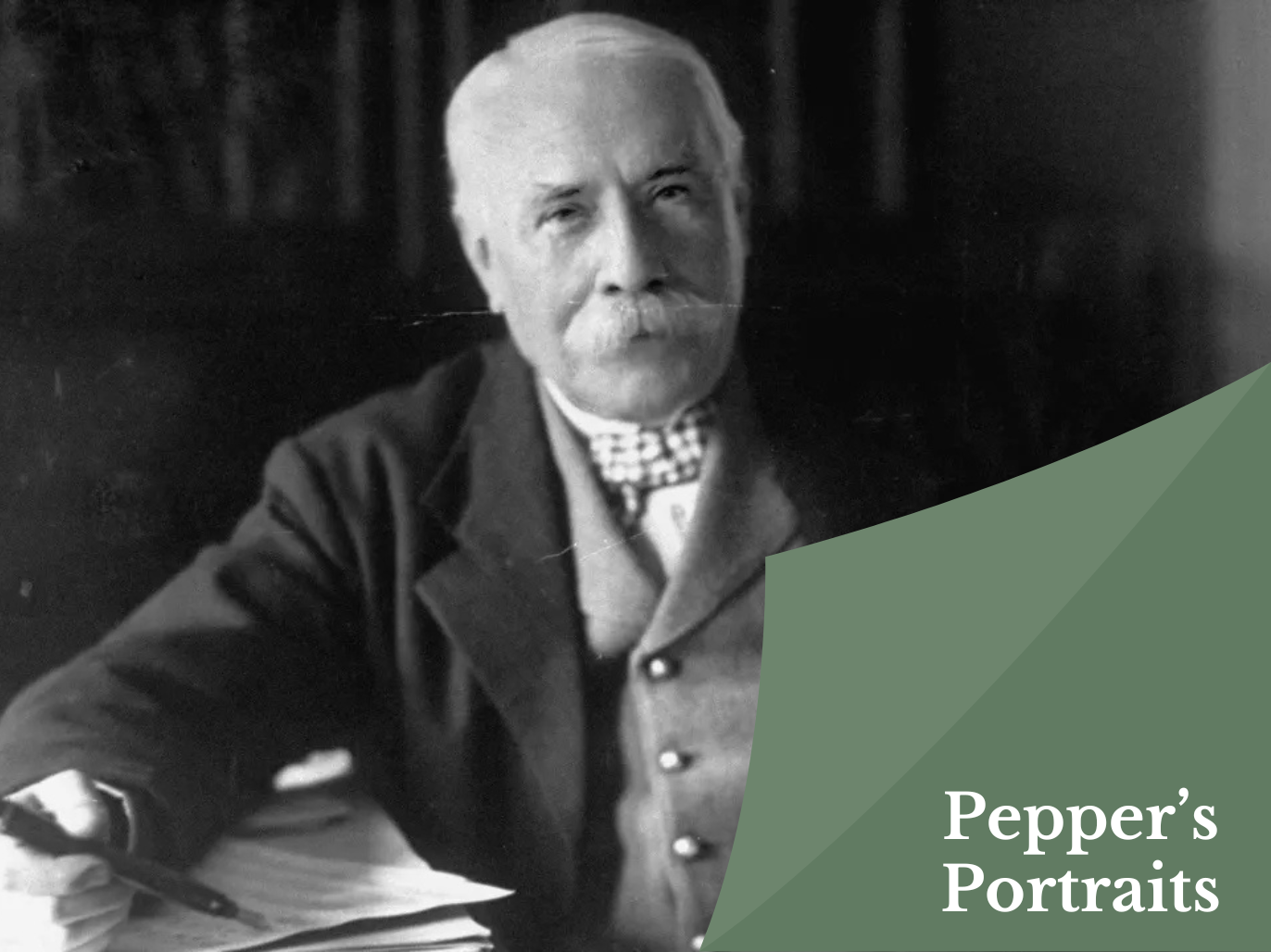
In some ways, Edward Elgar is the quintessential Gemini. Their supposedly mercurial, dual nature applies well to this composer: typically English yet thoroughly European; the self-taught composer who could teach us all a thing or ten about technique; the country boy who made it big in the city; the working class writer who became Britain’s iconic aristocrat; the outsider who became the Grand Old Man establishment figure… In some senses, Elgar was the caterpillar who became the butterfly; only, as we shall see, he could be both at the same time…
View author's page
Reading time estimated : 11 min
Slow burn
Elgar was born on June 2, 1857 in the Malvern Hills in Worcestershire, in a village that to this day has only 2000 residents. His father was a piano tuner who also ran the local music shop; the family lived above it.
Young Edward left school at just fifteen and worked as a trainee clerk in a solicitor’s office, but the family music store proved his true school; he said that it gave him the opportunity to “read everything, play everything and hear everything”. He studied scores of Bach and Beethoven and had taught himself the violin and piano to such a degree that by sixteen he was giving lessons. But he didn’t enjoy the work. It was a scratchy existence, walking many miles between pupils’ homes just to make ends meet. He was broke and depressed.
Then came the psychiatric hospital. Yes, Elgar’s first compositions really were played in the local asylum; the director of the institution believed in the restorative power of music and recruited young Elgar to lead their in-house orchestra. This soon became a welcome platform for testing his earliest works.
Yet Elgar’s compositional development is the definition of slow burn. His first recognisably Elgar piece was his Serenade for Strings, penned in 1892; he called it “the first thing I ever did” – quite a statement for a work written at the age of 35.
Love songs
That’s not to say Elgar was an unknown by this point. Four years prior, he had had popular success with Salut d’Amour (excerpt below) – only he never saw any financial reward from it, having sold the piece to Schott outright for a mere two guineas (at least ask for two guinea pigs, eh?!).
The piece, however, proved a milestone in a different way. It was originally called Love’s Greeting and was inspired by a music student who soon became much more. Alice Roberts was the daughter of a Major General, and so represented a completely different class and upbringing to her 31-year-old teacher; when the pair became engaged in 1888, there was outrage from her family. Who marries a mere musician, least of all a 30-something unpublished school dropout?! Yet from the start, Edward and Alice’s relationship was one of intense belief, safety and commitment; Alice would even write the staves onto his paper, as they were too broke to afford printed manuscripts. Salut d’Amour was his engagement present to her.
It was casually entertaining Alice one evening that led to Elgar’s breakthrough work. The composer often relaxed after a long day of teaching by improvising at the piano, and one night devised a game for his wife; he doodled away at a melody and asked her which of their friends it reminded her of (hilariously, Alice replied “Billy Baker going out of the room” – which makes you wonder what Billy going into a room would sound like!). Alice encouraged her husband that there was more than just a game in this idea, and so were born his Enigma Variations. His defining work, at the age of 42.
Dedicated to “my friends pictured within”, it’s the sonic equivalent of a photo album; the tenth variation uses staccato woodwind to mimic the laugh of their friend Dorabella, while the eleventh piece was inspired by a dog walk with one George Robertson Sinclair (that’s their friend, not the bulldog they used to walk together…). The surging orchestral outbursts and swirling strings to me suggest the River Wye that George was apt to fall into, the timpani crash at the end surely denoting a definitive slam dunk.
Beyond the humour, there’s great heart. The most famous variation was dedicated to the person who supported Elgar most, beyond his wife; August Jaeger was his publisher and creative confidante, and Nimrod (excerpt above) was a nod to the German word Jäger meaning hunter (Nimrod being described in the Bible as a “mighty hunter”). It is a supreme study in beautiful melodic writing; achingly poignant falling sevenths create a sense of dissonance and longing, the rapid culmination of an expanding melody that begins with the interval of a third, soon a fourth, before opening out to this gaping seventh – a step soon becomes a leap, a sigh becomes a cry. Likewise, trace the melodic peaks like a line graph; every time we reach a high note, it pushes us slightly beyond the previous one, creating this sense of yearning and reaching for an ever-taller sky. It is a melody taking flight – much like its composer, thanks to the encouragement of his loved ones pictured here.
That said, even Enigma is a work of two sides; the Gemini duality remains. This is clear in Nimrod, which could be described alternatively as hopeful or mournful. There is a sense of assurance on the one hand, and a melancholia on the other. At the time of writing it, Elgar spoke of a “dark saying” and the “loneliness of the artist”. Perhaps the enigma in question is the creative person themself.
The dark side
Among the most powerful examples of this darker side is Elgar’s Cello Concerto, his last major work; it speaks to a potent sense of isolation, dejection and despair.
Famously written in the wake of the First World War, its tone is said to reflect Elgar’s awareness of an era drawing to a close; stylistically the world was entering the high period of Schoenberg, Stravinsky and people like Antheil writing for 16 pianolas, 3 airplane propellers and a siren (I call it the era of “why not?!”). Elgar’s richly romantic language would soon fall out of fashion; the large orchestra would be replaced by a more clinical, stripped-back sound, while singing melodies would give way to something more fragmented and abstract. It was an inevitable musical reaction to a world that had changed; it’s believed up to 22 million people may have died in World War One, while Britain’s place in the world was rapidly shifting. This was an era that was desperate to move on.
Yet, as often seems the case with this composer, it was an intensely personal development in Elgar’s immediate environment that caused the most seismic change. In 1920, his beloved Alice passed away. Soon after, he wrote: “there is no work left for me to do. My active creative period began under the most tender care and it ended with that care.” In many ways, most of his output can be seen as an extended love letter to the person who best understood him, a musical expression of the confidence that she had brought out of this naturally shy, introspective, insecure outsider. He may have taught himself how to play and write music, but clearly she taught him a whole lot more. His music becomes representative of a self-belief that came largely from his wife.
He spent the last fourteen years of his life devoted mostly to conducting and recordings; when Elgar himself passed away in 1934, he was buried alongside Alice in Little Malvern.
Style and influence
Elgar ended life the Grand Old Man of British music; he had been knighted in 1904, appointed to the Order of Merit in 1911 (the first composer so honoured), and then for the last decade of his life served as the Monarch’s in-house composer, The Master of The King’s Music (though in this role he wrote little more for them than his Nursery Suite, which rehashed musical sketches from his youth for the young Princesses Elizabeth and Margaret). A man who openly admitted his agnosticism wrote some of the defining works of religious choral music. A man who never went to university had nine honorary degrees. His is a tale of outstanding personal triumph against the odds.
England – and specifically its countryside – undoubtedly had a huge influence. Elgar was a passionate cyclist, while as a boy he recalled “gazing from the windows in rapt wonder at the great trees swaying in the wind”. Aged 64, he told a friend: “I am still at heart the dreamy child who used to be found in the reeds by the River Severn with a sheet of paper trying to fix the sounds and longing for something very great,” before adding with characteristic self-doubt: “I am still looking for this.”
Yet for all his avowed love of the English hills and his quintessentially Edwardian tweed suits and handlebar moustache, Elgar was compositionally very much a European. His style is rooted in the German symphonic tradition, and even his immense choral works – The Dream of Gerontius (excerpt below) following in a long line of oratorios stretching back to Handel – proved more popular in Germany than in England, at least at first. Indeed, Hans Richter was the dedicatee of Elgar’s mighty First Symphony (1908), and he proclaimed it “the greatest symphony of modern times, written by the greatest modern composer, and not only in this country.” Its premiere was described as one of the great nights in British music, heralding “the first great English symphony’”; that explains why it had 100 performances within a year, and toured America in the space of mere months arousing the kind of interest last shown to Tchaikovsky.
So, Elgar’s language was firmly rooted in an international tradition; he had recently given a lecture on Brahms’s symphonies, no less than Richard Strauss called him “the first English Progressive”, and Richter was the first to point to a Beethovenian parallel in the Adagio. It is time we stopped defining Elgar just as a great British composer, and instead a great composer.
Reputation return
Although his rise to success took decades, it didn’t take nearly as long for Elgar’s reputation to wane. Since success and tastes are fickle, no sooner had he reached the top than his reputation took a nosedive after his death. As the British Empire crumbled and musical tastes pointed towards the twelve-tone method and experimentalism, Elgar was soon seen as a relic of the past.
Perhaps there remains a snobbery to this day, with some commentators nervous of perceived jingoism and nationalism in his music; this completely overlooks the intensely personal qualities in his work, where he wrote his deepest thoughts and emotions into sound.
A one-dimensional view of Elgar also inevitably neglects the fact he was man of many facets; his life is a fascinating study of the creative psyche, of self-doubt and the power of those around a creator to lift them out of themselves and thus be able to look within. What could be more 2026 than a study of contradictions?!
Elgar: the European Englishman, the professional amateur, the teacher student, the provincial establishment man, the aristocrat working boy, the outsider on the inside, the grand doubter… It is precisely this mix of contradictions that makes his life and work speak so clearly today. In his birthday month, we doff our bowler hat and tip our smoking pipe to the ultimate self-made man.
