
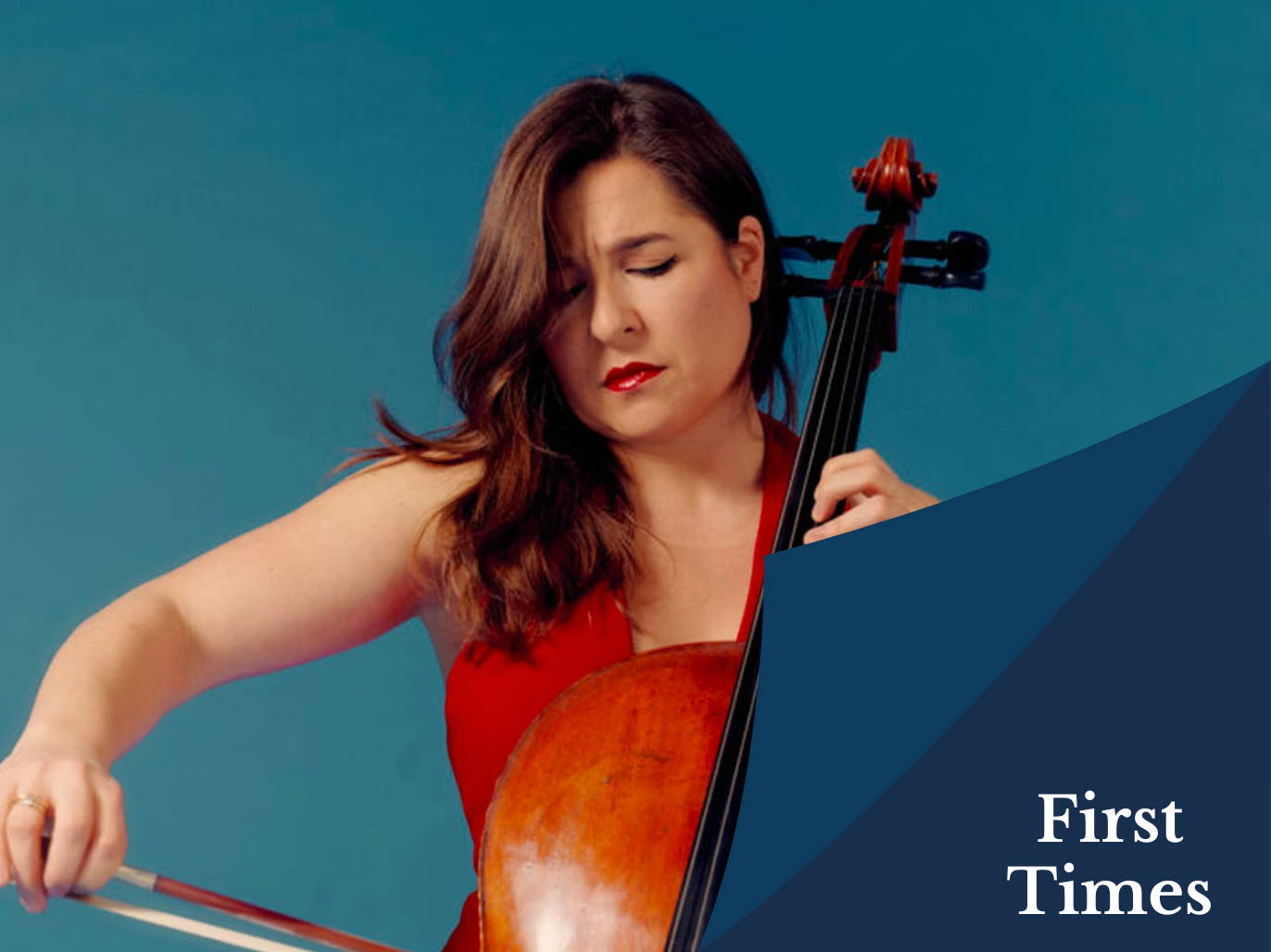
First Times with Alisa Weilerstein: Her First Elgar and Beyond

A cardboard cello, a defining first Elgar, and a memorable Bach mishap — Alisa Weilerstein retraces the formative “first times” that forged her artistic identity.

View author's page

By Andrew Mellor

Reading time estimated : 11 min

A particularly delicious new addition has just dropped onto the medici.tv menu – an evening of music from La Jolla, the famously easy-going yet penetrative music festival in San Diego. 

After Purcell, Britten and Tchaikovsky to savor, an all-star string quartet takes to the stage for a performance of Anton Arensky’s String Quartet No. 2 – famously scored not for one cello, but two. One of them is manned by Alisa Weilerstein. 

It put me in mind of one of my favourite ‘archive’ performances available to watch on medici.tv – the Berliner Philharmoniker’s 2010 performance at the Sheldonian Theatre (below) in Oxford under Daniel Barenboim, where Weilerstein was the soloist in Elgar’s Cello Concerto.

Weilerstein is more than a wondrous sonic communicator; she also talks (and writes) movingly and incisively about music, life and the world. So it seemed like too good an opportunity to miss to include her in our First Times series, and ask about her first encounter with that most resonant and emotive of cello concertos – the one written by Edward Elgar, in England, in the wake of the First World War.   

Early Ambition

You may be familiar with the origins of Weilerstein’s obsession with the cello. Before her third birthday, her grandmother assembled ‘a makeshift set of instruments from cereal boxes’ (according to her official biography) and Weilerstein headed straight for the ‘Rice Crispies box’ cello. Infuriated that it couldn’t produce a sound, she badgered her parents to buy her an actual cello. A year and a half later, she had one. 

Despite her early start, Weilerstein’s career has been a conscious ‘slow burn’, she tells me on the phone from Berlin. But there wasn’t much patience involved when she first heard the cellist Jacqueline du Pré performing the Elgar concerto on record. 

‘It was both the recordings – with [conductors] Barbirolli and Barenboim,’ she says referring to Du Pré’s two albums including the work, ‘and I listened to them on repeat a few times a day until I was 10 or 11 years old.’ At the age of 12, she started learning the concerto herself. ‘That’s when I realized that, sadly, I had to break up with those recordings if I was going to form my own relationship with the piece.’

Elgar and Du Pré are a potent combination even now. Does Weilerstein remember how she felt, hearing it? ‘I fell in love with the piece, I fell in love with her, and I just loved everything about it. The music seemed to ooze out of her. It was a purely visceral response, not an intellectual one. I was seven years old… you don’t really know why you love something at that age, you just love it!’

Broaching a Masterpiece

At the age of 16, Weilerstein gave her first public performance of the piece – outdoors, at the Brevard Festival in North Carolina. ‘It was so hot, so humid, that my fingerwork became this sort of wet slide,’ recalls Weilerstein. ‘It was challenging, but of course I was thrilled to do it.’

Ten years later, she found herself playing for Daniel Barenboim – Du Pré’s husband until her untimely death at the age of 42, and the conductor on one of those iconic recordings of the Elgar. ‘I played the Dvořák concerto to him and Haydn’s D Major concerto, and he basically coached me,’ explains Weilerstein. 

On the way to her third meeting with Barenboim, Weilerstein ran into the conductor Asher Fisch – once Barenboim’s assistant conductor at the Berlin State Opera – who urged her to play the Elgar concerto for him. ‘I’m sorry, I said, but that’s the one piece I will never play for Daniel Barenboim, for obvious reasons,’ recalls Weilerstein. 

Fisch persisted, urging Weilerstein that she would learn more about the piece from Barenboim than anyone else. ‘I concluded that was probably true, so I got the courage to play it for him at one of our meetings. He sat down at the piano and played the tutti orchestral part from memory. And that’s when he asked me to do those concerts with the Berliner Philharmoniker, in Berlin and Oxford.’ 

Weilerstein’s Elgar

The Berliner Philharmoniker’s ‘Europa’ concerts, in which the orchestra travels to a part of the continent it isn’t normally associated with, are always special – unfamiliar venues, new audiences, high expectations. But this one has a particular atmosphere that one can sense even from the film. 

Du Pré, more associated with the Elgar concerto than anyone, was born in Oxford. The venue, the Sheldonian Theatre, is not really a concert hall; it’s more like a lecture theatre or crucible, with overtones of academic examination – even medical autopsy – as its limited audience is wrapped high and tight over the performers. 

I’ve referred to this concert before, because of the Brahms symphony in the second half. But the Elgar itself is remarkable. Watching it now, I suggest to Weilerstein, we get close to her adolescent obsession with the piece; she was older by now, and yet seems – in all her maturity – to channel the spirit of a teenager who has discovered something of such supreme importance it obliterates everything else. ‘Well yes, it was the most important thing in the world!’ she responds with a laugh, before her tone becomes more serious: ‘It was an incredibly meaningful moment. That was obvious. I understood the gravity of that moment.’

Twelve years later, the moment might have been a little less severe even if the music remained just as impassioned, as Weilerstein joined the red-trousered teens of the National Youth Orchestra of the USA for a performance of the Elgar concerto at the Konzerthaus in Berlin

The Elgar concerto is a work in which passions, even angers, jostle with lyricism. In the performance with the youth orchestra, a Weilerstein with less to prove seems to enjoy its lyrical side marginally more than she did in Oxford. ‘I had lived with the concerto for many more years, it just evolved that way,’ she says of that performance now; ‘at its heart, it’s an extremely lyrical, very personal piece.’

We often describe Elgar’s concerto as a wartime work – one whose brittle moods stemmed from the mass destruction of the First World War (it was first performed in 1919). Does the score take on different significances at different times – especially now war has returned to Europe? 

‘It feels like it could have been written yesterday,’ Weilerstein says. ‘We’ve all lived through events that changed the world and changed the zeitgeist. It’s inevitable that music reaches us in different ways. I was recently at a performance of Shostakovich’s Symphony No. 7 conducted by my husband, Rafael Payare. That touched a very raw nerve and I was a wreck afterwards. If the Elgar sounds like it could have been written yesterday, Shostakovich sounds like it’s being written right now.’

First Time Troubles

Her approach to the Elgar concerto suggests Weilerstein is not the sort of artist to put a piece of music on a pedestal – to consider themselves unready for it. But there is one, easily-guessed exception to that rule: Bach. 

‘For a long time I was scared to play Bach in public,’ Weilerstein admits, ‘especially in my teens and twenties, but in my thirties I got more confident.’

In fact, her first time playing one of the composer’s complete Cello Suites was pretty much a disaster. ‘I was 16, it was the Suite No. 5 – a very long, elaborate Prelude with an intricate fugue, and then all the dance movements. So I started the Prelude, really nervous, and it went spectacularly well – much better than I ever thought it would. Then I made the mistake of relaxing. I started the Allemande and it was going fine… until I got to the end of the first half and took a wrong turn somewhere. There was about ten seconds of Stockhausen and then I called quits on that, and went straight on to the Courante!’ 

The memory can’t be that bad, given the cellist emits a peal of joyous laughter as she recounts it. ‘In a way it was kind of a rite of passage. The good thing about messing up when you’re young is that you get over it pretty quickly and don’t allow it to stick in your head. You know what not to do next time. I played the Suite No. 5 again in public a few months later and it went fine.’

Weilerstein approached recording Bach with similar hesitance. ‘I was certainly very reluctant, until I reconciled myself with the idea that it’s okay to put down a time-specific point of view – and acknowledge that it will change later.’ 

Even so, her first recording of the complete Bach Cello Suites, released in 2020, was nominated for a Gramophone Award while the Sunday Times concluded that it had ‘something of Du Pré’s emotional style.’

You can watch Weilerstein play Bach, an encore to her highly affecting performance of Shostakovich’s first concerto, on this concert from the 2018 BBC Proms.

Another highlight from the archive is the cellist’s 2023 performance of the quintessential American cello concerto, that by Samuel Barber, with The Cleveland Orchestra at Severance Hall.

This concert is particularly pertinent, because it takes us straight back to Weilerstein’s actual ‘first time ‘– her debut with a symphony orchestra, which took place with this very ensemble on this very stage when she was 13 years old. 

‘I played the Rococo Variations with Alan Gilbert, with whom I’m playing tonight in Berlin as it happens,’ she says. But back to that debut. ‘I was 13, Alan was 28 – he was the orchestra’s assistant conductor. I just had the best time!’

Weilerstein knew the lie of the land, having grown up in Cleveland and heard countless concerts by its renowned orchestra in this very building. But her familiar drive was well-established. ‘For some reason I felt like I’d waited a very long time to make my debut with The Cleveland Orchestra, which is ridiculous! But you’re an adolescent you think that you own the world and that you’re invincible.’

Which makes it all the more surprising that Weilerstein should describe her ‘slow burn’ career. Clearly, there was a deeper patience keeping her hunger in check – one reason, surely, she opted to read Russian History at Columbia University rather than rush into a performing career. 

‘I was allowed to grow up, make mistakes and pick myself back up again before I regularly did high-profile concerts and I credit my management with that too,’ she says. ‘Nobody allowed me to crash and burn.’ 

Written by Andrew Mellor

Journalist and critic

Andrew Mellor is a British writer, critic, and broadcaster based in Copenhagen. After studying music at the University of Liverpool, he began his career with the Manchester Camerata and the London Philharmonic Orchestra before training as a journalist at Classic FM magazine and Gramophone. Since moving to Denmark in 2015, he has become a leading voice on Nordic music and culture, contributing regularly to Opera and Opera Now.

A regular critic for the Financial Times and a presenter for medici.tv and the Danish Broadcasting Corporation, Andrew Mellor also writes extensively for orchestras, festivals, and record labels around…

View author's page