“But is it Classical?” Shining a Light on Rosalía’s LUX

LUX, the classical-infused album from Spanish pop star Rosalía, has dominated the musical landscape since its release in November. But do these lush orchestrations, fierce choral interludes, and soaring vocals merit calling this music “classical”?

View author's page

By Andrew McIntyre

Reading time estimated : 16 min

In October 2025, Rosalía dropped her latest single, the maximalist “Berghain.” Classical music organizations from the Royal Opera House to the New York Philharmonic were quick to react, sharing videos incorporating the song’s intense vocals and strings. The following month, she released her fourth studio album, LUX, to near-universal acclaim. Critics have praised this record-breaking album as “transcendent,” a “grand cathedral of an album,” and “an ambitious and unusual tribute to the European song tradition, from opera house to nightclub.” Tickets for her upcoming tour have sold out in minutes (happily, this writer was able to snag a pair).

But while many have heaped praise upon this new avant-garde work (dare I say “masterpiece”?), others have rushed to draw a stark line between LUX and what they see as “real” classical music. Who is the artist that has everyone talking? Can her work be considered classical, or is this record something else entirely? 
Who is Rosalía? The Woman and the Art

Rosalia Vila Tobella, known by the mononym Rosalía, is a Spanish pop singer and songwriter who blends flamenco with pop, hip hop, and other genres. One of the most successful Spanish pop stars in recent memory, she is the first Spanish-singing performer to be nominated in the Best New Artist category at the Grammy Awards (she has since won two Grammys and eleven Latin Grammys). She released her fourth album, LUX, in November to critical acclaim. Its lead single, “Berghain,” went viral for its operatic vocals, tempestuous orchestral arrangements, and enigmatic music video.

A Classical Pedigree

Rosalía grew up listening to a mix of pop and classical music. Her mother and grandmother were especially fond of opera; she’s said, “I think that my grandma would have loved it if I would sing like Maria Callas and Pavarotti. She would like me to be an opera singer.” When she was a teenager, Rosalía was captivated by the sound of flamenco singing. “It was like getting pierced by an arrow,” she recalls. “It was the purest thing I had ever heard.”

Smithsonian Magazine defines flamenco as a “complex art form incorporating poetry, singing, guitar playing, dance, polyrhythmic hand-clapping, and finger snapping.” It originated in southern Spain centuries ago and has become an international symbol of the country; in 2010, UNESCO added flamenco to its list of Intangible Cultural Heritage of Humanity.

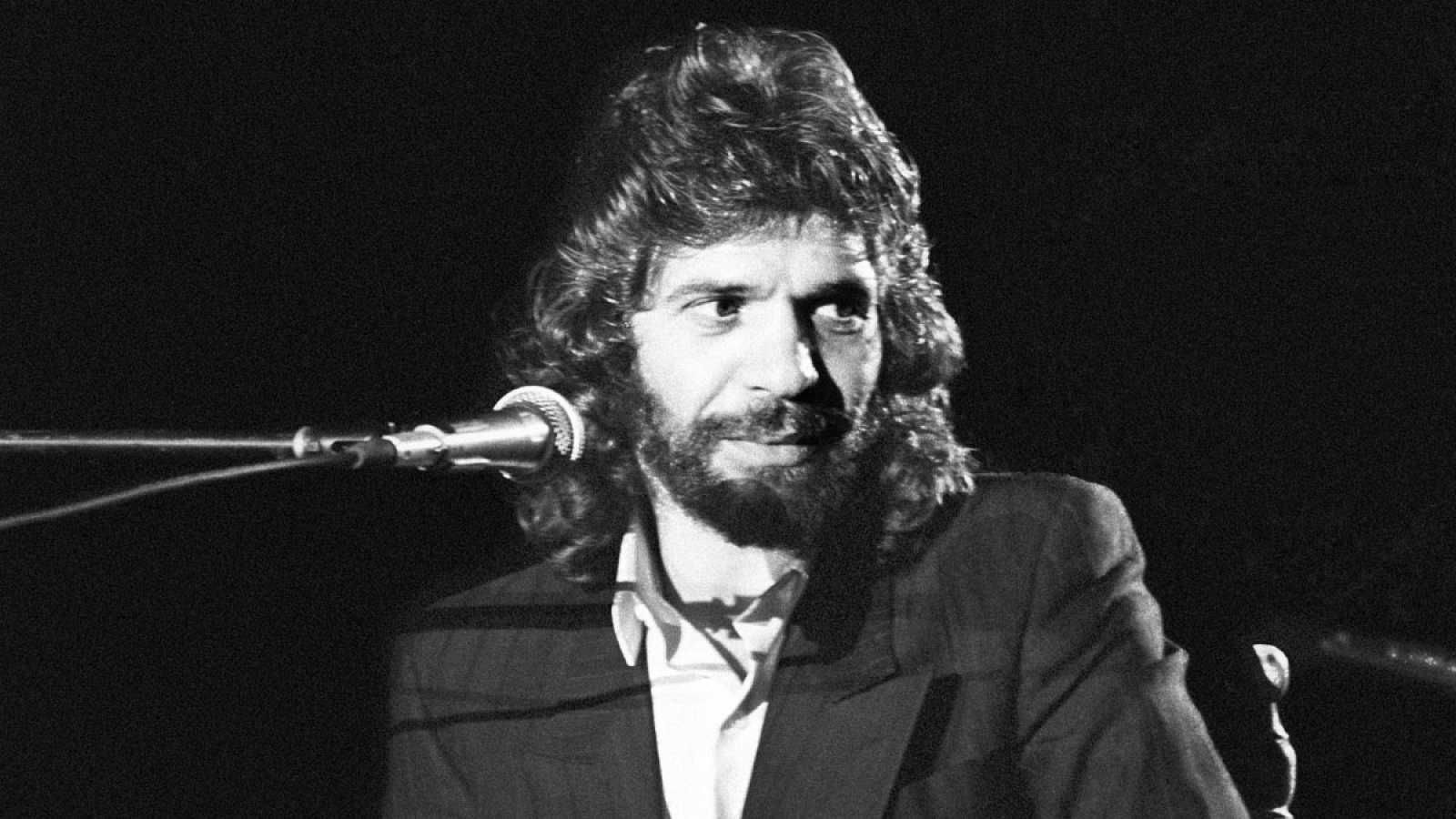
Camarón de la Isla
Camarón de la Isla, the legendary flamenco singer, often cited by Rosalía as a key influence.

Before launching her career, Rosalía spent a decade studying the art of flamenco. “I fell in love with it, but I couldn’t sing it. To sing flamenco is like being a kind of opera singer. You have to learn how. Flamenco is dark—it’s about tragedy and intensity. Those are the traits I became passionate about.” She eventually enrolled at the Catalonia College of Music, which accepts just one student per year to its flamenco program. She graduated in 2017, the year she released her first album, Los Ángeles. Her second album, El mal querer, served as her senior graduation project. Rosalía’s flamenco training forms the core of her artistry, especially evident in her full-throated vocal delivery and deft approach to rhythm.

Classical Influences in LUX

Listeners have been drawn to the epic sounds of her latest album, LUX. Across the album’s eighteen tracks, Rosalía performs in an impressive thirteen languages. Her songwriting reflects the careful approach to setting languages used by opera composers: “It’s a lot of trying to understand how other languages work,” she said in an interview with The New York Times. “It’s a lot of intuition and trying to be like, I’m going to just write and let’s see how these will sound in another language.” 

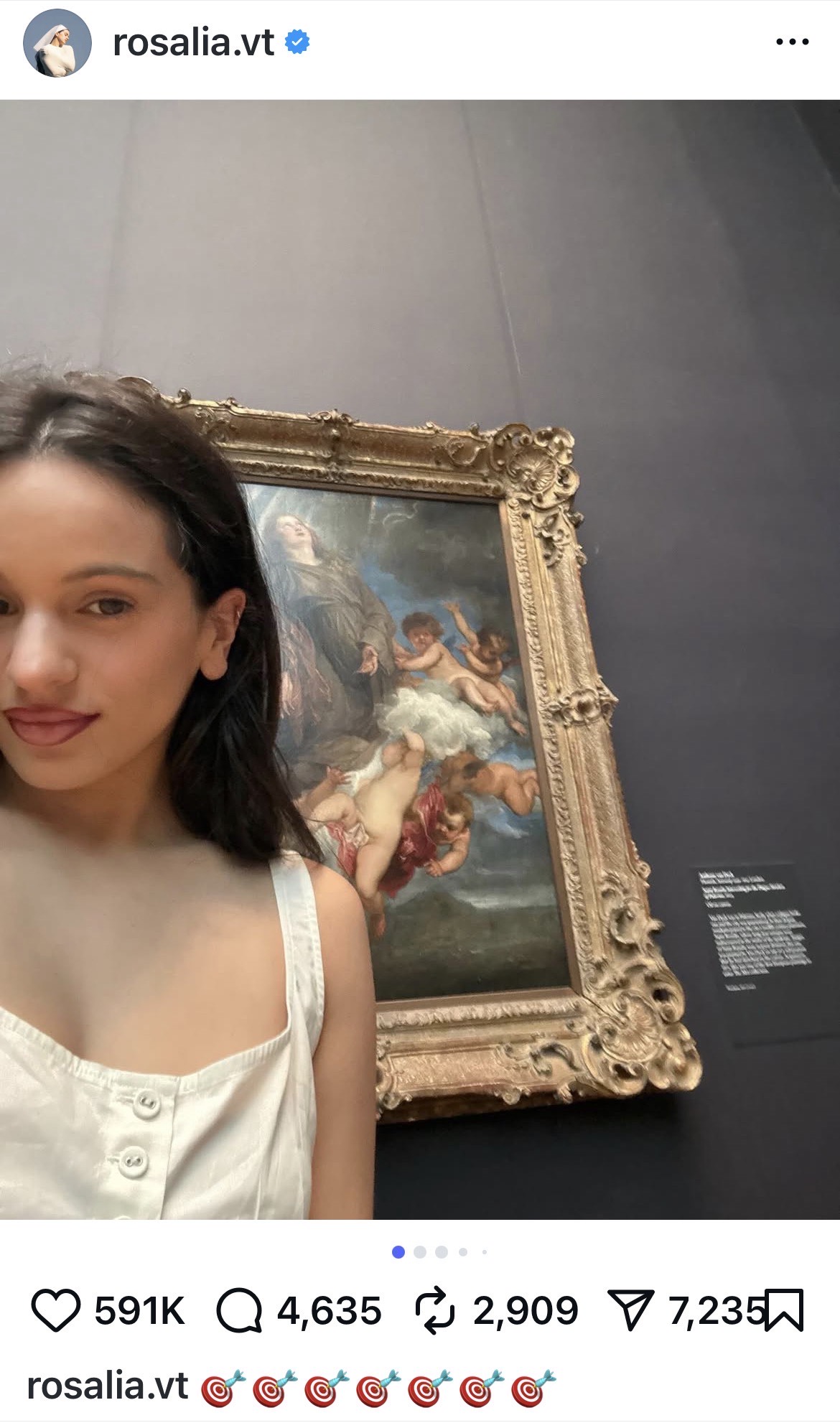
Rosalía next to Flemish Baroque painter Anthony van Dyck's Saint Rosalia, one of the inspirations for LUX. Currently housed in the Museo del Prado in Madrid. (Instagram)

Though the album garners comparisons to opera, it bears stronger resemblance to the art song tradition. These songs (“Lieder” in German) are often arranged in cycles to tell a larger story, much like the concept album. Gustav Mahler, whom Rosalía cites as inspiration for LUX, orchestrated many of his Lieder. Its songs are arranged not in acts—as one would expect in opera—but in four “movements,” a nod to the tradition of symphonies and string quartets.

The album features a large ensemble of talent, from the London Symphony Orchestra (conducted by Daníel Bjarnason) to arrangements by Pulitzer Prize-winning composer Caroline Shaw. From its opening bars, LUX is steeped in the sounds of art music. “Sexo, Violencia y Llanta,” the inaugural track, hearkens to Lieder in its solo piano. Here and in other songs, Rosalía duets with a solo cello; with its lower range, the instrument evokes a male partner. The track ends with a Picardy third, a major chord at the end of a song in a minor key. This “happy ending” chord appears throughout the Baroque repertoire, including the St. Matthew Passion of Johann Sebastian Bach.

On “Porcelana,” stabbing strings and thundering kettledrums accompany flamenco handclaps. These spiky string arrangements recall the opening of Mozart’s Symphony No. 25 in G minor. The next track, “Mio Cristo Piange Diamanti,” is sung almost entirely in Italian. Classically trained singers may be reminded of the famous Schirmer publication, Twenty-Four Italian Songs & Arias, a staple for younger singers. On her 2024 album Cowboy Carter, Beyoncé interpolated a portion of the aria “Caro mio ben,” the most famous song from the collection, into her song “Daughter.”

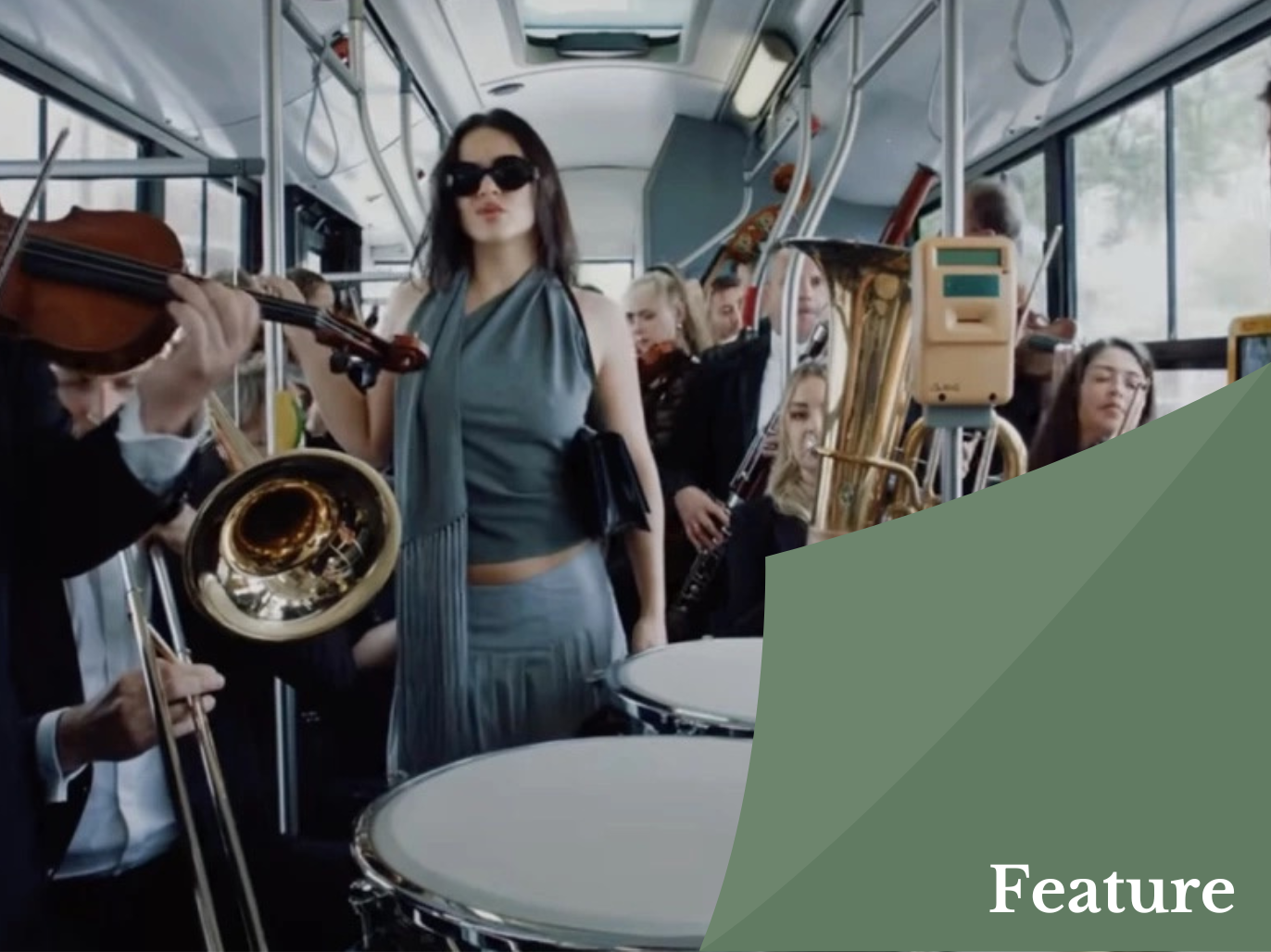
Berghain (clip above),” the album’s lead single, opens with a flurry of strings akin to The Four Seasons, Antonio Vivaldi’s famous set of violin concertos. A full chorus enters, intoning a dramatic stanza in German. The mood and texture recall Carl Orff’s cantata Carmina burana, or perhaps a Baroque oratorio by Georg Friedrich Handel

Others have drawn comparisons between the maximalist orchestration of “Berghain” and the ballet The Rite of Spring by Igor Stravinsky.

The music video for “Berghain” is equally evocative. It depicts a depressed Rosalía attempting to mend her (literally and figuratively) broken heart. As she does chores, visits a jeweler for repairs to a Sacred Heart locket, and gets an EKG, she is haunted by instrumentalists and choristers who follow her across the city. In this urban space, surrounded by people yet alone, overwhelmed by sound and stimuli, she struggles to find peace. At the video’s climax, she returns home to find her apartment empty, its walls painted to look like a dark forest. Only here do the musicians and all of their cacophony disappear. Woodland animals, including a bird voiced by Björk, appear. Nature itself is speaking to her of salvation.

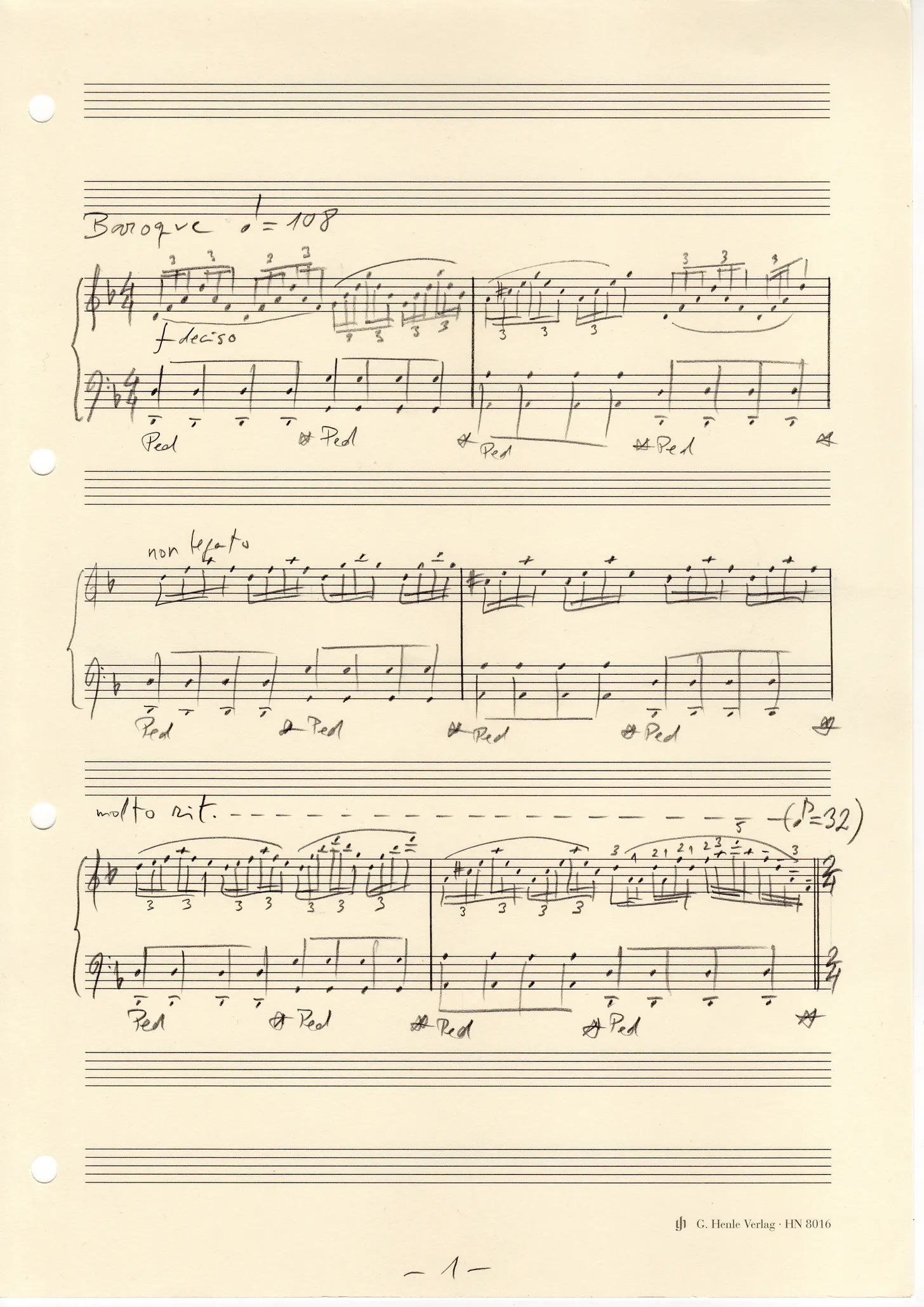
Piano score for "Berghain" posted by Rosalía on her Substack.

Where Else Has Rosalía Used Classical Music?

LUX isn’t Rosalía’s first foray into the world of classical music. Several collaborators on this album, including Caroline Shaw, worked on her last album, 2022’s Motomami. “SAOKO,” its opening track, includes a short jazz interlude between choruses. In a later track, “G3 N15,” she sings a cantabile melody accompanied by organist Cory Henry of the jazz fusion band Snarky Puppy. “Reniego,” a track on 2018’s El mal querer, features the Bratislava Symphony Orchestra.

But is it classical?”

Multiple news outlets have asked variations on the question, “But is it classical?” Despite the pedigree of many of the artists involved, and the many art music gestures employed throughout, LUX is not classical music. Rosalía herself has stated, “I want to think that my music is pop. It’s just another way of making pop.” Rather than classical, this music has roots in baroque pop, a decades-long project of combining genres.

What is Baroque Pop?

Baroque or chamber pop is the fusion of popular music with elements of classical music. This includes the use of counterpoint, certain harmonies, and instruments associated with classical music such as bowed strings, French horns, and the harpsichord. Baroque pop emerged in the 1960s with artists such as the Beach Boys and producer Phil Spector. The Beach Boys’ 1966 song “God Only Knows” incorporated harpsichord and symphonic instruments including flutes, clarinets, and horn. 

The most famous examples of Baroque pop may be the Beatles’ songs “Yesterday,” which includes a string quartet, and “In My Life.” While producing the latter song, John Lennon asked producer George Martin for “something Baroque-sounding” on the piano. When Martin sped up the recording, the Bachian counterpoint took on a sound evoking the harpsichord. More recently, artists such as Rufus Wainwright and Florence and the Machine have incorporated similar gestures into their songs.

How is the Classical Music World Reacting?

Since “Berghain” took the Internet by storm, classical musicians and fans have taken to social media to debate it. From comments sections to reaction videos, opinions have been divided. One TikTok influencer called it “the most important thing that’s happened to classical music this year.” Others have derided LUX for what they see as an ersatz evocation of art music. For Rosalía, whose earlier albums encountered similar resistance among the flamenco community, the debate was expected. She argues, “In flamenco, because it’s so strictly codified, there are people that have a very narrow way of looking at it, and if you deviate from that, you’re fucking around with something sacred. To me, you should do things with respect and with love, but there’s nothing that’s untouchable.”

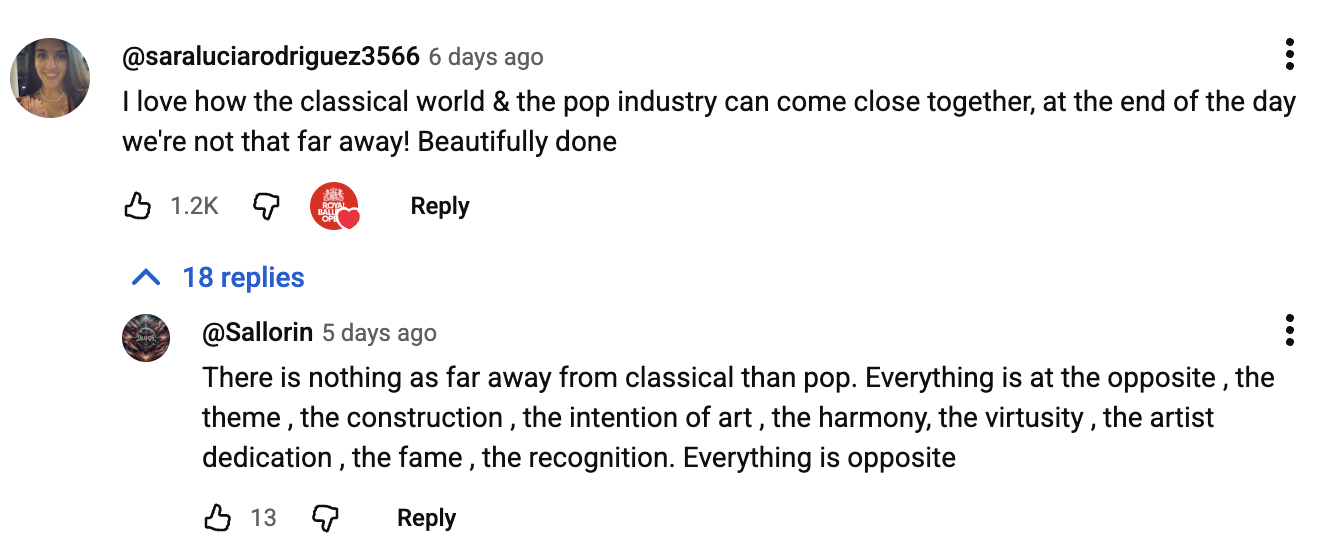
Screenshot showing two users interacting in the comments of a YouTube cover of "Berghain."

What Can Classical Music Learn from LUX?

Just because Rosalía isn’t a classical musician in the strictest sense doesn’t mean that the classical music world can’t embrace LUX and its grand musical gestures. What can musicians and arts organizations learn from Rosalía and her global popularity?

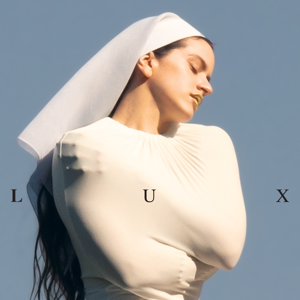
LUX album cover

Find Common Ground

LUX, like many pop albums, explores universal themes of love, loss, betrayal, and devotion. These raw, powerful emotions also form a core part of the operatic canon. In “La perla,” the album’s most-streamed track, Rosalía sings of a fickle playboy, “ The local disappointment, national heartbreaker, / An emotional terrorist, the greatest disaster in the world.” She, playing the part of the jilted ex, could easily be Donna Elvira, one of the victims of Mozart’s Don Giovanni:

The man she describes sounds like a twenty-first century character study of the Duke from Verdi’s Rigoletto:

Classical music has long sought to make sense of life, as does pop music; this common ground should be a source of connection.

Embrace Diversity

Pop music trends reflect an unparalleled level of globalization. The ubiquity of genres like K-pop and reggaeton—Puerto Rican rapper Bad Bunny will headline the Super Bowl in February—demonstrates that more listeners than ever are embracing multi-lingual music created by diverse artists. Opera and art song singers who perform in multiple languages should be thrilled by these cultural shifts. Language barriers are certainly real, but they are becoming less important, and after all, singers are gifted with the most expressive of all instruments. 

Classical music has fallen behind as orchestras and opera houses continue to draw primarily from a canon of long-dead white men from Europe. Concertgoers across genres want to see themselves represented in repertoire and in the bodies onstage. The music directors, administrators, and soloists who program seasons must expand their view of which music deserves the spotlight.

Give the People What They Want

Much of the praise for LUX has centered on its lush, multi-octave vocals. In a world where Auto-Tune is ubiquitous and “AI slop” pervades our algorithms, people crave music that feels real. There is a real audience for powerful, emotive vocals and analog instruments, for art that takes time, talent, and craft to create. Classical music has all of those things. 

Some within the classical music world are already using the album as a gateway. The Royal Opera House released a video of soprano Jacquelyn Stucker performing an “unplugged” version of “Berghain” with violin and piano. In fewer than two weeks, the performance became one of the ROH’s most-watched videos of the entire year.

Be Bold

A casual search of classical music playlists on Spotify reveals how disengaged many listeners are from the art form. Popular playlists include titles like “Gentle Classical Sleep Mix,” “Calming Classical,” and “Classical Focus.” Here, classical music is merely a means to an end, like studying or sleeping. For many, their exposure to what can be powerfully expressive art has been reduced to “Classical in the Background.”

Rosalía refuses to be background music. LUX presents a diverse range of sounds: sometimes loud and jarring, other times soft and intimate, but never dull. This music is dramatic, raw, and even transcendent; so is classical music. Classical music organizations should enthusiastically celebrate the power of their art, not in the cultural background, but center stage.

One interviewer asked Rosalía if she asks a lot of her audience. She replied, “Absolutely, I am. The more we are in the era of dopamine, the more I want the opposite. That’s what I’m craving.” These words echo those of the great bel canto opera composer Vincenzo Bellini: “The opera must draw tears! Terrify people, make them die, through singing.” Even if her latest album leans more pop than Pavarotti, it remains a sonic tour de force that cannot be ignored. The success of this album, a thrilling fusion of genres that refuses classification, proves a genuine need for complex, powerful music. In our increasingly atomized age, emotive music such as this reminds us of the importance of human connection.

Written by Andrew McIntyre

Writer and concert producer

Andrew McIntyre is an American writer and concert producer living on the East Coast. He studied musicology at Northwestern University, where he specialized in opera and queer popular music. Since 2013, he has written concert program notes for classical music presenters including the Celebrity Series of Boston, UC Santa Barbara Arts & Lectures, and the Los Angeles Philharmonic.

View author's page