
The first thing you hear when listening to the opening measures of the prologue of Wagner’s tetralogy The Ring of the Nibelung is not even a note. What you hear — what you feel, actually — is something more like a rumbling. A deep, low vibration emerging almost imperciptibly from the back of the orchestral pit. This is the hypnotic beginning of Das Rheingold, part one of the four-opera Ring cycle by Richard Wagner.
View author's page
Reading time estimated : 5 min
The first musical instruction in the score directs the double basses to tune their lowest string to E-flat — a semitone lower than the standard E.
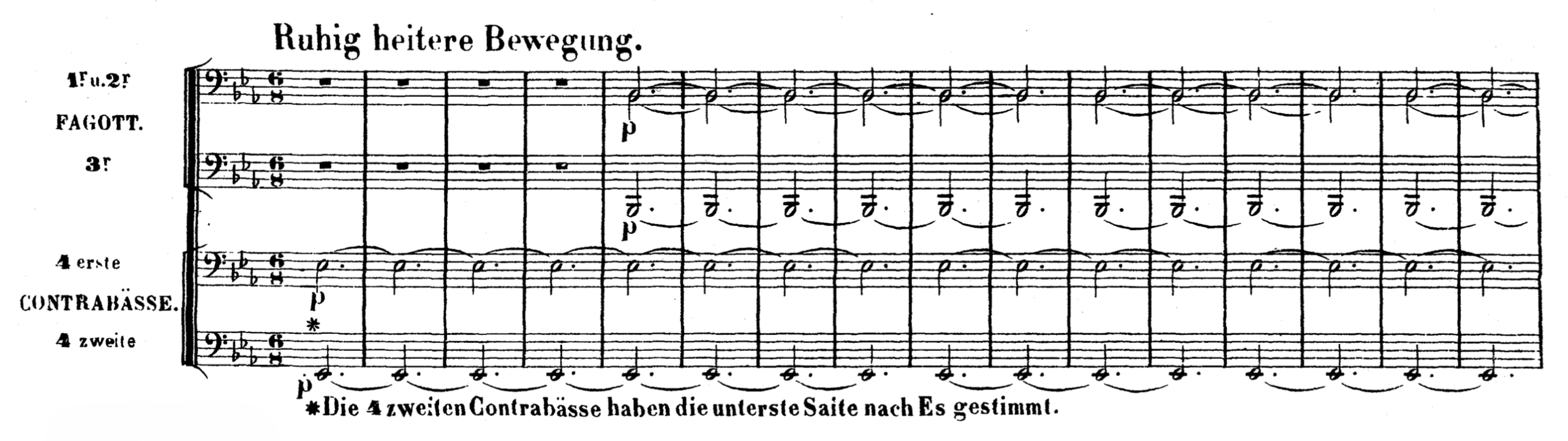
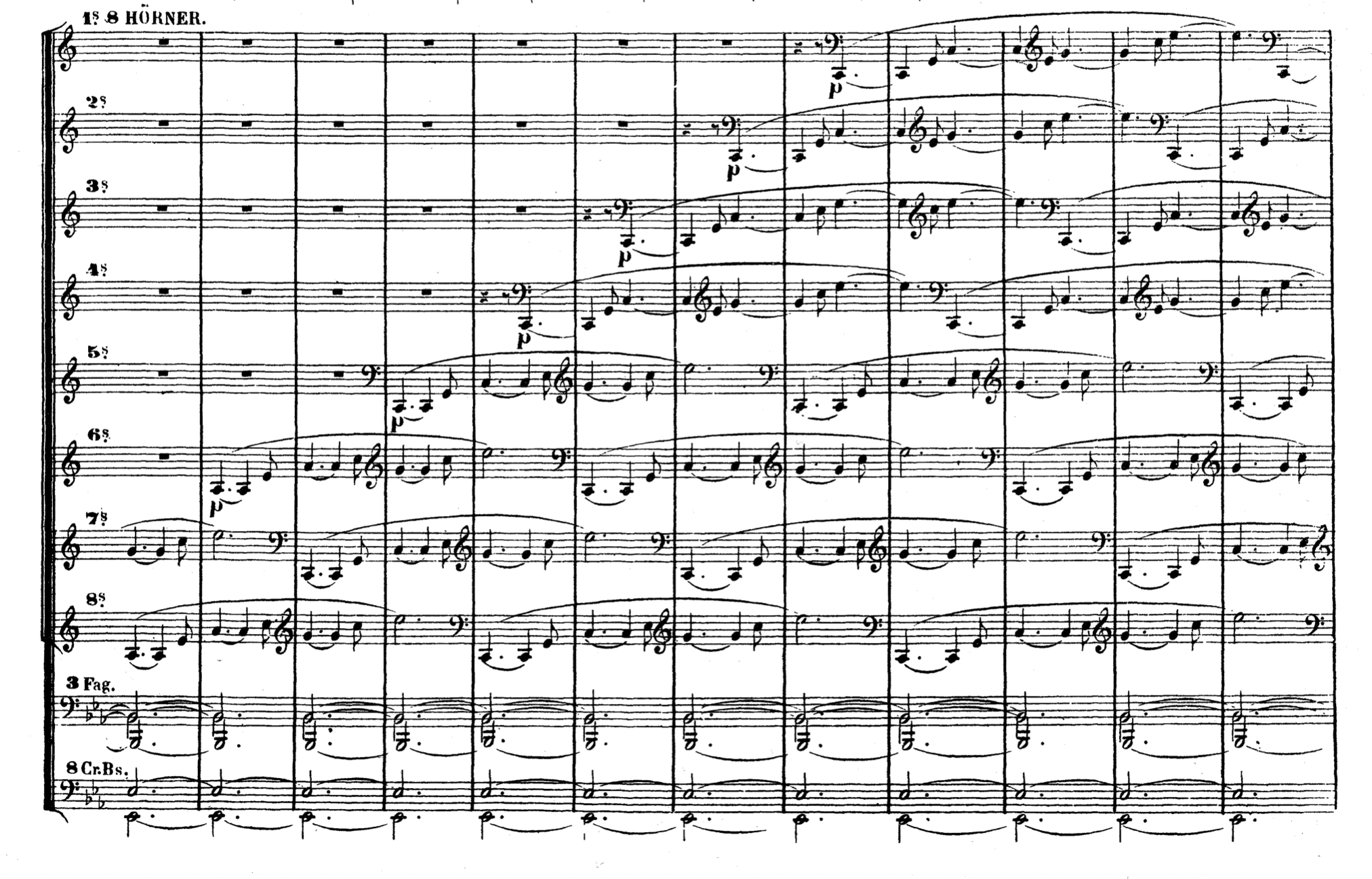
The lowest string instruments thus begin with a note that normally does not exist in their range. This deep, primal sound can be seen to represent several ideas at once: the basis of all things, the fundamental matter of Creation—water, perhaps?—and the very beginning of time. Atop that sound, sustained for 136 bars, eight horns start to build one by one on overlapping notes that will form major chords. It is the first Leitmotif of this massive work: Nature.
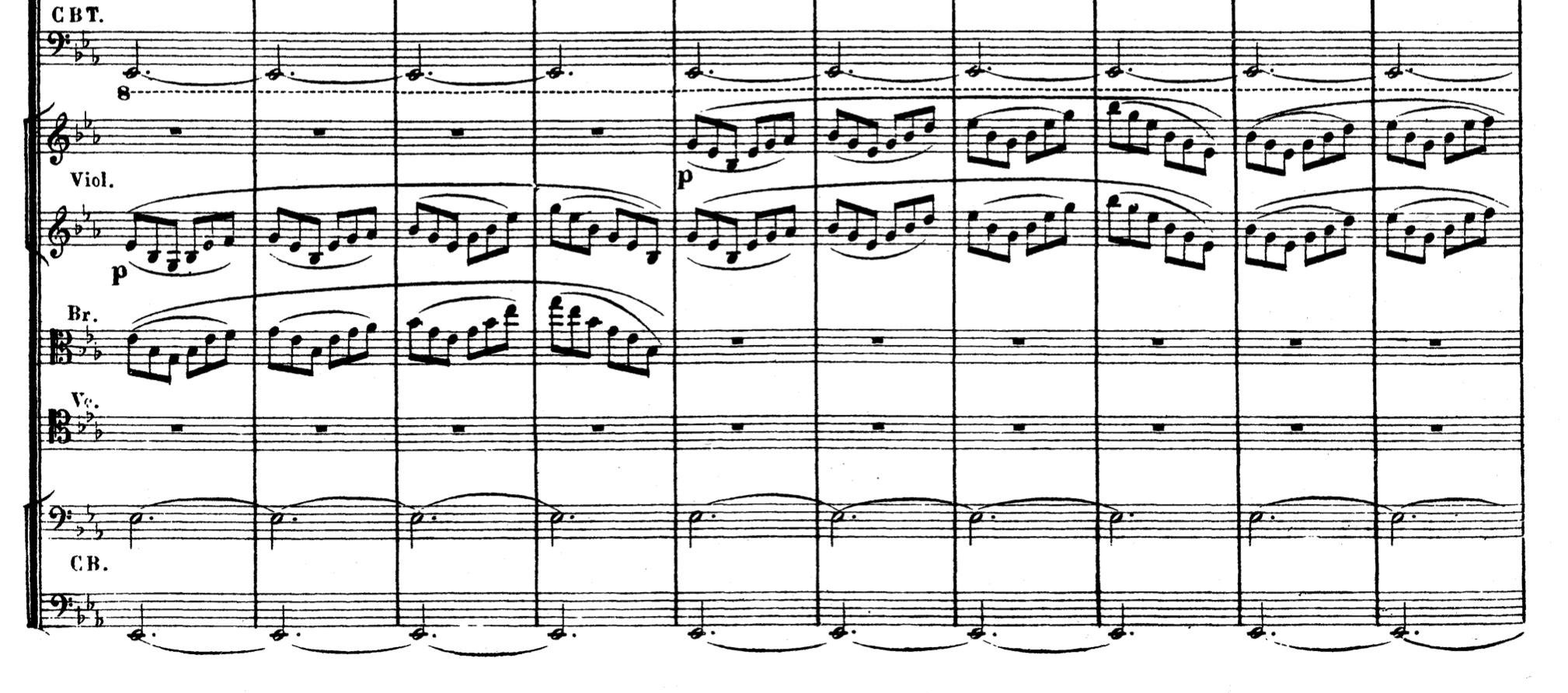
In an implacable crescendo, wave-like arpeggios represent the course of the Rhine, first murmured by the cellos and violas, later joined by the violins at twice the speed. Here is another new Leitmotif: the river.
And—as sound becomes pitch, pitch builds to chords, and chords surge into arpeggios—sweeping E-flat major scales on the winds and strings now depict the churning motion of the Rhine. We hear not only what the composer calls “deep water currents at full force,” but also the passage of time and its inexorable force on every lifeform.
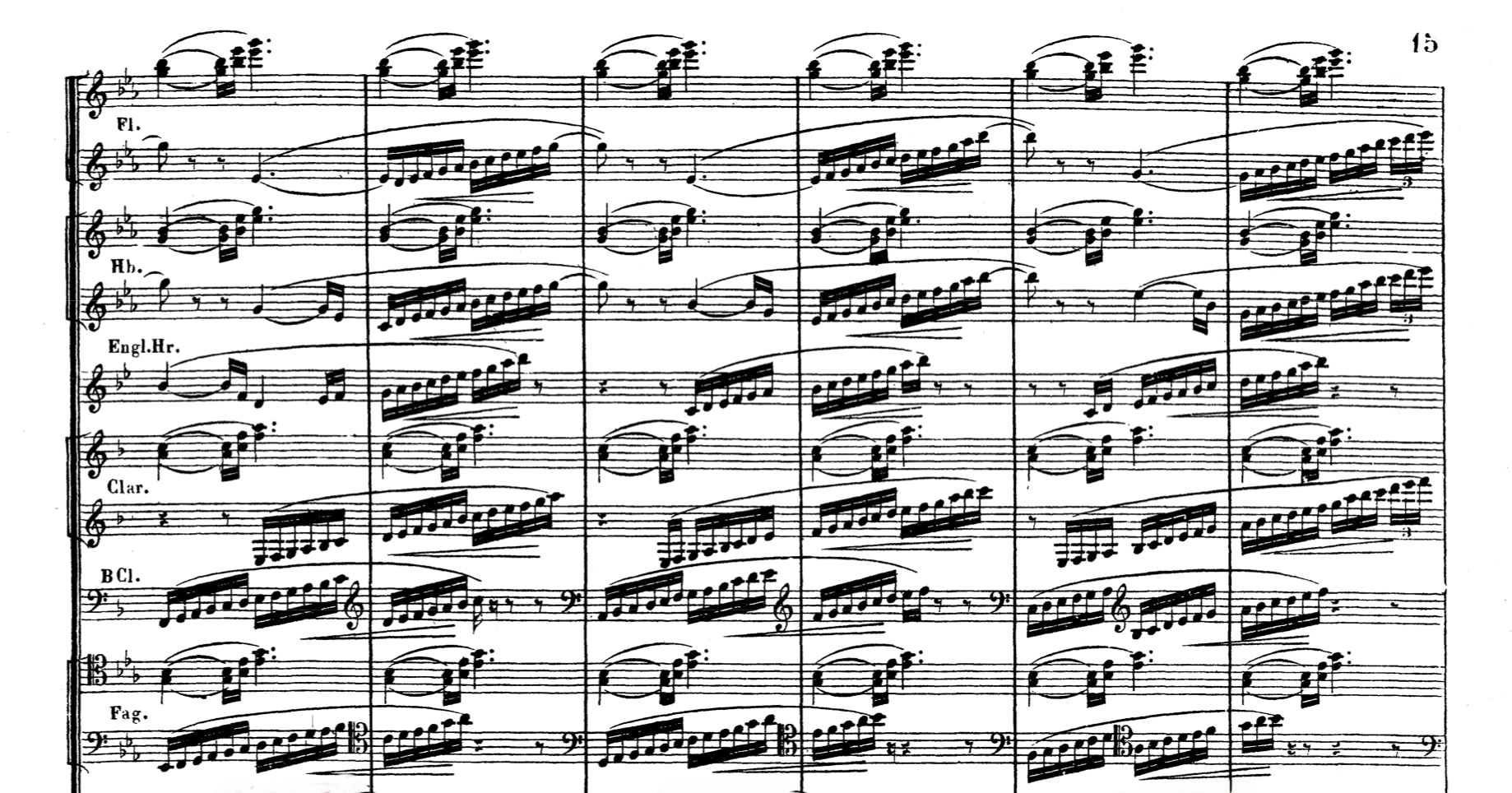
This lays the energetic backdrop against which the daughters of the river swim while singing their ancient song, praising the precious gold they are instructed to guard.



The rhythmic element of this melody is made by one long note—the one with a dot beside it—succeeded by two shorter ones, a “dotted” rhythm that instills the music with dynamic physicality. Not properly a Leitmotif itself, this rhythm pattern associated with movement, energy, and even violence will be found in various Leitmotifs, including the ultra-famous music of the warrior-sisters in “The Ride of the Valkyries,” performed in full force by the brass, woodwinds, and strings.
This intoxicating rhythmic pattern will also depict the Nibelungs, a completely different race whose Leitmotif (not a melody or a chord, just the dotted rhythm) can be heard here. It is played first by the whole orchestra and then by 18 anvils, representing the backbreaking forced labor of Alberich, the creature who steals the gold and harnesses its power to enslave his underworld race.
This music is undeniably thrilling even on superficial level. But the Leitmotif not only represents ideas that we hear and see — it almost unconsciously weaves another layer into the storytelling, driving emotion and sensorial reactions in the audience while, or sometimes even before, we watch the saga’s narrative unfold. Opening the third opera of the cycle, Siegfried, the Nibelung motif comes back as one thread in a tapestry of other Leitmotifs, all foreshadowing the events to come in this installment.
First we have the bassoons’ triads in the ruse motif, which anticipates how Mime—Alberich’s brother—will manipulate his foster son Siegfried to get the ring for him:
The “praised gold” motif sung ecstatically by the Rhine maidens earlier is then played in its antithetical minor mode, first by the English horn, then by the brass. The mad obsession with the ring becomes all-encompassing, inescapable:
By now you have probably caught the Nibelung motif… But what is that you’re hearing underneath? Indeed, there is another parallel motif here: the hoarding motif which alludes to the ring and its attendant treasures in the possession of the greedy dragon Fafner. Trombones and tubas take on this hoarding motif, masterfully weaving the obsession motif into it.
This complex, rich mosaic of Leitmotifs is where the Nibelung motif—the one with the anvils—comes back. We hear it first in the orchestra and then played by Mime himself while singing, trying unsuccessfully to forge a sword worthy of Siegfried and capable of slaying the dragon.
This impressively wrought passage is one of the most enthralling, eloquent, and information-charged parts of the entire cycle. But that’s not the only moment we can hear such an effective conglomeration of ideas in the musical-narrative device that is the Leitmotif! At the end of the cycle, after all the Ring’s earth-shaking events have transpired, the world and the order of things crumble as the time of the gods comes to an end. All that has happened is heard, not seen, in the final minutes of Götterdämmerung, without any singing or mise en scène: a pure musical synthesis that retells virtually the whole story and closes the cycle perfectly.
Dive into our Zürich Opera House production of Wagner’s complete Ring Cycle and see if you can recognize some of the motifs that recur across the saga’s 16 epic hours of music. We encourage you, of course, to take your time!
