
Great composers draw from a deep bag of musical tricks to craft moving and memorable works of art. With the help of a 150-year-old technique called leitmotif, composers from Richard Wagner to John Williams have forged scores of truly epic proportions.
View author's page
Reading time estimated : 20 min
What Is a Leitmotif?
A leitmotif is a short, recurring musical theme associated with a particular person, object, place, or idea. From the German Leitmotiv, meaning “leading motif,” these themes lead or guide the listener through a piece, bringing a sense of unity and structure. It can consist of a melody, chord progression, rhythm, or even a single pair of notes (as in the case of Jaws).
Skilled composers don’t simply repeat a leitmotif over and over: they create variations of these themes that alter their meanings. A composer may devise any number of different treatments of the same melody: they can fragment the theme, change its tempo or rhythm (a slower version may seem sad, relaxed, or noble depending on the context), modify the orchestration, or alter its harmonies (a previously dark, minor-key harmonization may become triumphant in a major key), among other things.
There are many reasons why a composer might use leitmotifs in their work. When used as musical signposts, these themes help the audience make sense of what’s happening. Music can powerfully evoke memory, and a recurring theme can trigger memories of what happened earlier in the piece. A theme introduced in the overture, before the action even begins, feels familiar when repeated later in the drama.
Music can reveal what’s going on without saying a word. Whether on stage or screen, characters don’t often narrate their interior thoughts and feelings. Sometimes, music can even reveal the truth to us: if a character is lying but the music says something else, the audience knows the truth even if none of the characters do.
Leitmotif Before Wagner: Weber and Early “Reminiscence Motifs”
Today Richard Wagner is the composer most associated with the leitmotif, but he didn’t invent it. Earlier composers like Carl Maria von Weber used “reminiscence motifs” to recall earlier moments in their operas. Weber also used recurring harmonies to accompany characters; in his most famous opera Der Freischütz, dissonant diminished seventh chords represent the sinister Samiel (such chords consist of a pair of discordant tritones, the “devil in music”). Weber also associated specific key signatures with certain characters or personality traits: in Euryanthe, E-flat major signifies divinity.
Berlioz and the Idée Fixe: A Key Precursor to Leitmotif
In his groundbreaking Symphonie fantastique, French Romantic composer Hector Berlioz introduced an important precursor to the leitmotif. Throughout the symphony’s five movements Berlioz repeats variations of a melody that represent his beloved. He called this obsessive theme his idée fixe (“fixed idea”). As the drama unfolds, so too does the theme adapt to illustrate changes of plot, mood, and setting.
Flutes and violins introduce the idée fixe in unison. The theme rises in hopeful, impassioned longing before ultimately collapsing, yet its timbre, rhythms, and phrasing suggest beauty, even perfection.
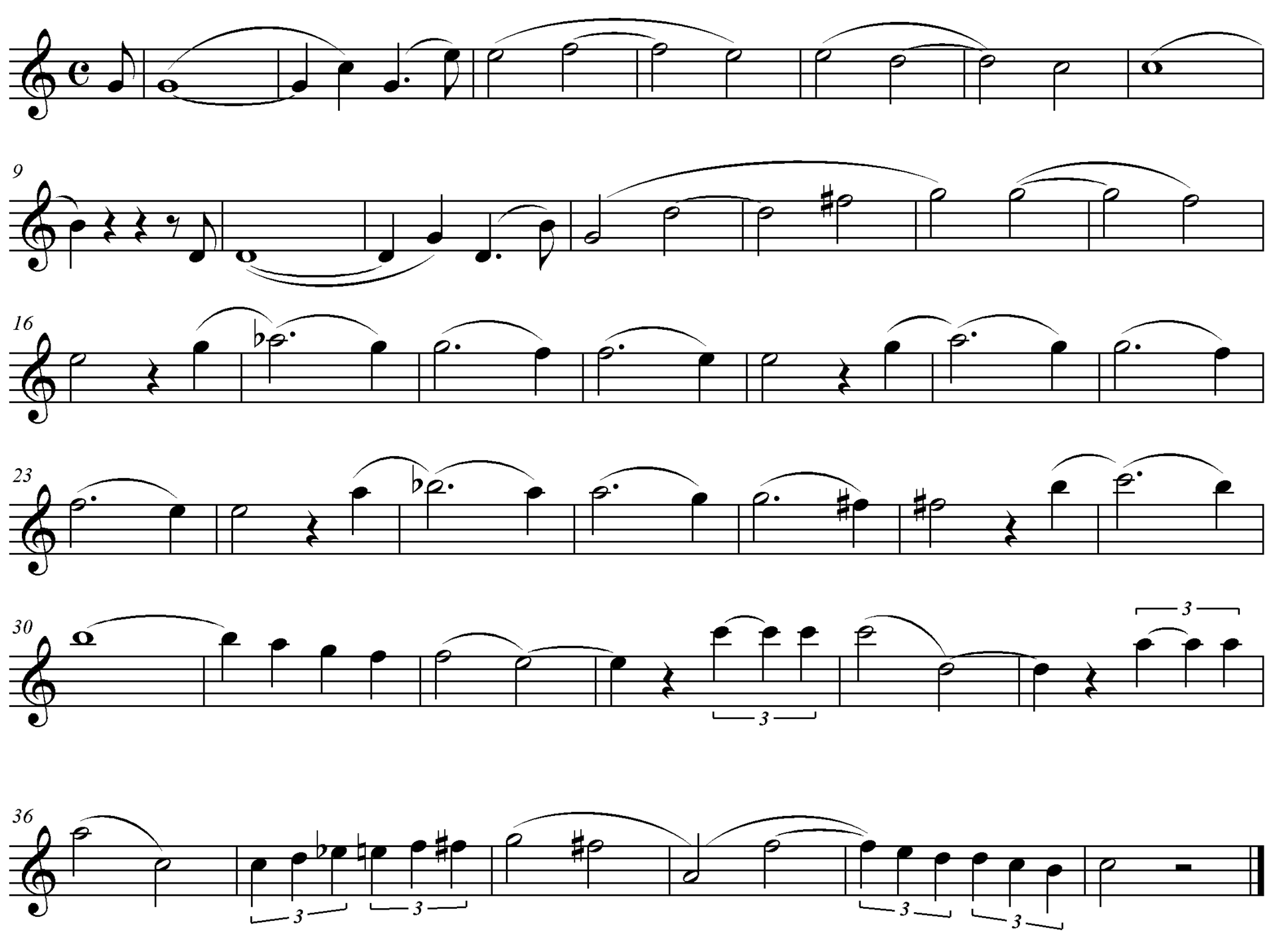
Berlioz’s Symphonie fantastique, Daydreams—passions
By the time the work reaches its final movement, warmth and beauty have been stripped from the idée fixe. Instead of the lush sound of flutes and violins, the theme is now sounded on the E-flat clarinet; Berlioz specifically chose this instrument to “parody, degrade and vilify” the melody. Its rhythms have also been changed, and what was once a cantabile theme is now a mocking dance.
Berlioz’s Symphonie fantastique, Witches’ Sabbath
Wagner and the Leitmotif Revolution: The Ring Cycle
Although the association of ideas, characters, objects, and places with specific thematic material had been a fairly common practice since the Baroque era, German opera composer Richard Wagner took it to a new level with the leitmotif. For Wagner, this was not just one compositional strategy among many but, in fact, the main structural element in much of his music.
“The poet’s greatness is mostly to be measured by what he leaves unsaid, letting us breathe in silence to ourselves the thing unspeakable; the musician it is who brings this untold mystery to clarion tongue….” – Richard Wagner
His greatest and most comprehensive use of this technique occurred in his magnum opus, the four operas of The Ring of the Nibelungen. Wagner threads nearly 100 distinct themes throughout his massive tetralogy. These musical gestures appear, reappear, transform, and blend together across this epic journey of the gods. Because of Wagner’s groundbreaking, all-encompassing use of leitmotif in the Ring cycle, it has become nearly synonymous with the composer despite rarely using the term himself (he worried that a shallow focus on identifying melodies à la Where’s Wally? would detract from the emotional impact).
Leitmotifs abound from the very first note of the first opera: the single low E-flat by the double basses evokes not only the depths of the Rhine, but also the birth of the world and the act of creation itself. One of these, the so-called “Redemption Through Love” theme, appears only twice in the entire cycle, yet it may be the most important. It first appears in Die Walküre, the second opera, when Brünnhilde tells the pregnant Sieglinde that her unborn child will grow to be Siegfried, a great hero. At the climax of the final opera, Götterdämmerung, Brünnhilde sings a transformed version of the theme before sacrificing herself in the fires of Siegfried’s funeral pyre. It then makes one final appearance in the final postlude.
Redemption Through Love, Die Walküre
Redemption Through Love, Götterdämmerung
Redemption Through Love, Götterdämmerung
Leitmotif After Wagner: Puccini, Dvořák, and Richard Strauss
Ever the lightning rod for controversy, Wagner inspired both intense adulation and ferocious condemnation. Debussy, who in his youth so admired Tristan und Isolde that he could play the entire piano-vocal score from memory, wrote his mature works in opposition to Wagner. He refused to use leitmotif in his opera Pelléas et Mélisande, deriding the technique as “slavery,” chains rather than a guiding thread.
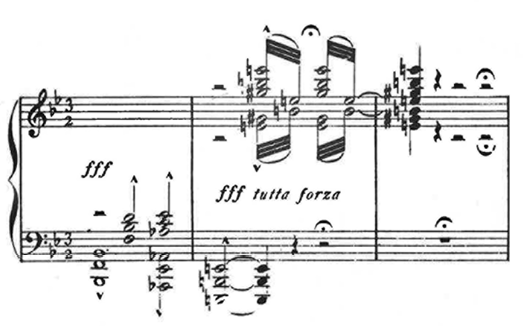
Other composers, however, welcomed the formal innovations and guiding principles of this technique. Giacomo Puccini used leitmotifs in his operas, most notably in his verismo masterpiece Tosca. In the very first bars he introduces the harsh, dissonant brass motif that signifies the evil baron Scarpia.
Of the post-Wagner generation, Czech composer Antonín Dvořák was one of the most faithful adherents to the leitmotif technique of The Ring. In Rusalka, his most enduring opera, Dvořák introduces the titular water spirit with muted violins. The mute establishes a clear sonic link to Rusalka, who gives up her voice in the pursuit of love. Upward leaps in Rusalka’s theme reflect her longing to leave the water and walk on land, yet sixteenth note patterns evoke the gentle rippling of waves. The first appearance of her theme concludes on a dominant chord; like Rusalka, its unresolved nature feels torn between two worlds.
Richard Strauss, one of the foremost late-Romantic composers of the twentieth century, used Wagnerian leitmotifs in several operas, from his first opera Guntram to the achingly beautiful Der Rosenkavalier. He also used the technique in several of his tone poems (Don Juan, Till Eulenspiegels lustige Streiche, and Ein Heldenleben, to name a few) to provide continuity and narrative development. Comparing his work to Beethoven’s Eroica (which is also in E-flat major), Strauss joked that “while it has no funeral march, it does have lots of horns, horns being quite the thing to express heroism.”
In Ein Heldenleben, the hero’s theme is a bold, wide-ranging melody introduced by unison horns and cellos.
Introduction of the hero’s theme
When critics attack the hero in the second movement, the theme has been transfigured into a minor key.
The hero’s adversaries
Later in the work, when the hero has emerged victorious in war, the theme returns in its boldest and most majestic orchestration.
The hero emerges victorious from battle
In the final movement, when the hero goes to his well-deserved rest, the theme makes a last appearance as a slow, tranquil horn fanfare.
The hero’s retreat from the world
Leitmotif in Film Music: Why Cinema Adopted Wagner’s Method
“If Wagner had lived in this century, he would have been the No. 1 film composer.” – Max Steiner
Moving pictures exploded in popularity at the turn of the twentieth century, and film music followed right behind it. In the silent film era, musical accompaniment served practical functions like obscuring the sound of rustling popcorn, talking audiences, and clanking projectors; it also played an important narrative and artistic role. When dialogue was limited to intertitles, music helped bridge the narrative gap. “The poet’s greatness is mostly to be measured by what he leaves unsaid,” wrote Wagner, “ the musician it is who brings this untold mystery to clarion tongue….” In this case the poets couldn’t say much at all, making music even more important.
The first music to accompany silent films was drawn from the classical repertoire, but eventually accompanists began to pull from a library of stock tunes like the cartoonish “Villain’s Theme.”

As films and their soundtracks grew more sophisticated, so too did composers’ techniques. They had a ready-made model in Wagner. Ernő Rapée, an early film music composer, praised the leitmotif method as “the one which can best be applied in scoring pictures.” For audiences unused to moving pictures, consistent musical themes provided a sense of narrative, continuity, and familiarity.
Cinema’s embrace of leitmotif was natural, maybe even inevitable. Like opera, film involves a number of characters engaged in narrative storytelling. Both include dialogue and staged scenes, forming a pre-existing non-musical scaffold for composers to build upon.
Max Steiner: “Every Character Should Have a Theme”
Ironically, the foundational film scores written in Hollywood, that most American of cities, largely came from Europeans. Many great film composers emerged from the world of classical music; some of them, like Sergei Prokofiev, William Walton, and Hanns Eisler, are still more known for their concert works than for their pioneering soundtracks.
Max Steiner, widely regarded as the “father of film music,” grew up in Austria, where he studied with Johannes Brahms and Gustav Mahler as a child. Beginning in the late 1920s, he wrote and arranged scores for more than 300 films including legendary titles like Gone with the Wind, Casablanca, and King Kong. He readily acknowledged Wagner’s influence on his work and the film music industry writ large: “If Wagner had lived in this century, he would have been the No. 1 film composer.”
“Every character,” Steiner famously stated, “should have a theme,” from the descending three-note figure that introduces King Kong to the “Deutschlandlied” that shadows the Nazis in Casablanca (though the original song is in a major key, Steiner recomposed the piece in a minor key to add a layer of menace).
Casablanca
He not only wrote themes for characters; he wrote them for places as well. When Scarlett O’Hara, the heroine of Gone with the Wind, walks dazedly across the barren fields of Tara, the family plantation, the ascending Tara theme plays softly. When she vows to “never be hungry again,” the theme boldly darts upward in a series of rising octaves, crescendoing in a blaze of brass and strings.
John Williams: Leitmotif in Jaws and Star Wars
Over the last 50 years, nobody has been a greater exponent of the technique than John Williams. The creator of some of Hollywood’s most memorable film scores, Williams imbues movies with enduringly catchy earworms that propel the narrative forward. One of his first major successes came with the 1975 horror film Jaws. The American Film Institute ranked Williams’s score the sixth greatest of all time, thanks in part to his skillful and economical use of leitmotif.
Williams uses an insistent two-note ostinato (you know the one) to signal the shark’s presence. The theme begins in the low strings, providing a sonic depth and murkiness evocative of the impenetrable darkness of the deep sea. The thrumming, alternating half steps have been compared to heartbeats and panicked breathing; Williams described the motif as “grinding away at you, just as a shark would do, instinctual, relentless, unstoppable.”
Some of Williams’s most iconic melodies come from the nine films he scored for the Star Wars franchise. Rather than turn to the ethereal, unsettling effects of earlier science fiction films—think Herrmann’s theremins in The Day the Earth Stood Still or the dense, slow-moving music of György Ligeti in 2001: A Space Odyssey—George Lucas asked for old-school Romanticism, the sort of music found in the leitmotif-heavy scores of Steiner and Korngold. Williams happily obliged: “It was not music that might describe terra incognita,” he later said, “but the opposite of that, music that would put us in touch with very familiar and remembered emotions, which for me as a musician translated into the use of a nineteenth-century operatic idiom, if you like, Wagner and this sort of thing.”

The “Imperial March” theme, introduced in The Empire Strikes Back, is one of the most recognizable leitmotifs in the Star Wars galaxy. A forceful, minor-key march typically led by the brass section, the theme depicts the dreadful might of Darth Vader and the Galactic Empire. In fact, the “Imperial March” has become so strongly associated with militaristic evil that a man in the United States capitol followed military patrols around the city while playing the theme from his phone.
The “Imperial March” theme
Williams skillfully threads the “Imperial March” throughout the saga. In The Phantom Menace, the first of the prequel trilogy, Jedi Master Yoda expresses fear at the prospect of training Anakin Skywalker (the future Darth Vader) as a Jedi. As he and Obi Wan Kenobi discuss Skywalker’s fate, a muted, ominous fragment of the “Imperial March” appears.
Several films later, at the climax of Return of the Jedi, Luke Skywalker has defeated the Emperor and is attempting to flee the Death Star with a dying Vader. Vader insists that Luke remove his mask so that the two might finally see each other face to face. As Vader’s helmet is removed the “Imperial March” leitmotif returns, now stripped of its staccato martial rhythms. High, eerie string harmonics contribute a sense of mystique in the moments before his face is revealed. Once the audience sees Vader’s face, however, a softer version of the theme appears, played for the first time on a flute with a light harp glissando beneath it. The theme repeats one last time after Vader takes his last breath, now on a solo harp. This orchestration is light years away from the terrifying theme that represented Vader’s relentless power. In addition to its gentle timbre, the harp has long associations in Christianity as both a bridge between the physical and spiritual worlds and a bringer of spiritual harmony (balance to the Force, perhaps?).
Howard Shore and The Lord of the Rings: A Modern Wagnerian Web
Of the many film composers who have incorporated leitmotifs into their scores, Howard Shore may come closest to approaching Wagner. His scores for The Lord of the Rings trilogy are one of the crowning musical achievements of the twenty-first century. Shore composed, orchestrated, and conducted over ten hours of original music for the three films.
Though he looked to Italian opera to inform the music’s emotional tone—“I think opera is film music,” he’s said—Shore applied the principle of leitmotif to build a truly interconnected musical landscape. Over the course of the trilogy he used over 90 distinct themes to represent races, individual characters, locations, the Ring, and even Nature. One of the most recognizable melodies from The Fellowship of the Ring is “Concerning Hobbits,” a pastoral theme representing the Shire and its diminutive denizens. Based on a D major pentatonic scale, this folksy melody evokes the comfort and tranquility of rustic domesticity. The theme is initially played on fiddles and woodwind instruments, avoiding the heroic and militaristic connotations of brass.
“Concerning Hobbits”
The theme reappears at the climax of the film, when the Hobbit Frodo decides to journey to the evil land of Mordor alone. Shore transforms the original Hobbit theme, slowing it down, fragmenting the melody, and re-orchestrating it to include a noble brass accompaniment. Though elements of the leitmotif have been transformed, the key (D major) remains unchanged, and the melodic contour contains enough of the original that we hear not a new theme but an evolution of what has come before.
Breaking of the Fellowship
Conclusion: Why Leitmotifs Stay in Our Memory
Combining the powers of emotion and memory, recurring themes keep listeners coming back to their favorite musical moments. One scholar of leitmotif invites us to ask, “How many of us can hear the score to a film we have seen without images and emotions flooding our consciousness?” Some suggest that this technique works best for epic, larger-than-life stories, and this may be true. For at their core, tales of gods and monsters, or rings and lightsabers, are really stories about what makes us all human.
