
How Wagner Made Modern Theatre

As the Ring Cycle turns 150, Wagner’s famously neckless dragon offers a witty way into a bigger story: how his obsession with illusion, machinery and spectacle reshaped modern theatre.

View author's page

By Andrew Mellor

Reading time estimated : 11 min

In August, it will be 150 years since the first performance of Wagner’s Ring Cycle, in Bayreuth. A serious milestone, which prompts me to think about the funniest story surrounding the premiere. 

As you know, the third instalment of the tetralogy, Siegfried, requires the appearance and subsequent killing of a singing dragon, Fafner. Wagner had commissioned a mechanical dragon from the nineteenth century’s most renowned theatrical prop maker, a fellow who went by the name of Dykwynkyn (he was, actually, plain-old Richard Wynne Keene, Head of the Decorative Props Department at Her Majesty’s Theatre in London). 

Keene created the first Fafner in his London workshop – a resplendent serpent whose hundreds of meticulously crafted scales concealed its mechanical insides. When the contraption was complete, he sent it in pieces from London to Bayreuth, where bit-by-bit, it was duly received by an excitable Wagner. 

Unfortunately, one vital part didn’t make it to Bavaria – Fafner’s neck. The appendage still hadn’t arrived by the time of Siegfried’s opening night on 16 August 1876. Legend has it that the dragon’s neck had mistakenly been sent not to Bayreuth, but to Beirut. The sight of a supposedly fearsome dragon missing one of its most distinctive features – or rather, displaying a hastily assembled temporary cover-up for the fact that one of its most distinctive features did not exist – reduced one of the Ring Cycle’s pivotal scenes to a farcical mess. 

Wagner and The Art of Illusion

These days, the theatre world is a little more professional – we would justifiably expect a more passable solution to be found in the event of a Siegfried facing the prospect of a neckless dragon. In 2023, English National Opera’s production of Die Walküre, the opera before Siegfried in the Ring Cycle, to be dramatically changed at the last minute when Westminster Council refused to grant the company a pyrotechnic license for the ring of fire surrounding Brünnhilde. ENO managed to scramble a solution that didn’t do too much harm to the end result (or, at least, it didn’t become the focus of all the reviews).

In Wagner’s day, it was far harder to muster fixes to problems like that, mostly given the pioneering nature of the composer’s ideas. Wagner was fascinated by stage technology and innovation. He wanted audiences to be sucked into performances of his works much like they would at a modern cinema – unaware of the trickery that lay behind them and unaware, even, that a huge orchestra was playing in the same room as them (hence Bayreuth’s orchestra pit, which conceals instruments and their players entirely from sight).

The problem was that Wagner’s theatrical conceptions didn’t quite fit within the confines of the theatres he believed would be able to present them – even the theatre he built himself at Bayreuth. In terms of stage technology and illusion, he continually changed his mind about the best way to achieve what he wanted and was constantly dissatisfied with the results. 

In the case of the Ring Cycle, Wagner soon learned that writing the music had been the easy bit. The really hard bit proved to be staging the whole thing. Perhaps that’s why the cycle remains such a head-scratcher for opera directors today – despite the clear motivations and resonances of so many of its key characters and the brilliance of Wagner’s musical dramaturgy. 

How Do You Solve a Problem like Fafner?

Fafner the dragon is a case in point – and perhaps the most obvious stumbling-block for a director of the Ring Cycle (though there are many more, and some a good deal more complicated). Mechanical dragons tend to look as ridiculous in 2026 as they did 150 years ago, even when they do have a fully-functioning neck. 

The easiest solution would be to keep Fafner off-stage altogether – just about possible, if a little crude, given the score. This was a concept Wagner’s first movement director Richard Fricke encouraged the composer to explore. Naturally, the composer ignored Fricke’s advice, resulting in the fiasco on the opening night.

In this production of Siegfried from the recent Ring Cycle staged at Zurich Opera, director Andreas Homoki very nearly follows Fricke’s advice. Before the actual fight, when everyone from Mime to the Wanderer is provoking the dragon, all you see of the beast is his large black tail flapping around through an interior doorway of the mansion house in which Homoki sets the entire drama, to the accompaniment of some electronic “dragon noise” (see 1’44’53). 

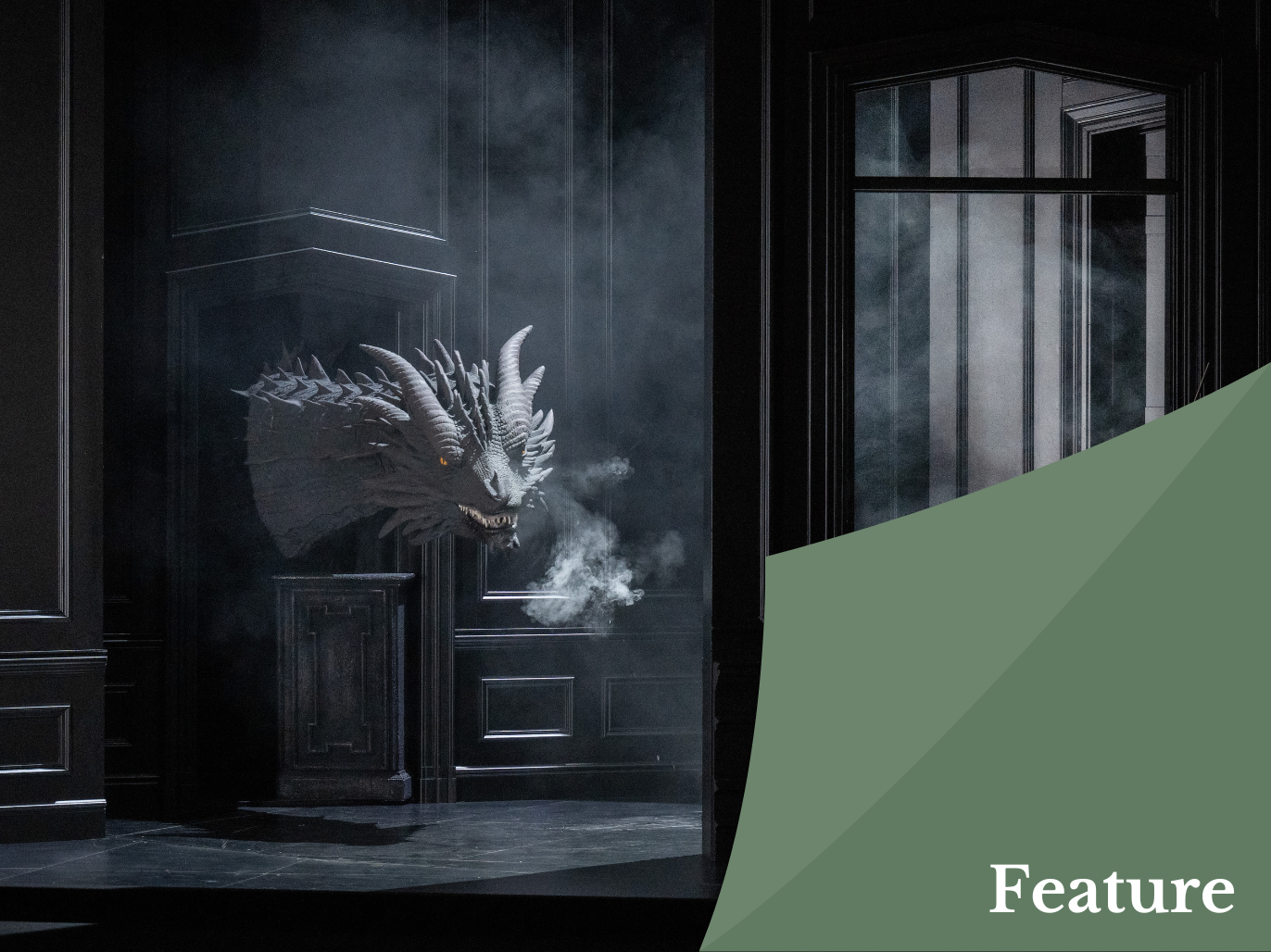
But Fafner isn’t done yet. A little later and surprisingly given the style of the staging and the current trend for avoiding literalism, an actual steam-breathing dragon appears in Homoki’s Siegfried (skip to 2’10’00) as if it has forced its way into an elegant home – probably probably the point. 

The reason it was fun to see Homoki’s dragon is that we so rarely see the real thing these days. That’s okay: contemporary productions of the Ring Cycle tend towards modern or reflective settings in which the sudden appearance of a dragon would seem incongruous. 

The problem, is that this makes imagining Fafner as much of a conceptual problem for directors as it has long been a practical one. The last time I saw a complete Ring Cycle live, it used all sorts of brilliant theatrical tricks, including a hologram “river” of people forming the River Rhine which appeared to flow out and embrace us all in the audience (it used hundreds of volunteer extras). It was an innovation absolutely in the spirit of Wagner and it set a high bar. Alas, the director could find no equal solution for Fafner, whose appearance was a mighty disappointment. 


Step forward the German school of opera directing, in which anything can be explained by a little psychoanalysis. In this highly engaging production of Siegfried by Jossi Wieler for the Staatsoper Stuttgart, Fafner is simply a man sitting on a chair with his back to Siegfried. When the hero approaches and kills Fafner, he realizes that his nemesis was no dragon but simply a manifestation of himself – his form, wearing his clothes (a T-shirt with “Siegfried” written on it, for those on the back rows). 

Recently we have seen Fafner as a fellow inmate of the same experimental facility as Siegfried (Dmitri Tcherniakov’s Berlin Staatsoper Ring) and a voodoo-like figure in a cloak of shimmering gold shards (Barrie Kosky at Covent Garden). A personal favourite of mine was in Kasper Holten’s Royal Danish Opera Ring Cycle from 20 years ago, when Fafner operated the controls of his own underground steampunk dragon machine – a neat abstraction following which the woodbird manifested itself as an actual, live bird. 

What Wagner Wanted

Staging Wagner is as endlessly fascinating as playing Wagner, singing Wagner, hearing Wagner and seeing Wagner staged. That’s one reason there are plenty of books on the subject, most recently Gundula Kreuzer’s Curtain, Gong, Steam: Wagnerian Technologies of Nineteenth-Century Opera (which, naturally, has an image of Fafner on its cover) and Patrick Carnegy’s unmissable Wagner and the Art of the Theatre (which has plenty of steam on its cover). 

One of Carnegy’s conclusions is that Wagner didn’t want his works embalmed; he wanted them to live with vitality and fluidity, according to theatrical trend. As the composer’s grandson Wieland Wagner asserted: “there is no living style in the theatre other than that of its time”.

More than any other composer, Wagner seems to draw an emphatic response from the theatre-makers of each subsequent era, many of whom respond with the same sort of appetite for technical innovation as the composer himself demonstrated. 

Perhaps the most infamous staging of Wagner’s Ring Cycle of recent times was mounted at the Metropolitan Opera between 2010 and 2012 under the artistic leadership of the visionary Canadian theatre practitioner Robert Lepage. It used a single, huge set known as The Machine – a colossal series of rotating planks that was so heavy (45 tons) it necessitated the rebuilding of the Metropolitan Opera’s foundations (it’s easy to imagine Wagner himself demanding such a solution). Some thought Lepage’s Ring Cycle an inspired success – The Machine’s movements offering a constant visual equivalent to Wagner’s endlessly-transitioning music (more on that here). Others thought it a disaster, beset by glitches and ultimately far too theatrically rigid.

The Met’s Ring Cycle stood on the shoulders of many similar endeavors. Immediately before it came the Valencia Ring Cycle staged by La Fura del Baus, which merged acrobatics and industrial machinery. After it came the 2022 Berlin Staatsoper Ring, which dazzles its audience with a colossal building – the “E.S.C.H.E.” research facility, in which director Dmitri Tcherniakov imagined the entire cycle taking place – whose endless rooms are conveyed into position with Wagnerian grandeur. 

In each case, one must ask oneself whether the bravery of the spectacle detracts from the telling of what is, in effect, a very human story (ditto with ever appearance of Fafner the dragon). One of the most powerful movements in Wagner production came in the latter half of the twentieth century, an era which seemed to move away from the composer’s celebration of theatre as a world of illusion and towards one that, to paraphrase Carnegy, recognized the artifice of theatre for what it was. Often, productions consisted of little more than people and lighting.

More recent trends can appear like a fusion of the two. In this production of Wagner’s Die Meistersinger von Nürnberg from the 2013 Salzburg Festival, director Stefan Herheim plays his usual trick of putting the composer himself on stage – in this case, having both Hans Sachs and Sixtus Beckmesser take on the personage of Wagner. 

Though the concept depends almost entirely on the ability of individual performers to perform, it does indulge in one grand theatrical spectacle. Acts I and II play out on giant, oversized sections Hans Sachs’s house, which we see during the Prelude. The entirety of Act I, the grand cathedral scene, takes place entirely on Sachs’s writing desk, its little organ emblem becoming an actual, full-sized organ. At one point in Act III, the toy steam train being played with by children manifests itself in full-size, puffing with actual steam. 

That brought to mind Kreuzer’s book, in which she outlines just how much Wagner pioneered the use of steam in the theatre to mask scene changes and create atmosphere. Every time we see steam in an opera production, in a musical, in a magic show or even on Taylor Swift’s Eras tour, it is Wagner we have to thank. Likewise, every time we see an incredible theatrical innovator like Barrie Kosky, Robert Lepage, Andreas Homoki or Kirill Serebrennikov working on the opera stage, we have Wagner to thank, partly, too.   

Written by Andrew Mellor

Journalist and critic

Andrew Mellor is a British writer, critic, and broadcaster based in Copenhagen. After studying music at the University of Liverpool, he began his career with the Manchester Camerata and the London Philharmonic Orchestra before training as a journalist at Classic FM magazine and Gramophone. Since moving to Denmark in 2015, he has become a leading voice on Nordic music and culture, contributing regularly to Opera and Opera Now.

A regular critic for the Financial Times and a presenter for medici.tv and the Danish Broadcasting Corporation, Andrew Mellor also writes extensively for orchestras, festivals, and record labels around…

View author's page