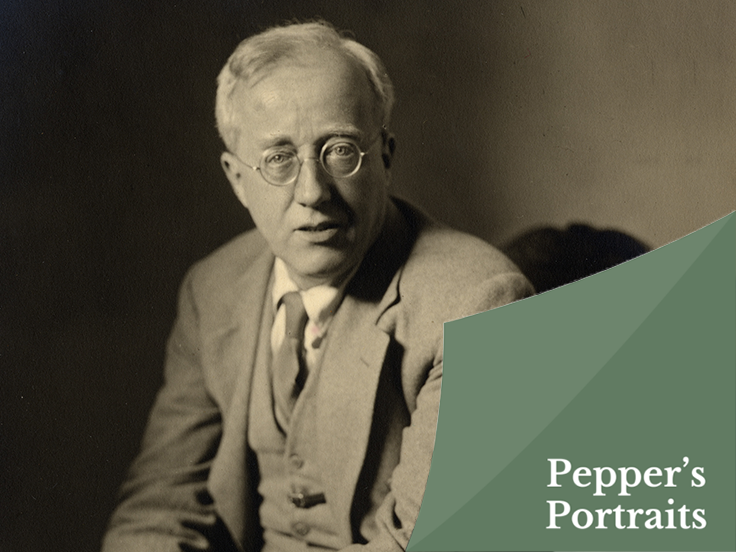
Gustav Holst: A Musical Explorer with Universes of His Own

Far from the cliché of the pastoral British composer, Gustav Holst wrote much for voices: choral works and operas based on Sanskrit and ancient Greek texts, as well as settings of English folk songs. A believer in community, he also championed women’s place in orchestras and composition, rooting his vision in the world around him. Jack Pepper looks beyond The Planets to reveal the unique qualities of this craftsman and musical adventurer.

View author's page

By Jack Pepper

Reading time estimated : 13 min

Often, I sense that there is a peculiarly British mentality that fails to acknowledge the quiet daring of our own native composers. 

Think of “experiment” or “forward-thinking” in British writers and perhaps Harrison Birtwistle or Thomas Adès first come to mind. The legends of an era or two before are perhaps associated with greater conservatism at first glance. But we forget that Ralph Vaughan Williams was embracing film scoring in the 1940s (in his seventies!), or that back in 1925 he was behind that dissonant and mystic suite for viola and wordless choir, Flos Campi; likewise, when we mention the name of his good friend Gustav Holst, it’s rarely his Sanskrit investigations of the Rig Veda or the astringent Egdon Heath that come to mind.

Maybe it’s simply because one piece came to define their “sound” in the popular imagination, The Lark Ascending and The Planets for these two legends; but gorgeous as these pieces are, they represent only a fraction of their creators’ sound and outlook. For a long time, Britain has been far from a “land without music,” and these composers far from a stereotype.

Holst was a consummate craftsman and musical adventurer who, appropriately enough, explored many different musical planets of his own…

Sofi Jeannin conducts 50 young vocalists from the Maîtrise de Radio France in a performance of Gustav Holst’s Choral Hymns from the Rig Veda Op. 26 in the magnificent Chartres Cathedral, one of the world’s best-preserved medieval cathedrals.

Beginnings: Poor Health Maketh the Man

Born in Gloucestershire, England in September 1874, Holst was thoroughly European: he was of Swedish, German, Russian and Latvian heritage. Such a family melting pot surely inspired his own exploration of different languages and cultures to come. But equally, he was proud to be British, dropping the ‘von’ in his name at the time of the First World War to ensure his countrymen knew what side he was on.

If an international heritage helped shaped his outward-looking perspective, childhood sickness also helped define his path. Holst started learning the trombone at the age of twelve as an attempt to combat asthma; meanwhile, severe neuritis in his arm prevented him from becoming a concert pianist—his father’s ideal—and pushed him towards composition. 

He started composing aged twelve, his very first piece foreshadowing the daring sense of ambition to come: not yet a teenager, his first compositional attempt was a choral and orchestral setting of Thomas Babington Macaulay’s fifteen-minute-long poem Horatius! Then at just eighteen, he attempted a first symphony and an operetta in the style of Gilbert and Sullivan. 

Having entered the Royal College of Music, it was his fellow students who had the greatest influence. Holst met Vaughan Williams aged 21, and the pair soon organized friendly weekly gatherings at local Kensington tea shops to discuss each other’s compositions (and presumably also whether to opt for carrot cake or Victoria sponge). Musical chat soon expanded to philosophical and historical debate, underlining Vaughan Williams’s assertion that “what one really learns from university is not so much from one’s official teachers as from one’s fellow students.”

The Schoolteacher

Like his friend, Holst believed in community and education. He headed up music-making at Morley College, a school for adults, and famously worked as Director of Music at St Paul’s School for Girls in Hammersmith for three decades. There, he was a big believer in “learning by doing”: one of his favoured ways to teach music was to encourage the improvisation of vocal rounds. There, placing a student inside the sound and in the role of creator, the nuts and bolts of music become clear.

Little-credited was his parallel ambition to teach a new breed of women conductors. Holst was keen to make his school a global hub for inspirational female music leaders of the future; this makes him far ahead of his time, when it was only in 1913 that the first professional British orchestra even admitted a female player, let alone conductors. It is fitting that Holst’s own daughter, Imogen, would later become a noted conductor and champion of his music. 

Sir Antonio Pappano and the London Symphony Orchestra perform the sumptuous Persephone, an overture of Ravelian harmony and mythological imagery by Imogen Holst, the daughter of Gustav, whose work has been rediscovered and acclaimed in recent years.

It was Holst’s students in Hammersmith who helped copy out the parts for The Planets; he composed much of it in a soundproof room the school provided just for him, on a piano they had bought for his use. He had already expressed their strong bond with his 1913 St Paul’s Suite, penned for the school string orchestra to mark the opening of a new music building; its lively dances form a fitting celebration of the academic environment in which Holst always felt so at home.

His educational work highlights how tireless innovation and curiosity don’t necessarily lead to distance or esoteric self-absorption; his music was grounded in the practical everyday and served his community. As Vaughan Williams commented: “it is the blend of the visionary with the realist that gives Holst’s music its distinctive character.”

The Planets: Wartime and International Fame

Holst was prevented from serving in the First World War due to his asthma, neuritis and terrible eyesight (he couldn’t see further than a few yards, and along with Shostakovich wins first prize for Harry Potter lookalike). Despite the physical obstacles, he still travelled to Greece and the Middle East in 1918 to organise concerts for soldiers. 

It was quite a year, since he returned home to find himself famous. Holst’s friend Balfour Gardiner had financed a single performance of The Planets as a good luck and farewell gift; Adrian Boult conducted the Queen’s Hall Orchestra in front of an audience of friends one Sunday morning, just a month before Holst set out to the Eastern Front. Holst’s own students from Morley College and St Paul’s School formed part of the choir. Within months and with Holst now abroad, Boult was leading public performances of the work so that, when his friend returned home, the piece—and the name Gustav Holst—were suddenly the talk of the town. 

London’s Queen’s Hall was sold out twice in one week when Holst conducted his music there—the only time this ever happened in the history of the famed venue. Across the pond, a battle ensued between the New York Philharmonic and Chicago Symphony to be able to give the American premiere (Chicago won). 

This was the only major public acclaim Holst enjoyed in his lifetime, and in many ways the piece is not typical of Holst. It is written for a huge orchestra, without the influence of a major poet or ancient text, and its tonal and melodic directness are in stark contrast to the bleaker, sparser sound of his later writing. Yet mention Holst, and we think of The Planets sound world—however atypical.

It was a work that took a while to gestate. He had started thinking about astrology after a chance conversation on holiday in Spain (who said holidays were for switching off?…). Holst had long been interested in horoscopes, and the suite became his musical channel for what the cosmos says about the human spirit. He took three years to write it all, saying: “it grew in my mind slowly, like a baby in a womb.” Such lengthy gestation was partly a result of his heavy teaching schedule, which restricted his writing to weekends and school holidays. His poor health also made things difficult, the neuritis rendering Holst unable to hold a pen for long periods; two fellow schoolteachers had to help write down his thoughts. 

It is an awe-inspiringly colourful and evocative work. “Mars, the Bringer of War,” written at the outset of World War One, is seen by many to mirror the mood of the times. Its distinctive use of col legno—where the wood of the bow is used to tap the strings to create a percussive drumming sound—and the 5/4 time signature create an ominous sense of foreboding (an inspiration for John Williams in Star Wars). 

Sir Antonio Pappano leads the LSO in an out-of-this-world rendition of Gustav Holst’s beloved suite The Planets, opening with the cinematic “Mars, the Bringer of War.”

In “Jupiter”, the Bringer of Jollity is depicted with bouncing folksy rhythms, only to be cut across by an andante maestoso central chorale that is surely one of the most noble melodies ever written; it is a perfect illustration of how emotive melodic writing often traces its way from a low beginning to an emotional climax on a high note, the rise and fall of a musical rollercoaster where tension and emotion peak as a melody climbs. When later paired with words by Cecil Spring Rice as I Vow To Thee, My Country, it was premiered by Holst’s students and became his school’s official hymn—as well as a powerful regular at Remembrance in Britain every November.

The London Symphony Orchestra performs a sublime and ebullient “Jupiter, the Bringer of Jollity,” conducted by Sir Antonio Pappano. As the melody rises and falls through epic climaxes, the piece tells a grandiose story of many different emotions.

Fearless and Faithful: Languages and Opera

Although The Planets is now hailed as distinctively British, Holst was hugely international—by diligent study, as well as heritage.

A 1908 visit to Algeria led him to incorporate African melodies in his writing. His love of Ancient Indian texts began in his youth; early on Holst realised the inadequacy of English translations and set himself the enormous task of learning Sanskrit so he could make his own realisations that would prove more faithful to the originals (eventually, he based two operas on Hindu subjects). He would perform a similar linguistic feat when setting the Hymn of Jesus in 1917, learning ancient Greek so that he could read the original Apocryphal Acts of St John. And he didn’t even have Duolingo…

Even before The Planets, Holst was writing Savitri. Having been lent a book on Hindu literature while on tour as a youthful trombone player for the Carl Rosa Opera Company—playing at various English seaside towns—he decided to write a libretto for a one-act chamber opera inspired by the Mahâbhârata (a major Sanskrit epic of ancient India and one of the most important sacred texts in Hinduism), to his own libretto. It had an amateur premiere in 1916 but had to wait another half decade before a professional outing.

It is a stark score, stripped back and delicate with just three solo singers (thus anticipating the chamber operas of Britten by three decades). In many ways, the score is classic Holst: his trademark irregular time signatures include frequent bars of seven and shifting phrase lengths. The use of a wordless offstage female choir looks ahead to their more famous inclusion in The Planets.

Holst wrote operas throughout his life, an aspect of his writing that remains little celebrated. They cover a wide range of themes and subjects. He wrote nearly a dozen stage works, from the children’s operetta Ianthe as a 19-year-old, to a Falstaff opera set to folk tunes (At The Boar’s Head), to the comic one-acter The Perfect Fool. The latter premiered at Covent Garden in 1923 and displays Holst’s little-shared sense of humour (composers referenced in his own libretto include “Verdizetti” and “Horridinsky-Kantakoff!”).

His opera Sita, giving full Wagnerian treatment to an ancient Hindu text by Valmiki, was written in his early days as an orchestral trombone player, during extensive musical rests mid-concert (yes, as a young man he really composed on stage in front of an audience while allegedly performing in an orchestra—I suppose it’s one way to wait for your next entry…).

Fading Star?

Much of Holst’s music baffled the public, but the opinion he valued most was that of his musical colleagues. 

As far as he and Vaughan Williams were concerned, Egdon Heath was his finest piece. He described its “tender austerity” as his ideal. Written for the New York Symphony Orchestra in 1927 as a tone poem inspired by writer Thomas Hardy, he quotes the author at the top of the manuscript: “Egdon Heath: a place perfectly accordant with man’s nature… like man, slighted and enduring.”

It features his trademark five and seven-beat bars, and many barren textures. Its bleak chromaticism and dissonance lead to a sense of instability and vagueness that feels miles away from the clearly-defined plastic themes and surging rhythms of The Planets; indeed, at its British premiere in 1928, the London audience greeted it with unsettled noise and Imogen Holst later described the day as a “disaster.” However, critics came to predict it would become his defining and most familiar work… a fact still yet to materialise.

Rather like the best of British writers, from Elgar to Vaughan Williams and the present day: Holst was distinctively British yet thoroughly European, highly adventurous but a believer in community and engagement, a master craftsman grounded in the language of others but who nonetheless forged his own way. “English composer” should not conjure an image of something rattlingly jingoistic or one-dimensional, but deeply international yet distinctive; not ‘pastoral’ or rigidly conservative, but inquisitive and open-minded. 

Holst once advised young writers: “never compose anything unless the not composing of it becomes a positive nuisance to you.” He wrote out of necessity of expression; every piece has something of its own to say, which is surely the greatest compliment. The Planets may have made his reputation, but perhaps a single-dimensioned one. With Holst, there are many more worlds to discover…

Written by Jack Pepper

Composer, Broadcaster and Writer

Jack Pepper (b. 1999) is one of the UK’s youngest commissioned composers and youngest-ever national radio presenter. He spent his teens composing for the Royal Opera House, Classic FM and Royal Liverpool Philharmonic Orchestra, and now has a major stage musical in development. Most recently, he premiered his song ‘Harmony’ for HM King Charles III, for whom the piece was written; Jack has been named one of The King’s Foundation’s 35 Under 35, recognising young ‘makers and change makers’ who represent the changes His Majesty wants to see in the world. As a broadcaster, aged 19, Jack helped to create Scala…

View author's page