
“The Small Talents Heaven Has Given Me for Music”: A History of Bach's Brandenburg Concertos

The story behind Bach’s Brandenburg Concertos, six monumental works born of creative freedom, instrumental virtuosity, and an unmatched imagination for musical form.

View author's page

By Darío Moreno

Reading time estimated : 8 min

In 1717, 32-year-old J.S. Bach signed a contract with Leopold, Prince of Anhalt-Köthen, engaging him as music director and composer for the court of Köthen, and promptly found himself thrown in jail. His current employer, Duke William Ernest of Saxe-Weimar, took umbrage with Bach’s failure to properly request leave from his post as first violin in Weimar — but the duke had unjustly denied Bach the position of Kapellmeister that Prince Leopold was now offering, and the composer was determined to leave, even if it meant showing some impertinence.

The worldly Leopold, a musician himself, soon became the godfather to one of Bach’s children and even a friend, as far as social conventions would allow. He provided Bach not only with a relatively comfortable salary, almost twice what he had in Weimar, but also — in a Calvinist court with a more sober approach to sacred music than its Lutheran counterparts — the rare opportunity to write different kinds of instrumental works for high-level performers.
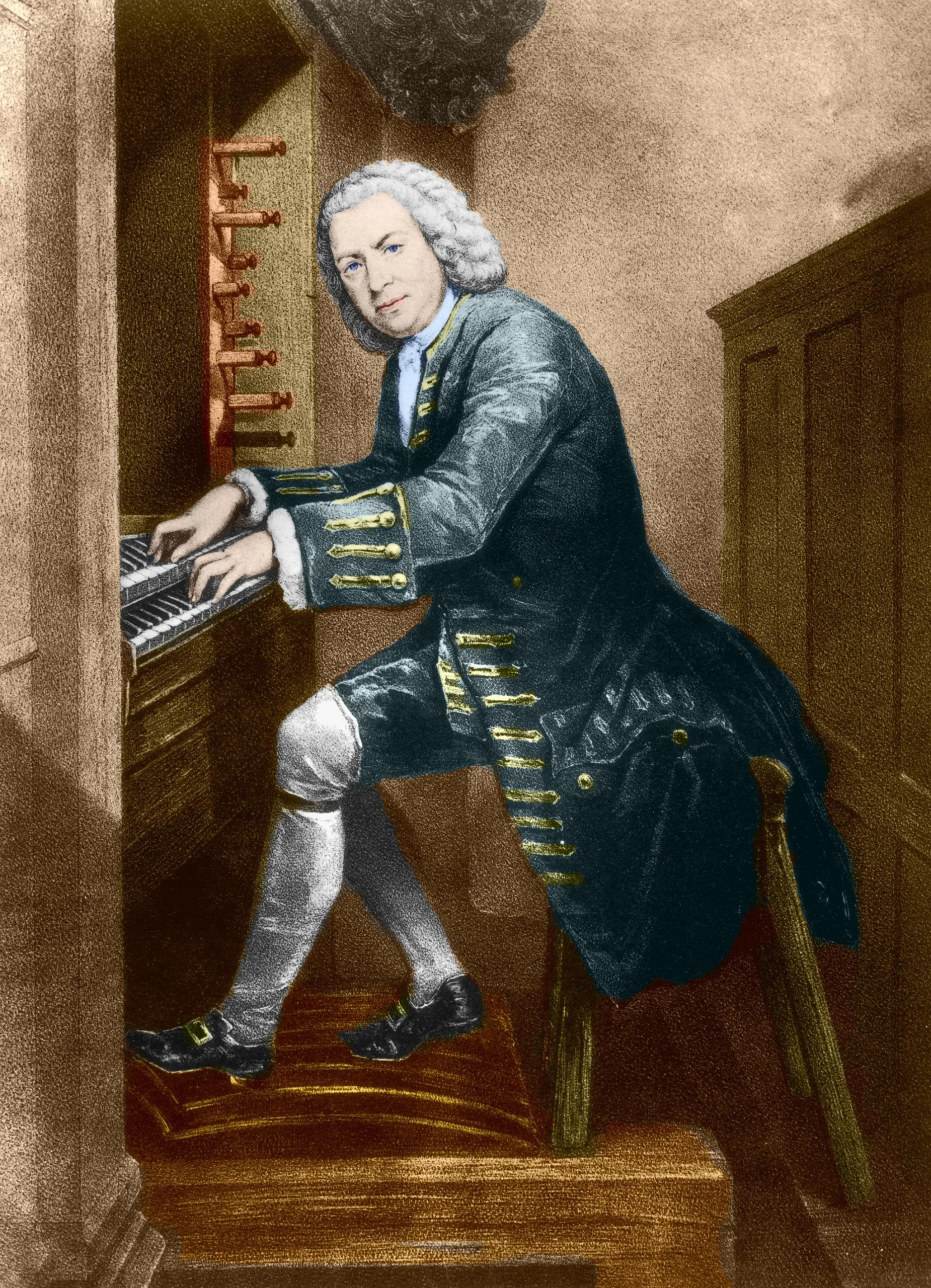
Most of Bach’s instrumental masterpieces were written during his time in Köthen between 1717 and 1723, including The Well-Tempered Clavier, the French and English Suites, the Sonatas and Partitas for solo violin, the Cello Suites, several violin concertos, and sonatas for flute, viola da gamba, and violin. The influence of Italian composers, especially Vivaldi, became an essential element in Bach’s style, integrated into a new language forged through the experimentation afforded by his broad creative freedom. That freedom he found in Köthen, along with the perks of working with a proficient orchestra for the first time, made for what his son Carl Philip Emmanuel called “the happiest time he ever knew.”

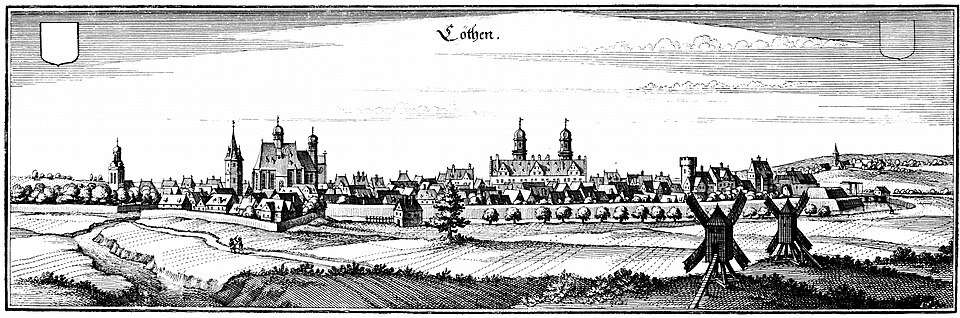
View of the city of Köthen, by Matthäus Merian the Elder

In 1720, however, Bach returned from a two-month spa stay with Prince Leopold to discover that his wife had died suddenly and already been buried. (Some observers have speculated that the profoundly poignant Chaconne from his Partita No. 2 for Solo Violin reflects his grief from this time.) A year later, political and personal circumstances forced Prince Leopold to reduce the size of his top-tier orchestra, signaling to Bach that it was perhaps time to begin looking for new horizons. It was then, in 1721, that he sent a collection of “Six Concerts avec plusieurs instruments” to Christian Ludwig of Brandenburg-Schwedt, a military officer and nobleman he had met a few years earlier in Berlin, who apparently appreciated what Bach called “the small talents Heaven has given me for Music”…

With polite humility, Bach states in the dedication to the margrave Christian Ludwig that he has “arranged” these pieces for “several instruments,” indicating that at least some of the concertos may have existed in preliminary versions. A compilation of six of the most unique compositions of the entire Baroque era, the Brandenburg Concertos are now appreciated as masterpieces of extraordinary originality in terms of structure, orchestration, and form.

Brandenburg Concerto No. 1 for two natural horns, three oboes, bassoon, and violino piccolo

During the first decades of the 18th century, the concerto alla italiana dominated all corners of Europe, both in structure (three movements: fast-slow-fast) and form (alternating solo passages in dialogue with ritornello or tutti sections by the orchestral forces), and Bach adopted several characteristics of that modern Italian style without renouncing the signature contrapuntal substance present in all of his music. Contemporary France, too, was viewed as a model of refinement and taste, which impacted upper-class social conventions in German-speaking countries (the dedication of this collection is written in French, for example), as well as musical choices: Bach began incorporating French dance-like elements, as seen in the elegant Menuet that closes the First Concerto.

Brandenburg Concerto No. 2 for natural trumpet, recorder, oboe, and violin

In the Second Concerto, an instrument from each family gets the opportunity to show off the full range of its technical possibilities in some of the most virtuosic solos ever written for the violin (strings), recorder (woodwinds), oboe (double-reed woodwinds), and trumpet (brass). Each of these solos achieves an extraordinary balance, with a particularly impressive showing from the trumpet — an instrument worlds removed from the one we know today — which relies on an almost superhuman command over an instrument without valves!

Brandenburg Concerto No. 3 for three violins, three violas, and three cellos

Independent parts for each of the nine soloists in perpetual conversation make this Third Concerto a strikingly unique work in terms of orchestration and counterpoint. They are all soloists, and they are all the orchestra. They present eloquent, unceasingly moving lines in formations of 1, 2 or 3 solo episodes, sometimes overlapping one another, before a cryptic second movement, comprising just two single chords, that still inspires debate among musicians: Is the first violin or harpsichord meant to improvise a solo, as was then customary for cadential chords, or is the movement meant to be performed exactly as written, a contemplative breather before the exhilarating moto perpetuo to come?

Brandenburg Concerto No. 4 for violin and two recorders

Framed by the bucolic color of the two recorders, the violin solos in this concerto are among the most demanding in the Baroque repertoire. Bach himself was a more than competent violinist, but these solos defy tradition and go beyond even the Italian style in difficulty. The fugue of the final movement shows Bach at the peak of his powers as a master of this intellectually and aesthetically fascinating form, in which the same theme is taken up by different voices at different times, and later developed independently. The rules of the fugue are strict, and deploying them consistently within the structure of the Italian concerto is a pure stroke of genius.

Brandenburg Concerto No. 5 for flute, violin, and harpsichord

Technically advanced solo pieces are not uncommon in the large harpsichord repertoire, but it is less frequently encountered as a concertante instrument. In the Baroque period, virtually only Bach wrote solo concertos for the harpsichord, and most are later transcriptions of earlier violin or oboe concertos. This “experimental” concerto for harpsichord, flute, and violin — a combination seen especially in France in the trio sonata form — gives the harpsichord a particularly prominent role. The Fifth Concerto may have been inspired by Vivaldi’s Concerto for Violin “Il Grosso Mogul”, which the composer knew and transcribed for solo organ well before his Köthen years. Both pieces have improvisatory cadenzas near the end of their first movement, and both feature scales, arpeggios, high notes, polyphony, and even more spectacular techniques for the solo violin (Vivaldi) or solo harpsichord (Bach).

 Vivaldi’s Concerto for Violin “Il Grosso Mogul”

Brandenburg Concerto No. 6 for two violas, two viole da gamba, cello, violone, and harpsichord

Can a concerto without an orchestra still be called a concerto? The genre’s boundaries blur in this incredibly atypical example featuring five soloists in the absence of a “proper” orchestra of violins, violas and cellos. The Sixth Brandenburg Concerto forges a completely new path, seeming to pit two branches of the string family against each other in a battle for the future of music. For Bach, the winner is quite clear. The two violas da gamba — associated with “old money” nobility — play a fairly significant role in the first movement as they dialogue with the violas, unburdened by the viols’ aristocratic connotations and, here, promoted from the accompanying role they have traditionally played. In the second movement, however, the violas da gamba are not even required, and in the third they join the continuo group, withdrawing into the instrumental texture and letting the two other instruments (and the cello) fully shine — a decisive, even convention-setting, musical statement.

The Brandenburg Concertos are, for many listeners, synonymous with the sound of the Baroque era. They stand as one of the most important, unique, and beloved collections in the history of music, and they have long been regarded as a milestone of mankind’s creativity, a glimpse of eternity in this world (and even beyond). Alongside data sets related to life and culture on Earth, NASA included a movement of the Brandenburg Concerto No. 2 on the Voyager Golden Records, launched into the heavens in 1977. So much for “small talents”!

Written by Darío Moreno

Editor at medici.tv

View author's page