Musical Dynasties: Five Families, Five Ways Out

From the Bachs to the Scarlattis, five musical dynasties reveal how inheritance can be embraced, defied, transformed, or exhausted — and how genius negotiates the weight of a name.

View author's page

By Maria Matalaev

Reading time estimated : 15 min

Inheritance is never optional. A name, a trade, a model, an expectation, a habit picked up at the dinner table, a color of eyes – these arrive whether we ask for them or not.

The children of famous musicians know this well. The world recognizes their names and demands an accounting. It feels entitled to comment on relationships it knows nothing about. I know a pianist, the daughter of a celebrated conductor. Strangers regularly approach her after concerts to say: “I can’t believe you’re his daughter, he never mentioned you!” She replies: “He never mentioned you either.”

In classical music, the question of inheritance takes on a dramatic form. Certain families have produced major composers across two, three, even four generations. What gets passed down is an environment saturated with music, a merciless training, an address book, a duty to honor, and sometimes, a genuine gift.

Five families. Five ways of reckoning with inheritance.
The Bachs: Same Name, Different Fates

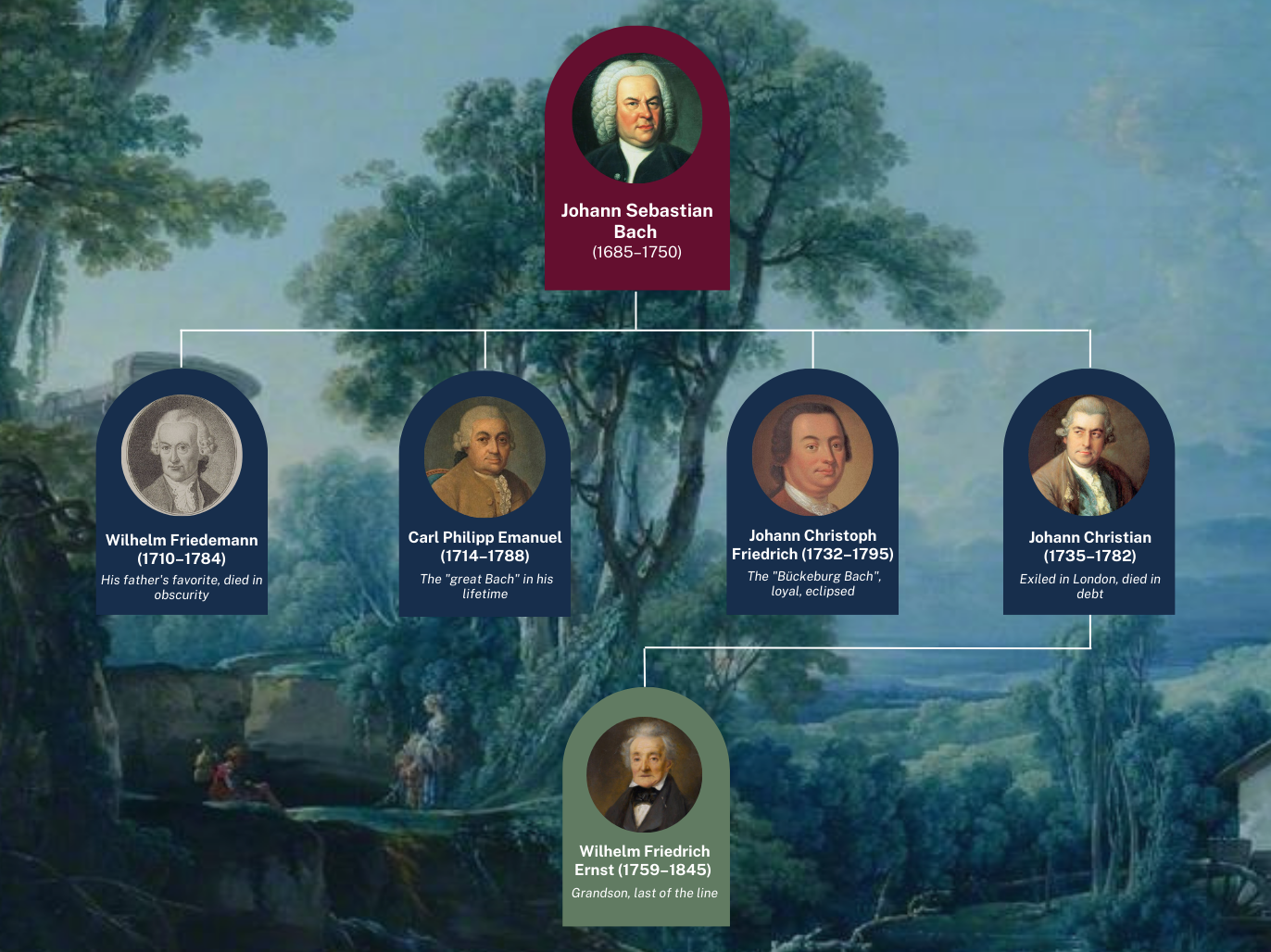
Bach's family tree

Johann Sebastian Bach had twenty children. Of these, ten survived to adulthood; we cannot tell all their stories here. Three daughters were trained musicians who never married and died in poverty — the youngest so destitute that Beethoven raised money for her. Four sons became composers and the drama unfolds in the contrasts among them.

J. S. Bach, Chromatic Fantasia and Fugue in D minor, BWV 903 — Vertigo in counterpoint.

Wilhelm Friedemann, the eldest son and his father’s favorite, was considered by Johann Sebastian the most gifted of the four yet he never managed to convert that gift into a stable career. Unable to hold a position, he drifted from Dresden to Halle to Berlin, selling off parts of his father’s manuscript collection to survive and sometimes signing his own name on them. He left barely a hundred works. He died in 1784, destitute and forgotten. His only obituary called him “the greatest organist in Germany.” No one mentioned the composing.

W. F. Bach, Fantasia in A Minor, F. 23— Clever and imaginative.

Carl Philipp Emanuel, the second son, chose differently. He became the master of Empfindsamkeit, the “sensitive” style: expressive, nervous, nearly pre-Romantic. Sudden ruptures, dramatic silences, emotional outbursts in the middle of a phrase; the rebellion against paternal order can be heard in his music. Haydn revered him, Mozart studied him, and for decades, it was he, not his father, whom Europe considered the great Bach.

C. P. E. Bach, Sonata in C minor, H. 121: I. Allegro assai ma pomposo — The tempo marking says it all: very fast, but majestic.

Johann Christoph Friedrich, the “Bückeburg Bach,” took another path: loyalty. He joined the court of Count Schaumburg-Lippe at nineteen and never left, serving forty-five years as music director. He collaborated with Herder on oratorios, raised a family and composed steadily. Then, near the end of his life, a younger composer seduced the regent and took control of the orchestra. After four decades of faithful service, Johann Christoph Friedrich found himself pushed aside. He died shortly after, in 1795.

Johann Christian, the youngest, exiled himself to Milan and then London, adopted a light, theatrical style that charmed the continent, then watched his popularity decline before dying in debt in 1782.

A beautiful fact is that Johann Sebastian had written for them. The Inventions and The Well-Tempered Clavier were not born for the stage: they were first pedagogical works, written to train his sons, note by note, in absolute rigor. 

The line continued one more generation. Wilhelm Friedrich Ernst, son of Johann Christoph Friedrich and grandson of Johann Sebastian, was trained by two of his uncles: Carl Philipp Emanuel in Hamburg, Johann Christian in London. He became Kapellmeister (music director) in Berlin, served the Prussian royal family, and lived long enough to attend the unveiling of his grandfather’s monument in Leipzig in 1843, where he met Schumann. His only son died in infancy. With him, the musical dynasty ended. He is reported to have said: “Heredity can tend to run out of ideas.”

The Strausses: Disobedience as Founding Act

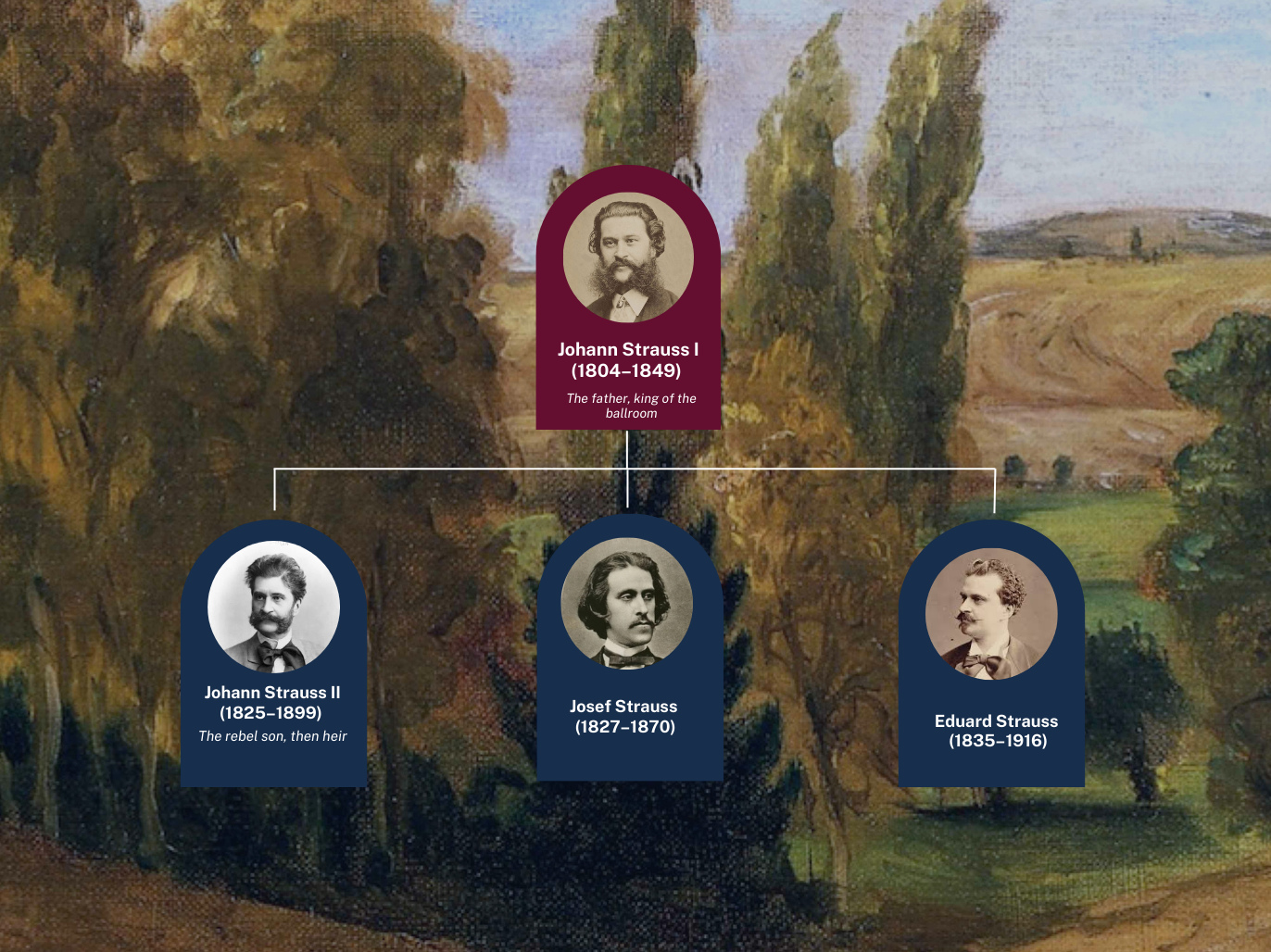
Strauss Family tree

Johann Strauss the elder invented the modern Viennese waltz and reigned over the balls of the imperial capital. He expressly forbade his sons from becoming musicians: Johann was meant for banking, Josef for a military career, and Eduard for the diplomatic corps. He claimed to be protecting them from an unstable profession. He may also have been protecting himself.

Johann Strauss I, Radetzky March — The father’s anthem, bright and foursquare. Beat time.

Johann the younger learned the violin in secret, with quiet support from his mother. Ironically, his teacher was Franz Amon, the first violinist in his father’s own orchestra. At nineteen, he formed his own ensemble andis father was furious: he banned his musicians from playing his son’s works, and tried to block his access to Viennese venues. It made no difference. Johann II’s debut was a triumph, the critics were ecstatic, and the Viennese press took gleeful pleasure in stoking the rivalry. Father and son eventually reconciled. When the elder Strauss died in 1849, Johann II merged the two orchestras, inherited the unofficial title of Waltz King, and built a glory that would far surpass his father’s.

Johann Strauss II, The Blue Danube — The same energy, with air inside it. Breathe with the phrases.

Josef and Eduard, the two other sons, joined the enterprise their brother had built. Josef, an engineer by training, was pushed into music by their mother; Johann himself considered him the more gifted of the two. He collapsed on the conductor’s podium in 1870 and died shortly after, at forty-three. Eduard conducted the orchestra for decades, keeping the family business alive.

Josef Strauss, Sphärenklänge Waltz, Op. 235 (Music of the Spheres)— Melancholic, refined.

The Mozarts: The Prodigy and His Phantom Sister

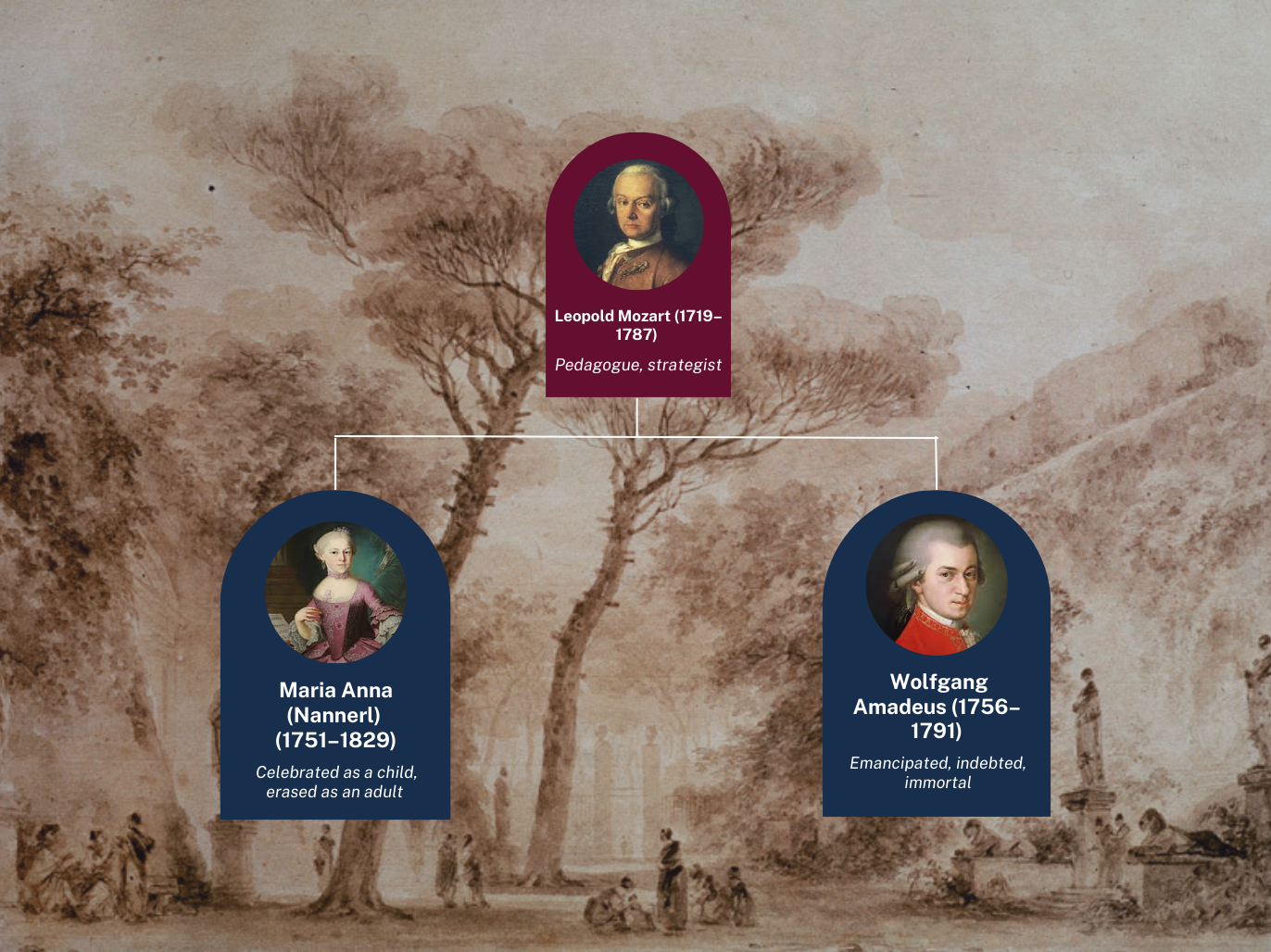
Mozart family tree

Leopold Mozart was a respectable violinist and a brilliant pedagogue. His Treatise on the Fundamental Principles of Violin Playing (1756) was authoritative across Europe: it is a manual of obsessive precision, and a portrait of Leopold the man. Methodical, demanding, and convinced that talent is made as much as it is given. Yet his true masterpiece, in his own eyes, was his children.

Maria Anna, known as Nannerl, was the elder. As a child, she toured with her brother and father through the courts of Europe; she dazzled at the harpsichord and received lavish praise. Then she reached adulthood, and Leopold withdrew her from the circuit. As a woman, no career was possible. She married a widower with five children, had three of her own — none became musicians — and outlived her brother by nearly four decades. Her gravestone in Salzburg identifies her as “Marianne Baroness von Berchtold zu Sonnenburg, sister of W. A. Mozart.” Even in death, she remained the opening act.

Wolfgang Amadeus became the genius we know. He emancipated himself violently: he left Salzburg against his father’s wishes, married without his consent and lived in Vienna in feverish freedom. He knew what he was. “A man of mediocre talent will remain a mediocrity, whether he travels or not,” he wrote to his father, “but one of superior talent—which without impiety I cannot deny that I possess—will go to seed if he always remains in the same place.” He died at thirty-five, in debt. Leopold, who had died four years earlier, never saw the end.

Wolfgang Amadeus, String Quartet No. 19 “Dissonance,” K. 465 — The first eight bars. Let yourself be unsettled.

What Leopold transmitted was perfect technique: how to balance voices so none overwhelms the others, how to close a phrase cleanly, how to recognize every style circulating in Europe and reproduce it flawlessly. Wolfgang absorbed all of it and went where his father could never have followed. The harmonic audacity of the Dissonance Quartet, the psychological depth of the operas, the abyss of the Requiem… territories Leopold had never envisioned. The dynasty ended there. Wolfgang’s two surviving sons never married. The name died with them.

Wolfgang Amadeus Mozart, Requiem, K. 626 — Any passage. Stay until the end.

Further reading: Robert Spaethling, Mozart’s Letters, Mozart’s Life (Norton, 2000) — Not a listen, but a read. The letters are extraordinary: frank, funny, rude, and startlingly modern.

The Couperins: a Trade

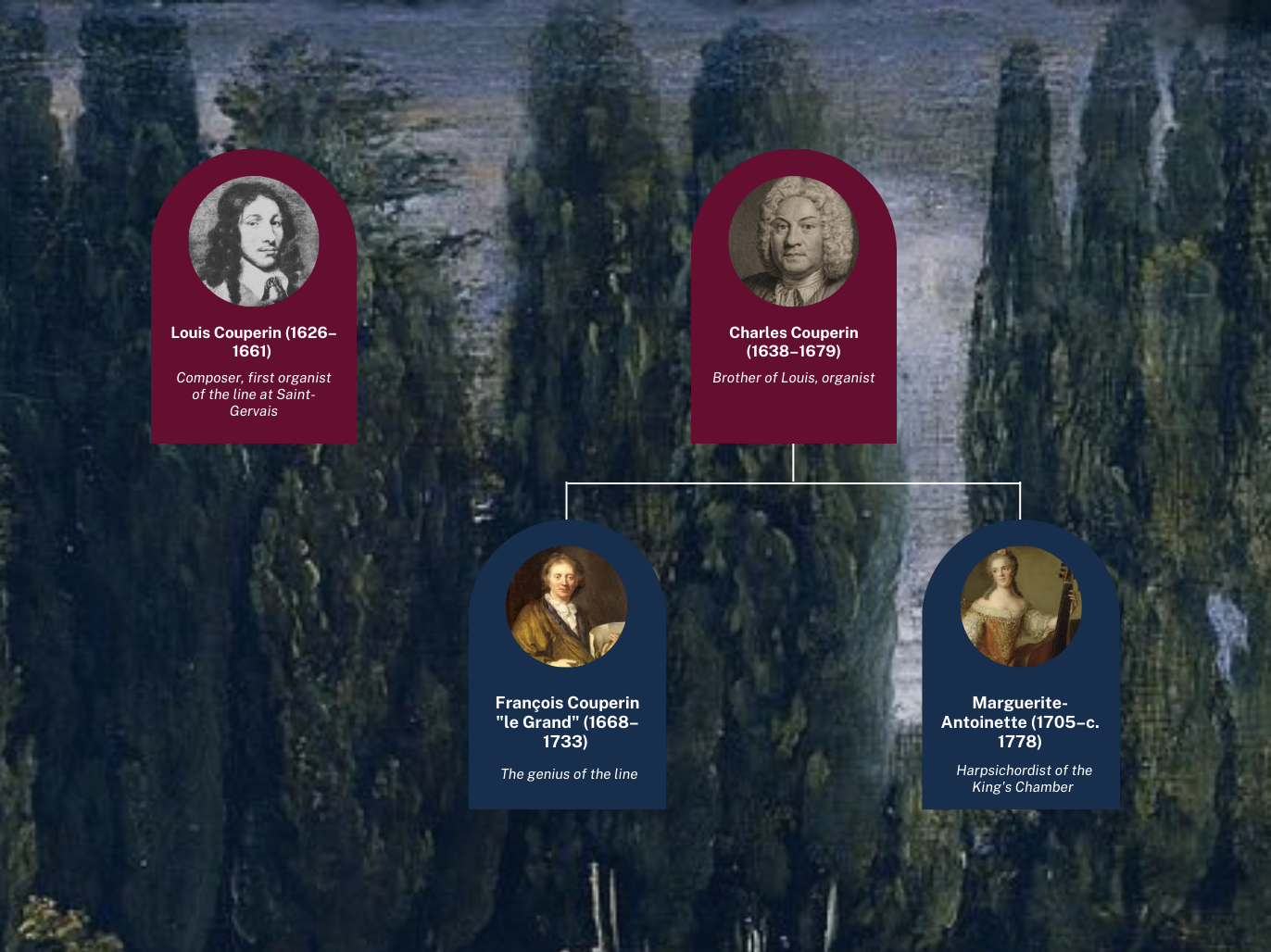
Couperin family tree

The Couperins are the anti-saga. For over a century and a half, the family held the organ loft at the church of Saint-Gervais in Paris and occupied positions at court. One was trained, one took over, one passed it on. No rupture, no cursed son, no flight abroad.

François Couperin, called “le Grand” (1668–1733), is the undisputed genius of the line. His Ordres for harpsichord and his Leçons de ténèbres rank among the summits of French Baroque. Yet he worked within a framework: he inherited the position from his uncle and transmitted it to his daughter Marguerite-Antoinette, who became harpsichordist of the King’s Chamber in her own right.

François Couperin, Third Leçon de ténèbres — A bare voice in the night. Dim the lights.

Louis Couperin, Prélude non mesuré No. 9 (Suite in C major) – No bar lines, no fixed rhythm: the player decides when to move. The frame before the frame.

This may be the sanest trajectory: accepting the inheritance, refining it, passing it on. No need to kill the father when the father has already made room.

One can hear it. Louis Couperin, the first of the line at Saint-Gervais, had already established the style brisé: the unmeasured preludes (written without bar lines, leaving the performer to shape the rhythm), the subtle ornaments. François refined what he received without breaking it. He pushed the poetry further, reaching new heights of intimacy in Les Barricades mystérieuses, but he did not blow up the frame.

François Couperin, Les Barricades mystérieuses — No one knows what the title means. Some barricades hold.

The dynasty outlasted François le Grand. When his health failed, he passed the organ loft at Saint-Gervais to his cousin Nicolas; Nicolas passed it to his son Armand-Louis, a respected composer in his own right. The Couperins held Saint-Gervais for 173 years. Then came the Revolution of 1789, and Paris became a city in upheaval. Armand-Louis was killed in a traffic accident, struck by a carriage while rushing to play a service his son had already started for him. Pierre-Louis, the son, died later that same year, undone by the shock. The dynasty ended the year the old world did.

The Scarlattis: Freedom Through Exile

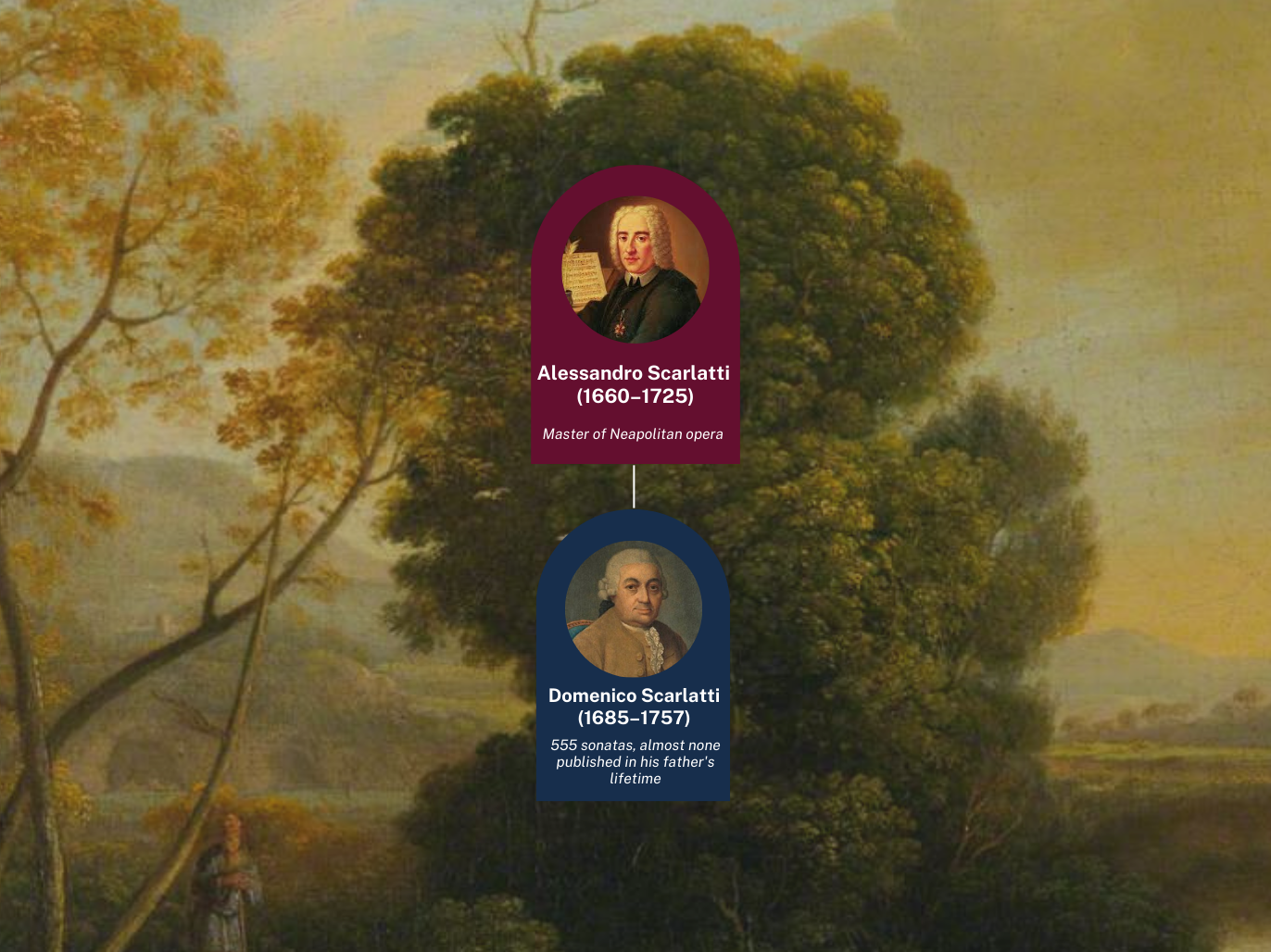
Scarlatti family tree

Alessandro Scarlatti dominated Neapolitan opera at the end of the seventeenth century. His son Domenico grew up in that immense shadow, studied under his direction, and composed in his wake.

Alessandro Scarlatti, Infirmata vulnerata — A motet on unrequited love, dated 1702.

Then he left. First to Portugal, then to Spain, in the service of Princess Maria Barbara. Far from Naples, far from his father, Domenico finally found his voice: his 555 keyboard sonatas are a world apart. Virtuosic, percussive, full of hand crossings and rhythms borrowed from the Spanish guitar and popular dances. He published almost nothing during Alessandro’s lifetime. Almost no correspondence between the two survives. That silence may say everything there is to say.

Domenico Scarlatti, Sonata K. 87 — Tenderness, but a tenderness that belongs only to him.

Their differences are audible. Alessandro wrote for the voice: long melodic lines, the da capo aria, phrases that breathe and arc and land gracefully. He dominated Italian opera for forty years. Domenico wrote for the keyboard, and what he did with it was new: rapid repeated chords like strummed guitars, hand-crossings that astonished audiences, dissonances that wouldn’t be heard again until Schubert. Listen to Sonata K. 141 — the hammered chords sound almost like flamenco. Nothing of Naples remains. Spain has replaced Italy, the harpsichord has replaced the voice, and the son has become someone his father wouldn’t recognize.

Domenico Scarlatti, Sonata K. 141 — Turn up the volume. It is physical.

Five ways out

What connects these five stories is not the music. It is filiation: the weight of a name, the expectations of a father, the choice between continuity and rupture.

The options are limited. One can join the lineage with gratitude: that is François Couperin. One can conquer one’s place through disobedience, then amplify the inheritance: that is Johann Strauss the younger. One can take the father’s tools and build a world he could never have imagined: that is Mozart. One can flee and publish nothing while the father is alive: that is Domenico Scarlatti. One can also simply fail: that is Wilhelm Friedemann Bach.

There are other paths, of course. Some dynasties end by refusal — Yul Brynner and Bette Davis famously cut ties with their children. But musicians seem drawn to transmission. Some descendants reinvent the inheritance so radically it becomes unrecognizable: Gabriel Prokofiev, Sergei’s grandson, is a DJ and electronic producer who wrote a Concerto for Turntables and Orchestra

Talent sometimes emerges in these environments saturated with music and expectation. No one ever really knows what goes on inside a family, and we should be careful not to interpret too much. But these families left clues in their letters, memoirs, and above all, in the music itself. The temptation is too strong. Let’s listen and play investigator.

Written by Maria Matalaev

Writer

Macha Matalaev was born in Paris into a distinguished family of Russian musicians: her grandfathers were Valentin Berlinsky, founder and cellist of the legendary Borodin Quartet for 64 years, and renowned conductor Lev Matalaev. Her father, Anton Matalaev, founded the Anton Quartet, and her mother is pianist Ludmila Berlinskaïa.

She began her career as a pianist, studying at the CRR de Paris and the École Normale de Musique A. Cortot. After completing a degree in Applied Modern Literature at the Sorbonne, she worked in art history before returning to music as a producer, later earning a…

View author's page