
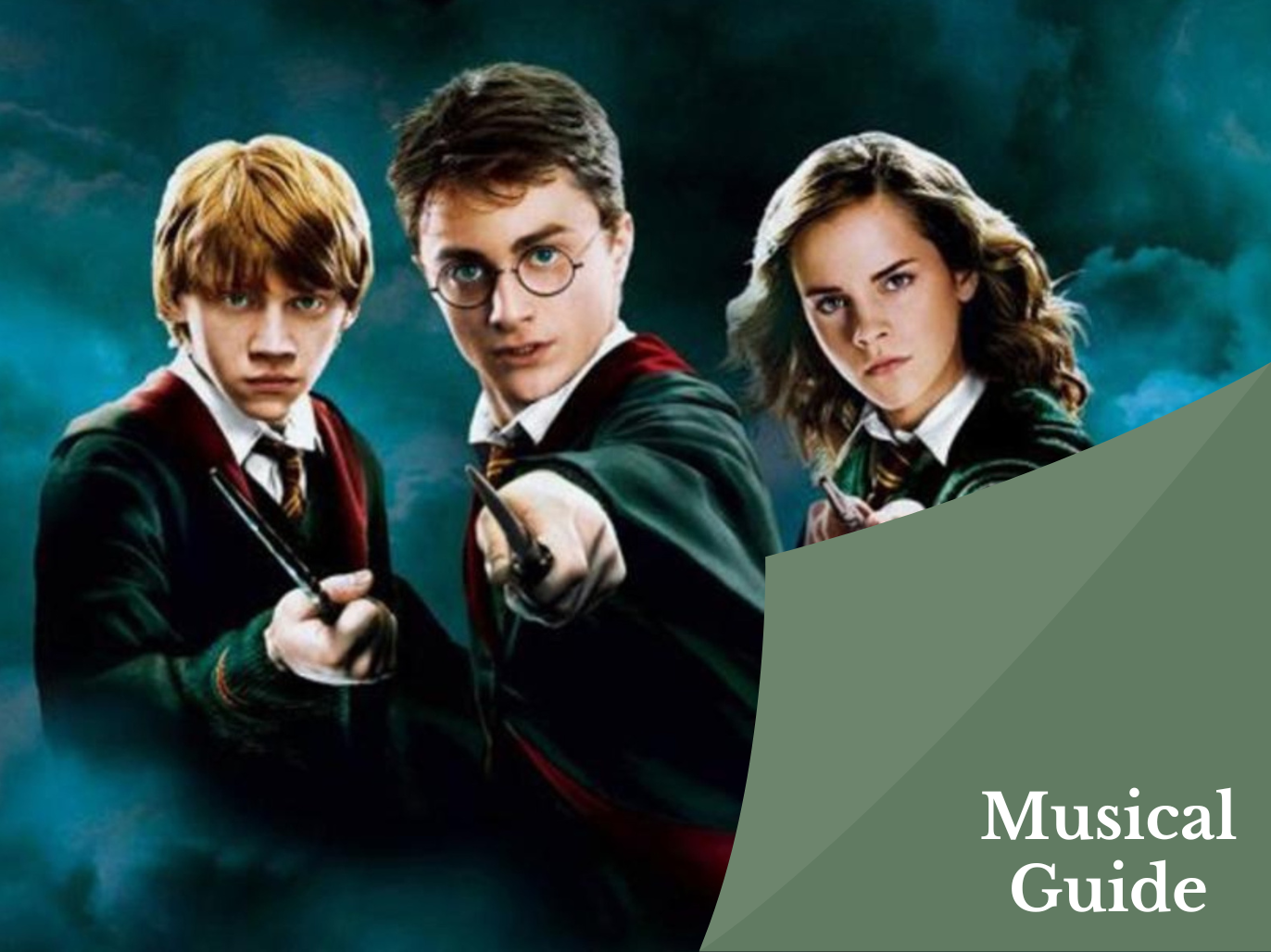
From Holst to Hogwarts: Music of the Harry Potter Film Series

For twenty-five years the blockbuster Harry Potter film series has cast its spell over audiences worldwide. Hogwarts headmaster Albus Dumbledore called music “A magic beyond all we do here!” To celebrate this movie magic, we’ve paired some of the films’ most iconic musical moments with similar works from the classical repertoire.

View author's page

By Andrew McIntyre

Reading time estimated : 23 min

Since the publication of J. K. Rowling’s Harry Potter and the Philosopher’s Stone in 1997, the Wizarding World has taken the Muggle one by storm. The saga of an orphaned boy discovering his magical destiny has spawned everything from films, video games, and hundreds of thousands of pieces of fan fiction to theme parks. 

Most celebrated of all these is the Harry Potter film series. These eight films grossed nearly $8 billion and defined the Hollywood blockbuster for a generation. Crucial to their success is the nearly fourteen hours of music that appear in the films. From the mysterious “Hedwig’s Theme” to the madcap meanderings of the Knight Bus, we’ve paired some of our favorite musical moments with works by famed classical composers.

Four composers—John Williams, Patrick Doyle, Nicholas Hooper, and Alexandre Desplat—used musical magic to bring Harry’s wondrous world to life. While each of these composers brings their own style to the films, all make use of a nearly 200-year-old thematic technique called leitmotif.

What is a Leitmotif?

A leitmotif is a recurring musical theme associated with a particular person, object, place, or idea. Nineteenth-century opera composer Richard Wagner is most associated with this technique, particularly in his massive tetralogy Der Ring des Nibelungen. The Harry Potter films contain nearly eighty distinct leitmotifs.

Skilled composers don’t simply repeat a leitmotif, they create variations of these themes that alter their moods and therefore their meanings. A composer may devise any number of different treatments of the same melody: they can fragment the theme, change its tempo or rhythm (a slower version may seem sad, relaxed, or noble depending on the context), or alter its harmonies (a dark, minor-key harmonization may become triumphant in a major key), among other things. “Hedwig’s Theme,” for example, appears in various guises: while celesta imbues the theme with a sense of mystery, it takes on a noble character when played on horns.


Hedwig’s Theme, from Harry Potter and the Philosopher’s Stone


The first movie in the series, Harry Potter and the Philosopher’s Stone, opens with “Hedwig’s Theme.” The melody’s most recognizable incarnation is as a unique, celeste-like sound. Dotted rhythms and a chromatically-inflected melody make the tune immediately recognizable. Since its initial appearance, “Hedwig’s Theme” has become the primary musical motif for Harry Potter, appearing in all eight films; it even makes a diegetic appearance in the first film when Hagrid plays it on his flute.

Pyotr Ilyich Tchaikovsky: “Dance of the Sugar Plum Fairy” from The Nutcracker

“I have discovered a new instrument in Paris,” wrote Tchaikovsky to his publisher, “something between a piano and a glockenspiel, with a divinely beautiful tone. I expect the instrument will make a tremendous sensation.” Indeed it did. Tchaikovsky brought the celesta to the world’s attention in The Nutcracker, his final ballet. The celesta’s twinkling tones accompany the Sugar-Plum Fairy in her famous pas de deux. Thanks largely to Tchaikovsky, the celesta took on associations with the fantastical that persist to this day.

Gustav Holst: “Neptune, the Mystic” from The Planets

Holst composed his magnum opus, the symphonic suite The Planets, during the First World War. Its opening movement, the militaristic “Mars, the Bringer of War,” remains the most well-known of the suite (it famously inspired John Williams’s score for Star Wars, particularly the Imperial March). The final movement, “Neptune, the Mystic,” is equally compelling. As in Williams’s score, celesta, harp, and wordless chorus convey a sense of mysticism and wonder.

Béla Bartók: Music for Strings, Percussion and Celesta, mvt. III

Hungarian composer Béla Bartók also used the celesta’s ethereal timbre to great effect in his inter-war work Music for Strings, Percussion and Celesta. He wrote the slow third movement in a style termed “night music.” Celesta and hushed, trembling strings evoke nocturnal mystery while rising and falling arpeggios echo our first introduction to Dumbledore.

Aunt Marge’s Waltz, from Harry Potter and the Prisoner of Azkaban

When young wizards and witches lose their tempers, their magic can erupt in unexpected ways. Harry’s horrible “aunt” Marge learned this the hard way: after she insults Harry’s parents, he inadvertently blows her up like a balloon. As she bounces around and eventually floats away, the playfully pompous “Aunt Marge’s Waltz” dances in the background. The elegance and formality associated with the waltz provide a hilarious foil to Marge’s predicament.

Johann Strauss II, By the Beautiful Blue Danube

For decades, the Vienna Philharmonic has performed a celebrated New Year’s Eve concert highlighting the music of the Strauss family. “Waltz King” Johann Strauss II’s 10 Things to Know About The Blue Danube remains a perennial favorite. This most famous of waltzes has appeared in hundreds of films and TV shows, most famously in Stanley Kubrick’s science fiction classic 2001: A Space Odyssey.

Richard Strauss: Oboe Concerto in D Major, AV 144, TrV 292

Richard Strauss (no relation to Johann) waited until his twilight years to compose his sole oboe concerto. It came into existence by a curious twist of fate: in the final weeks of the Second World War, American oboist (and future director of the Curtis Institute of Music) John de Lancie was deployed in the town where Strauss lived. He asked Strauss if he’d ever considered writing an oboe concerto. Though Strauss replied, “No,” by the end of the year he had completed this one. Like “Aunt Marge’s Waltz,” it features jaunty oboe solos and inventive orchestration.

Gioachino Rossini: Overture to La gazza ladra

Legendary bel canto composer Gioachino Rossini completed nearly forty operas before retiring at the age of thirty-seven. Many of his overtures have become concert staples, including the overture to La gazza ladra (The Thieving Magpie). “Aunt Marge’s Waltz” was greatly influenced by this high-flying, mischievous music. Both are in 3/4 and feature chirping, playful woodwinds alongside darting strings. Williams even borrows a snippet of Rossini’s melody!

The Knight Bus, from Harry Potter and the Prisoner of Azkaban

John Williams spent his youth immersed in jazz. His father was a jazz percussionist and Williams himself played piano in jazz bands. He also released several recordings under the name “Johnny” Williams. Harry’s journey on the violently purple Knight Bus allowed Williams to show off his jazz pedigree. He was unsure how director Alfonso Cuarón would react, but Cuarón loved Williams’s “funny and spooky” approach to the scene. Williams enlists a brass band, rollicking piano, saxophones, and even a trolley clang to give life to Harry’s wild ride.

Bud Powell: “John’s Abbey”

Bud Powell, a contemporary of John Williams before his premature death, pioneered the development of bebop improvisation. A protégé of pianist and composer Thelonius Monk, he played with legendary saxophonist Charlie Parker, among others. He released his rollicking, rhythmically complex “John’s Abbey” in the late 1950s.

Nikolai Kapustin: Toccatina from Eight Concert Études, Op. 40

Like Williams, Soviet-Ukrainian composer and pianist Nikolai Kapustin was influenced by jazz from an early age. Much of his output belongs to the “third stream,” the fusion of jazz and classical. He composed this dazzling Toccatina in 1984, the same year Williams completed his Oscar-nominated scores for Indiana Jones and the Temple of Doom and The River. Kapustin’s jazzy harmonies and swinging rhythms meld with the Baroque genre of the toccata.

Secrets of the Castle, aka “Bluebird,” from Harry Potter and the Prisoner of Azkaban

Woodwinds are an obvious choice for representing birds and mimicking birdsong. These instrument families share similar timbres and ranges with their avian counterparts, as well as the ability to play florid, virtuosic melodies. In Prisoner of Azkaban, a solo flute accompanies a bird as it soars around the Hogwarts grounds. Flute players know this infamously difficult cue as “Bluebird.”

Camille Saint-Saëns: “Aviary” from Carnival of the Animals

Saint-Saëns’s Carnival of the Animals is one of his most popular works, delighting children and adults alike. It also delighted its creator, who confessed that writing it kept him from completing other pieces. Yet Saint-Saëns insisted that the suite remain unpublished in his lifetime lest it detract from his reputation as a serious artist. 

This musical menagerie depicts a variety of animals from lions and elephants to kangaroos and birds (Saint-Saëns even pokes fun at pianists, giving them their own movement). Audiences may be most familiar with “The Swan,” a graceful theme for cello, though birds populate two additional movements. In “Aviary,” a flute trills a virtuosic solo spanning much of its range.

Olivier Messiaen: “Abîme des oiseaux” (“Abyss of the birds”) from Quatuor pour la fin du Temps

Messiaen composed and premiered his Quatuor pour la fin du Temps under dire circumstances. He spent part of the Second World War held in a German prisoner of war camp; here he wrote this quartet for the instruments he had available. These included a clarinet, which plays unaccompanied in the third movement. Messiaen said of this movement: “The abyss is Time with its sadness, its weariness. The birds are the opposite to Time; they are our desire for light, for stars, for rainbows, and for jubilant songs.”

W. A. Mozart: Flute Concerto in D Major, K. 314

Mozart originally penned this concerto for oboe but re-wrote it on commission from a wealthy Dutch physician. Since then, Mozart’s playful, virtuosic concertos have become a core part of the repertoire for flutists. Though this work is not programmatic, it takes little effort to imagine birdsong in its high-flying melodies. This is especially true in the florid, unaccompanied cadenza that concludes the first movement.

Buckbeak’s Flight, from Harry Potter and the Prisoner of Azkaban

Throughout the series, flight acts as both a pivotal plot device and a powerful metaphor for freedom. Whether playing Quidditch or fleeing Voldemort, Harry appears on a broomstick in nearly every film. In Chamber of Secrets, the Weasleys break Harry out of the Dursleys with the help of their father’s enchanted flying Ford Anglia; Ron and Harry later drive the car to Hogwarts. Prisoner of Azkaban introduces Buckbeak the hippogriff, whom Harry rides across the castle grounds. No stranger to scoring music for flight (E.T. the Extra-Terrestrial, anyone?), Williams provides a soaring backdrop for this powerful scene.

Jean Sibelius: Symphony No. 5 in E-flat Major, Op. 82, mvt. III

No orchestral work captures the wonder of flight like Sibelius’s profound Symphony No. 5. Beginning with a flurry of strings and woodwinds, the third movement introduces one of Sibelius’s most famous melodies: a simple gesture of ascending and descending notes in the horn section. Much like in “Buckbeak’s Flight,” this three-note rising and falling figure calls to mind the slow, powerful beating of wings. The majestic theme, which Sibelius called his “swan hymn,” came to him as he watched a flock of swans fly over his home. “One of my greatest experiences!” he wrote. “Lord God, how beautiful!”

Harry in Winter, from Harry Potter and the Goblet of Fire

Following John Williams’s work on the first three films, Scottish composer Patrick Doyle took up his mantle for Harry Potter and the Goblet of Fire. Doyle turned to the Romantic era for inspiration. “You can’t avoid these great stalwarts of the nineteenth century,” he says. “These people invented the musical wheel, as it were.” 

While the film revolves around the Triwizard Tournament and Voldemort’s return, it also finds the trio confronting their first pangs of jealousy and burgeoning romances. The cue “Harry in Winter” appears when Harry unsuccessfully asks Cho Chang, his crush, to go to the Yule Ball with him. Doyle uses graceful, sweeping string melodies to evoke youthful yearning. 

Pyotr Ilyich Tchaikovsky: Waltz from Act I of Swan Lake

Patrick Doyle was “heavily influenced” by the music of Tchaikovsky. Tchaikovsky’s first ballet, Swan Lake, begins with Prince Siegfried celebrating his birthday with friends. Much as Professor McGonagall tasks Harry with choosing a date for the Yule Ball, Siegfried’s mother demands that he must select a bride at the royal ball. The arcing melodies of Tchaikovsky’s waltz evoke a similar youthful innocence.

Hector Berlioz: Roméo et Juliette

“I have always said Berlioz was the very first film composer,” Patrick Doyle states. Following in the footsteps of Beethoven’s programmatic Symphony No. 6, Berlioz created his own highly expressive, pictorial symphonies. He created the forerunner of the leitmotif employed by so many film composers, what he called idée fixe.

With Roméo et Juliette, Berlioz created a new genre. Neither opera nor oratorio, it combines orchestra and chorus in a thrilling hybrid. Wagner, who pioneered the use of leitmotif in his operas, attended the symphony’s premiere. Again we find a young protagonist preparing for a ball. In this scene, an oboe represents Romeo’s solitary ruminations. Much like “Harry in Winter,” beneath its long melodies runs a restless undercurrent of longing.

Fireworks, from Harry Potter and the Order of the Phoenix

In addition to his illustrious career as a composer of film music, Nicholas Hooper has spent many years playing guitar in various folk music groups. His enthusiasm for folk dance permeates the jubilant “Fireworks.” This rowdy music accompanies Fred and George Weasley’s firework-forward mayhem and their flight from Hogwarts. “Fireworks” bounds along in the spirit of Celtic fiddle music.

Aaron Copland: “Hoe-Down” from Rodeo

“Dean of American Music” Aaron Copland often incorporated folk music into his compositions; his 1942 ballet Rodeo was no exception. Early reviews noted the “film sensibility” of Agnes de Mille’s choreography. One of the first truly American ballets, Rodeo remains one of Copland’s most enduring works. Its boisterous finale, “Hoe-Down,” suggests Weasley-esque rowdiness.

Richard Strauss: Till Eulenspiegel’s Merry Pranks

Strauss’s lush, late-Romantic orchestration influenced generations of film composers. Both Hooper and Strauss use lively rhythms and raucous fortissimo outbursts to convey their heroes’ joie de vivre. Like “Fireworks,” Strauss’s Till Eulenspiegel’s Merry Pranks cheerfully celebrates mischief managed. The tone poem depicts the adventures of German folk hero Till Eulenspiegel. These include flirting with young women and making fun of stuffy academics; Fred and George would be proud.

George Frideric Handel, Music for the Royal Fireworks

King George II of England commissioned this victorious music to commemorate the signing of the Treaty of Aix-la-Chapelle. Much to Handel’s annoyance, the king insisted on “no fiddles” (Handel later reorchestrated the suite to include strings). The Music for the Royal Fireworks premiered as part of a massive spectacle held in London’s Green Park. The titular fireworks caught a pavilion on fire and injured several unlucky attendees. 

Handel’s ensemble sounds radically different from “Fireworks,” which features an electric guitar. Still, both Handel’s brass fanfares and Hooper’s spritely strings capture a shared sense of joyful triumph.

“Ah, music,” said Albus Dumbledore, wiping his eyes. “A magic beyond all we do here!” – Harry Potter and the Philosopher’s Stone

Dumbledore’s Farewell, from Harry Potter and the Half-Blood Prince

String orchestra and wordless chorus accompany Hogwarts’ reaction to the murder of Dumbledore, one of the most heartbreaking moments in the films. Hooper crossed descending and ascending melodic lines to “give a sense of growth,” allowing the character’s grief to transform into catharsis. As the music swells, Professor McGonagall leads the school in casting an illumination spell to drive away Voldemort’s Dark Mark. To this day, audiences at Harry Potter film concerts activate their phone flashlights to honor this solemn moment.

Samuel Barber: Adagio for Strings

Barber’s Adagio for Strings holds a long association with public mourning. The piece has been broadcast and performed in the wake of numerous tragedies including Albert Einstein’s death and the assassination of American president John F. Kennedy. Barber’s Renaissance-like polyphony, simple harmonies, and chant-like melodies create a sense of timeless grief.

Edward Elgar: Cello Concerto in E Minor, Op. 85

Composed in the aftermath of the First World War, Elgar’s Cello Concerto has been called “a lament for a lost world.” As in “Dumbledore’s Farewell,” mournful strings provide a backdrop for an emotive solo cello. Despite its poor initial reception, it has become a cornerstone of the cellist’s concerto repertoire. British cellist Jacqueline du Pré’s electrifying performances of the concerto in the 1960s helped cement the work’s popularity.

Farewell to Dobby, from Harry Potter and the Deathly Hallows: Part 1

French composer Alexandre Desplat wrote the scores for the final two Harry Potter films. Hearing John Williams’s score for Star Wars as a teenager inspired Desplat to pursue a career in film music. “Farewell to Dobby” captures the nobility of the house-elf’s sacrifice. Its slow tempo and gentle melodic contour convey both mourning and repose. 

Maurice Ravel: “Pavane de la Belle au bois dormant” from Ma mère l’Oye

Desplat cites the symphonic music of Debussy and Ravel as early influences. Both had an enduring love for children’s music and wrote pieces celebrating the world of children’s tales. Ravel composed Ma mère l’Oye for the daughters of family friends and later orchestrated the work. Here, the music of Sleeping Beauty echoes the “Farewell to Dobby” in its woodwind-forward orchestration, fleeting glimpse of impressionistic harmony, and stillness.

Edward Elgar: “Nimrod,” from Enigma Variations

“Nimrod,” the ninth variation from Elgar’s Enigma Variations stands as a profound musical testament to friendship. He composed this slow and stately variation, the most popular of the set, for a close friend. Elgar said that the main theme, which he nicknamed “Enigma,” was related to a popular melody whose identity he took to his grave. Like Barber’s Adagio for Strings, “Nimrod” has become commonplace at large funerals, particularly in England.

Gustav Mahler: Symphony No. 5 in C-sharp Minor, mvt. 4, “Adagietto”

Though Mahler wrote the Adagietto of his Symphony No. 5 as a love letter to his bride-to-be, this yearning music has also become associated with grief. Leonard Bernstein conducted the movement at the funeral of American politician Robert F. Kennedy in 1968 (Jacqueline Kennedy referred to it as “music of all the gods who were crying”). Scored for strings and solo harp, it shares a similarly warm timbre and depth of feeling with “Dobby’s Farewell.

Lily’s Theme, from Harry Potter and the Deathly Hallows: Part 2

The final chapter of Harry’s saga opens with the mournful “Lily’s Theme.” Beginning with a low, minor-key drone, the music blooms with a wordless soprano intoning a soaring melody. Named for Harry’s mother, the theme links Lily to both her son and Professor Snape, who loved her since childhood. 

Gabriel Fauré: Vocalise-étude

Composers have long written wordless pieces called vocalises, often for study purposes. As early twentieth-century composers increasingly focused on timbre, many turned to the voice as a source of tone color. The wordless choruses of Debussy, Ravel, and Holst, among others, influenced later film scores, as did vocalises like this one.

Sergei Rachmaninoff: Vocalise from 14 Romances, Op. 34

Rachmaninoff’s is perhaps the most famous classical vocalise. In works such as this, singers rely on just one vowel throughout the piece: its beauty therefore lies in the performer’s ability to convey tone color and emotion through the melody. The piece has been arranged and orchestrated for a variety of instruments and ensembles, including solo piano.

Henryk Górecki: Symphony No. 3 (Symphony of Sorrowful Songs), Op. 36

Much like “Lily’s Theme,” Górecki’s Symphony of Sorrowful Songs reflects on motherhood, war, and loss. Its lyrics range from a medieval Marian lament to an inscription scrawled in a Gestapo prison. In the final movement, a soprano intones a folk song recounting a mother searching for her murdered son. Górecki cradles her unadorned vocal line in a rocking ostinato.

Written by Andrew McIntyre

Writer and concert producer

Andrew McIntyre is an American writer and concert producer living on the East Coast. He studied musicology at Northwestern University, where he specialized in opera and queer popular music. Since 2013, he has written concert program notes for classical music presenters including the Celebrity Series of Boston, UC Santa Barbara Arts & Lectures, and the Los Angeles Philharmonic.

View author's page