
From Book to Ballet: Adapting the Written Word for the World of Dance

Ballet choreographers and composers have long found inspiration in the pages of great novels, plays, and poems. Explore thrilling stage adaptations and learn how these creators translate our favorite texts into dance.

View author's page

By Andrew McIntyre

Reading time estimated : 9 min

June 17, we will be livestreaming prolific choreographer Carolyn Carlson’s latest work, Un saut dans le bleu. The ballet follows her poetry collection of the same name which blends melancholic, nostalgic imagery with philosophical insights on human existence. With Toulouse’s prestigious Ballet de l’Opéra national du Capitole, Carlson brings her poetic vision to life in this work of abstract lyricism, boundless creativity, and intimate meditation on what it is to be human.

Un saut dans le bleu is the latest in a long tradition of ballets based upon books. For choreographers and composers, the world of literature is a treasure trove of brilliant stories waiting to be given new life on the stage. 

Narrative vs. Abstract

At its core, ballet has always been a vehicle for telling stories through dance. It’s unsurprising that plot-driven dancing has dominated for most of this history: both ballet and ballad, a story set to music, share a root in the Latin ballare (“to dance”). These narrative works reached their zenith in the 19th century. Much of the credit goes to Marius Petipa, one of history’s most renowned balletmasters. During his decades-long tenure at the Mariinsky Theatre in Saint Petersburg he presented dozens of story ballets. Petipa’s spectacular productions ushered in a “golden age” of Russian dance.

In the 20th century, impresario Serge Diaghilev created one of history’s most important dance companies, the Ballets Russes. He commissioned and premiered numerous works that had no plot or narrative at all, including Igor Stravinsky’s Apollo, and Claude Debussy’s Jeux. One of Diaghilev’s protégés, George Balanchine, continued to create both narrative and abstract ballets; Jewels, created in 1967 for the New York City Ballet, was the first full-length abstract ballet. Today narrative ballets have made a comeback, with works based on novels, plays, and poetry taking center stage.

From Book to Ballet

Translating a written work to the wordless world of dance brings both challenges and opportunities. Dialogue and the inner thoughts and feelings of characters, central to most printed stories, cannot directly be communicated in a ballet; the story must be told through music, scenery, costumes, and movement. Unlike books, which are meant to be read, stage works are meant to be seen and heard. This usually requires adapters to omit characters and simplify plots, stripping stories down to their essentials. 

The generic and structural conventions of the stage also dictate what makes it into a final work. For much of ballet’s history it would have been unthinkable to omit a pas de deux or divertissements regardless of how little bearing they had on the plot. Early reviewers of The Nutcracker complained because the prima ballerina doesn’t dance until the grand pas de deux near the end of the final act.

Despite these hurdles choreographers and composers have some advantages. Dancer’s movements and facial expressions convey subtle emotions that language alone cannot capture. The unspoken subtext of a dramatic dialogue can manifest in a well-choreographed pas de deux. Whereas written, spoken, or sung texts often encounter language barriers, dance allows skilled performers to “translate” the words for the audience.

Sergei Prokofiev, Romeo and Juliet


Shakespeare’s plays have been a wellspring of inspiration for countless artists, providing source material for everything from movies and paintings to a performance of Hamlet within the violent video game world of Grand Theft Auto. Beethoven, Berlioz, and Verdi are among the most revered composers to adapt the Bard’s plays in the 19th century. Prokofiev carried that torch into the 20th century with one of his most popular works, Romeo and Juliet. Since its Russian premiere in 1940, this timeless tale of star-crossed love has become the most widely performed ballet based on Shakespeare. 

Prokofiev found the subject matter perfect for a ballet. The central love story provides ample opportunity for lush, romantic music and the expected pas de deux. Because the original play already contained a ball, the creators of Romeo and Juliet seamlessly incorporated lavish costumes and showpieces for the corps de ballet. In the famous “Dance of the Knights” sequence, the Montagues and Capulets dance to harsh, jagged melodies accompanied by heavy martial rhythms. This dark, even unpleasant music illustrates the history of strife between the two houses, foreshadowing future tragedy.

Joby Talbot, Alice’s Adventures in Wonderland

When Alice’s Adventures in Wonderland premiered in 2011, it was the Royal Ballet’s first new full-length score in 20 years. Carroll’s whimsically surreal settings and absurd characters seem tailor made for the stage, but the creators struggled to bring Wonderland to life. “The wordplay is of course the very first thing to go, and that’s a large chunk of the charm of the original Lewis Carroll novel,” said choreographer Christopher Wheeldon. “So we needed a glue to pull all of those episodes together.” Composer Joby Talbot’s inventive, playful score provides just such a glue. Each character gets their own theme: ticking percussion throughout evokes the presence of the White Rabbit’s pocket watch, while the Queen of Hearts’s theme is played on a detuned violin (quite literally a “high-strung” sound!). Here, Alice meets some of Wonderland’s most famous denizens, the grinning Cheshire Cat and the Mad Hatter, the zany host of a tap-dancing tea party.

Léon Minkus, Don Quixote

How does one turn a 1,000-page novel about a deluded Spanish nobleman into a ballet? That question has plagued composers and choreographers for nearly 300 years. The first known danced adaptation of Miguel de Cervantes’ epic Don Quixote appeared in 1740, but it has long since been upstaged by Léon Minkus and Marius Petipa’s elaborate retelling. Their version omits many of the novel’s episodes and more philosophical themes, focusing instead upon the romantic woes of two young lovers. In this telling the title character often sits to the side, an observer of the danced setpieces around him.

For all their changes, Petipa and Minkus did retain the novel’s most famous scene: Don Quixote, accompanied by his squire Sancho Panza, imagines a group of windmills to be giants and engages them in battle. Here, however, the fight is secondary, coming only at the end of a raucous dance of roving gypsies.

Tchaikovsky, Sleeping Beauty

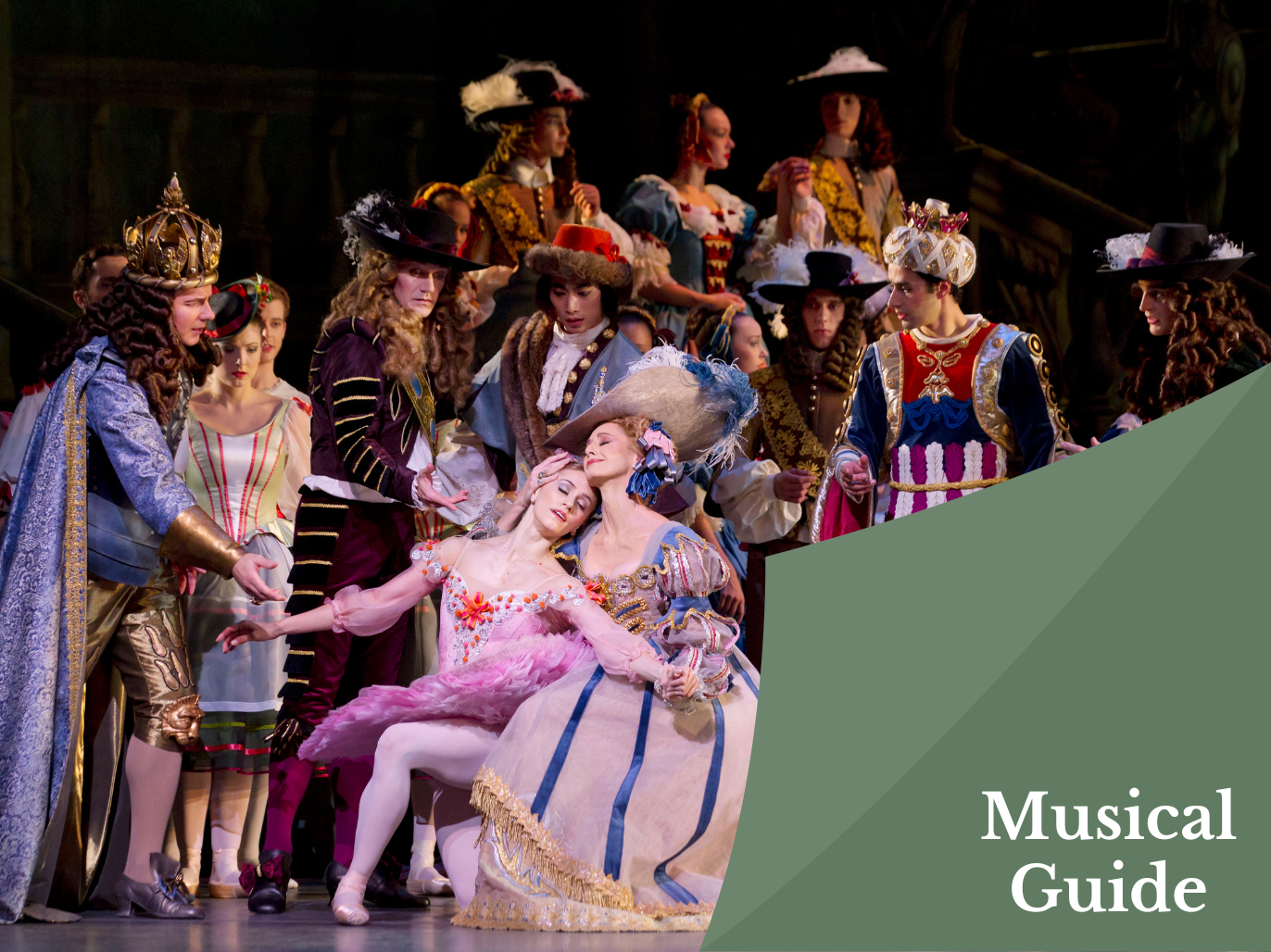
Since its 1890 premiere at the Mariinsky, Sleeping Beauty has remained one of the most popular works in the repertory. Walt Disney’s 1959 animated film version, which incorporated music from the ballet, has introduced the tale to new generations of audiences. Sleeping Beauty was Tchaikovsky’s second ballet and his first collaboration with Marius Petipa. Based upon Charles Perrault’s La Belle au bois dormant as well as the Brothers Grimm version of the story, the famous fairy tale finds the Princess Aurora placed in an enchanted sleep by an evil witch. 

As with many fairy tales, several versions of the Sleeping Beauty story exist. In Perrault’s telling, the prince and princess secretly wed and have two children; his mother, an ogress, tries to eat the children and the princess. Petipa and Tchaikovsky omit this gruesome side plot, though an ogre and other fairy tale characters including Cinderella and Puss-in-Boots appear in the final act. In the beloved Act 1 “Rose Adagio,” Aurora meets each of her suitors.

Ye Xiaogang, A Dream of Red Mansions

Contemporary Chinese composer Ye Xiaogang is no stranger to larger-than-life performances. In 2008, his piano concerto Starry Sky received its premiere at the opening ceremony of the Olympic Games in Beijing, played by Lang Lang. Ye’s most recent ballet, A Dream of Red Mansions, has its own epic scope. The story is based upon Cao Xueqin’s 18th-century novel, one of the Four Great Classic Novels of Chinese literature. Though it is set 300 years ago, the timeless tale is one of intense love, politics, and family set against the backdrop of a changing society. 

It would be impossible to depict the novel’s 120 chapters and nearly 450 characters in one ballet. Instead, the production centers upon the love between two characters, Baoyu and Daiyu. The Act 1 finale takes place in the Prospect Garden, a crucial setting in the novel. Here Baoyu chases butterflies amid the blooming garden while his beloved, Daiyu, buries the fallen petals.

Manuel De Falla, The Three-Cornered Hat

Igor Stravinsky introduced Serge Diaghilev to Manuel de Falla during the Ballet Russe’s first tour of Spain. De Falla, one of the greatest Spanish composers of the twentieth century, agreed to compose a new work for the troupe. The Three-Cornered Hat premiered three years later. This farcical two-act ballet follows a lecherous magistrate in his attempts to seduce the faithful wife of a miller. 

De Falla turned to Andalusian folk music, including flamenco, to bring the story to life. Castanets, cries of “Olé!,” and flamenco singing in the opening bars immediately evoke the sunny south of Spain. The sets and costumes—designed by Pablo Picasso—and Léonide Massine’s choreography also drew inspiration from the Iberian Peninsula. Picasso’s mammoth curtain depicts the aftermath of a bullfight, while Diaghilev and Massine embarked upon a second tour of Spain to study the country’s various dance traditions.

Story ballets aren’t inherently superior to their abstract, non-narrative counterparts; both have the ability to deeply move. Still, their resurgent popularity points to our eternal desire for thrilling tales. Sometimes we need art that takes us on narrative journeys, that lets us root for a hero, and perhaps, in so doing, discover something new about ourselves.

Written by Andrew McIntyre

Writer and concert producer

Andrew McIntyre is an American writer and concert producer living on the East Coast. He studied musicology at Northwestern University, where he specialized in opera and queer popular music. Since 2013, he has written concert program notes for classical music presenters including the Celebrity Series of Boston, UC Santa Barbara Arts & Lectures, and the Los Angeles Philharmonic.

View author's page