
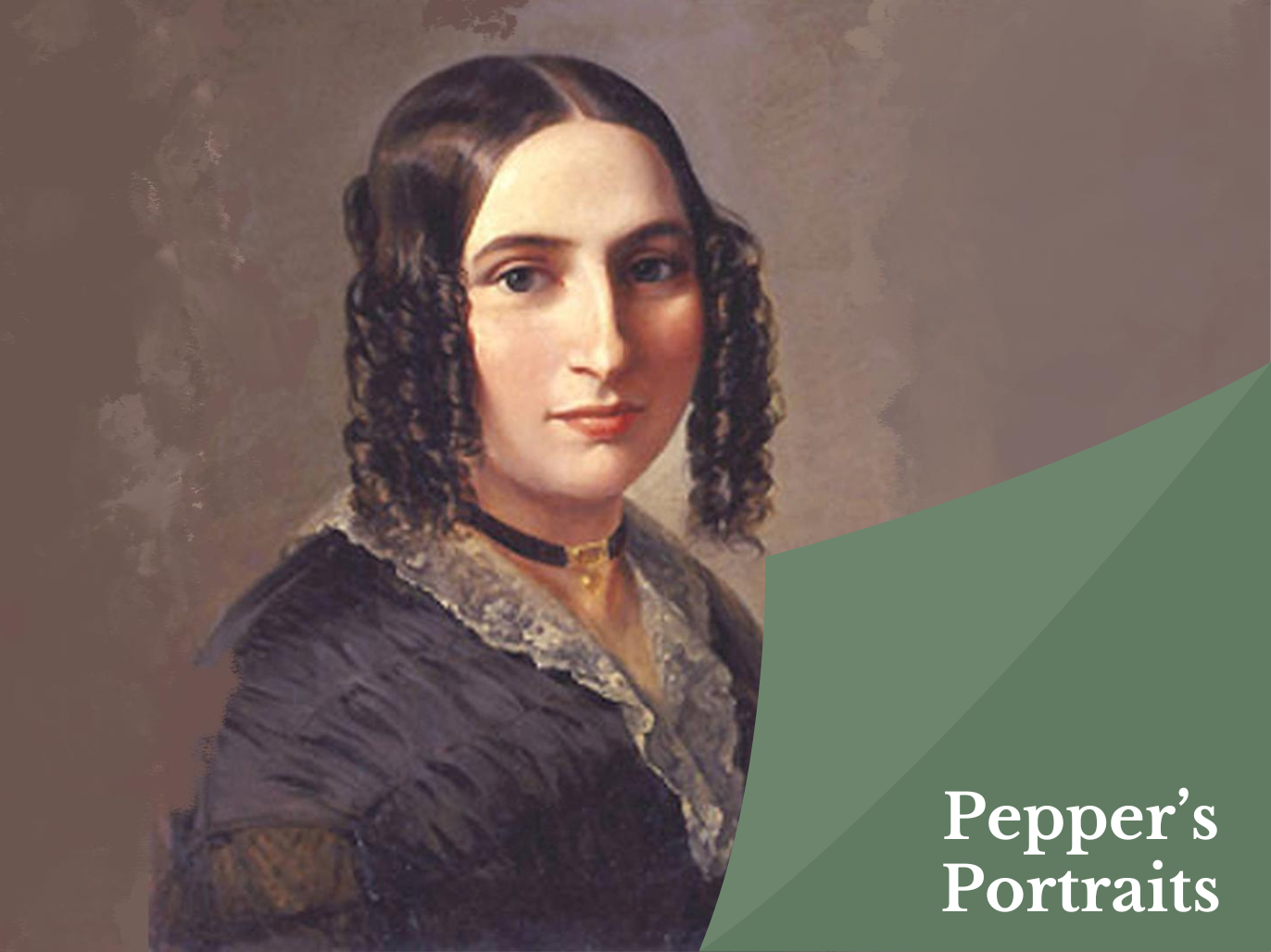
Last month’s portrait explored one of the 19th century’s great musical power-couples, spouses Clara and Robert Schumann. But equally celebrated in that same era was a couple of a different sort: brother and sister, Felix and Fanny Mendelssohn. But in contrast to the Schumanns – where concert pianist-composer Clara was the family’s headline breadwinner and celebrity – Fanny remained a mostly private, domestic musician. Yet however quietly, she wrote a HUGE amount: some 500 pieces in all. As a performer she appeared in public only once, and that just at a charity fundraiser (playing the first piano concerto by… her brother).
View author's page
Reading time estimated : 12 min
A huge inspiration to Felix, he nonetheless discouraged her pursuing professional publication; moreover, some of the pieces that were released were done so under the unhelpful name ‘F Mendelssohn’, leading to confusion as to who wrote what. So, when Queen Victoria was asked to name her favourite Mendelssohn opus, unbeknownst to her she chose one by Fanny. Check out this broadcast of the 2022 Jerusalem Chamber Music Festival, where Juliane Banse and pianist Elena Bashkirova share songs by Felix and Fanny Mendelssohn in turn; stylistically, it can be hard to tell the difference and who wrote what.
The added irony of this is that we know so much about Fanny and the provenance of certain pieces… only because Felix collected all their letters and handed them down through the family. Even her immediate legacy seems bound to her brother.
So, this being the month of International Women’s Day, it’s time we put right this historic imbalance…
The prodigy
Felix Mendelssohn may often be cited as one of history’s greatest prodigies, but Fanny could rival that claim. Aged thirteen, she performed from memory all of Bach’s 24 preludes from The Well-Tempered Clavier (her mother is said to have pointed out Fanny’s ‘Bach fingers’ soon after birth. Should get those checked by a doctor…). It was regularly acknowledged – even by their parents – that Fanny was at least a musical equal to her brother; no less than Goethe would write to Felix saying: ‘give my regards to your equally talented sister’. Ouch.
There can be name drops aplenty, since the Mendelssohn family was a positive temple of culture; visitors to the privileged family salon included Heine, Hegel, Jean Paul and Eichendorff (whose poetry Fanny would set to music). The Mendelssohn family itself was quite a name; grandfather Moses was a prominent philosopher, while father Abraham was the joint head of Mendelssohn & Co. Bank.
He hired Carl Friedrich Zelter as composition teacher to the teenage Felix and Fanny; a conservative mentor, he instilled in her an academic rigour that soon led to her exploring the complexities of double counterpoint (where an original countermelody and theme can be flipped without changing rules of voice leading and harmony, like playing a compositional Rubik’s Cube).
Musical encounters of the highest calibre continued as a norm; on a family holiday when Fanny was sixteen, the pair met Louis Spohr, while Ignaz Moscheles attended her nineteenth birthday celebration at which both sister and brother played.
On a trip to France, she studied with Marie Bigot; a pianist and composer much admired by Haydn, Mozart and Beethoven, the latter had even gifted Bigot the autograph of his new Appassionata Sonata. As such, Fanny was two handshakes away from Beethoven – and shaped into a formidable pianist.
It was all so promising. But despite encouraging her to lofty heights, Fanny’s father was determined music would prove a mere private pursuit, famously commenting: ‘music will perhaps become his [Felix’s] profession, whilst for you it can and must only be an ornament’. Wind forward to her twenty-third birthday, and he instructed her to prepare for her ‘real calling… the state of a housewife’.
Family collaboration – and conflict…
Composition continued apace, and family proved key to much of her writing. Many pieces were created as gifts; her first – written aged fourteen – was a lieder to celebrate her father’s birthday. In a similar fashion, Felix wrote a new composition to mark his sister’s birthday every year for the rest of their lives. They shared every new piece with the other, and gave weekly Sunday morning concerts at the family home. Theirs was a mutually inspirational relationship, with Fanny confiding: ‘without you, I can’t proceed with my music.’
This dialogue takes a literal form in some of their pieces, with brother and sister quoting the other’s melodies and motifs; it’s a musical collage, a conversation through crotchets and quavers.
And yet… Felix discouraged his sister from publishing her music, merely allowing her to release a few songs under his name! Whether this stemmed from patriarchal views, jealousy or loving protectiveness remains up for debate. Their mother thought she should publish, but writing back to her in utmost secrecy Felix argued: ‘I regard publishing as something serious…and believe one should do it only if one is willing to appear and remain an author for one’s life. That means a series of works… to come forward with just one or two is only to annoy the public… Fanny has neither enthusiasm nor calling for authorship; she is too much a Frau, as is proper… and thinks neither of the public nor the musical world… except when she has filled her primary occupation’. Felix made clear he would support Fanny publishing her music if the impetus came from her – but Fanny’s discussions around publication paint her as an almost indifferent bystander to the question.
It was a different matter with her husband. Artist Wilhelm Hensel provided a new manuscript paper every morning, lobbied for publication, and drew sketches inspired by her. A lengthy period of separation led Fanny to write a whopping 32 lieder about separation and loneliness. She even composed the music for her own wedding ceremony!
All change
Her opinions on publication took a dramatic turn in 1846. With just one year left to live, Fanny was determined to publish in her own name. This came with a stark admission: ‘I’m afraid of my brothers at the age of forty, just as I was of our father at the age of fourteen’. If you thought the psychiatry of a prodigy was complex, just imagine delving inside that of a family of them!…
Publication proved a creative catalyst. Regular weekly composition replaced her prior scattergun writing routine, and a consistent timetable of publication was maintained. Fanny expanded her instrumentation to writing a Piano Trio, while several entire collections were published within the year. It’s a remarkable thought: the composer who had composed all her life, and yet whose Op. 1 came at the age of forty.
The output
Fanny never wrote for the operatic or symphonic stage; her sole orchestral piece is the Overture in C, written in 1830-32 for performance in the family salon. She also wrote cantatas, oratorios and vocal trios but all of these were destined for her family home. Her output consists mostly of songs and piano pieces, intended for the domestic setting to which she was confined.
One of her largest-scale pieces is her Piano Sonata, the only one she penned; this was the closest her writing came to the concert hall, since the sonata had by then expanded to blur the amateur with the professional, the home with the concert hall.
A vocal tradition is clear even in her piano writing, and surely it’s no coincidence that many of her instrumental works have a singing lyricism akin to Felix’s Songs Without Words. Fanny came to describe her own piano pieces as ‘piano lieder’.
Felix Mendelssohn-Bartholdy, Songs Without Words, Op. 67. Presto (Spinnerlied).
But they’re not musical twins. It could be argued Fanny brings a greater sense of Romantic chromaticism and harmonic exploration versus the more conservative Felix, who remained a Classicist at heart. Although both certainly had more conservative-leaning musical tastes (embracing Bach, Handel and Mozart as listeners), more should be made of the difference between Felix and Fanny’s compositional language; she is arguably less afraid to go in unexpected directions. Despite domestic confines, her language has flashes of real power, daring and fire. Perhaps this was the very result of her environment; she didn’t need to consider the tastes of an audience or any commercial needs, and so could write as she pleased and treat her home piano as a creative laboratory. Perhaps the very thing that limited her public recognition expanded her compositional language.
Sample the emotional intensity of her song Vorwurf (Reproach), setting the words of Nikolaus Lenau; soprano Juliane Banse is accompanied by Elena Bashkirova at Mendelssohn House here on medici.tv. There are regular shifts between major and minor, a sinuous piano accompaniment creating uncertain ground and expressive instability. Indeed, Fanny’s songs have more intricate piano accompaniments than those by her predecessors; there’s greater harmonic variety and less symmetrical phrase lengths. Although still very much in a line of lieder composers before her, there is a sense of playfulness and discovery, of a composer toying around with a supremely well-trained compositional toolkit and asking ‘what next?’.
Likewise, listen to her 1834 String Quartet, which was remarked upon at the time for its sense of adventure; Felix disapproved of the work, thinking it showed lack of discipline and too much abandon. It was performed just once in her lifetime.
Playing manuscript detective
Despite her near-500-strong output, still only eleven opuses and sixteen single pieces without an opus number were published in Fanny’s lifetime. Many of her manuscripts existed in private collections (and still do), meaning new pieces are almost continually discovered. Take her Easter Sonata, written aged 22 and long attributed to her brother; the manuscript remained hidden for 150 years until it was uncovered in a private collection in France in the 1970s. Another fifty years of analysis was required to prove that the manuscript was in Fanny’s hand and not her brother’s. Isata Kanneh-Mason released a recording in 2024, finally attributing the piano sonata to the right Mendelssohn.
Or take Fanny’s hour-long piano cycle Das Jahr, with a movement for every month of the year. Touchingly written as a Christmas present for her beloved husband, it was unpublished in her lifetime, mentioned only once in her letters, and subsequently only discovered in 1993 and published in 2000. Das Jahr stemmed from a fruitful visit to Rome, where she met Charles Gounod. She helped convince him of the magnificence of Beethoven by performing five of his sonatas consecutively; in turn, he encouraged her to compose. Das Jahr was the result. His professional endorsement shocked her, with Fanny commenting: ‘I was never made so much of in my life, and it’s really rather pleasant!’
It was almost like she was oblivious to her own talent, throwing off a piece full of invention and craft but thinking little of it.
Epilogue
Sister and brother died just six months apart in 1847, some arguing that Felix couldn’t stand the strain of no longer having his sister to collaborate with. It had been while conducting a rehearsal of her brother’s Die Erste Walpurgisnacht that Fanny suffered a stroke and died. Their fates appear bound to the very end.
Fanny’s life was one of contradictions: a loving family that both enabled and restrained her, a lady unleashed and limited by love; we can see her as a Romantic classicist; a private celebrity. Whatever the contradictions, her place in a long line of lyrical and consummate craftspeople is undoubted. Writing with expert command and with singing melodies never far away, it’s about time we sang from the rooftops about the equally marvellous lady Mendelssohn.
