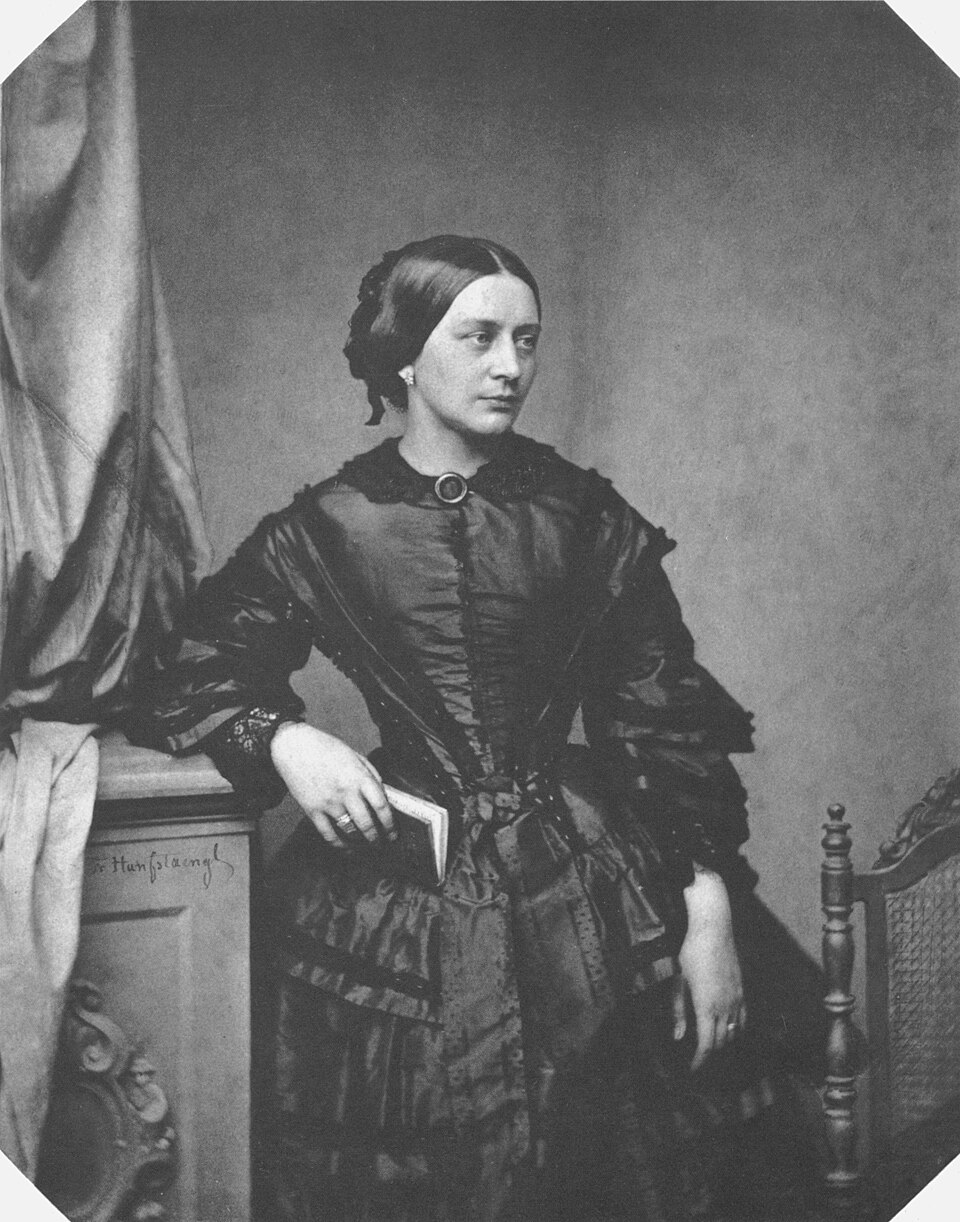
A Symphony of Two: Robert and Clara Schumann

Turbulent courtship, creative outpouring, professional rivalry and enduring loyalty: Robert and Clara Schumanns’ marriage was as dramatic as any opera. Yet through triumph and tragedy, their shared language remained music.

View author's page

By Jack Pepper

Reading time estimated : 12 min

Valentine’s month is upon us; if music is society’s emotional diary, then love will certainly be its headline… 

Berlioz wrote that love and music are “the two wings of the soul;” Sigmund Romberg stated “a love song is just a caress set to music;” while Charles Darwin went further, arguing that the very existence of music was down to an evolutionary necessity to charm and seduce. Tolstoy feared music’s power for this reason, his novel The Kreutzer Sonata likening it to a form of hypnosis that can incite dangerously passionate desire; music not only expresses but causes romantic urges. 

The magnetism of music is clear in the many examples of musician power-couples (with more than a splash of lovable “eccentricity” in the mix, too)… Richard Strauss was conducting soprano Pauline de Ahna in rehearsal when, having upset her, she hurled the score at his face and rushed into a dressing room where the pair proceeded to argue loudly, much to the bemusement of the orchestra outside; then Strauss emerged from the room to say that she had just accepted his proposal of marriage! His Symphonia Domestica later went on to chart a day in their family life, including musical depictions of baby bath-time and lovemaking. This was a composer who insisted music was autobiography: “do you know a composer who has ever composed anything but himself?” 

Elsewhere, Constanze Mozart helped sharpen her husband’s quills ready for composition; it was Mascagni’s wife who secretly entered Cavalleria Rusticana into a competition that won him fame; Alice Elgar ruled lines of staves onto her husband’s manuscript paper, and on her death he stopped composing for twelve years; Doreen Carwithen was one of Britain’s first female film composers (even scoring Elizabeth II’s Coronation movie) but set her career aside to support her composer husband, William Alwyn, by typing up his manuscripts and copying parts. Music, like love, is an act of giving and sharing.

Let’s meet one of classical music’s most famous composer couples…

A turbulent start: don’t trust the in-laws…

Robert and Clara Schumann faced many obstacles in coming together. Robert was a 20-year-old law student in Leipzig, taking piano lessons from Clara’s father, Friedrich; the young man ended up boarding in their house, set on a career as a concert pianist. Clara was already a sensational player, even on their first meeting when she was just nine; by then she had been playing concertos for a year and by eleven had made her formal debut at the Gewandhaus. Her “fans” included Goethe, Liszt and Felix Mendelssohn. 

Robert offered guidance as she wrote her Piano Concerto, a profoundly mature statement for a fifteen-year-old (watch Lisa de la Salle perform this alongside the Dallas Symphony Orchestra under Fabio Luisi below). By the time she was sixteen their friendship had blossomed into romance, with Robert dedicating a piano sonata to her name. Friedrich soon feared his influence; the father opened their mail and eventually spread malign gossip that Robert was a dipsomaniac. To evade his watchful eye, the family nanny was enlisted to lend her handwriting to envelopes to help create a covert channel of correspondence! When Friedrich forced the pair to separate and refused to allow their marriage, the argument was taken to court; the couple were married in 1840, just as Clara turned 21. It took three years before they so much as spoke with her father again. Understandably…

Clara described their first three months together as “the happiest of my life.” They studied for several hours daily, playing Bach Preludes and Fugues, then Mozart and Beethoven symphonies in piano transcription. The pair published some of their own compositions jointly, with the title page deliberately not distinguishing who penned what. That wasn’t the only collaboration; they even kept the same journal, their Ehetagebuch (marriage diary) – where a special symbol noted the days on which they made love. Who said musicians weren’t organized… 

Outpouring: Robert’s First Symphony 

Tellingly, this year of marriage prompted a huge creative outpouring from Robert. He penned over 100 songs that year alone, and in 1841 wrote his first symphonic work. Called the Spring, his first symphony was sketched in the space of just four days; written at the height of winter, he said it was filled with a “longing for spring.” That season’s suggestion of new life surely found a parallel in his marriage and their first child, born that year. 

Sample Bernard Haitink conducting the Berlin Philharmonic in 1999 (below) ; a brief trumpet fanfare gives way to a grand homophonic statement from the full orchestra, a call to attention. The dotted rhythms and skittish sixteenth notes of the first movement Allegro molto vivace burst with life. This is music of springtime: confidence, energy and life (and what better symbol of vigour than lots of percussion?… This was one of the first symphonies to require three timpani).

It was a significant point of compositional departure for Robert. Until marriage, he had been known as a composer of piano pieces; it was Clara who pointed him in the direction of large-scale symphonic works. She wrote: “his compositions are all orchestral in feeling… My highest wish is that he should compose for orchestra—that is his field. May I succeed in bringing him to it!” 

Some argue that this was misguided advice since Schumann was in many ways not a natural symphonist or orchestrator. Many academics point to his muddy and unsubtle orchestration, suggesting they are more like piano pieces written with keyboard figurations in mind. Whatever the result, it is clear Clara opened his horizons and encouraged a sense of ambition and possibility.

Difficulties: Clara the superstar (and working mother)

At the same time, Clara was a star. On one of her piano tours to Russia, a nobleman asked Robert the awkward question: “are you musical, too?”

She was the household’s primary earner, upturning all nineteenth-century conventions of domesticated wives. Yet Robert certainly harboured the patriarchal expectation that she would stay at home and see to family matters (soon after their marriage, he had given her a cookery book with the words “Meiner Hausfrau” emblazoned on the cover, hint hint). He struggled with the fact she was earning more than him. Quickly, this paranoia encroached on her music-making; Robert insisted on total silence when composing, meaning Clara was forced into long periods where she was unable to practise. However, he strongly advocated for the publication of her compositions and often lobbied publishers on her behalf.

Alongside an international concert career (despite the frequent practice ban), Clara also gave birth to eight children in thirteen years! Robert composed new pieces with these children in mind, and the couple took them on their concert tours. 

Such a large family would only grow the pressure posed by Robert’s deteriorating health. When he was taken to an asylum following an attempt to drown himself in the Rhine, Clara was left as a single mother with seven children to support; the asylum fees alone were the equivalent of her husband’s salary as a music director. In her mid-thirties and with children aged two to fifteen to support, she poured herself into yet more tours and teaching, not just out of celebrity–but necessity. She didn’t see Robert for two and a half years. 

Championship: changing the concert repertoire

It is telling that Clara stopped composing in 1854, at the time of her husband’s complete mental collapse. Following his death soon after, she helped cement his musical legacy by preparing a complete edition of his output. Even in his own lifetime, much of his public acclaim stemmed from his wife’s championship; major concert pianists of the day only started programming his work years after Clara. Robert craved such popularity, once writing: “I confess it would be a great delight to me if I succeeded in writing something which, when played by you, would make the public dance with delight.” 

Almost every concert she had given since their marriage had included one of his pieces, often as many as four; now she gave each concert dressed in black, in his memory. Across her career she played nearly every piano piece he had written, and the symphonic works were often shared at concerts where Clara was the headline. 

The Schumann name may be giant now, but in the nineteenth century she was the worldwide celebrity and his music was merely dismissed by many as eccentric or mad. In the 1920s and 1930s, his music was denigrated not for being forward-thinking, but backward; they were seen as an embarrassing example of the excesses of Romanticism. This neglects the intricacy of his polyphonic inner voices, the daring harmonic shifts and rich chords: this cerebral quality and lack of huge virtuosic display surely spoke to the classicist in Clara.

Clara Schumann performed for the last time at the age of 71. It’s believed she gave over 1300 concerts in her lifetime (little wonder her golden nugget of advice had always been: “make the most of the minutes”). 

Why did she continue? Brahms had challenged her to retire from such a demanding stage career sooner, but she replied: “you regard it only as a way to earn money. I do not. I feel a calling to reproduce great works, above all, also of Robert… to me, it is the very air I breathe.”   

Codes and dedications

How did their relationship influence the very notes they wrote? 

Robert Schumann had long been interested in making musical themes from words, embedding codes in his music as subtle nods to the people in his life. So, he quite literally embedded their names into his music; S–C–H–A (Eb–C–B–A) hinted at his own name, with Carnaval structured mostly around such four-note codes. His Op. 17 Fantasy and Piano Concerto (watch Martha Argerich alongside the Leipzig Gewandhaus under Riccardo Chailly below) include Clara’s name in code; listen out for a five-note phrase built around a descending fifth. Indeed, it has been proposed that a “Clara theme” is integral to many of his musical structures. Likewise, in a more explicit fashion, he would spin variations from melodies she had written as a teenager.

The dialogue went both ways. Clara set the words of a Friedrich Rückert poem “If You Love For Beauty” as a birthday present in their first year of marriage. Her Three Romances for violin and piano include a quotation of Robert’s Violin Sonata No. 1. Her boldest solo piano piece is her Variations on a Theme of Robert Schumann, taking his Bunte Blätter (which were in turn taken from his own earlier unpublished sketches dating back to his early twenties). Triplets, chromaticism and delicate inner voices soon enrich his noble hymn-like melody and hint at the star pianist in Clara. If any musical form can demonstrate the power of a muse, of coming together, and a conversation between partners, it’s a theme and variations.

Perhaps the most literal musical iteration of their relationship, though, is Widmung. Meaning “Dedication,” it was originally Robert’s song setting of a poem by Friedrich Rückert and given to Clara as a wedding present. The words describe the excitement of being in love. That was in 1840, the year of their marriage. Roll forward to 1872, decades after his death, and Clara made a piano transcription: a touching remembrance breathing new life into where it had all begun. Sample Lauma Skride peforming it in Leipzig in 2019 (below); the aching appoggiaturas, chromatic inner voices and sudden Schubertian harmonic shifts all create a sense of longing, heartache and profound feeling. Truly it is an emotion compressed into sound.

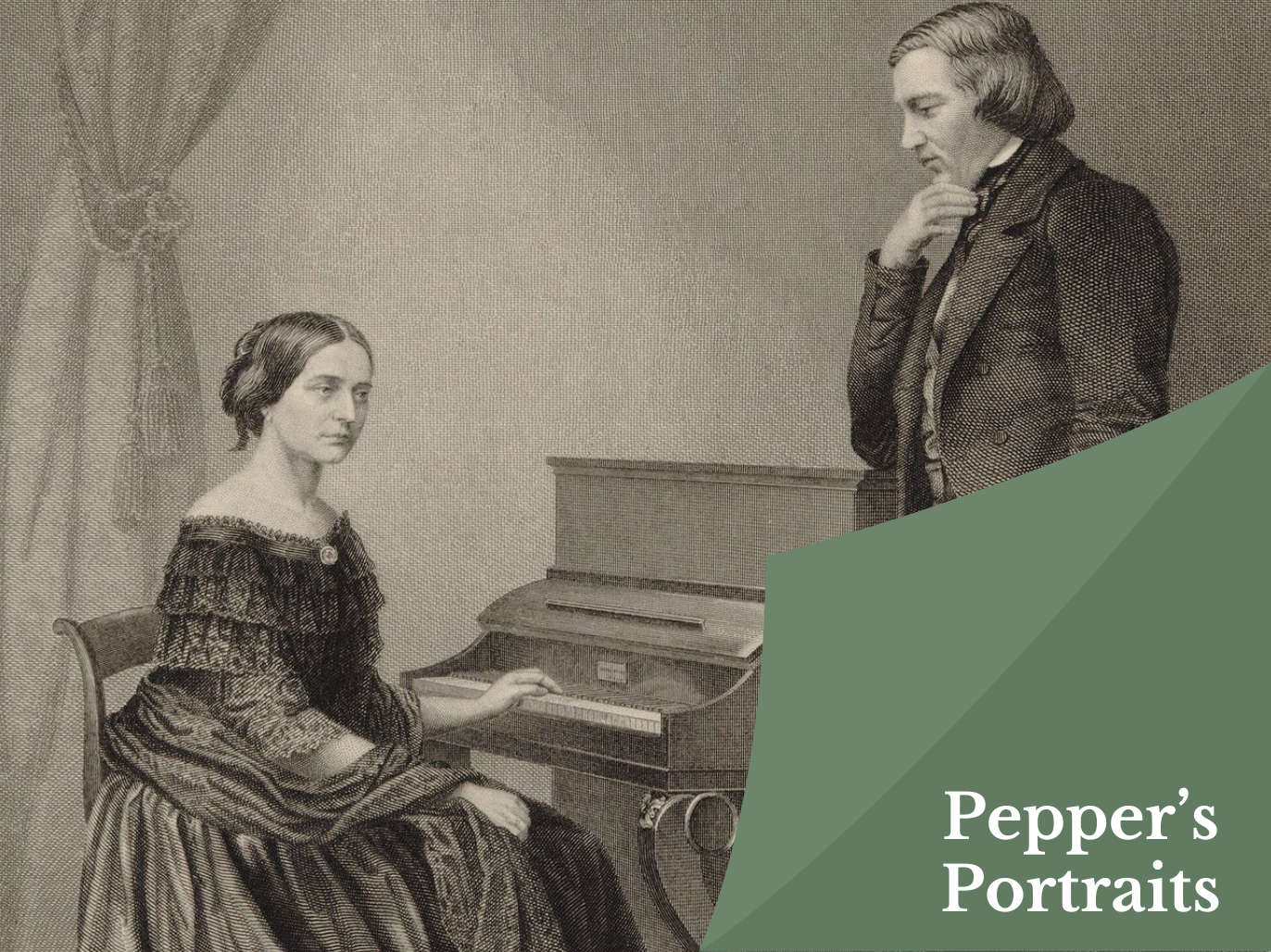
This month, “love is in the air” – but music is never far behind.

Written by Jack Pepper

Composer, Broadcaster and Writer

Jack Pepper (b. 1999) is one of the UK’s youngest commissioned composers and youngest-ever national radio presenter. He spent his teens composing for the Royal Opera House, Classic FM and Royal Liverpool Philharmonic Orchestra, and now has a major stage musical in development. Most recently, he premiered his song ‘Harmony’ for HM King Charles III, for whom the piece was written; Jack has been named one of The King’s Foundation’s 35 Under 35, recognising young ‘makers and change makers’ who represent the changes His Majesty wants to see in the world. As a broadcaster, aged 19, Jack helped to create Scala…

View author's page