
Great Conductor–Orchestra Relationships: What Makes Them Work?

Behind every iconic orchestra sound lies a partnership that worked — or sometimes didn’t. Looking at landmark collaborations past and present reveals how leadership, identity and context combine to create greatness.

View author's page

By Andrew Mellor

Reading time estimated : 11 min

Every time an orchestra announces a new Chief Conductor or Music Director, you can almost smell the sense of hope oozing out of the press releases and Instagram videos: we really, really want this to work out

A great relationship between a conductor and an orchestra can make all the difference to the way an orchestra plays – between the ‘very good’ and the ‘exceptional’. For us in the audience, it can be the difference between ‘I might watch that concert’ and ‘I simply have to see that concert!’

The truth is, these relationships are as unpredictable, vulnerable and sensitive as all our personal human and workplace relationships. If orchestra-conductor relationships take time to build and can often sour in an instant, at least orchestras have the benefit of being able to choose conductors they’ve got to know over time.

Unlike football teams, which must choose new coaches in an instant from a list of candidates that have probably never met the team before, orchestras and opera companies have the advantage of appointing conductors they’ve generally already worked with. Yet still, very few appointments rise beyond the ‘very rewarding’ and reach truly great heights, for musicians as well as audiences. 
What lies behind those that do? Many factors. Human chemistry, temperament, physical and financial conditions, the organizational health of the orchestra and all sorts of external personal issues including the particular stage a conductor might be at in their career or what they want from a private life. 

Some factors are more crucial than others, and these have arguably changed over time. In the post-war period, conductors were keen to build orchestras themselves and often wanted an extensive recording contract thrown in. These days, things are different – partly because you can’t fire an entire orchestra and hire your friends; and partly because the idea of recording and broadcasting has been turned on its head by pioneering media companies like medici.tv. 

But the biggest reason things are different today is because a conductor’s role is subtly different to what it used to be. Conductors are less likely to ‘use’ orchestras to channel an interpretative vision of a piece that comes entirely from them, and are more likely to try to work with an orchestra’s musicians to bring to life a version of the piece that they can all consider their own. 

Some say that has led to more bland, less distinctive interpretations. Others would counter that the performances themselves have more spirit and authenticity. Either way, this might be why long, electrifying relationships between orchestras and conductors are rarer: they tend to be more about ‘fit’; meetings of minds; the alignment of a personal philosophy with an organizational culture or civic mood. 

Of course, that’s a subjective opinion. Besides, it’s quite possible that there are astonishingly brilliant relationships between chief conductors and orchestras that we don’t know about because the orchestras and conductors in question aren’t the most famous. 

Right now, I’m very interested in the apparently strong bond between Rafael Payare and his Orchestre symphonique de Montréal; between Tarmo Peltokoski and the Orchestre National du Capitole de Toulouse; and between Jakub Hrůša and the Bamberg Symphony Orchestra. 

Who knows how they will work out. For now, let’s look at some of the proven examples from the past. Perhaps there are one or two that should be on this list, but aren’t?

The Cleveland Orchestra and George Szell 

So strongly was George Szell identified with The Cleveland Orchestra that his successor as Chief Conductor, Christoph von Dohnányi, once commented that ‘when we do an outstanding concert abroad, George Szell gets a good review’ – that was in 1990, a whole two decades after Szell had gone! 

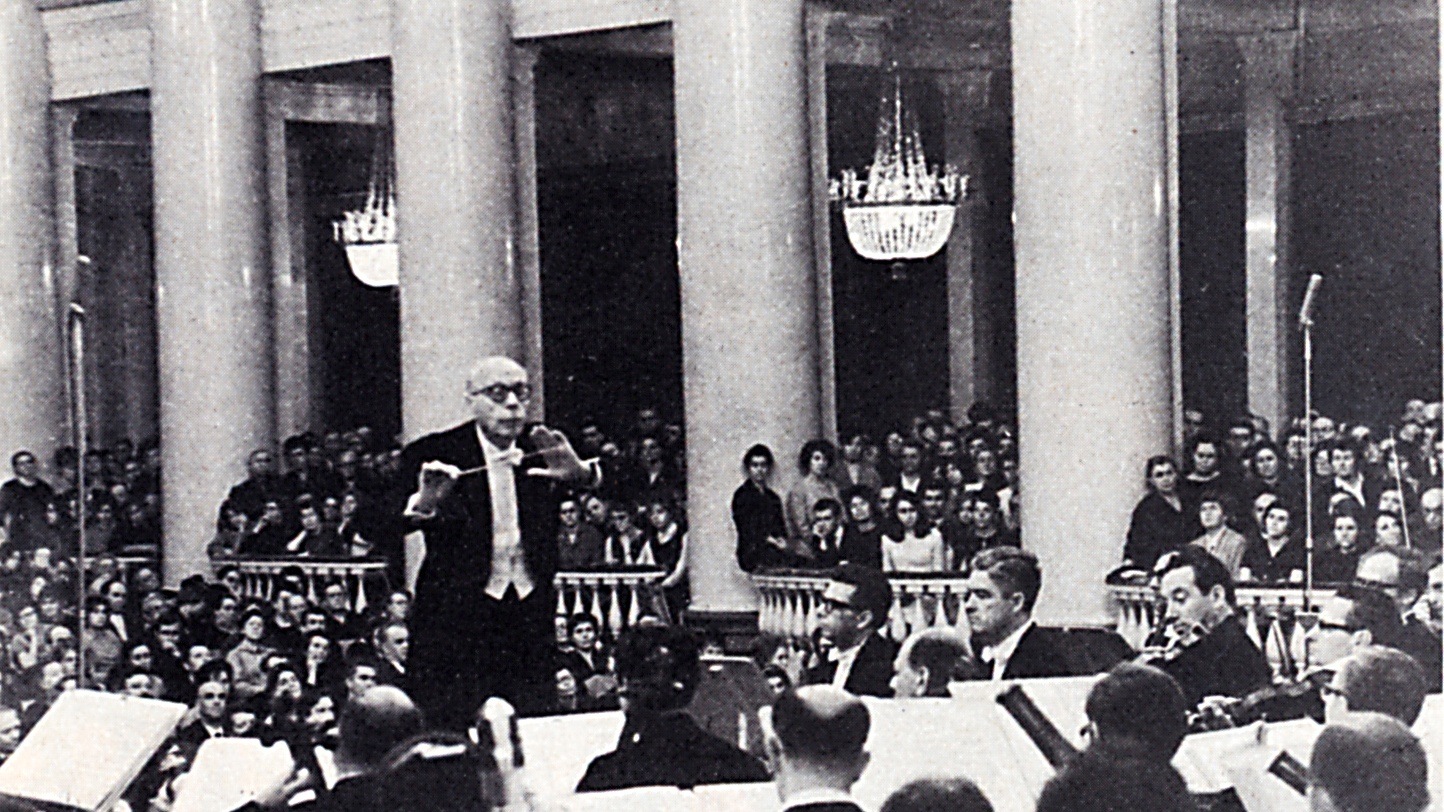
Conductor George Szell, leading The Cleveland Orchestra on their second European tour at Bolshoi Hall in Leningrad (1965). © Archipel Records

Szell rebuilt the orchestra when he arrived in Cleveland in 1946, replacing two dozen musicians almost instantly. He also had the acoustics of the orchestra’s home venue, Severance Hall, completely redesigned. The famous ‘Szell sound’ was founded on intense discipline, flawlessness of ensemble and very forward, ‘present’ playing.

The Cleveland Orchestra, by the way, tends to choose right. Its current Music Director, Franz Welser-Möst, is only the seventh since its founding in 1918. He is contracted to stay until 2027 at the earliest. 

The Berliner Philharmoniker and Herbert von Karajan

Herbert von Karajan’s 35-year tenure at the Berliner Philharmoniker remains the most definitive orchestra-conductor relationship of the second half of the twentieth century – perhaps of all time. It resulted in everything from a pioneering new concert hall that formed a blueprint for countless others to an unrivalled recorded legacy and the beginning of the Berliner Philharmoniker ‘brand’. It also heralded the age of the modern maestro, in which a conductor is seen as the figurehead for an orchestra off the podium as well as on it. 

Karajan’s working methods might be deemed controversial now, but they were in tune with the orchestral culture of the post-war period. And they got astonishing results: a homogenous, smooth sound of rare richness and glowing beauty in which absolute precision and chamber music-style interplay could co-exist. As their relationship grew, Karajan would increasingly conduct the Berliner Philharmoniker without specifying a beat and often with his eyes closed – as if a ‘sixth sense’ had developed between him and his players. 

Karajan was appointed conductor of the Berliner Philharmoniker ‘for life’. But it wasn’t to be. He resigned in April 1989 after a series of internal power struggles, including the appointment of a principal musician against the orchestra’s wishes, and died just a few months later. The episode led to greater autonomy for the orchestra’s players, who now control the big decisions themselves.  

The Chicago Symphony Orchestra and George Solti 

The Chicago Symphony Orchestra was made internationally famous by conductor Fritz Reiner – specifically, by his series of ‘Living Stereo’ recordings from the 1950s and 60s characterized by a highly involving, cinematic sound combining richness and brilliance with a sense of textural depth and clarity. 

Reiner was Music Director in Chicago from 1953-62. But it was arguably only after the arrival of George Solti in 1969, who stayed at Orchestra Hall for 22 years, that the orchestra started to truly capitalize on the foundations made by Reiner – in the concert hall, on tour in Europe and on an even wider range of recordings. 

Solti’s expressive tendencies, and his ability to create an atmosphere in a concert hall just by walking onto the stage, were a good fit for an orchestra that had added deep sensitivity, warmth and elegance to the power and precision instilled by Reiner. Solti could be a hard task-master and a cold leader, but CSO musicians mostly relished the heights he took them to.  

The Swedish Chamber Orchestra and Thomas Dausgaard

In 1995, the Swedish down of Örebro decided to transform its mediocre symphony orchestra by downsizing it into a crack chamber orchestra of 39 players. Two years later, Thomas Dausgaard arrived from Denmark as Chief Conductor and would remain in post for 22 years, presiding over some of the most illuminating performances of the symphonic repertoire along the way. 

A small town within commuting distance of Stockholm, Örebro was a perfect place for a grand experiment in which Dausgaard would work on chamber orchestra recordings of symphonies from Beethoven to Bruckner (and beyond) with a lithe, flexible orchestra of modern instruments capable of extreme detail and prone to very excitable performances. 

There may be no performances on medici.tv at present from the orchestra’s concert hall, completely rebuilt in 2015, but Dausgaard’s dozens of recordings with the orchestra are well worth seeking out and are a testament to the intensity of the musical understanding between musicians and conductor. 

The Pittsburgh Symphony Orchestra and Manfred Honeck

There’s nothing quite like the sound of the current Pittsburgh Symphony Orchestra under its Music Director since 2008, Manfred Honeck. Honeck’s Pittsburgh Symphony sounds a little more gritty than some of its illustrious counterparts – not meaning sloppy or ugly, just meaning that you hear the moving parts of the orchestra more, especially its highly distinctive, fizzy brass. 

Honeck has a fascinating blend of blue-blooded Viennese tradition and very informal childlike enthusiasm (follow the PSO’s social media feeds, and you’ll see plenty of wonderful videos of Honeck frothing about how much he loves chocolate). The result is an orchestral sound that somehow wants to involve even more than it does impress (yes, Fritz Reiner is one of Honeck’s predecessors in Pittsburgh) even though it happens to be very impressive at the same time. I hope Honeck sticks round until his contract expires in 2028…or ideally, even longer. 

The Los Angeles Philharmonic and Gustavo Dudamel 

When managers are thinking about who might be a good Chief Conductor for their orchestra, they increasingly look to the model established when Deborah Borda appointed Gustavo Dudamel at the Los Angeles Philharmonic in 2009. 

This wasn’t just about musical chemistry and it certainly wasn’t about a conductor who could impress his will on an orchestra whether they liked it or not. It was about the culture of an organization and the demographic of a city being reflected in the orchestra’s musical leader. Venezuelan conductor Dudamel wasn’t just a perfect fit for the LA Phil’s characteristic feistiness, he helped reconnect the city with is Latino population and reinstated its appetite for contemporary music while unashamedly celebrating its links to the movie industry. 


But Dudamel has clearly had an effect on the LA’s tonal quality too – giving it more general warmth and middle-section weight and increasing its agility and sensitivity. Dudamel left Los Angeles in 2025 after sixteen seasons. The orchestra is patiently searching for a successor to replace the apparently irreplaceable – the conductor Elim Chan is being talked about – but in the meantime, you can be sure that Dudamel’s occasional returns will be sell-outs.  

Written by Andrew Mellor

Journalist and critic

Andrew Mellor is a British writer, critic, and broadcaster based in Copenhagen. After studying music at the University of Liverpool, he began his career with the Manchester Camerata and the London Philharmonic Orchestra before training as a journalist at Classic FM magazine and Gramophone. Since moving to Denmark in 2015, he has become a leading voice on Nordic music and culture, contributing regularly to Opera and Opera Now.

A regular critic for the Financial Times and a presenter for medici.tv and the Danish Broadcasting Corporation, Andrew Mellor also writes extensively for orchestras, festivals, and record labels around…

View author's page