
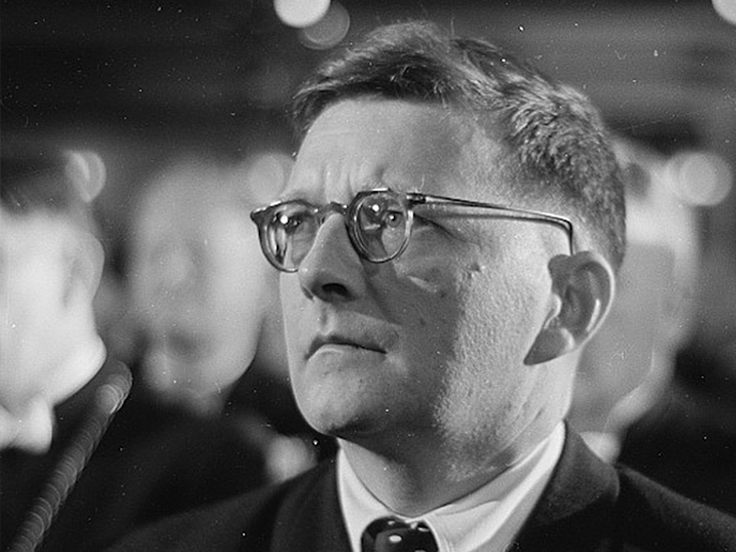
Music, Power, and Survival: 120 Years of Dmitri Shostakovich

Denounced, then decorated, Dmitri Shostakovich lived under Stalin’s watchful eye, his career a razor’s edge between conformity and defiance. 120 years after his birth, five of his essential works offer as many ways to listen to the USSR’s most enigmatic composer.

View author's page

By Nadya Miryanova

Reading time estimated : 8 min

“If they cut off both of my hands, I will compose music anyway, holding the pen in my teeth,” wrote Dmitri Shostakovich to his friend Isaac Glikman in a letter from 1936. Creating in the surveillant shadows of Stalin’s Communist regime, Shostakovich oscillated between favor and ostracism in the Soviet Union.

After his 1936 denunciation by the state, Shostakovich’s life was put in serious danger—his expressionist style had crossed a line with party officials. His career saw him navigate the two sides of this line: creating trail-blazing sonic worlds, while ensuring they didn’t ostensibly tip into the non-conformist realm.

On the occasion of his 120th birthday, medici.tv celebrates his musical legacy with a selection of his greatest works.

Symphony No. 5: an Ambiguous Life Line

In January 1934, Shostakovich’s opera Lady Macbeth of Mtsenk premiered to high acclaim in Leningrad and Moscow. The composer and his work experienced a sudden change of fortune when Joseph Stalin attended a performance two years later. A scathing criticism soon circulated in the Soviet newspaper Pravda condemning the work as “muddle instead of music.” Shostakovich was shunned overnight and declared an enemy of the people, constantly fearing arrest during the Great Terror.

The pressure on his next work was immense: it was a matter of life and death. His complex, modernist Fourth Symphony was shelved in favor of the more conventional Fifth Symphony, which the composer shielded as “a Soviet artist’s practical reply to just criticism.” Symphony No. 5 adopts a traditional structure and features more direct, accessible musical language to appease party officials. It premiered in 1937 and met with great success, receiving a standing ovation of over half an hour. But many have heard something much more complicated than a straightforward tribute to the Soviet regime—its tone is haunting and shrouded in ambiguity throughout, from the intense disquiet of the opening to the forced triumph of the finish.

Listen to the start of the elegiac third movement: it creates an atmosphere of mourning through its expansive use of strings, echoing the Russian Orthodox Requiem.

On the 50th anniversary of Shostakovich’s death, conductor Teodor Currentzis and the Verbier Festival Orchestra performed a delicate and sublime interpretation of his Fifth Symphony at the 2025 Verbier Festival.

String Quartet No. 8: an Intimate Musical Monument

When Shostakovich visited Dresden in 1960, he found a city that was war torn and haunted by the horrors of the Holocaust. He was invited there to write music for director Lev Arnshtam’s film Five Days, Five Nights. The composer was already in a state of despair—having recently been forced to join the Communist Party against his will—and instead of composing the film score, he wrote a harrowing string quartet. Subtitled “in memory of the victims of fascism and war,” the quartet hides another dimension revealed in Shostakovich’s letter to Isaac Glikman, in which the composer suggests that he himself is a suitable dedicatee of this work.

The quartet integrates allusions to Tchaikovsky’s Sixth Symphony and Wagner’s Twilight of the Gods with a range of themes from his own works. Featuring ever-changing shifts in mood, the work is played in five movements without a break and begins with a musical code. A four-note motif emerges from the first movement, a musical signature of sorts: DSCH, which becomes D–E flat–C–B (played originally by the cello but performed by the bassoon in David Walter’s arrangement below). This motif is the central thread of this composition, unravelling in a fugal beginning and recurring in distorted variations.

The Ensemble Ouranos—Flautist Mathilde Calderini, oboist Philibert Perrine, clarinettist Amaury Viduvier, plus Rafael Angster on the bassoon and Nicolas Ramez on the French horn—chose to offer their audience an interpretation of David Walter’s clever arrangement of Shostakovich’s String Quartet No. 8 for wind quartet.

Piano Concerto No. 1: a Display of His Own Virtuosic Skill

Although Shostakovich’s primary vocation was composition, he also trained as a concert pianist. He regularly played as a piano accompanist for silent films and took to the stage in his own works, including the 1933 premiere of Piano Concerto No. 1 with trumpeter Alexander Schmidt and the Leningrad Philharmonic. Initially conceived as a trumpet concerto, the work ended up emphasizing the piano part and the trumpet adopted a prominent secondary role—a convenient way of allowing Shostakovich to revive his piano career, perhaps.

The small-scale, unusual instrumentation inverts the grand traditions of the Russian romantic piano concerto, and Shostakovich takes inspiration from modernist composers like Stravinsky and Ravel. The work’s brighter, satirical tone is further emphasized by mocking quotations, including Beethoven’s rondo Rage over a Lost Penny and third piano concerto in the final cadenza of the fourth movement, which Martha Argerich performs to spectacular effect.

The living legend Martha Argerich in one of her signature pieces, Shostakovich’s Piano Concerto No. 1, alongside the excellent Rotterdam Philharmonic Orchestra under Lahav Shani.

Violin Concerto No. 1: Combatting the Status Quo

While Shostakovich’s first piano concerto was written in the early days before Stalin’s cultural purge, the first violin concerto was entangled in the 1948 campaign against Shostakovich’s music for “bourgeois formalism.” The composer was isolated from society once more: his music was banned and he temporarily lost his conservatoire positions. He wrote the finale in the evenings after attending gruelling government-mandated sessions by the Central Committee. As a result, the violin concerto’s premiere was delayed until 1955.

Written for violinist and close friend David Oistrakh, the concerto is an extreme technical challenge, including quadruple stops and a blizzard of both scalic and leaping passages. With dissonant harmonic language and angular thematic material, it’s a far cry from the joyful, nationalistic music that the Communist Party aimed to enforce. The agitated energy of the Klezmer-style dance in the Scherzo is one of the most vibrant examples of Shostakovich paving his own modernist path. The concerto was a resounding success in 1955 and took flight to Carnegie Hall, opening a new post-Stalinist era of cultural conversation.

Conducted by Gianandrea Noseda, the London Symphony Orchestra brings to life the terror of the regime and the effervescence of the musical genius portrayed in the First Violin Concerto.

Piano Trio No. 2: a Public and Private Lament

Shostakovich’s closest friend Ivan Sollertinsky passed away unexpectedly in 1944. The composer was deeply stricken by his death, telling his widow that it would be unimaginably difficult to live without him. On a broader scale, the country had just suffered the devastating siege of Leningrad and heaved from the immense brutality of World War II.

Dedicated to the memory of Sollertinsky, the second piano trio also commemorates the victims of war. Shostakovich was profoundly affected by stories of SS guards forcing Jewish prisoners to dig their own graves and dance upon them at the concentration camps in Treblinka and Majdanek. The final movement of Piano Trio No. 2 recalls the atmosphere of preceding movements: the muted mourning of the opening with the dark drive of the scherzo and the brimming unease of the passacaglia. A jarring Klezmer-inflected dance crescendos in ominous intensity and returns with ghostly variations that eventually fade into oblivion, the horrific descent of the “dance of death.”

In Toulouse, France, the Zadig Trio performs the second piano trio with great sensitivity and depth—a piece written in memory of the composer’s close friend, Ivan Sollertinsky.

Throughout his life, Shostakovich was constantly forced to overcome adversity and obstacles to liberated creation. Like many artists of the time, he was torn between personal artistic expression and a destructive political agenda. His vast compositional output includes “serious music, and music that has meaning,” but also music “written in order to have food on my plate.” His style shows a propensity for the ironic and absurd, the dissonant and disruptive.

Shostakovich’s perspective of the Communist Party remains a heavily debated subject amongst scholars: was he a dissident or a compliant artist? Neither argument fits neatly. Shostakovich’s strong instinct for self-preservation and desire to continue composing meant that he had to balance the two sides of the line, but not without significant personal and artistic compromise.

Written by Nadya Miryanova

Writer

Nadya Miryanova is a writer, editor, and translator. She has worked on a variety of projects with medici.tv, including the Verbier Festival, the Singapore International Violin Competition, and Festival Singer-Polignac. Having graduated from the University of Cambridge with a degree in Modern and Medieval Languages, Nadya works as the Communications Assistant at Trinity Laban and supports event production at The Friends of Oleksandriya.

View author's page