
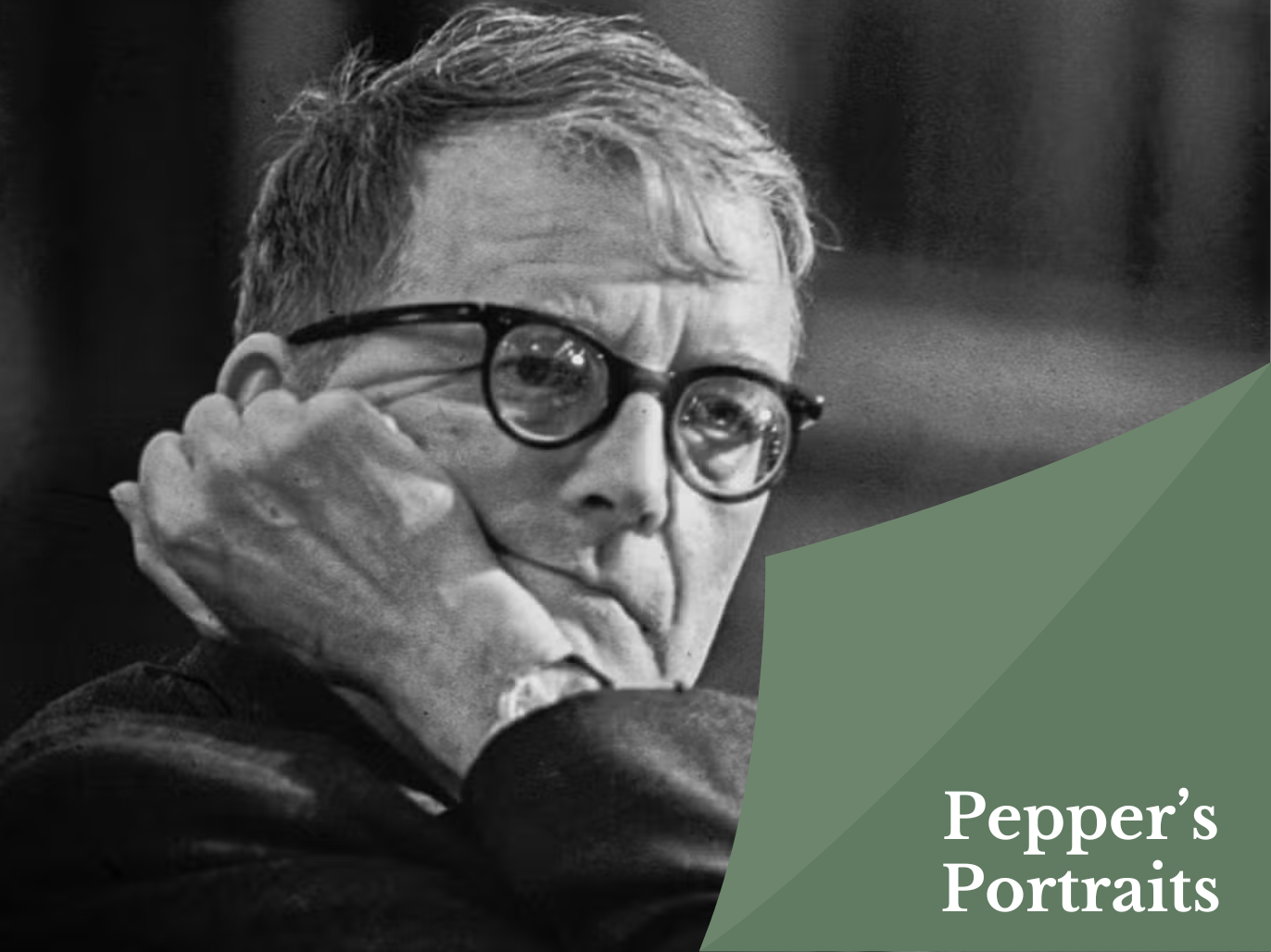
Dmitri Shostakovich: Music Under Siege

Bombarded by war and suffocated by politics, Shostakovich never stopped composing. In this portrait, Jack Pepper explores how a life lived under siege forged some of the most haunting, resilient music of the 20th century.

View author's page

By Jack Pepper

Reading time estimated : 11 min

One of the 20th century’s most dramatic symphonies owes its existence to poor eyesight.

Myopia had prevented Dmitri Shostakovich from enlisting in the Red Army and the Civil Guard come World War Two. Instead, he joined a firefighting unit that drew on professors and students from the Leningrad Conservatory; he would climb to the fifth-floor roof of his apartment block to monitor Nazi incendiary bombs around the school in which he worked. Such was the propaganda power of this image, Shostakovich was featured on the cover of Time Magazine in July 1942 (with the composer wearing a fireman’s helmet… and oven gloves!). A classical musician had become a warfighting icon.

Fire duties occupied him by night; Shostakovich the composer remained in demand by day. He churned out twenty-seven arrangements and two choral pieces for morale-boosting concerts on the frontline, before turning his hand to a Seventh Symphony: 

The first three movements were written under siege; Leningrad endured 900 days of Nazi bombardment. Shostakovich remained at the battered old piano in his flat as air raid sirens sounded and his family fled to a shelter; he was forced to work by candlelight as electricity was shut off. The second movement was finished within a fortnight. He played a piano reduction version to a small audience – a ‘premiere’ that was interrupted by a mad dash to the air raid shelter – and such was its positive reception, Shostakovich began work on the third movement that very same night. 

Rarely has a contemporary piece been so hotly anticipated – and needed. Shostakovich kept fellow citizens updated with the work’s development via radio broadcasts, believing the news of its composition would assure them ‘the life of our city is going on normally.’ It had tremendous effect, with poet Vera Inber noting in her diary: ‘I am moved by the thought that while the bombs rain down on this besieged city, Shostakovich is writing a symphony… in all this horror, art is still alive. It shines and warms the heart.’ 

In the end, stubbornness was overruled by practicality, and it was decided that such a vital national figure must be escorted to safety; Shostakovich was bundled onto a refugee train (which also carried Khachaturian and Kabalevsky). He had time to pack only one suitcase and two scores: his opera Lady Macbeth, and the Seventh. The train journey lasted over a week and carried him 600 miles; the symphony’s finale – poignantly, a prediction of victory – was penned on this train and in the safety of modern-day Samara. The entire symphony had been completed in around three months. The flames of wartime devastation would not destroy the burning fire of inspiration.

The practical realisation of this symphony became a military operation of its own. A 100-foot-long roll of microfilm carrying the score had to be smuggled out of the Soviet Union to Iran, then driven by car to Egypt before being flown to London and shipped to New York on a US Navy warship. The most poignant performance, though, was in Leningrad itself. Most of the city’s musicians had been killed; by 1942, just 15 out of an original 100 Leningrad Radio Orchestra players were still alive. To gather enough musicians, poster adverts were plastered across the city and messages sent to frontline units to send any musicians back. The Soviet military even launched ‘Operation Squall’ to knock out Nazi guns, specifically to create some vague silence for the upcoming premiere. 

That long-awaited event took place in a concert hall that lacked part of its roof, owing to bomb damage. The ‘orchestra’ somehow consisted of 100 players, many wracked with dysentery and starvation; three musicians died in rehearsals. Sessions were cut from three hours to just fifteen minutes as the players lacked the strength to continue any longer; they were given extra food rations just to get them through. One full reading was all that could be managed before the premiere. Come that day, loudspeakers broadcast their playing throughout the city and over the frontline towards the Nazis; German troops recalled this as the moment they realised they would never win, while in the hall, the audience gave a one hour standing ovation.

Musically, many people draw parallels between the first movement’s insistent ostinato theme and Ravel’s Bolero; it’s a similarity that Shostakovich himself acknowledged, saying ‘this is how I hear war’. It’s a menacing march that repeats a daring twelve times, pacing around itself anxiously while growing in orchestration over a whopping ten minutes until it becomes a sort of mass rally for orchestra; something that starts so simple and anodyne ends as an overwhelming terror (read into this, a powerful musical illustration of how fear, chaos and war can spread from small beginnings…). 

Codes in music?

Despite such a proudly assertive piece as the Seventh, ambiguity is king with this composer. Academics continue to debate whether he was a secretive critic of Stalin’s regime, hiding dissent in his music; many point to examples of irony, sarcasm and musical quotations of protest songs. Sometimes there is an almost proud banality, taking Stalinist demands for universality and simplicity to extremes as if edging into mockery. There is undoubted hyperbole and bombast, to the point we question what is really true. 

It was said that the composer himself commented the Seventh Symphony was really about a city that ‘Stalin destroyed and Hitler merely finished off’ (the piece had been planned before the war, after all). Indeed, Shostakovich was not always the regime’s ‘darling’; his dissonant opera Lady Macbeth had been dismissed as ‘muddle not music’ in a review likely penned by Stalin himself (one which also included the ominous line, ‘this game may end badly’). True, that opera wasn’t easy stuff; it follows a lady who murders her father-in-law and abusive husband, features a Siberian prison camp as its final act backdrop and ends with a suicide by drowning. Yet with trademark ambiguity, Shostakovich dubbed this piece ‘a Tragedy-Satire’. 

After the opera was banned, he soon withdrew his Fourth Symphony and titled his Fifth: ‘A Soviet Artist’s Response to Just Criticism’. It’s said Shostakovich slept with a packed bag on the landing in case he was selected to join the throngs of creatives torn from their sleep by the secret police. Paranoia was the word of the day. Shostakovich even kept a scrapbook of all published criticisms that mentioned his name, either a crude form of surveillance or an act of creative self-flagellation.

I can’t help but hear the unimaginable anxiety of such times in the frequent angst and tension of his writing; some of his works feel like a screw that keeps being turned tighter. There’s a contradictory feeling of simultaneous bombast and subtlety – of something that shouts and cries at the same time – just as his own life proved a delicate balance between individuality and the party line. 

Shostakovich and film

There’s a popular focus on the political thread through Shostakovich’s career, emphasising his life as possible dissident; yet if that very creative ambiguity tells us anything, it’s that he could be many things. One man can reflect a plurality of audience, intention, and impact. This is clear from his work in film, which was life-long yet little-mentioned today.

As a student, Shostakovich worked as a cinema pianist accompanying silent movies (until he was fired for laughing aloud, clearly putting more focus on watching the film than accompanying it!). 

Shostakovich went on to score 34 films, spanning 1929 to 1970. His most popular – heard on my radio show often – was The Gadfly, a 1955 action movie set against the backdrop of Italy’s struggle for independence. Elsewhere his love of Shakespeare found a channel in several film adaptations, including a 1964 take on Hamlet and a 1971 version of King Lear (both with director Grigori Kozintsev). 

Arguably, Shostakovich’s broader style resonates in film scores by Jerry Goldsmith and John Williams. His terse orchestral language and stark textures can be heard in many a sci-fi, thriller and fantasy film. The Beethovenian journey from darkness to light can be found as much in Shostakovich symphonies as in John Williams scores for ET and Star Wars.  More recently, his ‘sound’ is channelled directly in Armando Iannucci’s 2017 black comedy The Death of Stalin, where composer Christopher Willis was asked to craft a score that would sound like the symphony Shostakovich never wrote. Listening to the result, you’re not sure whether to laugh or scream… surely an emotional ambiguity that Shostakovich would have approved of!

Shostakovich for December

With his reputation for biting dissonances and severity of style, Shostakovich might not be first in mind for the festive season and the word ‘celebration’; and while he did not write a piece specifically for Christmas, one has become a December concert tradition…

His Festive Overture was Christmassy only in the sense of its celebratory origins; indeed, it feels a little incongruous to know it was written to commemorate a revolution! Penned in 1954 for the Bolshoi Theatre, Shostakovich had been commissioned to mark 37 years (always a big anniversary, that) since the October Revolution that had swept the Bolsheviks to power. 

Sample this broadcast of the 2009 Nobel Prize Concert (below) to hear it, with Yuri Temirkanov conducting the Royal Stockholm Philharmonic. It begins with a rousing brass fanfare, thunderous bass answering trumpeting treble before the skittish woodwind main theme enters. This is thrown around the orchestra like a melodic snowball, creating a positive blizzard of semiquavers while brass, wind and strings engage in a tussle for control. The compositional emphasis here is not so much on melodic power, as dazzling orchestration.

Its fizzing energy may in part be answered by the fact Shostakovich had just three days to complete the score; in fact, the deadline was so tight the commissioner sent copyists to Shostakovich’s house by the hour to collect the piece, page by page!

A footnote

As the world struggles with huge uncertainty, aggression and misinformation, the example of Shostakovich – and the questions he raises about integrity, patriotism and truth – finds especially strong resonance. As someone who stood firm in times of conflict and used music to express the inexpressible in turbulent times, we are reminded that no matter what hardship we face, the human spirit burns bright.

Written by Jack Pepper

Composer, Broadcaster and Writer

Jack Pepper (b. 1999) is one of the UK’s youngest commissioned composers and youngest-ever national radio presenter. He spent his teens composing for the Royal Opera House, Classic FM and Royal Liverpool Philharmonic Orchestra, and now has a major stage musical in development. Most recently, he premiered his song ‘Harmony’ for HM King Charles III, for whom the piece was written; Jack has been named one of The King’s Foundation’s 35 Under 35, recognising young ‘makers and change makers’ who represent the changes His Majesty wants to see in the world. As a broadcaster, aged 19, Jack helped to create Scala…

View author's page