
The Secret Lives of Christmas Carols

Our best-loved Christmas carols weren’t born in candlelit cathedrals but in fields, taverns, and bustling streets. This musical journey reveals the rebellious roots, poetic rewrites, and unexpected inspirations behind the season’s most iconic songs.

View author's page

By Jack Pepper

Reading time estimated : 12 min

Mention ‘Christmas carol’, and chances are you picture a polished professional choir singing devotedly to God in a beautiful church. But the origins of this festive form stretch back beyond sacred settings, and indeed beyond Christmas. The word derives from the Old French carole, a form of circular dance in the 12th and 13th centuries; a carol was originally simply a peasant dance and song of spirited celebration. Its earliest stages were fields, pubs and cobbled streets, not cathedrals or school halls; their singers were everyday people, not professional musicians. There were carols about Easter, hunts and politics; in fact, the earliest carols were often pretty raucous affairs with a preference for naughty words. It was all about fun, simplicity, and universality: a direct and raw expression of celebration. Keep that in mind, the next time you apologise for your wobbly intonation. 

For my final Pepper Portrait of the year, I’m expanding the lens to give you a portrait of a season in music…

O Come All Ye Faithful

Surely the best example of a Christmas classic sung today despite us not knowing what we’re truly singing about. The words of this carol could be, believe it or not, a call to revolution…

John Francis Wade fled England following the Jacobite Rebellion in 1745; he settled in France, where just fifteen years later he published the original text of this piece as ‘Adeste Fideles’. Why, though, in Latin? Perhaps as a form of protection. Some people have argued that the text was a call to arms in code, and that the ‘faithful’ are those willing to stand up to the British throne. Not feeling so faithful now, are we?…

The melody of this piece is especially satisfying. Good melodic writing often traces upwards, so that what starts down low can then build until we reach the highest notes at the emotional crux of the piece – and the most important words or message. This piece has a magnificent build, only elucidated by David Willcocks’s iconic arrangement complete with its crunchy harmonisation in the final verses. If a carol exists to inspire joy and wonder, and this piece a call for the faithful to appear, surely it doesn’t get more energising than this?!

Hark! The Herald Angels Sing

A rousing Christmas hymn that was originally a tribute to the printing press; the melody was penned by Felix Mendelssohn in 1840, as part of a choral cantata marking 400 years since the invention of movable type. 

The words tell an equally eclectic story, with at least five writers involved in shaping the piece we sing today. It began on Christmas morning in 1739, with the British preacher Charles Wesley walking to church and inspired by the pealing bells to write the words: ‘Hark How All The Welkin Rings’ (which, no, is not early Tolkien: ‘Welkin’ refers to the skies or Heaven). Subsequent writer-preachers then changed some of the more archaic words (out went ‘welkin’), and over a century later the text was paired with a Mendelssohn concert piece that had nothing to do with Christmas. 100 years and multiple writers: proof that enduring hits can be a long time in the making!

A few familiar signatures of upbeat festive hymns appear here: excited dotted rhythms, repeated opening phrases to aid easy memorisation and sing-ability, and a real singalong refrain that grabs the attention with its repeated unison texture (‘joyful, all ye nations rise’, a musical cousin to the similar unison interruption in O Come All Ye Faithful, with ‘O Come Let Us Adore Him’; in both pieces this unison moment acts as a ramp into a triumphantly assertive final phrase).

In Dulci Jubilo

Don’t complain that the days are short: night-time has given birth to many Christmas classics. Irving Berlin supposedly wrote White Christmas in a single night; he was fond of nocturnal writing, to the point he had the hammers of his piano fitted with special felt covers so as not to annoy sleeping neighbours. But don’t hate sleep, either: in Dulci Jubilo, we have music inspired by a dream…

Heinrich Seusse was a Dominican monk in the 14th century. He lay in bed one night and had a vision of an angel who commanded him to dance. He promptly wrote down the music in this vision.

Like the original secular carol’s roots, this is a piece that truly dances; there’s a lilting triple metre, while the repeated minim-crotchet-minim-crotchet pattern creates a sense of bouncing dotted rhythms when sung fast. ‘In Sweet Rejoicing’, indeed.

It proved a huge inspiration to composers across the centuries: JS Bach set the melody multiple times as chorales and even fugues; Liszt references it in his Christmas Tree piano suite; and in 1975, Mike Oldfield reached Number 4 in the UK Pop Charts with a recorder and synthesiser-based arrangement.

The Holly and the Ivy

Underlining the coarse and sometimes-ribald origins of carols before they became associated with Christmas, there are some who believe this carol is an extended innuendo. 

The pagan festival of Saturnalia saw the Romans share gifts of holly and ivy, evergreens quickly becoming a symbol of life, eternity and fertility. The melody here is believed to date back to a 17th-century or even medieval English folk tune, and songs of this time often embraced humour and double-entendres; holly and ivy were symbols of gender, and this song may have been used for parties and courting games (the All I Want For Christmas Is You of its day). Ever since ancient fertility mythology, holly had been associated with masculinity (think, phallic points) while the elegant and shapely ivy was linked with femininity (gender stereotypes to one side…). In fact, Henry VIII himself is believed to have set another version of a holly and ivy-themed text (and he was a famous prude). So think twice, the next time you sing ‘the holly bears a prickle’ and ‘the playing of the merry organ’…

Wind forwards several centuries, and we have Cecil Sharp to thank for collecting the melody we know and love; he visited the Cotswolds in Gloucestershire in 1909 and heard it sung by one Mary Campden. A festive forename, after all. The words and melody we know today were first published together in 1911.

Look at the shape of the melody, and you have an illustration of how a folk tune exists to be easily singable: the opening phrase repeats itself twice, then changes for the third phrase before circling back on the full pattern. Most of the movement is stepwise, with the largest leap an expressive sixth that helps us remember the title phrase (though what Sondheim would make of placing such expressive emphasis on the word ‘the’, before ‘ivy’, we can only imagine…). 

The Coventry Carol

One of the season’s darkest pieces is also one of the oldest. We’re back in the fourteenth century now, and hearing music that was created to accompany a medieval mystery play. Liturgical dramas were re-enacted in churchyards and on high streets to help parishioners understand religious stories; The Coventry Carol would have illustrated the cries of mothers who sought to hide their children from King Herod’s guards, singing this lullaby in a desperate effort to calm their babies. This is music in hiding, music of hope and fear. Such a narrative helps explain the unusually mournful and slow, dirge-like quality to the music. 

Compositionally, the chief interest here is the texture: the original piece – likely written specifically for a nativity play, rather than adapted from a previously existing melody – featured notated three-part harmony, representing three mothers in hiding with their children. There are some dissonances – musical friction between these three vocal lines – suggesting anguish and fear. Uncertainty reigns as we start with an open key, unsure if major or minor; darkness then prevails, before a ray of light emerges with a final major chord, an early example of a Picardian third. It tells us that despite the fear, there is hope. Long before Musical Theatre, this is dramatic storytelling through song.

A powerful reminder, then, that amid the light of Christmas there is also darkness; amid joy, trauma; amid generosity, loss. Christmas: a potent mix of emotions. 

Once In Royal David’s City

From the writer of ‘All Things Bright and Beautiful’ comes this carol service opener: penned by a bishop’s wife who published both favourites in a book of ‘Hymns for Little Children’ in 1848. Originally intended as a lesson for children about Nativity, Cecil Frances Alexander had a hit on her hands, with nearly seventy editions of her book published within five decades; Henry John Gauntlett then set her words to music. 

It’s appropriate, then, that a solo treble sings the opening verse of this child-aiming text; there’s a purity and innocence to the sound that reflects the story it tells. Likewise, there’s a powerful sense of restraint that feels in many ways miles apart from the hectic chaos of Christmas; its calm grandeur and poise reflect the compositional mantra, ‘a lot with a little’.

God Rest You Merry, Gentlemen 

Highlighting how a carol was always meant to be universal, this piece was sung for centuries before it was ever notated. Its anonymous melody is believed to date back to 16th-century London and Waits bands that toured the city’s taverns; it was a raucous, drunken pub sing-along!

Then came the Victorian public obsession for carols; cue much sanitisation of the words and the camouflaging of its original meaning. The piece became almost iconic: it was sung to redeem Scrooge in Charles Dickens’s A Christmas Carol (1843), having first been published a decade previously; it was then popularised further in an anthology co-published by the legendary organist John Stainer in collaboration with a reverend in 1867.   

This is one of the rare Christmas gems written in a minor key. With its thumping repetitive crotchets, one can imagine the melody being shouted out in pubs; likewise, the almost entirely-scalic melody means it can be sung by anyone (even the drunken).

Have Yourself A Merry Little Christmas

Okay, it’s not a carol or a hymn – but it’s a good message to end on!

As 2025 marks 80 years since the end of World War Two, we finish with one of the conflict’s most poignant Christmas songs. Although the film ‘Meet Me in St Louis’ was set in 1904, it was clear that the message of this song was firmly about 1943: a family faced with moving away, the themes of change and uncertainty resonated deeply. Indeed, the lyrics were originally much darker until the film’s star Judy Garland suggested they needed more optimism; hence, ‘have yourself a merry little Christmas / it may be your last’ was thankfully replaced. With amended words, the song walks a powerful emotional tightrope between longing and fulfilment. 

The writers knew all about song. Hugh Martin and Ralph Blane had begun their careers as singers, performing together in a vocal quartet called ‘the Martins’. Hugh Martin had originally dreamt of a classical career as singer and pianist, studying at the Birmingham Conservatory of Music, before ‘Rhapsody in Blue’ led him to Gershwin and then into the world of popular song. Your ideal Christmas party guests, then.

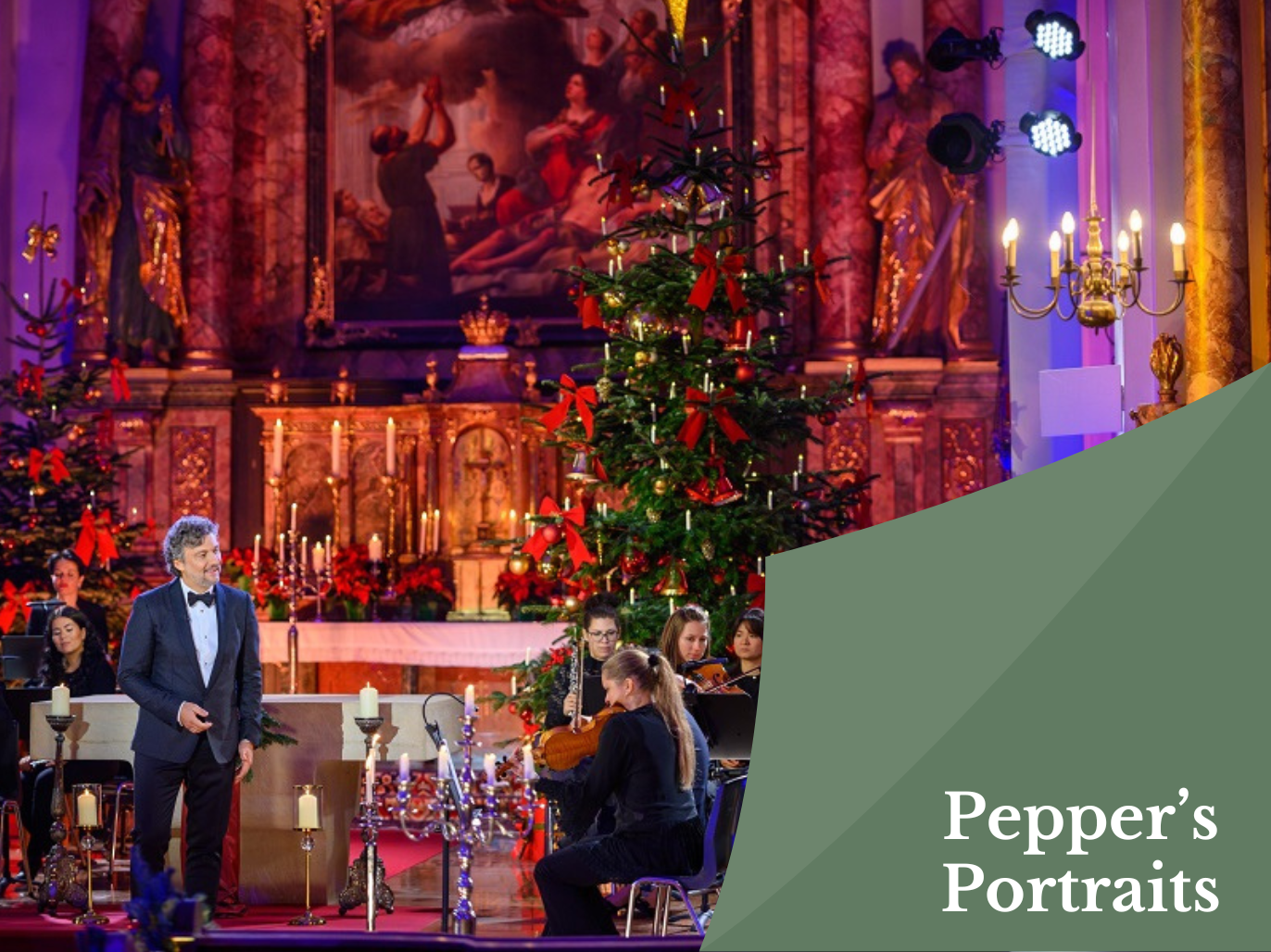
medici.tv have recorded superstar Jonas Kaufmann singing this classic: Jonas Kaufmann: It’s Christmas, alongside the Salzburg Chamber Soloists. 

Thanks for reading the column this year and for all your companionship, whether via my articles, broadcasts or compositions. I wish you a Merry and Peaceful Christmas – and a thoroughly musical 2026!

Written by Jack Pepper

Composer, Broadcaster and Writer

Jack Pepper (b. 1999) is one of the UK’s youngest commissioned composers and youngest-ever national radio presenter. He spent his teens composing for the Royal Opera House, Classic FM and Royal Liverpool Philharmonic Orchestra, and now has a major stage musical in development. Most recently, he premiered his song ‘Harmony’ for HM King Charles III, for whom the piece was written; Jack has been named one of The King’s Foundation’s 35 Under 35, recognising young ‘makers and change makers’ who represent the changes His Majesty wants to see in the world. As a broadcaster, aged 19, Jack helped to create Scala…

View author's page