
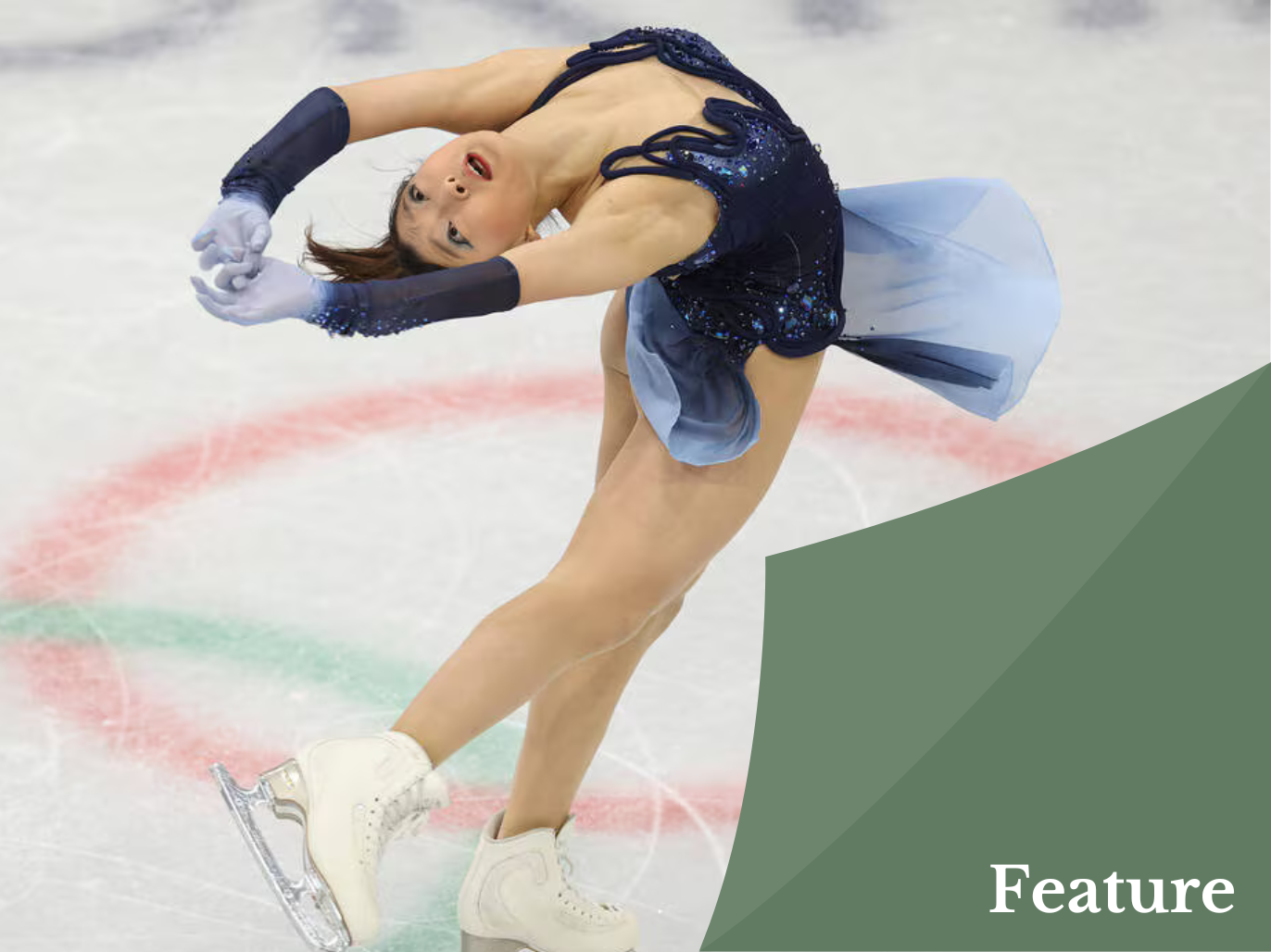
For over a century, ice skating has been a beloved part of the Winter Olympics. Since the sport’s infancy, music has accompanied skaters in their artistic and increasingly athletic routines. Figure skaters and ice dancers alike have long relied on masterpieces of classical music to take their programs to new heights. However, changing tastes and recent rule changes have ushered in the rise of pop music in figure skating routines. Is classical music on thin ice? We spoke to Kaitlyn Weaver, whose “brilliantly unusual” choreography appears on two Olympic programs this year, to learn more about how music is selected, why you might be hearing more Italian, and classical music’s enduring appeal.
View author's page
Reading time estimated : 13 min
Ice Skating from the Neolithic to Now
The term “figure skating” was first used in print in 1869 with the publication of the British book of the same name. Yet ice skating itself has existed for millennia. Evidence of iron-bladed skates in Scandinavia date back to 200 CE, and skates made using the bones of horses, oxen, and other animals have been dated to ~3,000 BCE. For the first several thousand years of its existence, the ice skate served practical rather than athletic or entertainment functions. Ice skating made long winter journeys easier and even turned the tide in battle. During the 1572 Battle of IJsselmeer, also known as the Battle on Skates, Dutch forces wearing ice skates soundly defeated invading Spanish troops.
The roots of competitive figure skating date to the late 1700s, but the sport found its footing in the nineteenth century. In the 1860s American figure skater Jackson Haines fled to Europe in the wake of the American Civil War; there he came to be regarded as the father of modern figure skating. Trained as a ballet dancer, Haines created figure skating innovations including the sit spin. Skating clubs on both sides of the Atlantic raised the sport’s profile, and in 1882 the first international figure skating competition took place in Vienna. The International Skating Union (ISU), the worldwide governing body for judging skating competitions, was founded a decade later, and in 1896—the same year as the first international Olympic Games held in modern history—the first World Figure Skating Championships were held in St. Petersburg, Russia. At the time, only male skaters competed.
Figure skating made its Olympic debut at the 1908 Summer Olympics in London, and in 1924 was part of the inaugural Winter Olympic Games in Chamonix, France. The first Olympic skating programs were accompanied by live music until the proliferation of recording technology allowed for pre-recorded tracks. Some of the earliest programs included George Enescu’s Romanian Rhapsody No. 1 in A Major and music from Jacques Offenbach’s Orpheus in the Underworld.
Thanks in large part to Swedish kater Ulrich Salchow (he invented the jump which now bears his name in 1909), figure skating became increasingly focused on athleticism, not just artistry. With the rise of competitions in the twentieth century, figure skaters have continued to push their limits both physically and artistically, a trend which continues to this day.
The Classical Music Connection
This year’s Olympic Games are held in Milan and Cortina, Italy. Known as an epicenter of fashion and art, Milan is also a global opera capital. La Scala, Milan’s grand opera house, has premiered some of the greatest operas of all time since its founding in 1778: the list includes Rossini’s La gazza ladra, Bellini’s Norma, Donizetti’s Lucrezia Borgia, operas by Verdi including Otello and Falstaff, and Puccini’s Madama Butterfly (retired French skater Surya Bonaly, the first Olympic figure skater to land a backflip on one blade in competition, skated to “Un bel dì, vedremo”) along with his final, uncompleted opera, Turandot.
“Olympic figure skating has always been more than just a sport—it may well be the most culturally charged event of the Winter Games.” — The New York Times
With Milan’s storied operatic history, it was inevitable that classical music would feature prominently in this year’s Games. As Chief Content Officer Alix Haywood noted, “The Opening Ceremony alone included classical legends Cecilia Bartoli, Andrea Boccelli, and Lang Lang, plus a trio of bobblehead-inspired marionette figures representing Verdi, Rossini, and Puccini—a striking image that was one of the buzziest moments of the evening.” To be fair, classical music has always played an important role in the Olympics, whether it’s Richard Strauss conducting at the 1936 Berlin Olympics or a staggering 84 pianists performing an abridged version of George Gershwin’s Rhapsody in Blue at the 1984 Los Angeles Summer Olympics.
No Olympic sport carries such strong associations with classical music as skating. Many pioneering figure skaters, including father of modern figure skating Jackson Haines, trained as ballet dancers. St. Petersburg, which hosted the first World Figure Skating Championships, was a central hub of Russian figure skating in the 19th century. The rise of Russian skating coincided with the golden age of Russian ballet, ushered in by Marius Petipa at St. Petersburg’s Mariinsky Ballet. In the Soviet era, the Moscow State Ballet on Ice and the Leningrad State Ballet on Ice were formed to translate classical ballet to skating. Today, some coaches use the Vaganova training method to instill ballet’s blend of artistry and athleticism in skaters. Ballet music remains a stalwart part of the skating canon, from Tchaikovsky’s Swan Lake to Delibes’s Coppélia.
Skating is one of the few sports, Olympic or otherwise, where music is a critical artistic component. Classical music has accompanied some of the most inspiring performances in skating history. At the 1984 Winter Olympics in Sarajevo, British skaters Jayne Torvill and Christopher Dean gave a now-legendary performance to Ravel’s Boléro. They received perfect 6.0 scores for artistic impression from all nine judges, securing the gold medal.
“What single piece of music has been performed to by more figure skaters than any other?” asks New York Times sports reporter Victor Mather. “No one knows the answer to this mystery, but we’re willing to bet it’s Carmen.” He was undoubtedly thinking of the “Battle of the Carmens” which took place at the 1988 Winter Olympics in Calgary. American Debi Thomas and German Katarina Witt both skated to an arrangement from Bizet’s opera. Their markedly different interpretations remain an inspiring part of the canon.
More than two dozen of the skaters competing at this year’s Olympics have skated to classical music this season. Their programs include staples of the figure skating repertoire: works by Tchaikovsky, Barber, Chopin, Offenbach, and Rachmaninov, plus Ravel’s Boléro and plenty of Carmen. There are also half a dozen overtly Italian works, including two pairs programs danced to “Caruso,” a song about the great Neapolitan tenor; selections from Puccini’s Madama Butterfly and Turandot; and Milanese composer Nino Rota’s score to Federico Fellini’s La strada.
Does the location of a competition influence musical selections? “1,000%” says choreographer and retired ice dancer Kaitlyn Weaver. “Because at the end of the day, you’re performing in front of an audience. If you can get the audience on your side, that’s a big boost not only to your performance, but there tends to be a boost in the marks.” Meryl Davis and Charlie White became the first Americans to win the gold in ice dancing when they skated to Russian composer Rimsky-Korsakov’s Sheherazade in Sochi, Russia. Weaver, who competed in the Olympic Games in Sochi and PyeongChang, adds, “I think of the audience as the tenth judge, and if the crowd is on their feet and they are screaming and you just had the skate of your life and it was the music that did it, then I think that the component scores are usually boosted a little bit.”
A Changing Landscape
Recent ISU rule changes, however, have brought about a dramatic shift in the figure skating soundscape. Following the 2014 Games in Sochi, figure skaters are now permitted to skate to music with lyrics (ice dancing has allowed music with lyrics since the late 1990s). The 2018 Winter Olympics in PyeongChang saw a blizzard of programs skated to popular music, and this year’s Games look to be the same. Both of the programs Kaitlyn Weaver choreographed for Milan are set to pop songs.
Many welcome this change, with National Public Radio heralding a “newer, edgier dawn.” Shortly after the rules change was announced, an ISU official said, “The young people requested to have vocal music with lyrics because it is more connected to the music of today, and they like to skate to the music they are hearing.” The rules change created a virtually limitless catalog of music and genres from which to choose, allowing skaters to put their own “spin” on their programs. For Weaver, the music itself can be a deeply personal choice. “If you tell me what music you like, I begin to learn a little bit more about you as a person.” She adds, “People want to stand out. I think that’s such a testament to Gen Z that individuality is actually celebrated.”
“There’s a reason why we still listen to Beethoven…. there’s something about classical music that is eternal.” — Kaitlyn Weaver

Pop music can also be easily accessible to audiences who are unfamiliar with classical music. “People like what they know,” Weaver says. “If you’re sitting in the crowd, there’s an inherent emotionality to lyrics because we’re human beings. We relate to it, we feel it. That’s a big part of trying to open up the sport, to have a bigger and more diverse audience.”
Not everyone views this change with the same optimism. The 2018 Games saw a sharp decline in the number of programs skated to classical music (one survey estimated a nearly 50% drop). This has led to worries that the figure skating canon and its long-held traditions will be forgotten, supplanted by whichever songs happen to top the charts that year. Pop music, some argue, cannot provide the nuance, drama, and artistry of classical music.
So does this spell the end of classical music in skating? Not quite. Mainstays such as Tchaikovsky, Chopin, and Ravel remain popular for a reason, providing a jolt of recognition to veteran judges and offering supremely beautiful accompaniment to skating routines. What some may view as “playing it safe” may be rewarded by judges who appreciate a nod to tradition. As pop songs comprise an ever larger share of programs, classical music may stand out as a bold, contrasting artistic choice. “I think that part of our job,” says Weaver, “is honoring our legacy and our traditions and making space for the new. Personally, I like to take something that we know—let’s say Carmen—and flip it on its head. That seems to be a theme that skaters are leaning more towards. We want to take the good—the incredible quality, the incredible drama, the musicality, all these things—and keep it moving into the twenty-first century.”
This year’s Olympics have also revealed a practical reason to choose classical music. Numerous skaters have been embroiled in complicated copyright disputes over their preferred music. Spanish figure skater Tomàs-Llorenç Guarino Sabaté, for example, nearly had to redesign his short program after Universal Studios refused to clear rights to music from the Minions franchise. Obtaining the rights to recordings of classical music, by contrast, remains far easier.
Classical music, whether in ice skating or broader popular culture, has felt the effects of a changing world. As it competes for attention in an increasingly crowded field, many wonder what role the art form will play in years to come. Weaver, a lifelong fan of classical music, isn’t worried. “There’s a reason why we still listen to Beethoven, you know? Because it is timeless. And there’s something about classical music that is eternal.”
