
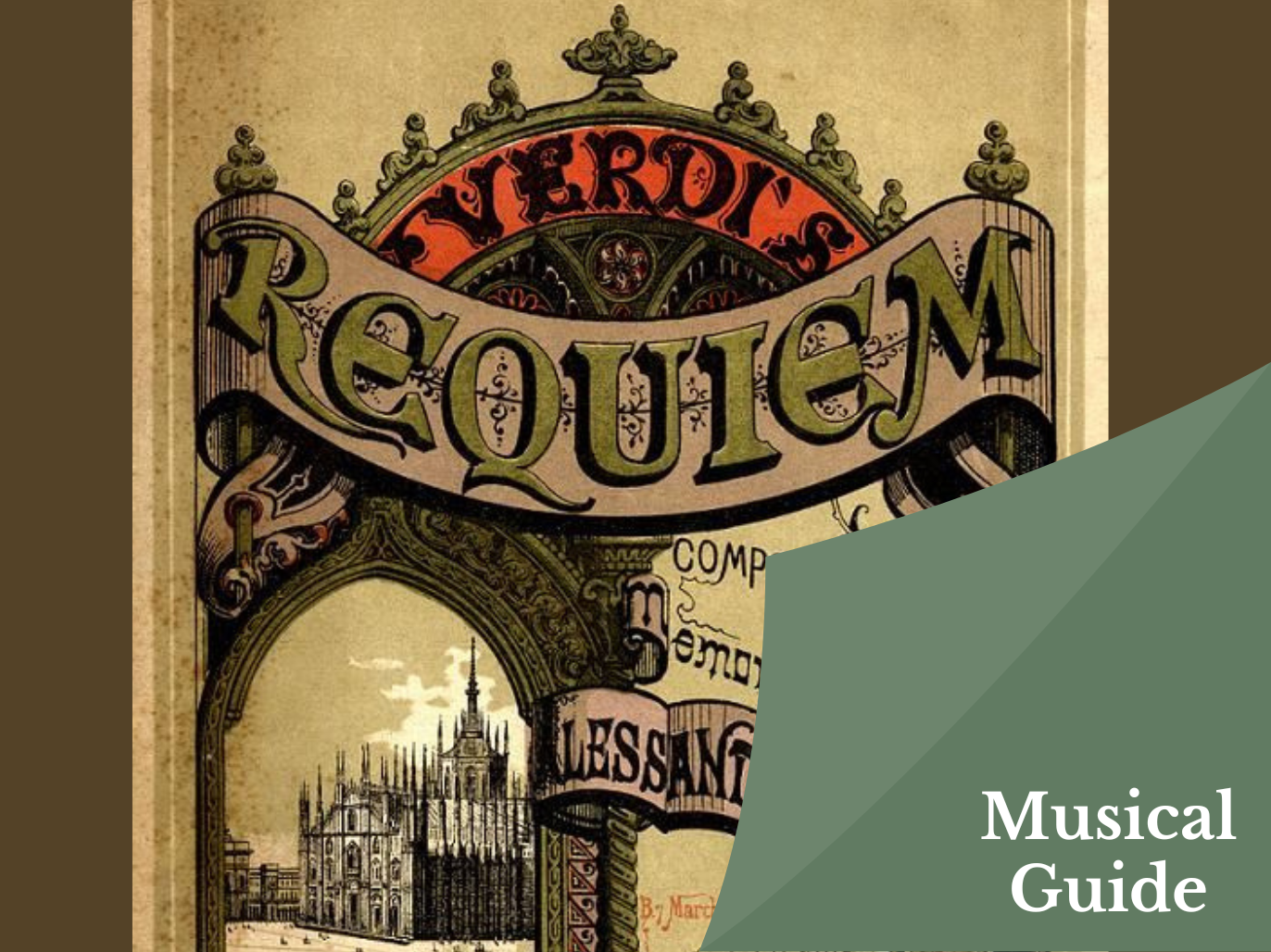
10 things to know about Verdi’s Requiem

From Rossini and Manzoni to thunderous Dies Irae and operatic controversy, discover 10 essential facts about Verdi’s Requiem, the dramatic masterpiece that transformed sacred music forever.

View author's page

By Nadya Miryanova

Reading time estimated : 8 min

“There are so many, many, many requiem masses; there’s no point in adding one more,” stated composer Giuseppe Verdi ahead of the premiere of his opera Aida. A critic had inquired whether Verdi would consider setting the entire text of the requiem mass to music, and the composer’s response was conclusive. Yet three years later, the first performance of his groundbreaking Messa da Requiem took place on May 22, 1874.

What prompted Verdi’s change of heart? And what is the narrative behind this composition? Here are 10 things to know about the history of Verdi’s Requiem, from the work’s unusual origins to its theatrical orchestration.

1 – The story of Verdi’s Requiem begins at the end

Verdi was devastated by the death of Rossini. Describing him as “one of the glories of Italy,” Verdi suggested a Requiem Mass be written in his memory by the country’s leading composers, and performed on the first anniversary of his death in 1869. He was assigned the final movement: Libera Me—a historic plea for mercy in the face of the Last Judgement. Although Messa per Rossini didn’t materialize, Libera Me remained and was transformed into the concluding seventh movement of Verdi’s Requiem

2 – Verdi revived the requiem to pay tribute to his literary idol

On May 22, 1873, Italian novelist-poet Alessandro Manzoni passed away. Verdi had previously described his book I Promessi sposi (“The Betrothed”) as “not only the greatest product of our times, but also one of the finest in all ages that has come from the human mind.” Manzoni was a literary titan and champion of Italian independence: a huge source of admiration for the composer. Overcome with grief, Verdi was unable to attend the public funeral and chose to visit the cemetery in isolation shortly afterwards. The composer soon approached the publisher Ricordi and proposed a requiem in Manzoni’s honor, to be performed on the first anniversary of his death. This time, he would work on the composition alone.

3 – The work was written in Verdi’s “retirement” period

After the immense success of his opera Aida, Verdi chose to “retire” from composing operas. Describing himself as a farmer who occasionally wrote music, he always showed a preference for the simplicity of country life. Once he had seen initial success with operas Oberto and Nabucco, he bought land in Busseto and built the Villa Sant’Agata near his birthplace. Verdi’s letters in the years 1871-1874 include little writing on music, focusing instead on livestock and crops. The death of Manzoni was the primary motivation behind his requiem. “Retirement” is a very loose term for Verdi’s activity and never fully arrived for the composer, as he went on to write two of his most beloved works after the Requiem: Otello and Falstaff.

4 – Its premiere was successful, but ignited a religious debate

Many Romantic masterpieces have failed to impress audiences at their premiere. Bizet’s Carmen caused widespread offence, Beethoven’s Symphony No. 3 was deemed too long, Verdi’s own La traviata was disastrous. The premiere of Verdi’s Requiem at the San Marco church in Milan was an overnight public sensation. Three performances at La Scala followed and the work was staged in Paris, London, and Vienna. Brahms famously said that “only a genius could write such a work.” Critical opinion, however, remained dividedmany labelled the requiem as “cheap” and “tawdry” due to its operatic nature. Conductor Hans von Bülow described it in print as “Verdi’s latest opera, though in ecclesiastical robes” and decided to skip the concert. He later apologized when profoundly moved by the work eighteen years later.

5 – Verdi was an agnostic who composed a Catholic work

Although much of Verdi’s music—including his Requiem—has profound spiritual overtones, the composer was an agnostic who remained deeply suspicious of organized religion. His second wife Giuseppina Strepponi first replied to a friend intent on converting Verdi in 1871 that her husband was an atheist, which she then revised to: “I won’t say atheist, but certainly very little of a believer.” However, writing to Countess Maffei after meeting Manzoni in 1868, Verdi said that he “would have knelt before him, if men might be worshipped,” regarding the author as a living saint. Manzoni himself was a devoutly religious man, a strong Catholic influenced by Jansenism, making the requiem format a fitting tribute to the novelist.

6 – The Requiem toured to a muted reaction in Britain

While Verdi conducted the Requiem to resounding success in mainland Europe, he played to half-empty houses at the Royal Albert Hall. The Requiem was likely considered too catholic to appeal to a larger audience in Protestant Britain. Verdi’s highly dramatic religious mass digressed from the spiritual consolation of contemporary works like Brahms’s Ein Deutsches Requiem that were instantly embraced by Britain. Performing with a chorus of over 1000 singers and an orchestra of 140, Verdi conducted the premiere but is said to have left the country early in disgust at the cooler reception.

7 – Women performing in this Catholic ritual was controversial 

The inclusion of female singers in Verdi’s Requiem caused a stir. In Verdi’s era, Catholic church rituals featured all-male choirs and male soloists. Female voices were banned from participation. However, soprano soloists and female choral vocalists were central to Verdi’s composition. To avoid conflict with the clergy, the premiere at San Marco Church saw the female vocalists wearing mourning veils and performing from behind lattices, so they would not be seen by the congregation. Critics were likewise sceptical of their inclusion in this operatic religious work, with Eduard Hanslick declaring: “When a female singer appeals to Jesus, she shouldn’t sound as if she were pining for her lover.”

8 – There were instruments behind the scenes

Verdi’s Requiem requires intense musical forces. Alongside a chorus and four soloists, the work is scored for two flutes, piccolo, two oboes, two clarinets, four bassoons, ophicleide, timpani, percussion, four horns, three trombones, and eight trumpets. Four of these trumpets are off stage, a dramatic device that is extremely impactful in the Tuba mirum movement. “Tuba mirum spargens sonum” (“The trumpet, scattering a marvelous sound”) rings out from the soloists: and the off-stage trumpets respond in antiphony to the trumpets seated on the stage. The sound of thunder is conjured through the bass drum, instructed to play at fffff. The off-stage trumpets create an echo that amplifies the terror and sudden nature of the Last Judgement.

9 – Verdi requires his soloists to take a leap of faith

The solo parts of Verdi’s Requiem are notoriously difficult and virtuosic. One of the most challenging (and terrifying) moments for the soprano soloist comes in the agitated tension of Libera me. They must sing an exposed octave leap to top B flat at pppp above the unaccompanied, sotto voce chorus, making it one of the most heavily scrutinized moments in the classical repertoire. Soprano Teresa Stoltzcelebrated by critics for her powerful range and pure tone, as well as for her stellar turn as Aidaperformed the role in Verdi’s premiere to high acclaim.

10 – The composer conjures earth-shattering power in his Dies Irae

Verdi’s Requiem is best known for its colossal second movement: Dies Irae, “the day of wrath.” Traditional liturgical settings prioritize a moment of sombre reflection. Not Verdi. The percussion is unleashed at fffff, scalic whirlwinds of strings and woodwinds underscore accented exclamations from the choir, the trumpets call out a terrifying fanfare. Verdi’s Dies Irae is a seismic depiction of the Last Judgement and a portrait of humanity in the depths of existential angst.

Verdi’s Requiem is an extraordinary musical monument in honor of Manzoni. But it ventures beyond the serenity traditionally associated with funereal commemoration, embodying a work of explosive contrast. Paroxysms of grief sit alongside pure stillness. In its operatic intensity, the Requiem not only showcases Verdi’s artistic originality, but reveals the complexity of the human condition and the turbulence that accompanies it.

Written by Nadya Miryanova

Writer

Nadya Miryanova is a writer, editor, and translator. She has worked on a variety of projects with medici.tv, including the Verbier Festival, the Singapore International Violin Competition, and Festival Singer-Polignac. Having graduated from the University of Cambridge with a degree in Modern and Medieval Languages, Nadya works as the Communications Assistant at Trinity Laban and supports event production at The Friends of Oleksandriya.

View author's page