
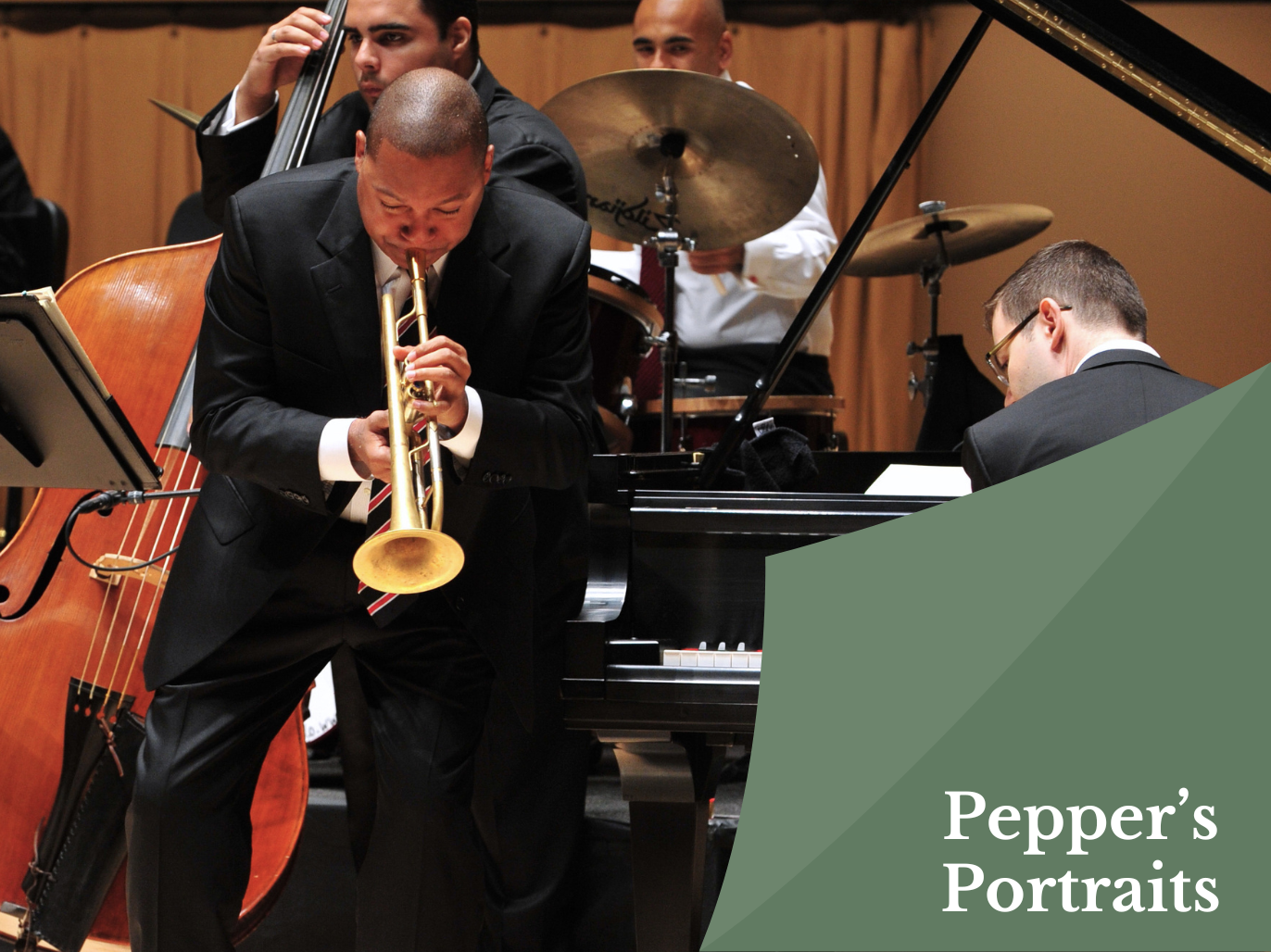
Wynton Marsalis: Jazz and Classical in the Same Breath

Four decades ago, a young trumpeter won Grammys in both jazz and classical in the same year. Now 65, Wynton Marsalis has founded an orchestra, made Pulitzer history and sparked debate along the way. Jack Pepper follows a musician who lives by one rule: the best way to be is to do.

View author's page

By Jack Pepper

Reading time estimated : 13 min

Turning 65 this month is a man who has crossed genre boundaries and challenged many stylistic clichés and assumptions along the way. Almost unique in pursuing both classical music and jazz at the highest level as a soloist, Wynton Marsalis has become a modern spokesman for the question of genre itself. He has fought hard to promote a view of jazz as a vehicle of technical sophistication, musical knowledge and thoroughness, placing it as an equal and a sibling to classical music rather than any lesser, rougher, earthier equivalent. His outlook finds a neat summary in his saying, “don’t settle for style. Succeed in substance.”

Or better still, substance achieved in style… In 1984, Marsalis made history by winning a Grammy in both the classical and jazz categories in the same year. He went on to become the first jazz composer to win a Pulitzer Prize. 

Marsalis once stated: “I’m not afraid of you being yourself. That’s America.” So, it feels extra appropriate in America’s own 250th year to mark a birthday for a true maverick who—like the American story itself—has fought hard for his vision and blazed his own trail…

Classical Beginnings

In many ways Marsalis was destined for music. Born in 1961 in New Orleans, the birthplace of jazz, his father was a teacher to the likes of Terence Blanchard and Harry Connick Jr. He even named his son after a jazz pianist, Wynton Kelly.

But it was the trumpet that came calling. It was while sat around a table with none other than Miles Davis that his dad joked, they might as well give Marsalis a trumpet too. Gifted an instrument at six, the boy only started serious studies and practise aged twelve after being captivated by a recording of Maurice André. When, years later, the pair met up, André called his admirer “potentially the greatest classical trumpeter of all time.” 

While jazz was the soundtrack of the family home, classical music was the sound of his school life. At fourteen he won a Louisiana state competition to appear as soloist with the New Orleans Philharmonic, with whom he played the Haydn Trumpet Concerto. At seventeen he became the youngest student ever admitted to the Tanglewood summer school, where soon he won the award for Outstanding Brass Player; for his audition, he chose Bach’s Brandenburg Concerto No. 2. By the time he left school, he had performed with the New Orleans Philharmonic, Symphony, Youth Orchestra… and a local funk band, “The Creators.”

When at eighteen he enrolled at Juilliard, it was to study classical trumpet; but to make ends meet, his spare time was spent in the original Broadway pit band of Sondheim’s Sweeney Todd (yes, that legendary production with Angela Lansbury). It was a dazzling kaleidoscope of practical experience in a short time—and professional demands only grew. Within two years, he had dropped out of university altogether to travel with Art Blakey’s Jazz Messengers sextet in the 1980s, before touring with a quartet spearheaded by Herbie Hancock. 

The latter’s example of crossing genres doubtless made an impression; Hancock himself had studied classical piano from the age of seven to twenty, and at just eleven had performed a Mozart concerto with the Chicago Symphony. The teenage Marsalis had quite a coterie of mentors and collaborators, surely helping build a very conscious sense of inherited tradition.

The Prodigy

His own star was rising rapidly. Marsalis was just twenty when, in 1982, his debut album was released by Columbia. Hancock himself produced and it won widespread critical acclaim. This was a proudly acoustic jazz in an era that had been broadening into jazz rock, electronic jazz and fusion. In shifting the emphasis back to a more acoustic, even classical tradition, Marsalis launched the so-called “Young Lions” movement which rekindled big label interest in young acoustic jazz players. In a way, he was taking jazz back to its roots.

Perhaps it was his love of acoustic jazz that informed his love of classical music, and vice versa: both showcase the proud virtuosity of an individual player, shunning electronic manipulation in favour of pure human achievement. Whether watching a classical concerto cadenza or a wild jazz improvisation, the effect is the same: to be awestruck at technical accomplishment and the power of a human spirit in song.

A year after his debut jazz album came his first classical recording, which saw Marsalis perform Haydn, Hummel and Leopold Mozart alongside the National Philharmonic Orchestra and Raymond Leppard. Here, history was made, with Marsalis becoming the first and only artist to win both classical and jazz Grammys in the same year… A feat he would repeat again twelve months later, with the albums Think of One and Baroque Music for Trumpet (this time showcasing Handel’s oratorio Samson, a rare concerto by Fasch and airs by Purcell, with the English Chamber Orchestra). Come 1984, he led a classical tour of 24 concerts with symphony orchestras across the US, Canada and Britain.

Still only in his mid-twenties, a “Wynton Marsalis Day” was already being marked annually in his hometown of New Orleans.

Impresario and Composer

Before the 1980s ended, Marsalis had added “impresario” and bandleader to his CV. One of his outstanding legacies is his creation of the Jazz at Lincoln Center Orchestra, which in its earliest days even boasted members of Duke Ellington’s band. His tight programming of so-called “Classical Jazz” was distinctive, with clear focuses on composition and form where other festivals leant more into eclecticism. Jazz at Lincoln Center became its own official organisation in 1996.

With such a bulky résumé so fast, it feels like his coming to large-scale composition aged thirty means Marsalis left writing relatively late! Although some originals appeared on his early albums in the 1980s, his first large-scale dance score was heard in 1992; then in 1997 came his famed jazz oratorio Blood on the Fields. This won him a Pulitzer Prize, the first jazz composer to be so honoured (and opening the gates for posthumous Pulitzers to be awarded to Duke Ellington, John Coltrane and Thelonious Monk).

Blood on the Fields is an epic two-and-a-half-hour meditation on freedom, following the story of two slaves with evocative movement titles like “Soul for Sale,” “Lady’s Lament” and “Freedom is in the Trying.” It is a familiar oratorio in its sense of sweeping drama, symphonic scale and spiritual meditation; yet stylistically—with amplification, wailing brass mutes and driving rhythmsit sits firmly within the geography its story describes. This is an American oratorio, if ever there was one.

Indeed, the Black American experience and spirituality are recurring themes in his compositions. Sample his Septet performing original works at the 1992 Munich Summer Piano Festival, with such titles as “Call To Prayer,” “Processional” and “Hymn.”

Always toe the line between sophistication and accessibility, Wynton Marsalis was only 31 years old when he performed “Call To Prayer,”  a track released in the following years on the album In This House, On This Morning, whose structure tells the story of an African-American sermon.

A classical framework has never been far from view. In more recent years, Marsalis has penned a Violin Concerto for his wife, Nicola Benedetti. It is a remarkable representation of their shared musical breadth; a solo whispered violin note ushers in four movements titled “Rhapsody,” “Rondo Burlesque,” “Blues” and “Hootenanny.” Benedetti reportedly asked for a piece that could “invite a diverse world of people into the experience of this piece.”

Marsalis has acknowledged that jazz and modern classical orchestras share a common language of texture and instrumental technique, but the question of improvisation can still prove very different between genres. As Marsalis commented: “the biggest challenges are how to orchestrate the nuance and virtuosity in jazz and blues for an ensemble not versed in those styles (a technical issue); and how to create a consistent groove without a rhythm section (a musical/philosophical issue).”

I for one always remember composing my first jazz piece aged seventeen and being baffled by the Canadian jazz musicians who said I could write merely “with a groove” above a given phrase, and they’d understand what rhythm I needed; until then, I was used to giving precise notation for symphony orchestras trained in the rigorously exact written tradition of classical music. For a young composer, this was freedom—and it’s a freedom that Marsalis has surely come to represent.

All Rise in Edinburgh

Freedom is at the heart of his composition All Rise, which inspired the theme for this summer’s Edinburgh Festival. Described as a “jazz symphony,” its twelve movements trace the progression of life from birth and self-discovery to maturity and reflection. Its musical style is similarly all-encompassing, traversing dancing juba rhythms, the blues, New Orleans funeral traditions and even an imitation of a train. 

The centrepiece of the festival’s opening concert, it brought together over 200 performers. We’re excited to be able to share it here on medici tv, with Marsalis and his Jazz at Lincoln Center Orchestra teaming up with the Royal Scottish National Orchestra, Edinburgh Festival Chorus and Jason Max Ferdinand Singers, conducted by James Gaffigan at the Usher Hall.

Debates and Disputes

Marsalis is not without controversy among jazz fans, criticised by some for providing too narrow a definition of the genre. Free jazz and the avant-garde are not to his taste. Indeed, the language he uses to describe jazz could apply as much to classical music, with his emphasis on clear structures and the importance of technical study; his jazz is the language of discipline and respect for history. 

His own website addresses the question directly, explaining (quoting an article he wrote for The New York Times in 1988): “My generation finds itself wedged between two opposing traditions. One is the tradition… that jazz broke the rules of European conventions and created rules of its own that were so specific, so thorough and so demanding that a great art resulted… The other tradition, which was born early and stubbornly refuses to die… regards jazz merely as a product of noble savages—music produced by the untutored, unbuttoned semiliterate for whom jazz history does not exist… Because of these writers’ lack of understanding of the mechanics of music, they thought there weren’t any mechanics… That myth is being perpetuated to this day by those who profess an openness to everything—an openness that in effect just shows contempt for the basic values of the music… Their disdain for the specific knowledge that goes into jazz creation is their justification for saying that everything has its place. But their job should be to define that place—is it the toilet or the table?” 

With such strong language, Marsalis shows himself to be among the first to champion the classical craft of jazz, bringing to mainstream stages its technical sophistication and the necessity of study. He is keen to challenge the ‘rough and ready’ image and in so doing, places it not apart from classical music but as its own equal and distinct, hard-won technical tradition. He has pointed out in interviews that even in classical pieces like The Prince of Denmark’s March, there is jazz; talking to the BBC in 2025, Marsalis explained “anything that has a harmonic progression and a melody, you can hear jazz in. It’s like reading something with a linguistic precedence, and then you’re free to do something of your own. It’s like a recipe where you know how to add your own ingredients.” 

But there is a wider, cultural implication to his argument. To Marsalis, jazz is at the heart of the American cultural experience. He has stated: “Jazz musicians… are searching for the freedom of ascendance. This is why they practise. Musicians like Art Blakey, Sarah Vaughan… and Betty Carter are rebelling against the idea that they should be excluded from choosing what they want to do or think, against being forced into someone else’s mould… They feel knowledge gives them choice; that ignorance is bondage.” Technical accomplishment, then, is at the heart of the jazz mission—since it is an aspiration to freedom and success.

America and a Bernstein for Our Times

In this way, Marsalis’s mission to place jazz as an equal discipline and craft to classical music is an assertion of the American Dream. To be American and to play jazz is to drive, to study, to work and aspire.

Despite criticisms of being conservative or rigidly old hat, in many ways his career is the epitome of the modern: the man who embraces TV and visual media as an educator, who sees the musician’s role in society as a galvaniser and unifier, with a CV that is the very definition of a portfolio career, and one that thinks nothing of jumping between genres and shared traditions. He proves that respect for the past can still root you in the present.

Many have drawn parallels with Leonard Bernstein. A kindred musical ambassador- spokesman of the first rank, Marsalis has travelled from classical to jazz, prodigy to elder statesman… He put it best when saying: “the best way to be, is to do.” 

Written by Jack Pepper

Composer, Broadcaster and Writer

Jack Pepper (b. 1999) is one of the UK’s youngest commissioned composers and youngest-ever national radio presenter. He spent his teens composing for the Royal Opera House, Classic FM and Royal Liverpool Philharmonic Orchestra, and now has a major stage musical in development. Most recently, he premiered his song ‘Harmony’ for HM King Charles III, for whom the piece was written; Jack has been named one of The King’s Foundation’s 35 Under 35, recognising young ‘makers and change makers’ who represent the changes His Majesty wants to see in the world. As a broadcaster, aged 19, Jack helped to create Scala…

View author's page