
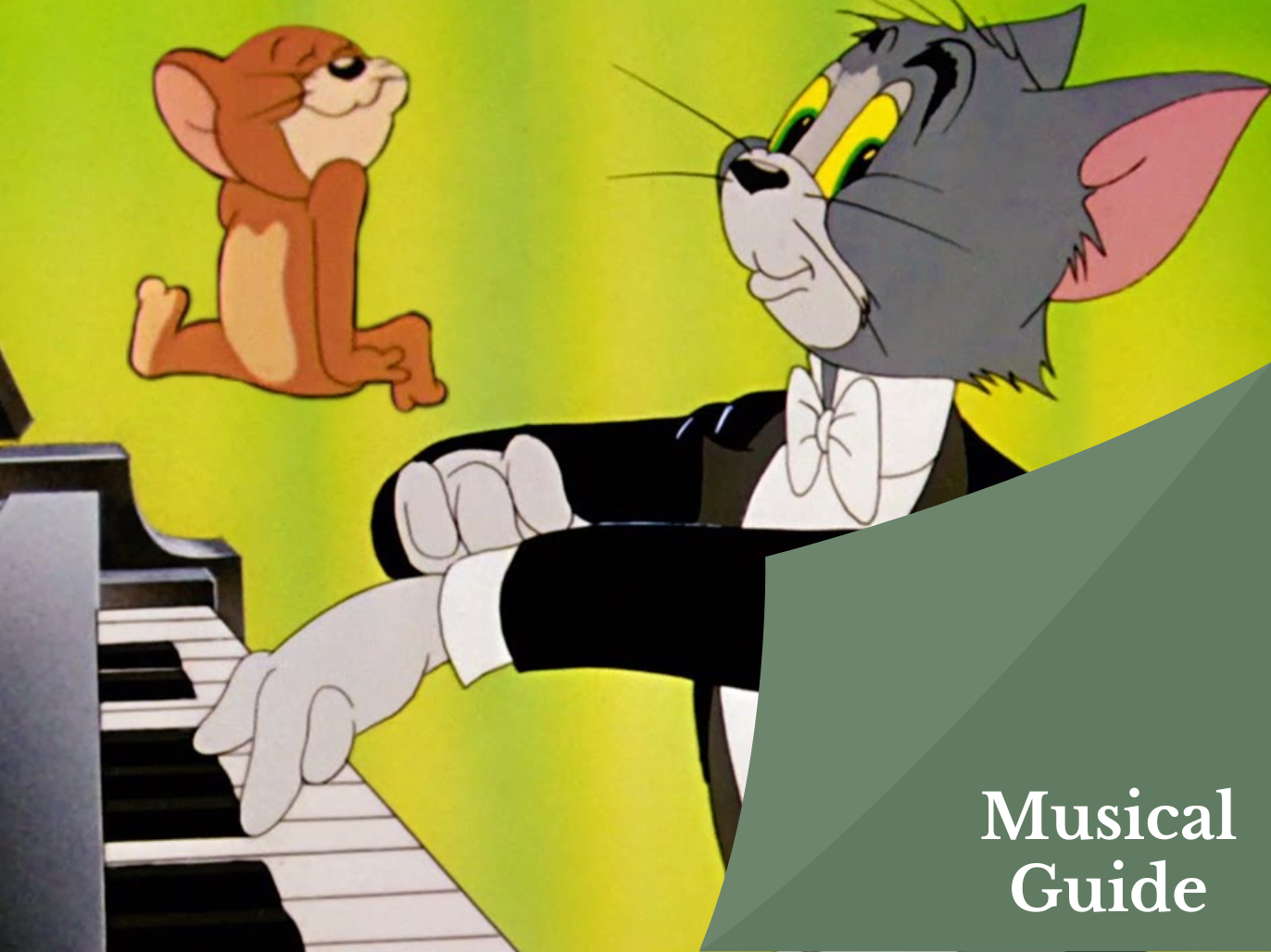
From the virtuosity of Tom Cat to the creative antics of the Pink Panther, cartoons have introduced generations of children to iconic compositions from the classical repertoire. Who doesn’t want to watch a feline in a tailcoat perform a concerto? The synchronization of music and animation makes the genre more accessible. As classic cartoons often use minimal speech, music is central to storytelling and character development. This format encourages the audience to ask questions about the soundtrack. What is this piece? How is the sound produced from those instruments? Could I make this sound too? Cartoons have fostered greater understanding of classical music and encouraged playful interaction with the genre.
View author's page
Reading time estimated : 7 min
Liszt’s Hungarian Rhapsody No. 2 — The Cat Concerto from Tom and Jerry
A grand piano takes center stage in the rivalry of Tom and Jerry. The audience are in for an expressive and eventful performance, featuring everything from a slamming lid to a sky-high piano stool. The cartoon opens up the world of Liszt’s virtuosity and professional performance, while introducing the internal mechanisms of the piano in a unique way. Initially focused on Tom’s playing, the camera pans out to show the moving hammers inside the grand piano. This demonstrates the basics of how the instrument works: pressing keys causes hammers to strike strings that vibrate and produce sound. Jerry, who lives inside the piano, comically emphasises the process when he rips out hammers from the piano and starts hitting the strings himself. The mouse successfully continues the composition while the cat is forced to keep up with the moving keys. The cartoon bears striking similarity to Rhapsody Rabbit, in which the protagonist also battles against a competitive mouse, but the Cat Concerto is more musically and technically accurate.
Mao Fujita performed a stunning rendition of Liszt’s Hungarian Rhapsody at the Fondation Louis Vuitton, blissfully free of small rodents. Liszt’s varied musical textures are brought to vivid life by Fujita’s formidable technique and abundant musicality.
Overture from Rossini’s The Barber of Seville — The Rabbit of Seville from Looney Tunes
Bugs Bunny, chased by Elmer Fudd, lures the hunter into a production of Rossini’s Barber of Seville at the Hollywood Bowl. Chaos ensues, as Bugs takes on the role of the barber and treats his client to a haircut he will never forget. Rossini’s fast-paced overture accompanies Bugs’s slapstick comedy, with a brief interlude of Mendlessohn’s Wedding March when Elmer and Bugs marry and fall into a Marriage of Figaro cake. Bugs casts himself as Figaro, using masterful disguises and quick thinking to outwit Elmer, just like Rossini’s protagonist manipulated Dr. Bartolo to get his own way. Through a parodied version of The Barber of Seville, the cartoon introduces the operatic stage as a memorable scene of drama and mischief.
Emilio Sagi’s production of Il Barbiere di Siviglia at the Teatro Real de Madrid is fantastic from start to finish. The cartoon’s overture is slightly abridged and accelerated, so why not listen to the original? The main section sparkles under the direction of maestro Gianluigi Gelmetti.
Beethoven’s Symphony No. 5 — Pink, Plunk, Plink from The Pink Panther
The Pink Panther is a violinist who sets off on a quest to play with the orchestra at the Hollywood Bowl. His aim is to perform his own theme music by Mancini instead of Beethoven’s Fifth Symphony. The four-note “fate” motif is central to the cartoon’s score, with the Pink Panther repeatedly interrupting it with the main melody of his theme. He’s a multi-talented musician, performing on the violin, trumpet, and tuba, before taking to the podium to conduct his theme in a triumphant finale. The cartoon effectively introduces the different instruments of the orchestra and shows how classical music can both blend and contrast with jazz.
The Berliner Philharmoniker’s performance of Beethoven’s Fifth Symphony under Claudio Abbado is legendary. There’s nothing quite like the drama of the first four-note motif, and the orchestra beautifully brings out the wide dynamic contrast between sections.
You’ll also be relieved to know that—unlike the panther—you don’t need to hide under the conductor’s suit to gain access to the Hollywood Bowl. You’re guaranteed the best seat in the house for performances with the LA Philharmonic via medici.tv, conducted by Gustavo Dudamel in Verdi’s Requiem and twentieth-century Argentinian music.
Overture from Rossini’s William Tell — Disney’s The Band Concert
Mickey Mouse conducts Rossini’s William Tell Overture with an outdoor orchestra, but his plans are foiled. Ice cream seller and flautist Donald Duck attempts to interrupt the concert and persuade the band to play folk song Turkey in the Straw instead, before a tornado hits. Through exaggerated movements, the cartoon shows how the instrumentalists take their cues from the conductor. When the tornado approaches, the houses and surrounding objects take off: the audience flee but the orchestra keeps playing. “The show must go on” to the most drastic degree. As the orchestra is swept up in the tornado, the musicians fly past household objects and revolve in circles around the conductor. Everyone—including the tornado—stops when the conductor stops. When Mickey continues, he lands on the ground while the band falls on tree branches, still playing and finishing the piece in time. It’s an extreme way of conveying a core pillar of orchestral performance: as long as you look at the conductor and follow his lead, everything will be fine.
Spared from hazardous weather conditions, Rossini’s Guillaume Tell at the Rossini Opera Festival is an outstanding production of the original French version. Juan Diego Flórez shines in the fiendishly difficult role of Arnold and the orchestra of the Teatro Comunale di Bologna flourish under the skilful baton of Michele Mariotti. The Storm section of the overture, with its dramatic shift in tempo and swelling crescendo, metaphorically carries all the drama summoned by the Disney tornado.
By integrating classical masterpieces into their cartoons, animators created imaginative and original entertainment that captivated audiences of all ages. But beyond the gags and slapstick humor lies a deeper message: the creatives dismantled the elitist perceptions surrounding classical music, demonstrating that it is—and always will be—for everyone.
