
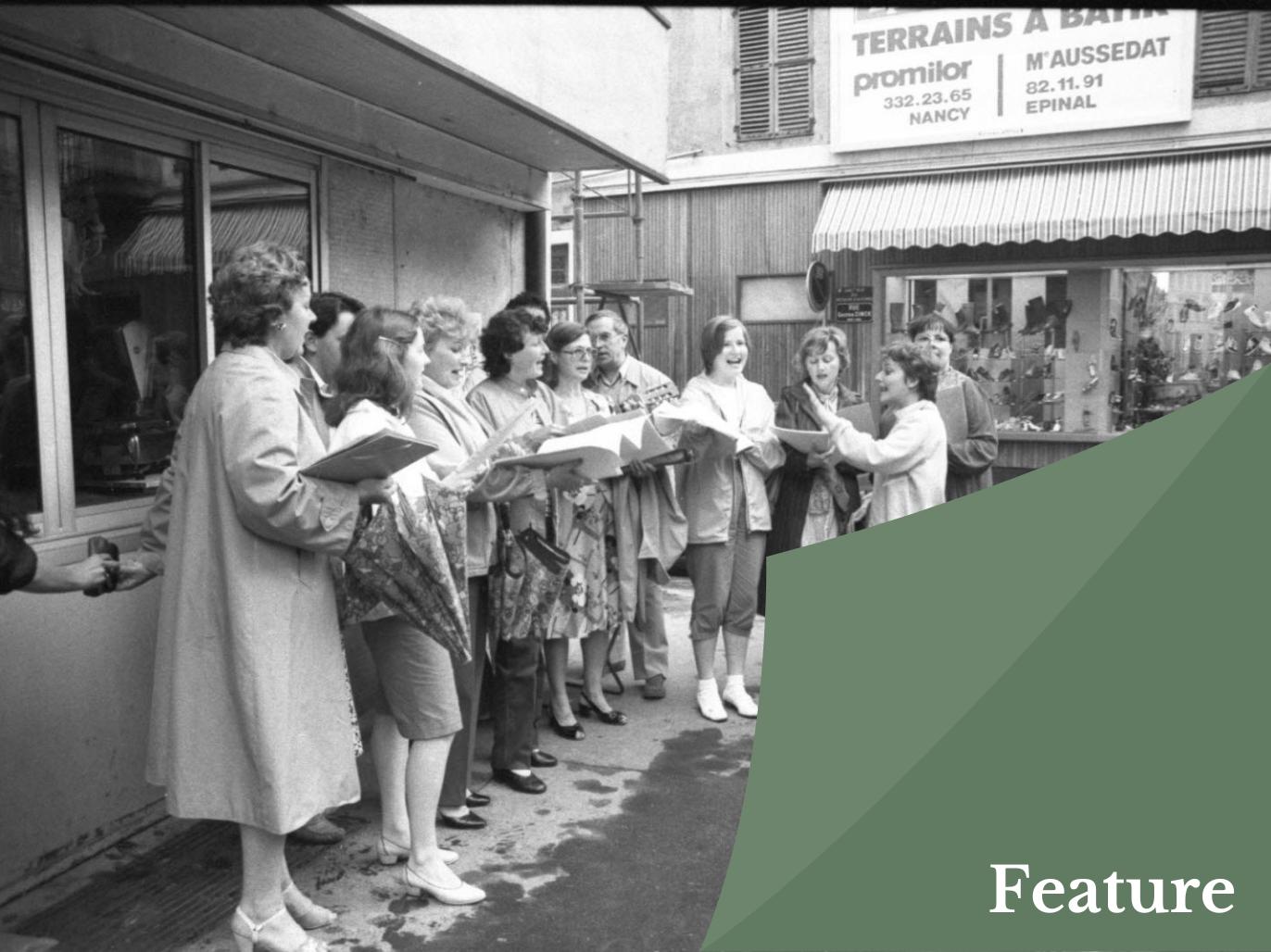
The Origins of World Music Day

Every year on 21 June, music spills into streets, parks, and public squares around the world. Now celebrated in more than 120 countries, World Music Day feels timeless—but its origins lie in a bold French cultural experiment launched in 1982.

View author's page

By Henri Gibier

Reading time estimated : 8 min

World Music Day is celebrated each year at the summer solstice on 21 June in over 120 countries and thousands of cities, becoming a global phenomenon that younger generations regard as a longstanding tradition. It seems natural to open up public spaces to all musicians—most of them amateurs—so they can unite in their love for music at the end of the longest day of the year. 

It is a French invention, and when it was first launched on 21 June 1982, the idea was met with great skepticism. “Even the Minister of Culture at the time, Jack Lang—whose name would become associated with the event’s global success—was only half convinced at that point,” recalls Maryvonne de Saint Pulgent, who chairs the Ministry of Culture’s History Committee. “The person who carried the project on his shoulders was Maurice Fleuret, then Director of Music in the Ministry of Culture. A former music critic at Le Nouvel Observateur, a fervent advocate for contemporary music, and promoter of street music through Lille’s Promenades musicales, this strong character devoted all his energy to convincing the music community and major musical institutions to support the movement.
As a result, the first World Music Day had a somewhat steadfast spirit. “Invited to play for free on the street, professional musicians were less than enthusiastic, and the heads of opera houses and major orchestras also had to be persuaded to step outside their usual venues,” recalls Maryvonne de Saint Pulgent. The decision to give the event a certain spontaneity and to emphasize its amateur aspect also led its founders to opt for a highly decentralized organizational structure across all cities in France. A study conducted by the ministry’s research department had just shown that nearly 5 million French people owned an instrument—one in ten at the time—and that one in two young people was interested in music. The last figure certainly helped to dispel the final reservations of Jack Lang, who had made youth access to culture his priority. 

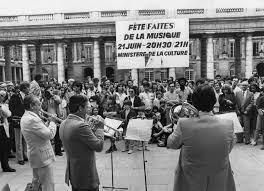
First edition of World Musique Day in France, 1982. © Radio France

In contrast to classical music, often perceived as elitist and primarily associated with older audiences, the new administration advocated a more inclusive approach to musical culture. It encouraged openness to all genres, sought to break down the barriers that divide them, and championed the right of everyone—including amateur musicians—to express themselves freely through music. The slogan printed in large letters on the posters calling for participation in the 21 June event emphasized its proactive nature, rather than its festive one: “Make music.” Unsure of its success, Christian Dupavillon—the other master of ceremonies alongside Jack Lang—had initially planned for this great moment of musical democracy to last only half an hour, from 20:30 to 21:00. A bit short for a party! French television networks refused to cover it. The police prefecture viewed these musical gatherings, scattered throughout every corner of the cities, with suspicion. It took Foreign Minister and opera fan Roland Dumas to intervene with his colleague at the Interior Ministry, Gaston Deferre, to get the prefectural blockade lifted.

On 21 June 1982, Jack Lang invited the French people to come out of their homes “to celebrate [the summer solstice] without inhibition… with their musical instruments.” In Christian Dupavillon’s mind, this was indeed a “demonstration,” a sort of “Music Pride”—so much so that they mobilized a truck driven by singer Jacques Higelin, which would follow the usual route of major labor demonstrations from the Bastille to the République. Very quickly, victory announcements began pouring in at Maurice Fleuret’s headquarters, where advisors could hardly believe the numbers. The impromptu concerts drew hundreds of thousands of French people, mainly in urban centers. At times, a kind of cacophony reigned, but less so than might have been feared, as the musicians generally respected one another. The quality of the performances inevitably had its limits, given this commitment to amateur musicianship. “In the gardens of the Palais Royal, there was a young man struggling with his cello, with the sound of water from the fountain flowing beneath the grating serving as a counterpoint,” recounts Maryvonne de Saint Pulgent. “I wanted to say to Maurice Fleuret: ‘It’s obvious you’re not a musician—you don’t play music like that.’” In any case, it was a triumph. The next day, Jack Lang accompanied François Mitterrand to Madrid. King Juan Carlos, who had come out to greet them on the tarmac, turned to the minister and asked him in front of the French president, “But what happened yesterday in Paris?” The gamble had definitely paid off.

The event was a success due to its popularity, but also because World Music Day had quickly taken on an international dimension. A close friend of Jack Lang, the actress and singer Melina Mercouri—his counterpart in Greece—launched the first event outside of France in Athens. In 1983, an international conference was organized under the auspices of the Council of Europe, with the idea of designating 1985—the tercentenary of Bach, Handel, and Scarlatti—as the European Year of Music. Maurice Fleuret proposed taking this opportunity to establish a European music festival. But he faced opposition from representatives of major musical institutions, including Rolf Liebermann—still basking in the glow of his tenure as Director of the Paris Opera and then heading the Mozarteum Summer Academy in Salzburg. Nevertheless, Jack Lang’s dream of seeing his World Music Day give rise once a year to “the world’s greatest concert” quickly took shape. After Athens, Luxembourg and Brussels joined in 1985, followed by Rome, Naples, Barcelona, London, Berlin… In Germany, the first major city to adopt the 21 June event was Munich, but it was the capital that provided the decisive impetus. More than 80 cities followed suit.

First edition of Make Music New York in 2006, ©makemusicny.org

In 1997, all the organizations in charge of the event across Europe gathered in Budapest to draft an International Charter for World Music Day, setting in stone the key criteria that define it: free admission, the date of 21 June, and openness to all genres of music and all audiences… Creating the event in America took a little longer. It owes much to Aaron Friedman, who brought the concept to his hometown in the United States in 2007 under the name, Make Music New York. In Latin America, singer Manu Chao played an important role in establishing the event.

“Jack Lang traveled the world, thanks to World Music Day,” Maryvonne de Saint Pulgent points out with a twinkle in her eye. “It was part of his international tours, much like the Mona Lisa and the Venus de Milo with André Malraux.” Strangely, the world that resisted this craze the longest was that of classical music, even though this gift to the world from France would not have been possible without the tremendous work of Maurice Fleuret’s predecessor as Director of Music, Marcel Landowski, who developed music schools across the country between 1966 and 1974. A prophet is not always honored in their own country.

In reality, the line between classical music and popular celebration is less clear-cut than it seems. Classical music, so often perceived as reserved for a specialist audience, is also shared in conservatories, music schools, choirs, and a whole network of amateur groups. It can even become a major popular event, as in 1991 when Luciano Pavarotti drew a crowd of nearly 125,000 to Hyde Park (as many as the Rolling Stones concert in 1969!).

Perhaps this is the true success of World Music Day. It serves as a reminder that—before being a matter of institutions, genres, or audiences—music is first and foremost a living art form, accessible to all.

Translation: Nadya Miryanova 

Written by Henri Gibier

Senior Editorial Advisor

Former Editor-in-Chief of Les Echos and Les Echos Week-End

View author's page