"Nobody Here Makes Music": Inside George Sand’s House at Nohant

She ordered his pianos, kept his accounts, and padded his doors against the noise of her own house. While Chopin composed upstairs at Nohant, George Sand was writing the great novel of music downstairs. It is time to read her again not simply as Chopin’s muse, but as the novelist, host, and collaborator who helped make that music possible.

View author's page

By Maria Matalaev

Reading time estimated : 21 min

In the first days of April 1839, from a rented room in Marseille, George Sand sat down to write to Camille Pleyel, one of the leading Paris piano makers and the one whose instruments Chopin preferred above all others. She was bringing Chopin back from Majorca. In a few weeks the two of them would go home to Nohant, the family house she had inherited in the Berry, a place she said she loved like a living creature that had always been good for her, calming and fortifying.

She explained what she wanted, everything already settled in her mind: a grand piano standing in the composer’s room when they arrived on the first of May. No more pianinos, the cramped little uprights he had been making do with. At twenty-nine he was no longer the drawing-room prodigy who had arrived in Paris a decade before; he had just spent the Majorca winter finishing the 24 Preludes, and he needed an instrument equal to what he had become.

Frédéric Chopin, Prelude in A major, op. 28 no. 7. Chopin completed the 24 Preludes on Majorca in the winter of 1838-39, just before the move to Nohant. This one, among the shortest, runs to sixteen bars: a single melodic idea, stated and then left hanging, a small example of how much he could say in very little.

Sand arranges every detail herself. Her own carter will collect the piano; if anything happens to it on the road, she will answer for it. At the foot of the page she notes the distance, seventy leagues, and the length of the journey, seven days. Then she adds one final request, writing a single word in capitals so there can be no misunderstanding: that he keep the secret of her SURPRISE.

And then comes the line worth pausing over, added to reassure a maker parting with a fine instrument for a country house he had never seen: nobody in my house makes music, she tells him, and Chopin alone will lay hands on this instrument.

By 1839 that was probably true, though it had not always been. The correspondence, which runs to twenty-six volumes in Georges Lubin’s edition, holds an earlier George Sand: the child taught the keyboard and singing by her grandmother in that same house; the young wife suffocating in her marriage who wrote that her husband had finally bought her a good piano; the woman of twenty-five who reported from Bordeaux that she was making a great deal of music in spite of her cough.

The grandmother who gave those first lessons was the natural daughter of a Marshal of France; the mother was the daughter of a Paris bird-seller; and the music belonged to the grandmother’s world. It was taught alongside drawing and dancing, as an accomplishment that would make a girl an agreeable wife, a training Sand attacked in Valentine, her second novel. Music as a young lady’s accomplishment and music as Chopin practised it upstairs were not the same thing, and she knew the difference.

It All Begins with a Piano from Marseille

By the autumn of 1831 she was in Paris, twenty-six, separated from her husband, living on what she could write and not much of it. The following year she published her first novel as George Sand, and the remaking was general: the men’s clothes she took to wearing, explained later in Histoire de ma vie on grounds of economy and convenience, had one advantage she mentions almost in passing.

Dressed that way, she could go down into the pit of the theaters, where the cheap seats were, where women did not go, and where the music was. Music was where she went when nothing else held. In her private notebook in 1834 she put down a plan: she wanted artists around her, and named them—Liszt, Delacroix, Berlioz, Meyerbeer.

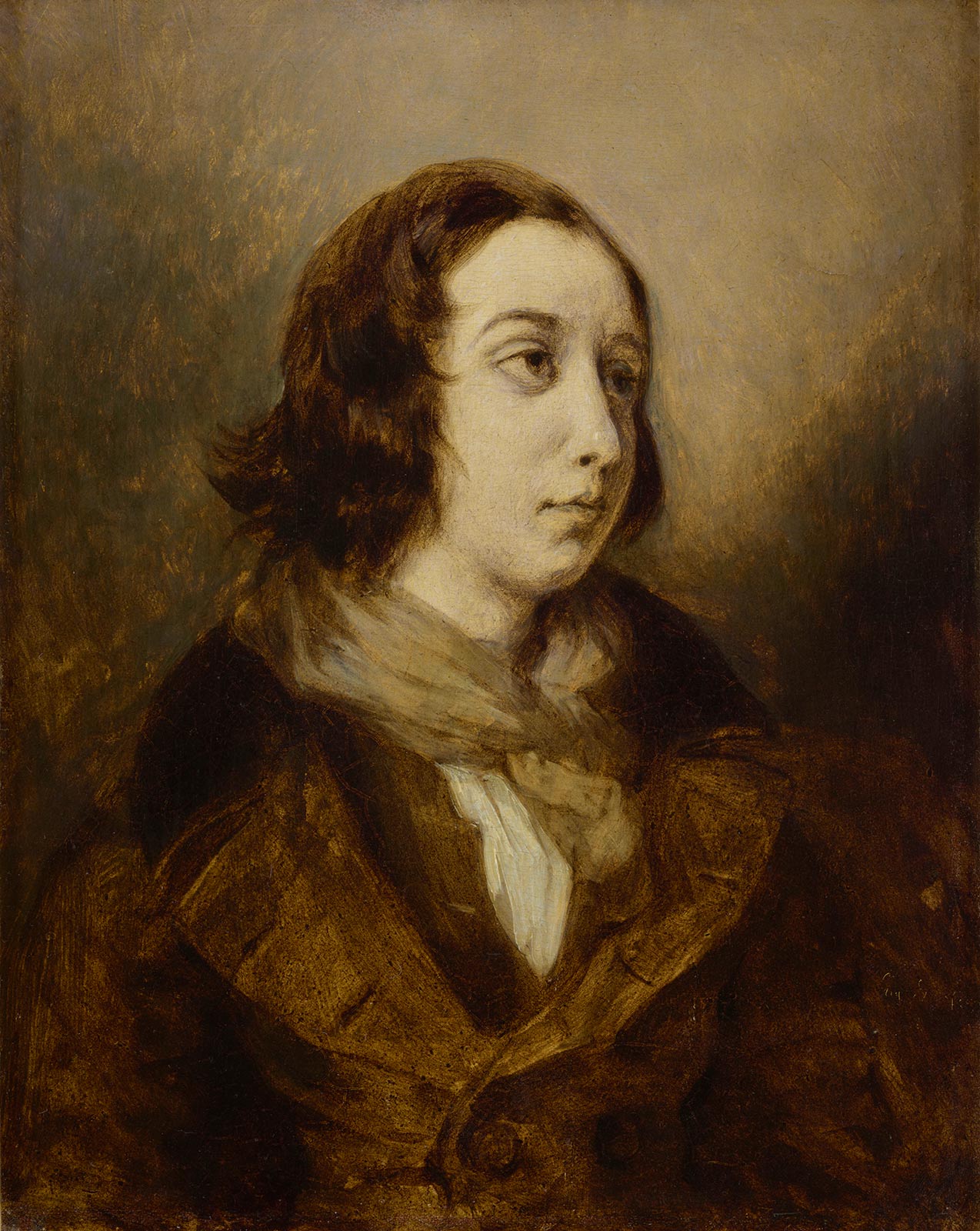
George Sand in men's clothes, painted by Eugène Delacroix in November 1834, shortly after she cut her hair following her break with Alfred de Musset. 

Franz Liszt was the first to come within reach, and in the autumn of 1836 he did her the greatest favour of all: he introduced her to Frédéric Chopin. It did not take, at least on his side. Chopin wrote home to Poland that he had met a great celebrity, Madame Dudevant, and that her face did not please him at all, that there was something in her that put him off. Liszt and Marie d’Agoult came down to Nohant the next summer; Chopin let two more summers pass before he made the journey.

At the end of May 1838, Sand wrote to Chopin’s compatriot and confidant Wojciech Grzymała a letter that runs to some five thousand words and is, from one end to the other, a deliberation: should this begin? She wants to know whether Chopin is still bound to the young Polishwoman he had hoped to marry, because if his heart is engaged elsewhere she will withdraw.

She weighs passion against friendship and the claims of the body against the claims of the work, and turns the whole question over with the thoroughness of a woman drawing up a contract. It is the same hand that would order the piano from Marseille a year later: before the affair had begun, she was already arranging it. By the summer they were together; by the autumn they were on their way to Majorca, and Nohant he had still never seen.

From the Quiet, Music That Asks for a Closed Room

When he finally came through the gates of the park, on June 1, 1839, the piano she had ordered from Marseille was waiting in his room. The house it stood in was a manor of 1767 at the edge of the village square, with no more grandeur, she said, than a villager’s cottage. The journey from Paris took eighteen hours by mail coach, if you were willing to sleep sitting up; the piano had taken seven days on the same road. After that first summer Pleyel sent a grand down every year.

In seven summers between 1839 and 1846, Chopin wrote or finished some forty works at Nohant, most of the great music of his maturity among them: the last two sonatas, the F minor Fantasy, the Barcarolle, the Polonaise-Fantaisie, the cello sonata, four sets of mazurkas. He composed; she ran the house, and kept the accounts. In March 1842 she wrote to her brother with the figures. Chopin’s concert in Pleyel’s rooms three weeks before had brought in over five thousand francs, more, she noted, than anyone took in Paris; he was resting now, giving lessons; she had sold five volumes to her publisher, enough to live on quietly through the summer.

Frédéric Chopin, Barcarolle in F sharp major, op. 60. Composed at Nohant in the summer of 1845: a Venetian gondolier’s song taken up and carried to concert scale, the work of the Nohant summers in miniature.

The tone of the household survives in a letter to the singer Pauline Viardot in the first days of October 1841. Sand is giving her a dressing gown: she made it herself, and it is clean, she insists, it has been washed. Chopin, she reports, is sending walnuts to Viardot’s husband and pears to Pauline. Then, at the foot of the page, a postscript in Chopin’s own hand: he has neither walnuts nor pears to offer, he writes, but he is himself the second of these, a poire, in the slang of the day, a fool.

The guest upstairs was also one of the house’s makers. In the evenings he came down to the piano while Maurice and the young people improvised pantomimes, steering the scenes from farce into solemnity and back with a change of harmony; Sand said later that the theatre of Nohant was born of those evenings. And through the summers her letters fill with diminutives for him, Chopino, Chip-chip, Chopinet, beside the other refrain, letter after letter: Chopinet’s rheumatism has come back, he is not well yet although he has spent the day in bed.

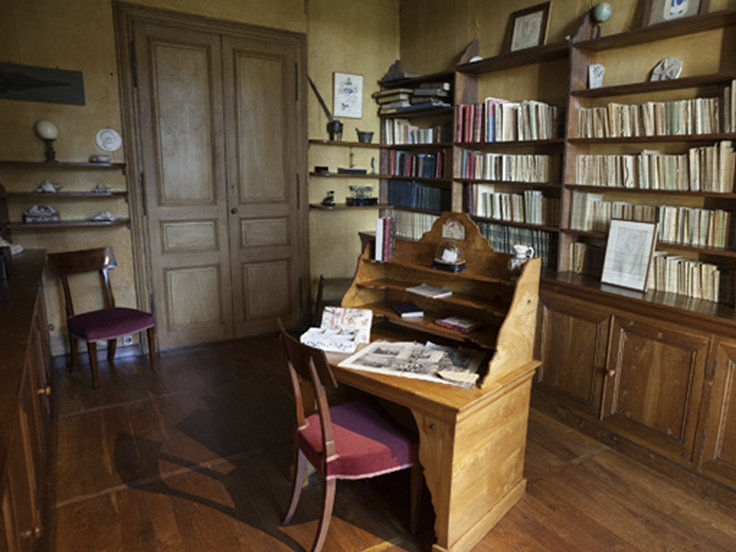
The quiet that let him compose was the same quiet his illness needed, and she provided both at once: she had the doors of his room padded, two panels stuffed with horsehair, against the kitchen, the bell-pulls, the servants’ clogs on the tiles. No one can prove the quiet got into the music, but the works of those summers turn steadily inward, the Berceuse spun over a single rocking figure in the bass, the Polonaise-Fantaisie opening as if overheard through a door: music that asks for a closed room.

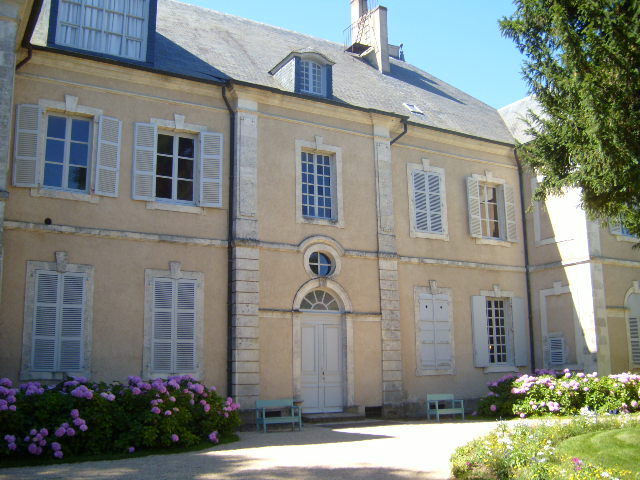
The house at Nohant, in the Berry, which Sand inherited from her grandmother and returned to every year of her life.
The house at Nohant, where Chopin wrote or finished some forty works between 1839 and 1846.

Two Workshops Resonating with One Another

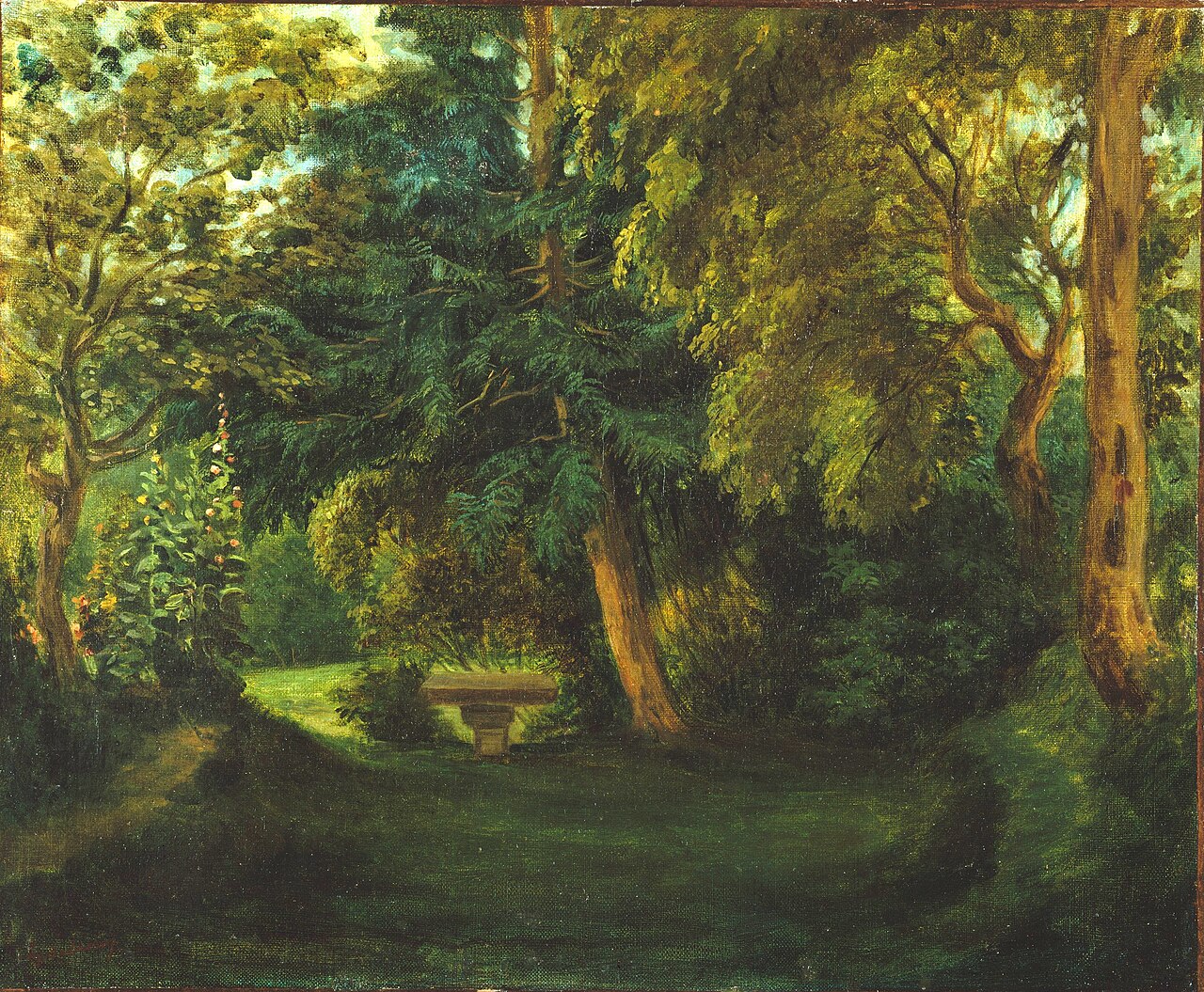
The garden at Nohant, painted by Eugène Delacroix during his stay in the summer of 1842.

She wrote at night. She rode during the day, played billiards in the evening, and slept in the morning. In a letter to Delacroix of April 1842 that sets out this schedule she reports that Chopin is still in pain and her daughter’s heart is still beating badly, and adds, without stopping on it, that she is the strongest of them all.

By the end of May she is writing to Delacroix again to get him to come, and the letter holds the whole house in three sentences. She has good tea and excellent cream for his breakfasts. She has a great quantity of Consuelo, her novel about a singer, to read to him, if he knows only the beginning of it. And Chopin has composed two adorable mazurkas which are worth more than forty novels, she tells him, and say more than the whole literature of the century.

What she was pricing can still be heard. The mazurkas of that summer went into the set published as opus 50, and the third of them, in C sharp minor, opens as a canon: one voice states the tune, the other follows a bar behind, the oldest device of learned counterpoint laid over the lilt of a village dance in triple time; towards the end the voices knot into chromatic part-writing that would not disgrace a fugue. A form danced at peasant weddings, worked with the full apparatus of the conservatoire: the argument Consuelo would spend a thousand pages making, carried out in a few minutes and without a word.

Frédéric Chopin, Mazurka in C sharp minor, op. 50 no. 3, played by Rafał Blechacz, winner of the 2005 Warsaw Chopin Competition. From the set Chopin was working on at Nohant in the summer of 1842: the mazurka that opens as a canon, the village dance and the learned counterpoint in the same few minutes.

Delacroix came, and from a room below the composer’s he wrote to a friend that when the household was not at dinner or billiards or out walking, Chopin’s music came up through the open window into the garden, mixed with the nightingales and the smell of the roses. The composing process sounded effortless; Sand, who watched it at close quarters, described the other side. The idea arrived whole, miraculous, on a walk or at the keyboard; then came days of shut doors, of pacing, of a single bar rewritten a hundred times, and often, at the end, the return to the version of the first day.

Every anecdote from those summers circles the same fact: for seven years, Nohant was a double workshop. Upstairs, by day, the mazurkas, the sonatas, the Barcarolle; downstairs, by night, the novels, and among them, in the very summers when Chopin was raising a village dance to the concert hall, a vast novel about a singer come up from the streets, and about what music is and who is allowed to make it.

The two bodies of work were not merely produced under one roof; they kept each other’s accounts. When Sand wanted to say what the mazurkas were worth, she priced them in her own currency: forty novels. And when she sat downstairs describing a musician of genius at work, she did not need to invent the sound; it was coming through the ceiling.

Nor was Consuelo a private manuscript. It was appearing in installments, as she wrote it, in the Revue indépendante, the journal she had co-founded the winter before; she was writing to a deadline, like a working musician with a concert announced. The novel of a professional performer was being made under a performer’s conditions. The heroine had a model close at hand. Pauline Viardot, the singer of the dressing-gown letter, was twenty-one that summer and the most gifted of her generation; born into a famous family of Spanish singers, raised in the profession and on its stages, she was living the life the novel describes. And it was to her, of all people, that Sand confessed the dream itself. In a letter:

Ah, how I wish I were fifteen, with an intelligent teacher and my whole life to myself. I would give my entire being to music, and it is in that language, the most perfect of all, that I would want to express my feelings and my emotions. I would want to make the words and the music at the same time. But that is a dream, like the dream one might have of an enchanted island at the moment the sea is about to swallow one for ever.

She wrote that from the house where, every summer, somebody upstairs was living that dream on her behalf. Or rather, the house was living it entirely: the words and the music, made at the same time, one floor apart.

Pauline Viardot, drawn by Sand's son Maurice around 1844. Singer, composer, and the model for the heroine of Consuelo.

“Simplicity Is the Essence of the Great”

The music Sand was arranging for other people, Chopin’s concerts and Viardot’s career, was the music of the salons and the opera houses. It was not the only kind she cared about. Until she was thirteen she had run more or less free at Nohant, playing with the children of the estate’s farm workers, and the music she heard then she went on hearing all her life: the bagpipers and hurdy-gurdy players of the Berry, at weddings and threshings a few fields from the house, whom she would put, years later, into a novel of their own, Les Maîtres sonneurs. She was not collecting the picturesque. The country dialects, she said, had a richness of verb and epithet that polished languages had lost, and she preferred the French her peasants spoke to the French of the Academy.

In the mazurkas the traffic ran both ways. The canon of opus 50 was the conservatoire reaching down into the village dance; the rest of their body is the village rising into the salon. The bass often holds a single sustained note, a drone, the sound of the bagpipe and the hurdy-gurdy under the melody; the accent falls where a drawing-room ear does not expect it, on the second or third beat of the bar, the stamp of a dancer’s heel; and the tunes keep reaching for the raised fourth of village scales, an interval that sounds strange, almost wrong, against the polished harmony around it.

Liszt, who had sat in the same rooms, devoted long pages of his 1852 book on Chopin to what the most refined pianist in Europe owed to the dance music of Polish villages. What Chopin was bringing into the salon through the bass of his mazurkas was the same drone Sand was hearing in the fields of the Berry. She made the case in fiction, and in Consuelo she stopped the story to make it in her own voice:

There is a species of music which may be termed natural, because it is not the production of science and reflection, but rather of an inspiration which escapes from the trammels of rules and conventions. Such is popular music, that of the peasants in particular. What glorious poetry appears, lives, and dies, as it were, among them, without ever having been correctly noted down… Educated musicians will not trouble themselves to collect them.

The peasant musician, she goes on, sings after the fashion of the birds, the nightingale especially: the same nightingales, a reader of Delacroix’s letters might note, that were singing in the garden under Chopin’s window. And one educated musician, one floor up from the page on which she wrote the reproach, was troubling himself very much indeed.

The novel is built on that conviction: that the learned and the popular music are finally one. Consuelo’s mother was a wandering singer; the child sang in the streets and on the highways before Porpora, the great singing-master, would take her; in Venice they called her the Zingarella.

On the novel’s second page the other pupils whisper that there is nothing to her: “She learns merely by rote; she follows to the letter the professor’s instructions, and her lungs do the rest.” What they mean as contempt Sand means as the whole point: the voice that has come up from the street is the real one. And when Porpora is asked what set his pupil apart, his answer could stand as an epigraph to the music being written upstairs: “simplicity is the essence of the great, the true, the beautiful in art.”

This is what the double workshop finally produced. The doctrine set out at night in Consuelo and the practice carried on by day in the mazurkas are the same argument in two languages: that art at its highest keeps faith with the song it came from. Neither made the other, but for seven summers each could hear the other through the floor.

Here, Pauline Viardot’s Havanaise. The model for Sand’s Consuelo, Viardot composed as much as she sang, including songs in a Spanish idiom. Writing from Nohant in July 1845, after hearing her sing one of her own, Chopin said he doubted one could hear anything better of its kind.

What the Fire Left Behind

The break came in 1847, over Solange’s marriage, Chopin siding with the daughter against the mother, a year after Lucrezia Floriani, the novel everyone but its author and its model read as their portrait. They met once more, by chance, in March 1848, on a staircase in Paris, and each wrote the scene down; the accounts do not match.

In his, he told her she was a grandmother, bowed, and left. In hers, she pressed his trembling, icy hand, wanted to speak, and he slipped away. He died in October 1849. Three weeks later Sand wrote bitterly that he had not spared one thought for her, who had nursed him nine years like her own son; she had misread a letter from Viardot, and by several accounts, at the end, he had asked for her.

As for what they wrote to each other across the nine years, it is almost all gone. Chopin had kept her letters; after his death his sister set out with the packet for Poland and had to leave it at the frontier, at Mysłowice in Silesia, where in 1851 Alexandre Dumas fils came across it and read the whole correspondence. Sand asked for her letters back, and burned them; only a handful of notes escaped. Their life together has to be read at an angle, through what she wrote to Pleyel, to her brother, to Delacroix, to Viardot: the letters that passed between the two of them are ash.

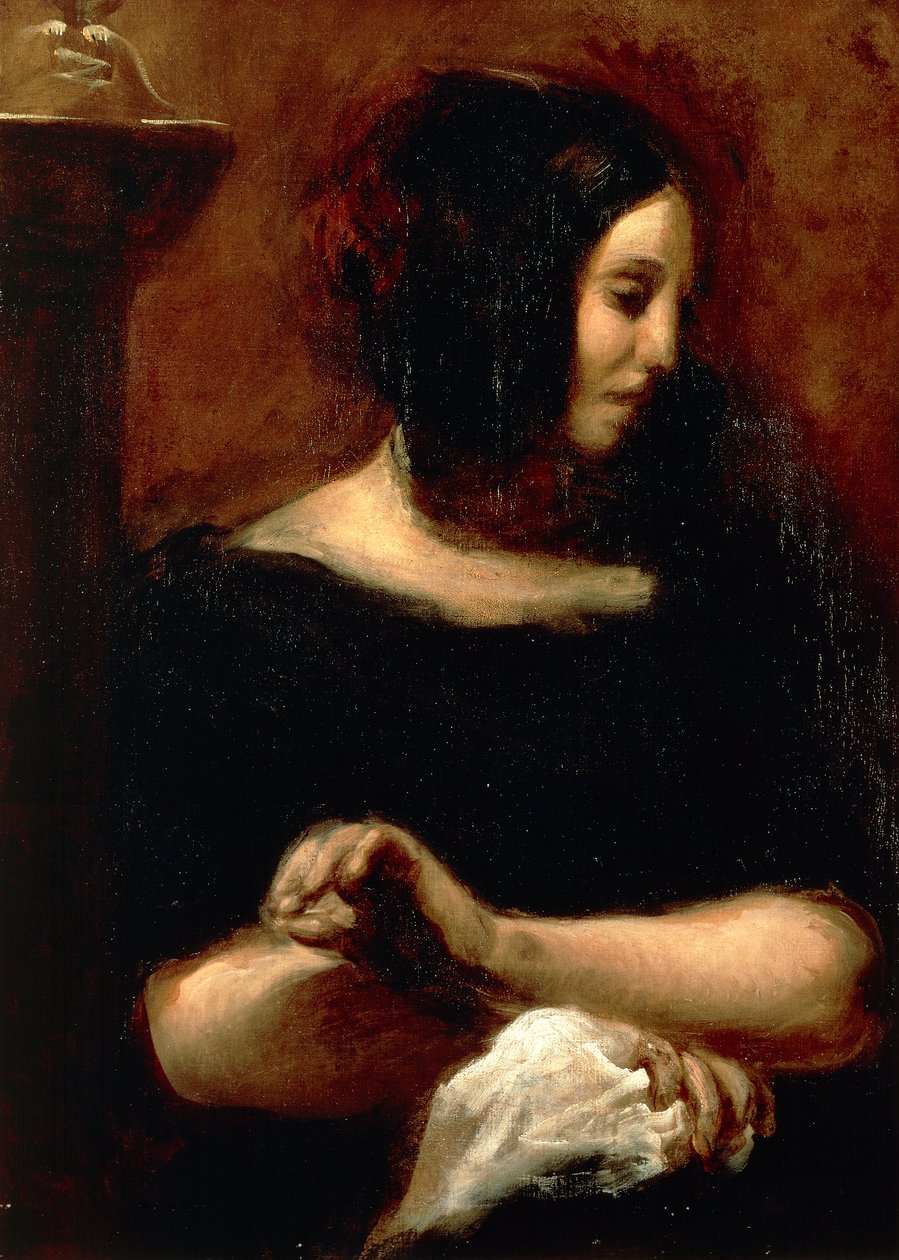
The Sand half of Delacroix's unfinished double portrait of 1838.

Delacroix had painted the two of them together in 1838, Chopin at the keyboard and Sand beside him, listening and sewing. He borrowed a piano to set the scene, and then never finished the canvas; the piano is the part he left unpainted. After his death the picture was cut in two and the halves sold separately, so that Chopin’s head now hangs in the Louvre and Sand, listening to a pianist no longer in the frame, hangs in the Ordrupgaard Museum in Copenhagen. No image says better everything the two of them were at once: a genius and his muse, and, in the same frame until the canvas was cut, a maker beside a maker.

Nohant, August 2026

This year, the hundred and fiftieth since Sand’s death, the old sheepfold at Nohant, which now serves the estate as an auditorium, holds the first Chopin-Pleyel competition. Twenty-six pianists have come from all over the world, Martha Argerich is its patron, and the rules carry one unusual clause: except for the concertos and the studies, everything they play was written or finished in this house. Each finalist must perform a complete set of mazurkas, the peasant dances Sand thought worth more than forty novels, as the final test before the prizes.

In 1839 a Pleyel took seven days on the road to reach Nohant, ordered from Marseille by a woman who assured its maker that nobody in her house made music. This August the competitors play on a Pleyel again, in the sheepfold, and almost everything the jury hears was written in the house behind it.

Upstairs, the padded doors are still in his room, almost the only physical trace of him left in the house. Her house is now a place where nobody does anything but make music. And she is where she was in the Delacroix: just outside the frame, listening, her hands busy, having arranged it all.

Further Reading

George Sand, Histoire de ma vie (1854–1855). In French: Gallimard, coll. Quarto, ed. Martine Reid (2004); in English: Story of My Life, ed. Thelma Jurgrau (SUNY Press, 1991).

George Sand, Consuelo (1842–1843). Sand wrote some seventy novels in every register: pastoral (La Mare au diable, La Petite Fadette), social, historical, fantastic, but Consuelo, the story of a singer, and its sequel La Comtesse de Rudolstadt have always been the musicians’ favourite. In French: Robert Laffont, coll. Bouquins, ed. Nicole Savy and Damien Zanone (2004), or Gallimard, Folio classique, ed. Léon Cellier and Léon Guichard. Quotations here follow the nineteenth-century English translation (A. L. Burt, New York).

George Sand, Correspondance, ed. Georges Lubin, 26 vols (Classiques Garnier). The letters to Pleyel, Grzymała, Delacroix, her brother and the Viardots quoted or paraphrased here are drawn from this edition.

Written by Maria Matalaev

Writer

Macha Matalaev was born in Paris into a distinguished family of Russian musicians: her grandfathers were Valentin Berlinsky, founder and cellist of the legendary Borodin Quartet for 64 years, and renowned conductor Lev Matalaev. Her father, Anton Matalaev, founded the Anton Quartet, and her mother is pianist Ludmila Berlinskaïa.

She began her career as a pianist, studying at the CRR de Paris and the École Normale de Musique A. Cortot. After completing a degree in Applied Modern Literature at the Sorbonne, she worked in art history before returning to music as a producer, later earning a…

View author's page