
What if a grand piano could perform for you? Picture an instrument that reproduces the artistry of the world’s greatest pianists, conveying even the smallest movement of the keys and pedals. The Steinway Spirio is a fully-functioning, handcrafted grand piano with “Spirio” technology that provides high-resolution playback. The integration of technology into a traditional instrument sparks debate about the instrument’s acoustic integrity and the accuracy of its playback. EMEA (Europe, Middle East, and Africa) Manager of Steinway Spirio Michael Geise takes us behind-the-scenes of the Spirio piano, explaining its cutting-edge technology and what it means for artists.
View author's page
Reading time estimated : 12 min
Steinway’s legacy and the “Spirio” technology
In 1853, Henry E. Steinway founded Steinway & Sons in New York City with the goal of building the best piano possible. Over the next 30 years, Henry and his sons developed the modern piano, building instruments that have become the top choice for approximately 95% of concert artists. Each Steinway consists of more than 12,000 individual parts, with several artisans working for up to one year to create one piano. The three models of the Steinway Spirio are no different, made of sustainably-sourced wood and metal. The standout feature is their technology. Geise reveals that initial development of the Steinway Spirio started in 2013 and the first model was introduced to the US market in 2015, before launching in Europe in 2016. This self-playing piano stores a catalogue of exclusive performances from Steinway artists—ranging from classical virtuosos like Bertrand Chamayou and Yuja Wang to jazz legends Thelonious Monk and George Gershwin—in an internal hard drive, controlled from a dedicated iPad. The Steinway Spirio | r was developed 3 years later: a model with additional technology that enables users to record, edit, and listen to their performances. Spiriocast was launched for the first time in 2021, offering live performances from one Spirio piano to another with unfiltered video and audio.
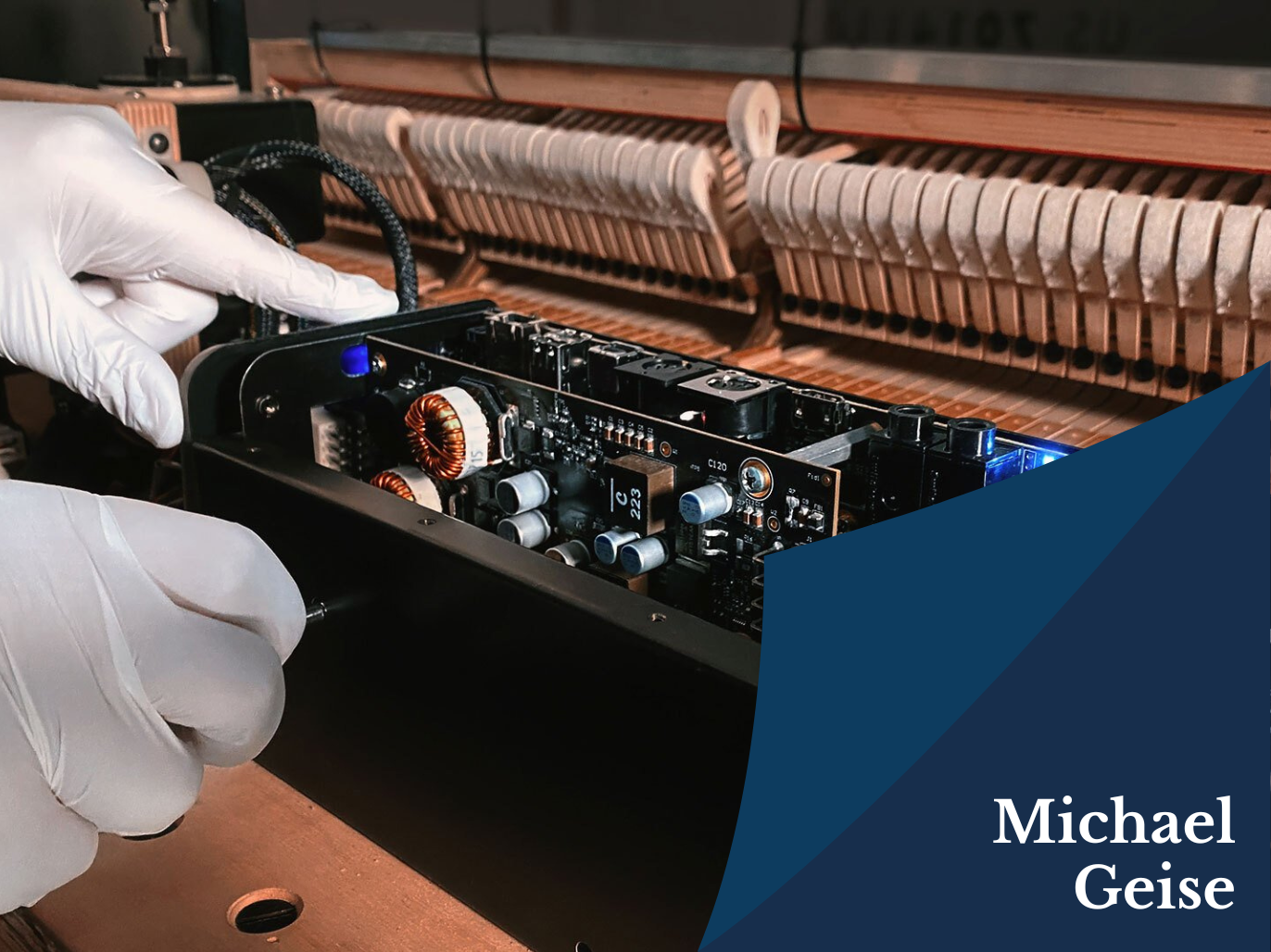
Geise explains that Spirio’s recording technology is based on light. A sensor system is built into the piano: performances are recorded by optical sensors (devices that detect light rays and convert them into electrical signals) mounted behind the keyboard that can measure the velocity at which hammers strike the piano wires whenever the keys are pressed. There are solenoids installed underneath both the keys and pedals: a solenoid is a small device consisting of a coil of wire and movable metal rod—called a plunger—inside the coil. When electricity flows through the coil, it creates a strong magnetic field that pushes the plunger up, driving the back of the key upward and making the front of the key go down (just like if a finger pressed it). This is used for capturing precise piano playback. There is also an integrated network module that uses the iPad to stream piano performances. The camera and microphone send their data to the server at the same time the piano data is being uploaded. The data is synchronized and sent to other Spirio pianos around the world.
The piano might be able to playback a pianist’s movements, but can it truly capture the human emotion of a performance? The subtleties in the pianist’s choice of timing, dynamics, articulation, and tone color are all integral to the beauty of a live performance. Geise believes that the Spirio’s recordings reflect this. “In the past, piano recordings were captured using MIDI. MIDI is a digital technology language that is standard in the music industry and it can control several instruments wherever they are,” he explains. “MIDI, as of today, has a resolution of 128 velocity levels, and this small capacity is not enough to capture the emotions of a pianist during their performance. As a result, our engineers developed a recording system which offers a resolution that is 8 times higher: we have 1020 velocity levels. There is no human being in the world that could play 1 single note at 1020 different volume levels, but by having this huge capacity in our recording system, we can capture the tiniest details and nuances of a pianist’s performance. When we playback the recordings, the music sounds very authentic and even the pianists recognize their playing. This is the main reason why Spirio has been successful.”
Challenging misconceptions
Adding technology to a classical instrument will inevitably invite scepticism, especially from traditionalists. Geise discusses the prejudices that the Steinway Spirio encounters and shares the ways they overcome them. “Many people, particularly the older generations, fear having technology in a very traditional instrument. If there’s a power cord hanging from the piano, it must be the devil inside! It’s commonly thought that the recording and playback capacity isn’t able to accurately reproduce a human performance. We have to explain to our customers, especially when it comes to institutional or artist use, that this is not the case anymore. Thanks to the high resolution recording, it’s an entirely original performance that plays back through the recorders for clients. People tend not to trust technology, but since we’ve had such a long development time and our engineers put so much thought into creating the perfect playback capacity, this is starting to change. Explaining this and inviting trust in the technology is the most difficult part.”
The artisans at Steinway install the Spirio technology at the time of manufacture, ensuring no alteration in the musical performance nor compromise in the instrument’s appearance. The only visible presence is the power cord—the rest of the technology is hidden from view. A roster of over 1700 Steinway Artists have recorded exclusively for the Steinway Spirio and more are added each month. This summer, Howard Jones released a neoclassical record called Piano Composed and its vinyl version is called Piano Composed, Spirio. The whole record was made on a Spirio piano because of its technology, granting the artist the possibility of creating sounds that you could never make with just two hands.
The reactions of artists and owners
Geise explains that the Steinway artists adapted to the technology very quickly. “They love it and they see it as a tool,” he says. “The SpirioCast option allows them to bring music to places they could never go—they can be in multiple places at the same time. The Piano Brothers, for example, used the Spirio technology to play duets with themselves, because an artist can pre-record two hands and then play along again with another two hands. This gives them an entirely new way of creating a performance.”
Spirio | r technology is also popular in the world of institutions, including music academies and universities, though it also took time to persuade professors. “The good thing about Spirio | r is that artists or students can record all their practice sessions from day one,” explains Geise. “The recordings are stored on the cloud free of charge, so a student can check their recordings and track their progress, creating a musical diary. Once you’ve completed a recording, you can open a note sheet, showing details of pedal movements and exactly how loud and long individual notes were. For example, if a professor interrupts a student and says that one note is always too loud within a chord and needs to be corrected, the student can open the recording and see exactly what the issue is. The professor can then use the technology to reduce the dynamic of this one note, making it less loud—immediately, the student knows how it should sound.”
Initially, however, the main customers of the Steinway Spirio piano were private people who couldn’t play the piano, but loved piano music. “They effectively used the Spirio piano as a jukebox, because our library offers about 5000 different music tracks and 130 live concerts on demand,” says Geise. “Every week, there are up to 2 or 3 different new live performances available through SpirioCast. They used it as a huge music record selection that covers different musical genres—pop, classical, jazz—and it animated their daily lives. These kinds of customers listen to a lot of popular music specifically, so it’s one of our strongest categories. This is followed by classical music and jazz.
“We developed Sprio | r technology on the back of feedback from our artists. They said that they wanted to listen to themselves and requested a recording feature. Artists use Spirio for composing and practising—for professionals, it’s very important to experience how they sound from the audience’s perspective. Since we have the recording function, the artist is able to listen to his own performance for the first time in his life from the audience’s vantage point. This helps them to develop their performances—they can understand how to adjust small elements according to the public’s needs.”
Spirio | r has also dramatically changed the way pianists can produce music for records. “In the past, the pianist had to book a recording studio for a time slot. Artists are very expressive when they perform—they move a lot, breathe heavily, and sometimes hum along to their playing. This is something you can’t do with a recording because these sounds cannot be erased: the artists have to be quiet and as a result, they’re not fully relaxed during the recording,” Geise explains. “With Spirio | r, the artists can do whatever they like in front of the piano because we capture the piano audio and the artist can be much more relaxed. The production is also much more detailed in the end.”
Several new features will be launched in the future that remain variable and confidential. “The most important thing is that we are working on the technology and every Spirio piano owner will confirm that this is the case,” says Geise. “Feature-wise, we offer 2-3 updates per year and the Spirio app will also be updated 3-4 times a year, offering new features and add-ons that customers can use. We are also working on some solutions for institutional use, as network structure can sometimes be fragile and we need to work with that.”
Championing innovation in the digital age
While most of us normally hear world-class artists from a distance, the Spirio makes it possible to hear them close-up in their entire range of motion and emotion. The constantly updated Spirio library includes over 4000 recordings and over 100 videos, with all music recorded live in Steinway’s recording studios in New York City and Hamburg. The recordings range from Bach and Beethoven through to Irving Berlin and Billy Joel. Steinway also employs musicologists who recreate archival recordings—programming a single minute of archival music generally takes between 40 and 60 hours. Through the use of proprietary audio translation software, the Spirio Library includes performances by Steinway immortals like Gelnn Gould, Duke Ellington, and Sergei Rachmaninoff. “Hearing is believing,” says Geise. “If institutions have concerns in using Spirio technology, we invite them to our showrooms or we come to them and do demonstrations. We have to be proactive and show people that technology is not an enemy anymore and it can be a very good friend. When they see how Spirio works and how easy it is to control this technology, they are convinced. It’s just like playing back Spotify music from a device. People were also concerned at the beginning that we were trying to keep artists out of the picture and just capture their work, but that couldn’t be further from the truth.”
“We are not using any kind of AI from inside or outside to copy an artist’s performance. This is impossible. It’s definitely not possible for the Steinway Spirio to create music and a performance by itself using its music library. We also secure the artist’s work that is stored on our piano—there is no analogue audio available and we really take care of their work. We always need a human being with two hands and ten fingers to bring their emotions to the keys. Technology can never, ever perform like that by itself.”
Given the fast pace of AI development, it’s encouraging to know that Steinway continues to place pianists at the heart of its creative strategy. As Geise says, Spirio can reproduce the magic of a live performance, but it could never replace it. This is the balance that Steinway strikes with its Spirio pianos: maintaining a respect for the acoustic tradition of the grand piano, while paving the way for the future of music recording.
