Listen Closer: Mozart’s Symphony No. 40

As we commemorate Mozart’s 270th birthday this week, take a moment to discover the musical pillars of his tempestuous Symphony No. 40.

View author's page

By Nadya Miryanova

Reading time estimated : 6 min

Composer Robert Schumann famously described Mozart’s Symphony No. 40 as a work of “weightless, Hellenic charm.” This nineteenth-century reception resonates with Mozart’s image in popular culture as a prolific creator of light Classical music. Symphony No. 40 adheres to the ideals of the Classical period. It employs traditional orchestration in a standard four-movement structure. Musical ideas are balanced and gracefully phrased. So why did modern musicologist Charles Rosen call this same symphony “a work of passion, violence, and grief”? 

Written in 1788 at a time of personal and professional hardship, Symphony No. 40 is one of only two symphonies that the composer wrote in a minor key. From his poignant String Quintet No. 4 to Pamina’s aria “Ach, ich fühl’s” in The Magic Flute, Mozart’s works in G Minor carry a strong sense of angst and tragedy. The harmonic dissonance and restless tempo markings infuse the work with dramatic tension, showing the influence of the artistic Sturm und Drang movement that prioritized emotion over rationalism. Mozart’s Symphony No. 40 is a work of profound emotional depth, with musical themes that are formally rooted in the Classical tradition but characterized by Romantic expression. 

An intentional contrast

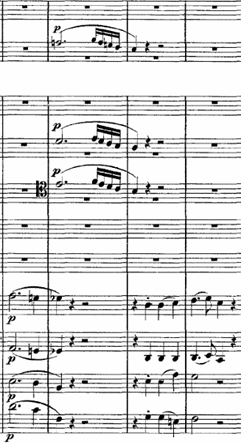
The first movement of Mozart’s Symphony No. 40 is in Sonata Form, a typical Classical structure that organizes the movement into three main sections: Exposition (introducing the melodic themes), Development (exploring the themes), and Recapitulation (the themes return to the tonic key). Entering via the violins in the opening bars of the piece, the agitated main theme is the most recognizable feature of the symphony. It starts with a three-note motif that is followed by a rising sixth, ending on an uncertain note. The next few bars present a step-like resolution.

This is a textbook example of periodic phrasinga cornerstone of Classical music—meaning that musical ideas are organized into balanced structures that function as a question and answer. However, the molto allegro and chromatic nature of the motif create a sense of instability that is more Romantic in nature. This melody is undoubtedly distinctive and has been widely used in popular culture, from the 1990s Nokia ringtone to TV shows like Frasier. Yet the symphony’s complexity has often been eclipsed by this famous introduction. Around 40 seconds into the movement, we hear a contrasting theme—one that is equally as compelling as the first.

The mood shifts, replacing the stormy intensity of the main theme with a warm melody in the relative key of B-flat Major. 

Played in lighter orchestration, the melody is smooth and lyrical, alternating between the strings and woodwind in balanced phrasing. Having two contrasting subjects (or themes) was typical for the Classical Sonata Form. We might also expect the major key to bring a more joyful feel to the music. However, falling semitones and leaning notes characterize the melody: the music releases a deep chromatic sigh. The tone remains unsettled, carrying a quiet melancholy as the tension introduced in the opening theme never fully dissipates.

Watch how Benjamin Britten sculpts these strikingly different lines of music with the English Chamber Orchestra:

Variations on the two themes 

The themes return unabridged during the first movement’s Recapitulation. The first theme sets out in the tonic key of G Minor, but takes an unexpected detour to the second subject. Notice how the sense of warmth has filtered out of the slower melody. It arrives in the same minor key with a much darker character, emphasizing the symphony’s tragic tone. Sir Simon Rattle demonstrates this emotional rollercoaster and sombre transformation in all its color with the Berliner Philharmoniker at the Lucerne Festival.

Although neither subject is directly stated outside of the first movement, the two themes cast a shadow across the rest of the work. Listen to the first few minutes of the second and fourth movements. Zubin Mehta softly introduces the brushstrokes of the Andante with the Münchner Philharmoniker. The wistful character of the melody, performed in E-flat Major, evokes the sighing musicality and contours of the second subject (particularly at 22:11).

Meanwhile, the Allegro Assai finale reintroduces the restless, driving rhythms reminiscent of the first theme and broadly follows its melodic arc. The minor-key unease of the symphony persists until the end. With stunning technicality and precision, Krzysztof Urbański leads a perfectly controlled rendition of the final movement with the Warsaw Philharmonic.

Mozart’s Symphony No. 40 represents the pinnacle of the composer’s orchestral writing. Written three years before his premature death, the symphony is often referred to as the “Great G Minor Symphony” and it’s not difficult to see why. Beyond the charming Classical form lie complex themes that are brimming with passion. Out of the three symphonies that Mozart wrote in the summer of 1788—including the vibrant Symphony No. 39 and majestic Symphony No. 41—Symphony No. 40 stands out as the most ardent and intense. The work paints a complete image of the composer’s music, connecting the Classical tradition with the dawn of early Romanticism and showing how his art evades strict definition.

Written by Nadya Miryanova

Writer

Nadya Miryanova is a writer, editor, and translator. She has worked on a variety of projects with medici.tv, including the Verbier Festival, the Singapore International Violin Competition, and Festival Singer-Polignac. Having graduated from the University of Cambridge with a degree in Modern and Medieval Languages, Nadya works as the Communications Assistant at Trinity Laban and supports event production at The Friends of Oleksandriya.

View author's page