
Can Architecture Shape a Performance?

Today’s concert halls alter more than acoustics: they influence musicians’ mindset, audiences’ connection, and the evolving identity of classical performance.

View author's page

By Andrew Mellor

Reading time estimated : 14 min

Apparently, it’s not just me who’s partial to a little Scandinavian design. A couple of weeks ago we learned that Hamburg’s new opera house will be built to a concept by the Copenhagen architecture firm Bjarke Ingels Group (BIG). 

Then, just a few days later, the city of Düsseldorf announced the architects for its new opera house: Snøhetta in Norway, the company responsible for Oslo’s amphibious opera and its soon-to-be-built counterpart in Riyadh.

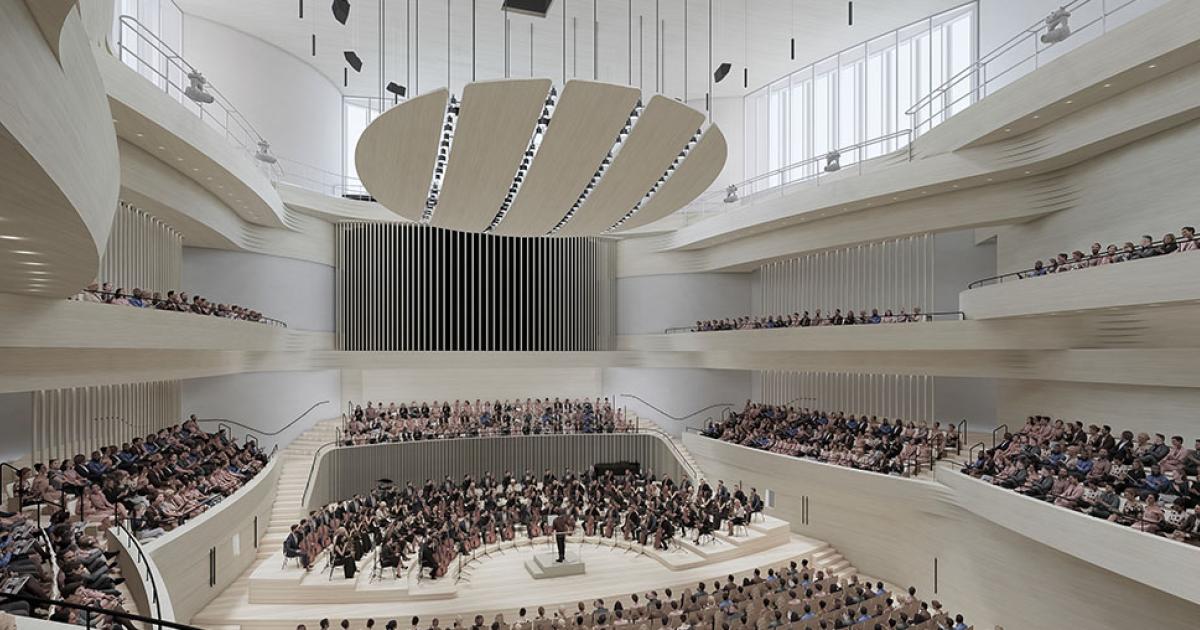
Plenty more cities are in line for new concert venues or opera houses that, on paper, look mouth-wateringly beautiful. In October, ground was broken on the Dunard Centre, Edinburgh’s first purpose-built concert hall in over a century. In less than a year, Fuuga will open in Turku, Finland – a new home for the Turku Philharmonic Orchestra rising in slatted copper from the banks of the River Aura. 
It might seem paradoxical that in a digital age – when the consumption of music is seen as a private transaction between an individual, their device and ‘platforms’ like medici.tv – that we are still building concert halls and opera houses. 

To me, this speaks to a few things. The first is that music is still absolutely a communal act; that musicians will always prefer to do their thing in a room full of people (and vice-versa) – perhaps a room that is being watched and listened to by thousands more people elsewhere via broadcasting, people who are still somehow part of that act (especially, though not exclusively, if watching live).

Turku Concert Hall
Turku Concert Hall

Second, it reminds us that a concert hall is effectively an instrument. Some vintage examples like the Concertgebouw in Amsterdam might improve with age, but plenty – like the current Turku Concert Hall – do not. Standards in playing and singing have risen sharply over the last 75 years, which is why we need to renew the ‘instruments’ in which that playing and singing is heard. We know more about acoustics now, too. 

Audiences want this just as much as musicians do. We want a better view of the performers, which might even influence the way they perceive a particular concert hall’s acoustic. But we also want more toilets, better access to bars and conveniences like on-site parking. We want to feel like we’re in a space fit for purpose.

Another factor in all of this is classical music’s unique position as a contemporary art form, even when it’s bringing to life a piece of art that might be hundreds of years old. Whether it was put on paper a decade ago or five centuries ago, classical music remains contemporary because, thanks to performers and instruments (including concert halls), it changes with us when it’s brought to life. It seems natural, then, that we should reimagine the spaces in which that process happens.

The ’Perception’ Principle

In reality, new concert halls and opera houses can do far more than improve conditions for audiences and performers. When the new opera houses in Copenhagen and Oslo opened in 2005 and 2008 respectively, there was a surge in interest in opera from the domestic populations and international visitors. 

In the first year the Oslo Opera House was open, over a fifth of Norwegians attended a performance there. There had been a similar uplift in Copenhagen, with many thousands introduced to opera or ballet simply because they wanted to nosy around inside the building. 

Contemporary architecture underlines the idea that classical music is a living art form; it encourages musicians to think of the relevance of their music to the modern world, and helps audiences make that connection too. 

It is inconceivable that an arts organization’s architectural surroundings would not influence the institutions that perform in them – their operations, their idea of themselves and their interactions with the city around them. If nothing else, the new acoustics will have altered the way instrumentalists play and singers sing. 

Of course, that goes both ways. Beautiful old concert halls like the Concertgebouw in Amsterdam (below) or the Musikverein in Vienna can also help underline the sense of continuity in the art form – the fact that we are part of a long, evolving tradition. 

Royal Concertgebouw (Amsterdam, Netherlands)

Some say, too, that the acoustics of these ‘shoebox’ halls cannot be bettered. When the city of Malmö opened its new concert hall Malmö Live in 2015, it didn’t take any chances – the dimensions and acoustics are based on a digital mapping of the Musikverein. The result is probably the best concert acoustic in Sweden, though the views from the back rows are undeniably better than those from the back row of its model in Vienna.

We know from research that gold-encrusted concert halls or opera houses can put people new to classical music and opera off – that they can, for some, reinforce the stereotype that classical music is only for the wealthy elite. For others, those details might be a central part of the experience. 

But it’s interesting that contemporary opera houses tend to be more egalitarian by design, without the rows of private boxes that emerged as a feature of operatic architecture at a time when the opera being performed wasn’t necessarily the focus. Contemporary opera houses, like the Bastille in Paris (shortly due for a rebuild by Copenhagen architecture firm Henning Larsen) can reinforce the idea that it’s only what happens on stage that really matters (below).

But how might the difference affect musicians and practitioners? Would you feel freer playing a symphony by Mozart in the ultra-modern surroundings of the Elbphilharmonie in Hamburg, surrounded by the audience on all sides, or on the stage of the Musikverein in Vienna, with images of Mozart himself (and Beethoven, and Schubert and so on) peering down at you? 

It’s undeniable that buildings influence performances. But how do they influence our perceptions of those performances as audiences – live in the venues, or at home watching broadcasts on medici.tv?

As well as those feelings of comfort and contemporaneity, new concert halls that offer better sightlines often give audiences a stronger feeling of connection to the music being played. 

When Helsinki’s Musiikkitalo concert hall opened in 2011, the famed Japanese acoustician Yasuhisa Toyota talked to us assembled journalist about ‘psychoacoustics’ – the idea that in a concert hall with good sightlines and a good sense of proximity to the performers, you might believe you’re hearing the music more clearly even if, technically, you are not.

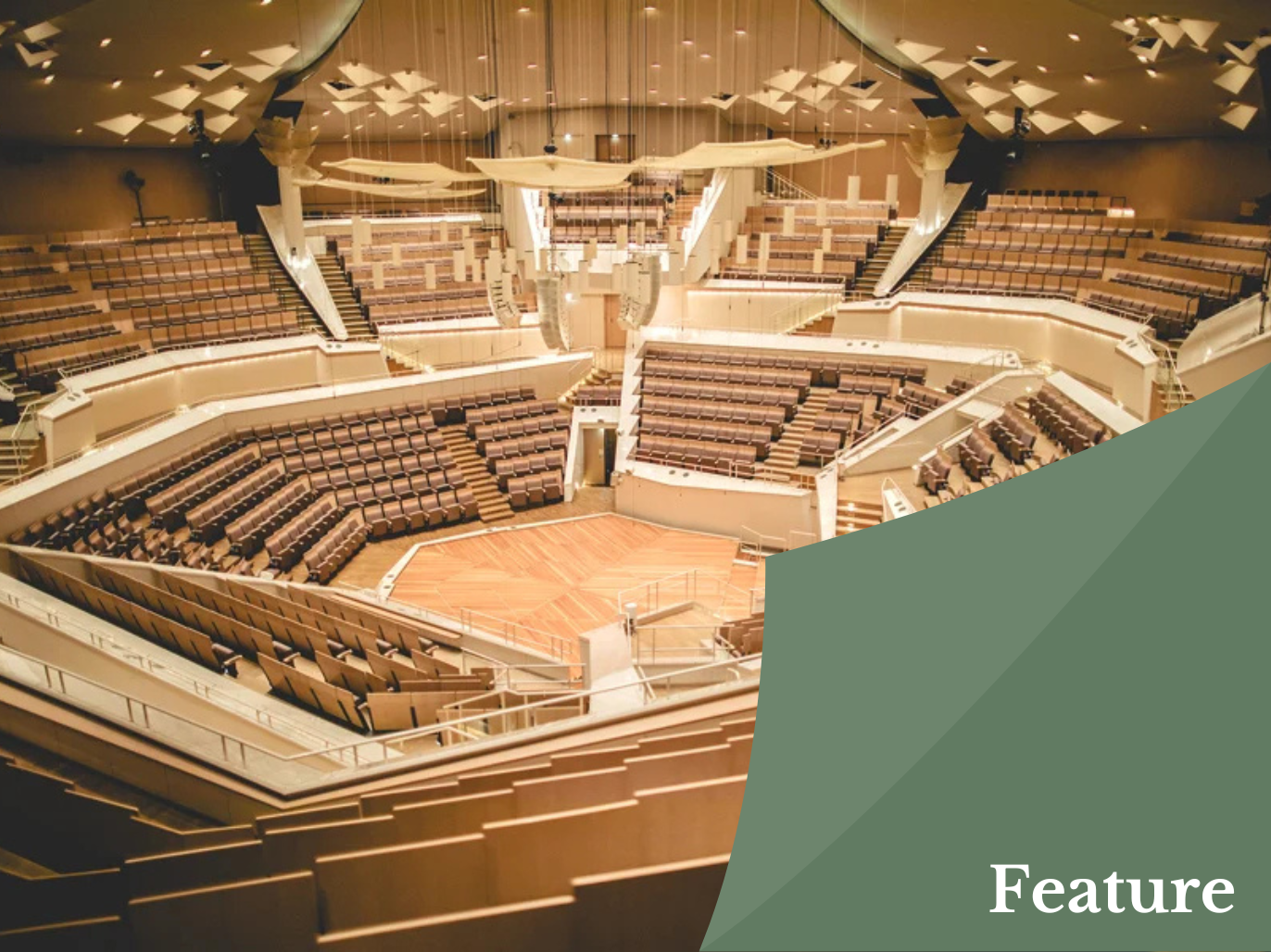
He was referring, specifically, to the new generation of ‘vineyard’ style concert halls in which every seat offers a good view of the orchestra, where the conductor is often in the very middle (and bottom) of the room. 

Like the Musiikkitalo, the Elbphilharmonie is a playful take on the vineyard style, which is said to have started with Hans Scharoun’s Berlin Philharmonie

The Hall is The Star

And here’s something interesting: both the Hamburg and Helsinki halls were designed not just with the live audience in mind, but considering a TV audience too. In Hamburg and Helsinki, the stages are built of a light wood; it’s far easier for the TV viewer to see the playing and movement of the musicians, often dressed in black, given they’re sitting on a lighter, off-white stage rather than a dark wood one. 

Watching concerts from these venues, you are struck by the fact that seeing and experiencing the venue is as much a part of the enterprise as seeing the musicians play. TV directors often respond by using more inventive camerawork. At the DR Concert Hall in Copenhagen, the production team used a camera on a long boom to capture the sweep of the music.

I happen to like new concert halls because I’m interested in contemporary architecture – and I’ve too often found myself at the back of nineteenth-century ‘shoebox’ concert halls not being able to see anything. 

It isn’t just new concert halls that inspire camera crews and TV directors to celebrate great architecture as well as great music. The Musikverein in Vienna is undoubtedly one of the most photogenic halls around, and is increasingly filmed with atmosphere and imagination. Ditto the Rudolfinum in Prague.

Feasts for the Eyes (and Ears)

There wasn’t much good about the Covid-19 pandemic, and it was often disheartening watching performances take place in empty concert halls – especially as a supposedly celebratory concert like the noted New Year Concert from the Musikverein in Vienna (below). 

But at least this incarnation of the event from the first day of 2021 allowed excellent views of the interior of the hall, literally leading you through the front door before the concert starts (fun fact: apparently it was fashionable to hire a Scandinavia architect even in the 1860s – the golden hall of the Musikverein was designed by Theophil Hansen from Denmark). 

The Musikverein’s golden hall is famous. Not so well known, but just as striking, is Victoria Hall in Geneva, designed in the 1890s by John Camoletti. After a devastating fire in 1984, the building was fully restored with new interior artworks and a new organ. A perfect way to see it in all its glory is to catch up on the recent final round of the 2025 Concours de Genève (below).

Similarly, we all know about the Teatro alla Scala and Opera Garnier. But if you haven’t before, you really should step inside the stunning surroundings of the Gran Teatre del Liceu in Barcelona, which is every bit as impressive. This concert sees Gustavo Dudamel conducting Mahler inside the auditorium but if you want opera, this performance of Tchaikovsky’s The Queen of Spades (below) gives you the feeling you’re taking a seat inside the opulent theatre (and also gives you a close-up of the auditorium’s iconic balcony candelabra).

I’ve already linked to the Los Angeles Philharmonic’s centenary concert in a previous article but it’s worth doing so again, given the splendid interior and exterior of the Walt Disney Concert Hall it offers. That building’s architect Frank Gehry also designed the New World Center in Miami, which feels like the Disney Hall’s younger brother. You can see it on this performance from NYO2. 

For the best of those Nordic concert halls, we need to head to Copenhagen and Helsinki. This performance from the Helsinki Philharmonic earlier this year lets you see inside the Musiikkitalo in Helsinki, including the recently-installed organ (the camerawork also means you can read the pianist’s score for Anna Thorvaldsdottir’s Aeriality…if you’re brave enough!).

In this performance of Carl Nielsen’s Symphony No 3 from the DR Concert Hall in Copenhagen (below), meanwhile, you get a sense of sweep not just from the music but from that ‘boom’ camera – and all the seductive reds, oranges and false perspectives of the inside of Jean Nouvel’s auditorium. 

Nouvel’s next big concert hall was the Philharmonie de Paris. The interior and exterior of the building are strikingly different, while each still manages to resemble a spaceship. Here’s a wonderful performance of music from the Americas from Alondra de la Parra and the Orchestre de Paris. Stay the course to Márquez’s Danzón No 2 and you even get the thrills of a handheld camera behind the timpani. 

To complete the trilogy of Nouvel’s major concert venues, check out this utterly stunning performance of Mahler’s Symphony No 5 from the Lucerne Festival Orchestra and Claudio Abbado, filmed at Nouvel’s KKL Concert Hall.

Back in Spain – and back in the opera house – this performance of a double bill of Ravel’s L’Heure espagnole and Puccini’s Gianni Schicchi (below) was shot at one of the most breathtaking looking opera houses to have been built in the last few decades, the Palais des arts de la Reina Sofia in Valencia. It opens with panoramic drone-shots of the interior of the building’s gorgeous opera theatre. 

And if you want to know how such buildings come together – with words from architects, builders and musicians – here’s a film about the genesis and creation of the Parco della Musica complex in Rome, that reminds us that none of these incredible structures was built in a day. 

Written by Andrew Mellor

Journalist and critic

Andrew Mellor is a British writer, critic, and broadcaster based in Copenhagen. After studying music at the University of Liverpool, he began his career with the Manchester Camerata and the London Philharmonic Orchestra before training as a journalist at Classic FM magazine and Gramophone. Since moving to Denmark in 2015, he has become a leading voice on Nordic music and culture, contributing regularly to Opera and Opera Now.

A regular critic for the Financial Times and a presenter for medici.tv and the Danish Broadcasting Corporation, Andrew Mellor also writes extensively for orchestras, festivals, and record labels around…

View author's page