
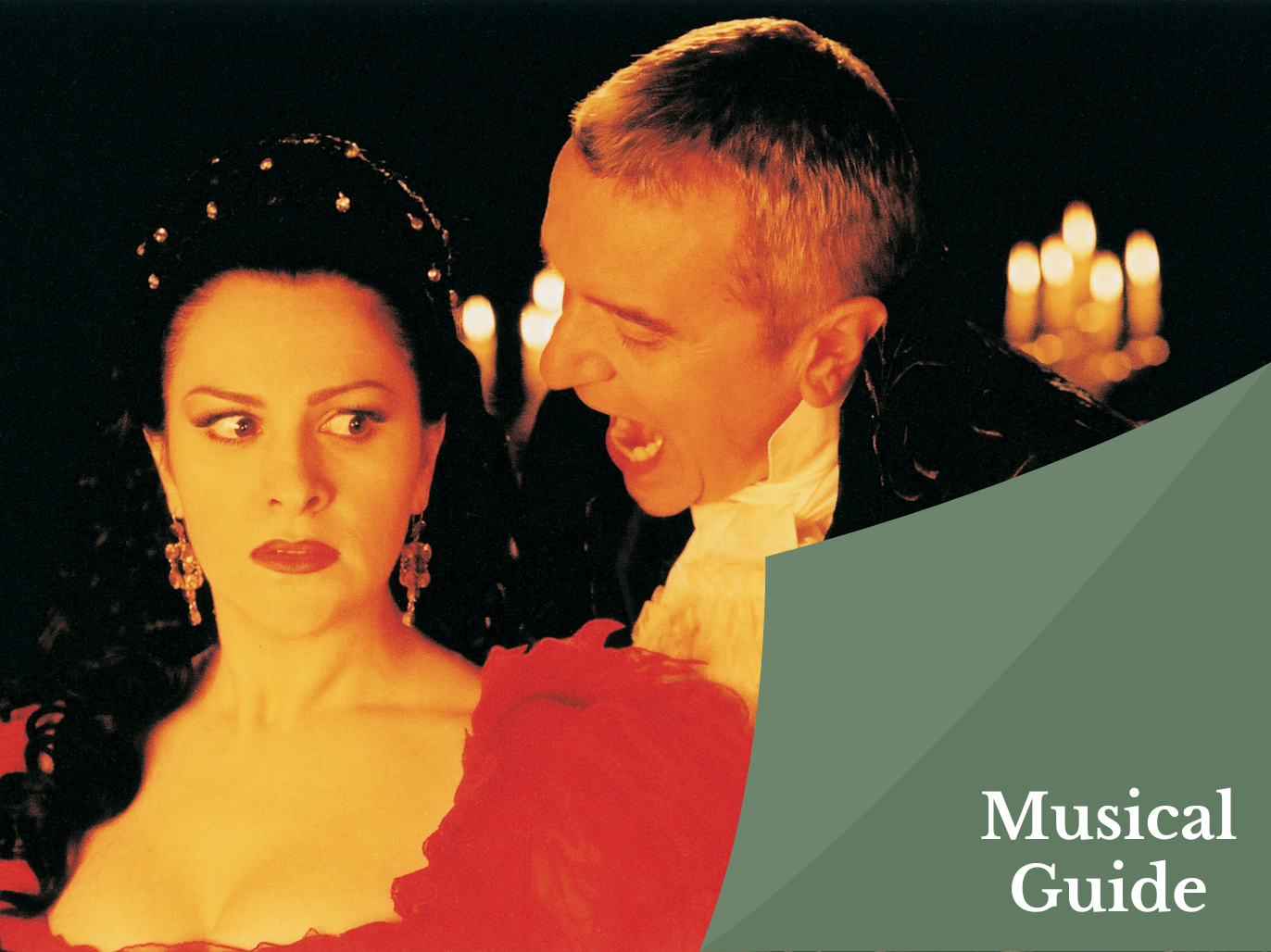
When Love Goes Wrong in Opera: A Dramatic Antidote to Valentine’s Day

This Valentine’s Day, look beyond romantic clichés and discover how opera transforms love into obsession, betrayal, and unforgettable drama.

View author's page

By Nadya Miryanova

Reading time estimated : 12 min

In Shakespeare’s A Midsummer Night’s Dream, Lysander tells his beloved Hermia that “the course of true love never did run smooth” — and I’m sure most opera characters can relate to this. Concerned with the full spectrum of human emotion, opera tells vibrant stories of love and loss through song. Whether it’s the fierce independence of the eponymous Carmen or the heartbreak of Rodolfo in La Bohème, the protagonist’s path is never straightforward. 

This Valentine’s Day, we’re exploring the music and narratives of ten operatic masterpieces. Composers seldom impose last-minute gifts or restaurant reservations upon their characters. They’re more interested in the fallout from love taking an unexpected turn. What happens when the knight in shining armor loses his horse and his mind? What’s left when a Muse shows her true colors? The operas below provide a brilliant variety of answers.

Offenbach’s The Tales of Hoffmann

The walls and piano of Giancarlo del Monaco’s production are messily inscribed with the word “Stella” in green. This is the unrequited beloved of poet and protagonist ETA Hoffmann, a disillusioned anti-hero and romantic man at the depths of his misery. Accompanied by the Muse in the guise of his friend Nicklausse, Hoffmann narrates the story of the three great loves of his life: Olympia the deceptive mechanical doll, Antonia the young girl, and Giulietta the courtesan. The music is scored for a fantastic range of vocal parts and styles, from Hoffmann’s spinto tenor to Olympia’s coloratura soprano. Based on three short stories by ETA Hoffmann, the opéra fantastique blends the light wit of operettas with darker Romantic drama. Listen out for Offenbach’s famous barcarolle “Belle nuit, ô nuit d’amour” — a dreamy, lilting melody — and notice how the Bilbao Orkestra Sinfonikoa supports the stunning vocals of mezzo Katharine Goeldner’s Muse and soprano Valentina Kutzarova’s Giulietta. While Giulietta lures Hoffmann into surrendering his soul’s reflection for her love, Nicklausse cautions him against such peril. The Muse prevails in the end, advising the poet to transcend his idealized notion of love and take solace in his artistic genius instead.

Bizet’s Carmen

A blazing tale of jealousy and fatal passion, Carmen follows the eponymous, free-spirited Roma woman whose fiery nature ignites the interest of both Don José and bullfighter Escamillo. Bizet’s music is filled with Spanish influences and colorful orchestration, creating a vibrant sonic palette that complements the intense drama of the story. In Kušej’s production, virtuoso soloists perform the full range of dramatic emotions — from the sultry tones of Carmen’s Habanera and the evocative lyricism of Don José’s La fleur que tu m’avais jetée — alongside the Staatskapelle Berlin, masterfully conducted by Daniel Barenboim. The plot pivots with the entrance of Escamillo and his performance of the celebrated Toreador song, a nod to him and his fellow bullfighters’ thrilling profession. He also remarks that “love is waiting for you” — Carmen has clearly caught his eye… Alexander Vinogradov brilliantly embodies the character’s overbearing confidence, a foil to the desperation of Rolando Villazón’s sensitive Don José.

Puccini’s Madama Butterfly

The Japanese bay of Nagasaki, c. 1900. Young American naval officer Pinkerton marries Cio-Cio San, a 15-year-old geisha who goes by the name of Madama Butterfly. Soon, the officer must leave his wife for the United States and, while he promises to return, events unravel otherwise… The score of Puccini’s tragic masterpiece fuses Italian verismo opera with Japanese-inspired motifs and pentatonic scales in a skilful fusion of Eastern and Western musical traditions. Familiar patriotic melodies also feature, with the Japanese National Anthem Kimigayo accompanying the Imperial Commissioner for the marriage ceremony and excerpts of The Star-Spangled Banner (the anthem of the US navy in Puccini’s time) representing Pinkerton throughout the opera. Performed in the open-air setting of the Arena di Verona, Giulio Chazalettes’ beautiful 1983 production stars the resplendent Raina Kabaivanska as Madama Butterfly. While the female protagonist waits for her beloved to return, the famous Coro a bocca chiusa accompanies her vigil: a wordless, off-stage chorus hums an ethereal melody representing the passage of time and the persistence of hope as Butterfly walks up the garden steps at nightfall — to no avail.

Cherubini’s Médée

This once overlooked 18th-century opera has reentered the spotlight once more, having been famously revived by Maria Callas in the 1950s. Although traditionally performed in its Italian-language version, recent productions have focused on restoring the original Classical-Romantic French opéra comique. Médée is one of opera’s most psychologically complex and dramatically daring women, weaponizing her unrelenting agency and rage to seek revenge against her unfaithful husband through infanticide. Warlikowski’s production presents Nadja Michael’s Médée not as a villain, but as a fully actualized figure confronting the reality of betrayal and exile. Watch her dramatic entrance into her husband’s wedding scene: the character is firmly rooted in the modern age, with her appearance heavily modelled on Amy Winehouse. The elegant marriage invocation is interrupted by her bitter spoken word: she promises her vengeance — Jason must not forget that she is Médée.

Strauss’s Salome

Adapted from Oscar Wilde’s eponymous play, Richard Strauss’s one-act expressionist opera Salome centers on a princess who falls in (unrequited) love with the prophet Jochanaan. Traditional adaptations show her hurt, dancing for her stepfather in a Thyestean exchange for the prophet’s head. Like Médée, she is a femme fatale intent on revenge. In Castellucci’s production for the Salzburg Festival, the story retains the scandal but with an avant-garde twist: it is built on abstraction. Castellucci avoids narrative literalism, for the Dance of the Seven Veils is not a dance at all, but a symbolic ritual where Salome is bound with black tape in a fetal position to a pedestal.

The director has eliminated built scenic elements while favoring non-naturalistic character portrayals which extend to their appearance — the lower red-painted faces of Narraboth and the Page of Herodias strip them of distinct identities. The atmosphere conjured on stage is oppressive, mirroring the intense dissonance, polytonality, and extreme contrasts of the music. Darkness is summoned on stage with the arrival of the prophet. Asmik Grigorian brings a fantastic freshness to Salome — she is a light soprano, but a force to be reckoned with — and after flirtatiously persuading Narraboth to get her way, Jochanaan arrives. He is a supernatural force that emerges from the shadows: the orchestral texture clears to the triumphant brass and his vocal line is elevated and stately.

Debussy’s Pelléas et Mélisande

Prince Golaud’s hunting expedition takes an unexpected turn when he stumbles upon the young and distressed Mélisande. Deciding to marry her, he takes her back home, but Mélisande falls in love with his half-brother Pelléas and a fatal rage ensues… A sequence of 15 poetic scenes conjure a dreamlike, impressionistic atmosphere typical of Debussy’s writing. Rather than embracing the conventional format of arias, duets, and choruses, Debussy establishes a free-flowing musical dialogue. When the composer introduced the music to his cast, he even specified that: “To sing the music of Debussy, you must forget that you are singers.” Tcherniakov’s production takes full advantage of the Symbolist nature of the opera, transposing the action from castle to living room. Golaud is a psychoanalyst who brings his patient home for more intensive study—he takes notes while observing Mélisande’s movements. The duet Qu’est ce qui brille, ainsi, au fond de l’eau ? in Act I perfectly illustrates this dynamic and sets a chilling, fragile tone for the rest of the opera. 

Dvořák’s Rusalka

Rusalka originated as a stand-alone libretto by Czech writer Jaroslav Kvapil. The director of the Prague National Theatre showed Dvořák the text and the composer was instantly enchanted. The fairytale describes the water nymph Rusalka seeking help from sorceress Ježibaba to make a young prince fall for her — with disastrous consequences. The music is shimmering and lyrical, with lush orchestration showcasing traditional Czech folk melodies and Wagnerian-influenced harmonies. Stefan Herheim brings out the darker aspects of the story and undermines the fairytale ideal, creating a psychoanalytical study of male desire and female archetypes in an urban myth. Myrto Papatanasiu shines as Rusalka, demonstrating the vulnerability and strength of the character under the male gaze. Watch how she sits upon an advertising column and sings to the moon of her love for the Prince: a crystal clear voice soaring across a blue-lit set reflecting the metaphorical depths of the ocean.

Puccini’s La Bohème

Illustrating the ill-fated love of two artists in Paris, La Bohème is an opera portraying victims of circumstance in place of traditional heroes or villains. Puccini writes soaring melodic arcs that are brimming with passion, though his motivic writing is less strict than Wagner and uses flexible musical ideas to evoke a certain memory or emotion. The unparalleled partnership of Mirella Freni and Luciano Pavarotti is beautifully captured in this live recording from the San Francisco Opera. Their powerful voices blend effortlessly in Rodolfo and Mimi’s iconic duet O soave fanciulla, the melodic leaps and phrasing flowing naturally over the moonlit rooftop set as the lovers embrace.

Mozart’s Die Zauberflöte 

A bird-catcher, a magic flute, and a quest to save a princess: Mozart’s fantastical singspiel has it all. Composed in the final year of his life, it blends folk melodies with virtuosic coloratura vocals and Masonic-style harmonies to produce a light-hearted yet varied masterpiece. Princess Pamina is the lyrical soul of this opera and Anna Prohaska does her justice with a gorgeous rendition of Ach, ich fühl’s, a poignant aria in which Pamina believes she has been abandoned by her beloved. She conveys the heartfelt lament and emotional maturity of the character, a stark contrast to the vengeful rage of the Queen of the Night.

Puccini’s Tosca

Rome, 1800. Singer Floria Tosca fights to save her artistic lover Cavaradossi from the brutal chief of police, Scarpia. Premiered in 1900, Tosca stands at the dawn of the 20th century and is a violent tale — far more so than La bohème — exploring authoritarianism and religion. The score presents extreme orchestral contrasts: sudden surges of brass, and suspended instrumental lines that heighten the tension. In a bold defiance of convention that mirrors the cinematic storytelling of the opera itself, Benoît Jacquot crafted a stylized film adaptation. His Tosca ventures beyond the stage, mixing pre-recorded performances with expressive close-ups and sepia-toned footage of different environments to elevate the historic drama between the three main characters. Notice how the first few minutes introduce the dramatic orchestral swells and the brilliant collage of shots. Instead of the orchestral pit, we get Abbey Road’s recording studio with an orchestral storm under the electrifying baton of Antonio Pappano. Maurizio Muraro as Angelotti wears headphones as he sings, before the camera shifts to the inside of a church and his character soon appears in costume. This sets the tone for the rest of the film: a captivating production that fully immerses the spectator in the action.

Across four centuries, a plethora of star-crossed lovers have graced the operatic stage. Yet their stories extend far beyond the realm of unrequited yearning. Each work reveals the different dimensions of love: the intense obsession, the ephemerality of the moment, the spiritual connection. It draws the audience into the storms that test the course of true love, transforming the characters’ trials into an unforgettable musical experience. 

Written by Nadya Miryanova

Writer

Nadya Miryanova is a writer, editor, and translator. She has worked on a variety of projects with medici.tv, including the Verbier Festival, the Singapore International Violin Competition, and Festival Singer-Polignac. Having graduated from the University of Cambridge with a degree in Modern and Medieval Languages, Nadya works as the Communications Assistant at Trinity Laban and supports event production at The Friends of Oleksandriya.

View author's page