
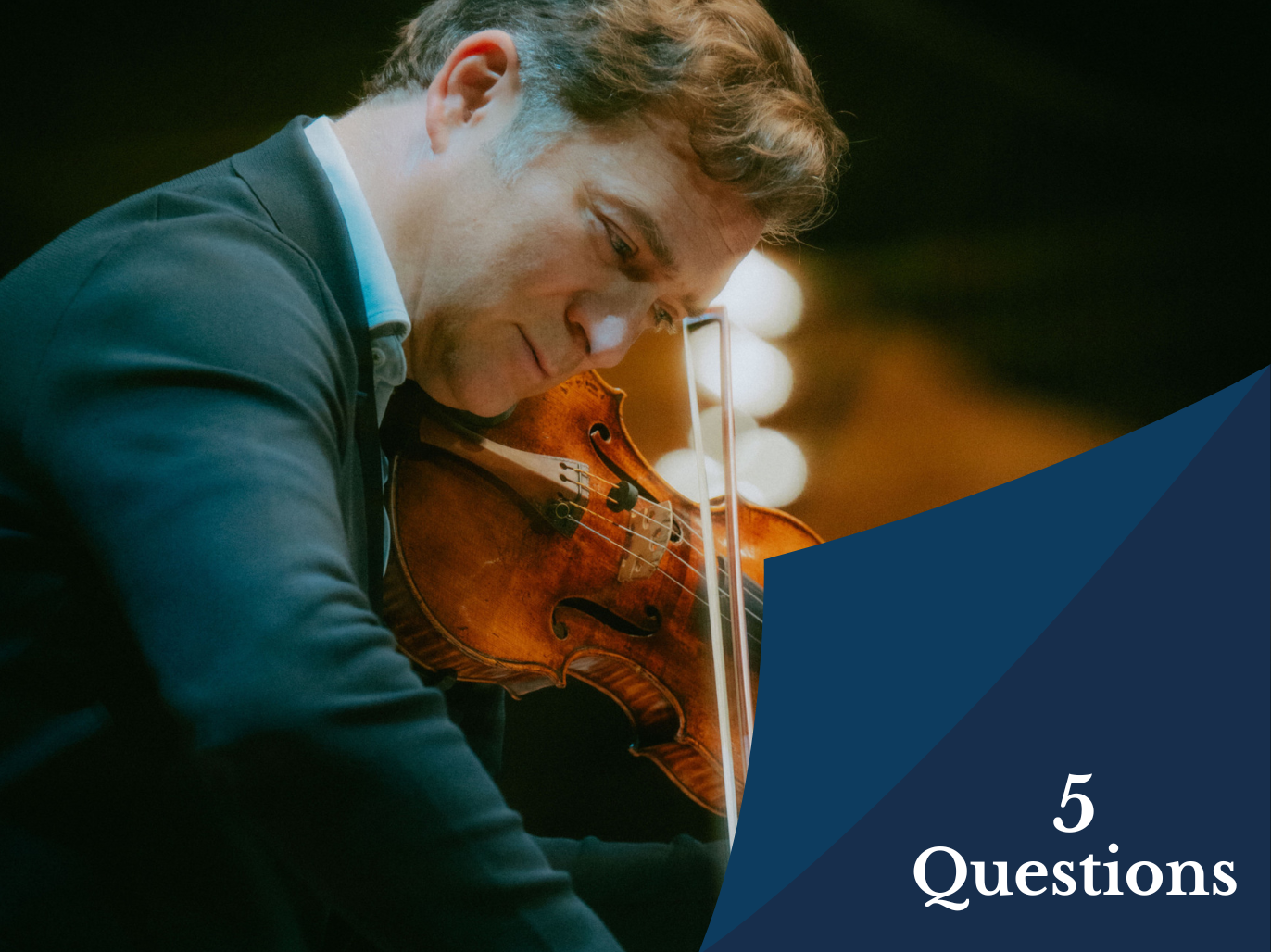
Turning 50 is a moment for reflection. For Renaud Capuçon, it became an invitation to retrace his journey as a violinist through music itself. From the first sounds that sparked joy in childhood to the works that now define his artistic core, he chose one piece for each decade of his life—five milestones, five deeply personal encounters with music.
View author's page
Reading time estimated : 6 min
0–10 years old: Mozart
There was music at home, and I discovered many things, but the first composer I really remember is Mozart.
I remember his violin concerto with Arthur Grumiaux, the sonatas and The Marriage of Figaro—my parents had a recording.
This music made me happy. And as far as I can remember, during those first ten years of my life, Mozart was absolutely central.
Maria João Pires and Renaud Capuçon play Mozart’s Violin Sonata No. 27 in G major
10–20 years old: Brahms, A German Requiem
This was clearly the period when I discovered chamber music. I could mention so many works, but one piece really struck me: A German Requiem by Brahms.
It’s not the kind of piece you usually listen to when you’re between 10 and 20—it’s not Lady Gaga, you know, it’s not the most “fun” music. But I think it’s one of the most extraordinary works Brahms ever wrote.
I remember listening to it on the train from Chambéry to Paris while I was studying. I was dreaming of one day playing it. Conducting it didn’t even cross my mind—it wasn’t imaginable at the time. And yet, years later, I conducted it for the first time.
So if you’re patient, dreams do come true.
20–30 years old: Richard Strauss, Four Last Songs
Perhaps I would choose Richard Strauss’s Four Last Songs, which I had the privilege to play with Claudio Abbado and some extraordinary singers.
This was a key moment. Playing this music with such a conductor, in such incredible halls—the Musikverein for example—was something very special. This piece opened the door for me into the world of Richard Strauss, and that world has stayed with me ever since, until today.
Richard Strauss’s Four Last Songs by Renée Fleming, “Im Abendrot”, conducted by Claudio Abbado
30–40 years old: Korngold, Violin Concerto
Maybe the Korngold Violin Concerto. It’s a piece I played a lot, and I truly believe Korngold is still not enough known as a composer.
It’s also the piece with which I made my debut with the Berlin Philharmonic, with Bernard Haitink. I don’t really believe in luck, but there are some concertos that simply bring you more concerts, more opportunities.
Korngold was always a very happy piece for me. It brings me only good memories.
Chad Hoopes plays Korngold’s Violin Concerto conducted by Tarmo Peltokoski
40–50 years old: Bach, Sonatas and Partitas
Bach’s Sonatas and Partitas, because they are so rare—and because they feel like a summary of 46 years of living with the violin: working, thinking, searching.
It took me many years to decide to record them.
Bach is so central in my life. I could have chosen only Bach for all five decades. Bach is the core of my life, somehow. And facing these works now, as I turn 50, is of course no coincidence.
I wanted to do it for my 40th birthday, but I felt I wasn’t ready. I wanted to become, somehow, a better man.
Two years ago, my wife asked me again: “So, are you finally going to do it?”
And I said, “I think I want to be a better man.”
She answered, “Yes, yes, okay. But do it now—because you might become a better man, but you might also become a worse violinist.”
She was right.
This music is too perfect. Two hours of absolute perfection and beauty. Playing Bach alone is, for me, like standing in front of God.
You can’t cheat. You are completely naked. It’s just you. And finally exposing myself alone through this music says a lot about who I am.
Midori plays Bach’s Partita No. 2 for Solo Violin
