
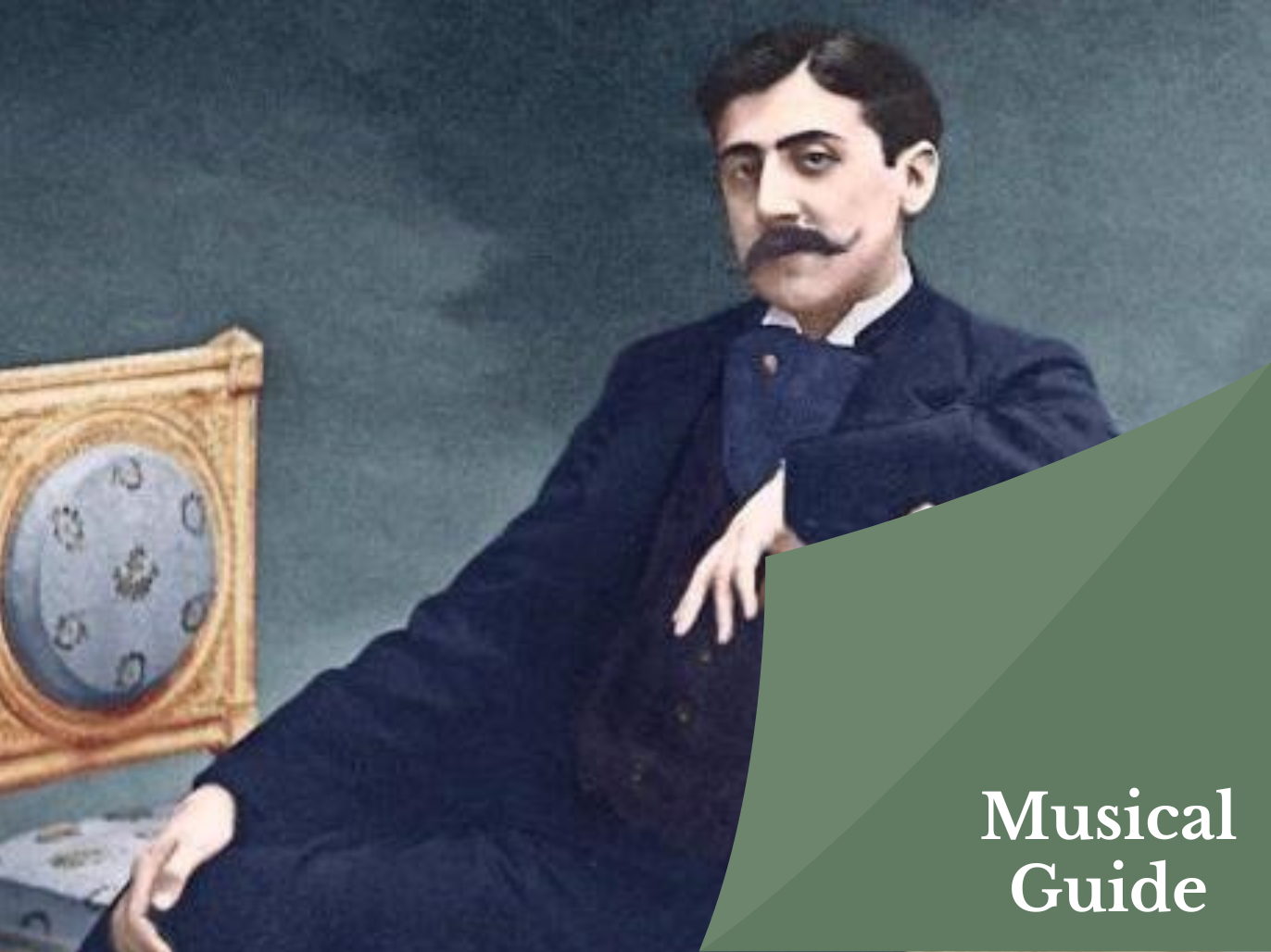
What Writers Hear in Music: From Proust to Murakami

Tolstoy heard danger. Proust heard memory. Woolf heard structure. Anaïs Nin heard an ideal she would have given twenty years of her life to reach. From Proust to Murakami, a short inquiry into what writers hear in music—and why they keep returning to it.

View author's page

By Maria Matalaev

Reading time estimated : 16 min

On a warm afternoon in April 1978, in the outfield bleachers of Jingu Stadium in Tokyo, a twenty-nine-year-old jazz club owner was watching a baseball game. An American hitter named Dave Hilton stepped up to the plate and drove a double into left field. At that moment, by his own account, the man in the bleachers had a thought he could not explain: he could write a novel. He went home that night, after closing his club, and began the manuscript at his kitchen table. He wrote the opening sentence in English first, with a Mont Blanc fountain pen on Japanese manuscript paper, then translated it back into Japanese. The exercise, he later explained, was a way of finding a rhythm he could not hear in his native language. The novelist was Haruki Murakami. Asked, years later, how he had taught himself to write fiction, he gave an answer that startled his interviewers: he had learned it from music. The explanation he offered for this had the precision of someone who had thought about it for a long time:

Whether in music or in fiction, the most basic thing is rhythm. Your style needs to have good, natural, steady rhythm, or people won’t keep reading your work. I learned the importance of rhythm from music, and mainly from jazz. Next comes melody, which in literature means the appropriate arrangement of the words to match the rhythm. Next is harmony, the internal mental sounds that support the words. Then comes the part I like best: free improvisation.

He was not the first novelist to think so, only one of the most explicit. The ancient Greeks sang their verses to the lyre; Homer’s epics were performed, not read; the troubadours of medieval France composed words and melodies as a single act. The sharp boundary that contemporary readers tend to draw between a poem and a song, between a story and a score, took a long time to harden into place, and even now, writers regularly describe their work in terms borrowed from composition rather than from rhetoric.

The traffic between the two arts runs in both directions. Romeo and Juliet, first staged around 1597, has since become a Berlioz symphony, a Tchaikovsky overture, a Prokofiev ballet, a Bernstein musical, and a Baz Luhrmann film. Each artist read the play and heard something in it (a rhythm, an ache, a dramatic shape) that asked to be answered in sound. But the reverse current is, in some ways, the stranger one: novelists and poets returning, again and again, to music as a kind of model. Not adapting its plots, the way composers have repeatedly returned to Shakespeare, but trying to do in language something language cannot quite do.

Poetry can strike as fast as music; a single line of Rimbaud or a haiku by Bashō can do what a brief musical phrase does in roughly the same time. The novelists in question were rarely poets, however, and they sensed in music something their own form was not built to deliver. Whether it was speed, or directness, or some particular quality of unmediated feeling, it has occupied a certain kind of writer for at least two centuries.

The philosopher Arthur Schopenhauer, writing in 1819, gave this feeling its most uncompromising formulation. All the other arts, he proposed in The World as Will and Representation, work by copying ideas, that is, the visible surface of the world: a painting represents an apple, a novel represents a man falling in love. Music alone copies nothing. It expresses, directly and without translation, what he called the will: the inner movement of existence itself. Whether or not one accepts the metaphysics, the intuition has had a long afterlife. Many of the writers who came after him spent their working lives trying to make prose do, by other means, what Schopenhauer said music did by nature.

The ways novelists have answered this feeling are surprisingly varied. For some, music is a key to a buried life; for others, a danger to be feared; for others still, a structure to be heard inside language itself; for others again, an ideal to be longed for.

Proust, the music of memory (or: the little phrase)

The most famous case is also one of the strangest. In In Search of Lost Time, Marcel Proust invented a fictional composer named Vinteuil, whose violin sonata haunts the entire novel like a recurring dream. A “little phrase” from the sonata becomes the private anthem of Swann’s love for Odette, the woman he will spend years adoring and then losing. Proust, who attended concerts obsessively and once paid the Poulet Quartet to play César Franck at his bedside at one o’clock in the morning, described the phrase with a precision that suggests long acquaintance:

Scarcely had the little pianist begun to play when, suddenly, after a high note held on through two whole bars, Swann saw it approaching, stealing forth from underneath that resonance… secret, whispering, articulate, the airy and fragrant phrase that he had loved.

Every time Swann hears the phrase again, the music ambushes him, returning him against his will to the emotional texture of a happiness he has lost. In one scene, he hears it unexpectedly and has barely time to think “It’s the little phrase from Vinteuil’s sonata; don’t listen!” before “all his memories of the time when Odette was in love with him… awoken and flown swiftly back up to sing madly to him, with no pity for his present misfortune, the forgotten refrains of happiness.”

Music, in Proust, does something language alone could not do for Swann. It tells him what he had been unwilling to admit about his own love. Novelists have often used music in this way: as a language that seems more honest than words themselves. More honest, sometimes, and more difficult to survive.

Reynaldo Hahn, “À Chloris,” sung by Philippe Jaroussky with Jérôme Ducros at the piano. Hahn was Proust’s lover in the mid-1890s and remained his closest musical confidant; his brief, lyrical phrases are one of the sources Proust drew on when imagining Vinteuil’s sonata.

Tolstoy, music as contagion

If Proust treated music as a key to the buried life, Tolstoy treated it as something closer to a contagion. His novella The Kreutzer Sonata, published in 1889, is narrated by a man named Pozdnyshev who has murdered his wife and now spends long train journeys explaining why. The reason, in his telling, has everything to do with a piece of music. One evening, his wife played Beethoven’s “Kreutzer” Sonata at home with a violinist she barely knew. Pozdnyshev watched from across the room and became convinced, on the basis of the performance alone, that the two were lovers.

A terrible thing is that sonata, especially the presto! And a terrible thing is music in general. What is it? Why does it do what it does? They say that music stirs the soul. Stupidity! A lie! It acts frightfully. Music makes me forget my real situation. It transports me into a state which is not my own.

Pozdnyshev is, of course, an unreliable narrator. Tolstoy makes no secret of his pathology. But the suspicion he voices runs through several of Tolstoy’s other novels. Anna Karenina finally surrenders to Vronsky in a ballroom thick with music and movement. Natasha Rostova, in War and Peace, loses her head at the opera and nearly elopes with a man she has only just met. In Tolstoy’s fiction, music tends to lower defenses and accelerate things that, in his moral universe, should not be accelerating. Pozdnyshev’s question, stripped of its violence, is one Tolstoy seems to have asked sincerely: “Can it really be allowable for anyone who feels like it to hypnotize another person, or many other persons, and then do what he likes with them?”

Tolstoy never resolved the question. He kept loving music and distrusting it in roughly equal measure, which may be why he could write about it with such accuracy.

Beethoven, “Kreutzer” Violin Sonata, No. 9, Op. 47, first movement, with Ilya Gringolts and Aleksandar Madžar: the Presto that drives Pozdnyshev to murder in Tolstoy’s novella.

Woolf, writing to a rhythm

A generation later, in the Bloomsbury circle in London, the question shifted entirely. Where Tolstoy had heard a threat, Virginia Woolf heard a form she wanted prose to share. Working on The Waves in the late 1920s, she wrote in her diary, with the casual confidence that often hides a serious intention: I am writing to a rhythm and not to a plot.” The novel that resulted, published in 1931, opens with a passage that resembles an overture more than a first chapter:

The sun had not yet risen. The sea was indistinguishable from the sky, except that the sea was slightly creased as if a cloth had wrinkles in it. Gradually as the sky whitened a dark line lay on the horizon dividing the sea from the sky and the grey cloth became barred with thick strokes moving, one after another, beneath the surface, following each other, pursuing each other, perpetually.

The six characters who follow do not exactly speak to one another. They speak into the air, in alternating monologues that work less by exchange than by superposition, as voices do in a chamber piece by Debussy or Ravel, present together without quite addressing one another. One of them, Bernard, articulates the problem the novel is built around: “How impossible to order them rightly; to detach one separately, or to give the effect of the whole, again like music.”

Woolf does not solve the problem. The book is not a piece of music, and she knew it. But the question she was working on (what prose and music share, what they cannot) became one of the great formal preoccupations of literary modernism.

Nin, the flute of bones

For other writers, the question was less formal. Where Woolf approached music as a fellow art, Anaïs Nin approached it as something her own art seemed to fall short of, an ideal she would give years of her life to reach. Born in Paris to a pianist father and a singer mother, Anaïs Nin grew up inside the repertoire. In a diary entry written in her late twenties, she set down what was already a settled conviction:

I would give twenty years of my precious life to be able to write as Debussy composed, to be able to give that profound, intangible, wordless sensation. Music goes directly through our senses, whereas only a certain kind of writing will go through our senses, and it is this penetration I seek.

Five years later, she published House of Incest, not a novel exactly, but a prose poem built on repeating images and rhythmic returns, the closest she would come to working as a composer might. The book opens with a striking figure for the writer’s craft:

There is an instrument called the quena made of human bones. It owes its origin to the worship of an Indian for his mistress. When she died he made a flute out of her bones. The quena has a more penetrating, more haunting sound than the ordinary flute. Those who write know the process.

When Nin was dying of cancer in 1977, she asked for speakers to be installed above her bed so that she could listen to Debussy until the end. The detail has the quality of a closing chord. Whatever literature had failed to give her, music was still expected to provide. 

 Debussy, “La Soirée dans Grenade”, from Estampes, performed by Joaquín Achúcarro. Debussy was close to Joaquín Nin, Anaïs’s Spanish pianist and composer father; the music she heard at home was as much Iberian as French.

Ishiguro, music as measure

Where Nin longed for music, Kazuo Ishiguro listens from the other side: not as an ideal to be reached, but as a way of measuring what has slipped away. He tried to become a songwriter before he became a novelist, and he still writes lyrics for the jazz singer Stacey Kent. His 2009 collection Nocturnes: Five Stories of Music and Nightfall is organized like a suite: five interlinked stories populated by café musicians, fading crooners, ambitious cellists, and aspiring saxophonists, each at some quiet crossroads.

The stories are written with the restraint of a chamber composer. Ishiguro lets pauses, silences, and unresolved cadences carry much of the weight. In the final story, “Cellists,” an older musician says to her young protégé:

But you play that passage like it’s the memory of love. You’re so young, and yet you know desertion, abandonment. That’s why you play that third movement the way you do. Most cellists, they play it with joy. But for you, it’s not about joy, it’s about the memory of a joyful time that’s gone for ever.

The Ishiguro signature shows here. The surface remains beautiful while something underneath it slips away. His characters are not tragic in any large sense. They chose one life and found themselves, by small degrees, in another. Music, in their hands, becomes the most accurate instrument for measuring that distance.

Beethoven, Sonata for Cello and Piano No. 3 in A major, Op. 69, with Mstislav Rostropovich and Sviatoslav Richter. In Ishiguro’s “Cellists,” an older musician tells her young protégé that she plays the third movement not “with joy,” as most cellists do, but as “the memory of a joyful time that’s gone for ever.” Beethoven’s finale, marked Allegro vivace, is exactly the kind of joy this hearing transforms.

Coda

There is a moment in Norwegian Wood when the narrator, on a plane landing in Hamburg, hears a Beatles song through the cabin speakers and finds himself returned, without warning, to a meadow in Germany twenty years earlier, standing next to a woman he has never stopped mourning. The song doesn’t remind him of the past: it puts him back inside it. Years later, Murakami would build an entire novel, Colorless Tsukuru Tazaki and His Years of Pilgrimage, around a single piece by Liszt — “Le mal du pays“, from the Années de pèlerinage. A character in that book explains that the title is usually translated as “homesickness,” but the words mean something more elusive: “a groundless sadness that wells up in a person’s heart.”

Writers have been describing this experience for a long time, in different vocabularies. The Portuguese call it “saudade.” The Germans call it “Sehnsucht.” The French philosopher Vladimir Jankélévitch, in Music and the Ineffable (1961), proposed that music is ineffable not because nothing can be said about it, but because nothing said about it can ever be enough. Music, in his formulation, does not so much speak as act, transforming the listener rather than informing them.

What so many novelists have circled around may be this. Not that music says something prose cannot, but that it does something prose can only approach. Proust, Tolstoy, Woolf, Nin, Murakami, Ishiguro: each found a different way to live with this proximity. Some tried to reproduce the effect. Others described it. Others let their characters be ruined by it. None of them, in the end, stopped writing in order to compose.

That may be the most telling detail. The jealousy, if that is what it is, never becomes a defection. It stays inside the work, like the memory of a melody in an empty room.

Bibliography

Murakami

  • Murakami. Hear the Wind Sing. Translated by Ted Goossen. In Wind/Pinball: Two Novels. Knopf, 2015. (Originally published 1979)
  • Murakami. Norwegian Wood. Translated by Jay Rubin. Vintage International / Knopf, 2000. (Originally published 1987)
  • Murakami. Colorless Tsukuru Tazaki and His Years of Pilgrimage. Translated by Philip Gabriel. Knopf, 2014. (Originally published 2013)

Proust

  • Proust. In Search of Lost Time. Moncrieff/Kilmartin/Enright revision. 6 vols. Modern Library / Vintage, 1992-1993. (Originally published as À la recherche du temps perdu, 1913-1927)

Tolstoy

  • Tolstoy. “The Kreutzer Sonata.” In The Death of Ivan Ilyich and Other Stories. Translated by Pevear/Volokhonsky. Vintage Classics, 2010. (Originally published as Крейцерова соната, 1889)
  • Tolstoy. Anna Karenina. Translated by Pevear/Volokhonsky. Penguin Classics, 2000. (Originally published 1875-1877)
  • Tolstoy. War and Peace. Translated by Pevear/Volokhonsky. Vintage Classics, 2007. (Originally published 1865-1869)

Woolf

  • Woolf. The Waves. Edited by David Bradshaw. Oxford World’s Classics, 2015. (Originally published 1931)
  • Woolf. The Diary of Virginia Woolf, vol. III (1925-1930). Edited by Anne Olivier Bell. Harcourt Brace Jovanovich, 1980.

Nin

  • Nin. House of Incest. Reissue, Swallow Press / Ohio University Press, 1958. (Originally published 1936)
  • Nin. The Diary of Anaïs Nin, vol. I, 1931-1934. Edited by Gunther Stuhlmann. Swallow Press / Harcourt Brace, 1966.
  • Nin. Henry and June: From a Journal of Love. The Unexpurgated Diary of Anaïs Nin (1931-1932). Harcourt, 1986.

Ishiguro

  • Ishiguro. Nocturnes: Five Stories of Music and Nightfall. Faber and Faber, 2009, or Knopf US, 2009. (Originally published 2009)

Schopenhauer

  • Schopenhauer. The World as Will and Representation. Translated by E. F. J. Payne. 2 vols. Dover, 1958. (Originally published as Die Welt als Wille und Vorstellung, 1819, augmented 1844)

Jankélévitch

  • Jankélévitch. Music and the Ineffable. Translated by Carolyn Abbate. Princeton University Press, 2003.

Written by Maria Matalaev

Writer

Macha Matalaev was born in Paris into a distinguished family of Russian musicians: her grandfathers were Valentin Berlinsky, founder and cellist of the legendary Borodin Quartet for 64 years, and renowned conductor Lev Matalaev. Her father, Anton Matalaev, founded the Anton Quartet, and her mother is pianist Ludmila Berlinskaïa.

She began her career as a pianist, studying at the CRR de Paris and the École Normale de Musique A. Cortot. After completing a degree in Applied Modern Literature at the Sorbonne, she worked in art history before returning to music as a producer, later earning a…

View author's page