Bach’s Six Cello Suites

Bach’s Six Cello Suites have challenged performers and captivated listeners for 300 years — here’s how to listen deeply to their dance forms, emotional breadth, and enduring interpretive questions.

View author's page

By Andrew McIntyre

Reading time estimated : 21 min

Even as their creator took his rightful place as one of the preeminent composers of all time, this music languished in obscurity. More than two centuries passed before this collection of six suites was first recorded. Miraculously, it was a young boy in a Barcelona thrift shop who resurrected the music that would come to be called the Mount Everest of the cello repertoire. Since then, this collection has been performed the world over and recorded by hundreds of soloists. These are Johann Sebastian Bach’s Six Suites for Unaccompanied Cello.

What is it about this music that continues to inspire and challenge the greatest cellists? How does a 300-year-old composition for only one instrument captivate the hearts, minds, and ears of those who listen? Over the course of a two-hour performance, Bach’s music runs the emotional gamut from ecstasy to tragedy. Though the Suites demand virtuosity, they provide ample space for cellists to bring freshness to every performance. Explore what has been called the “essence of music” itself. 
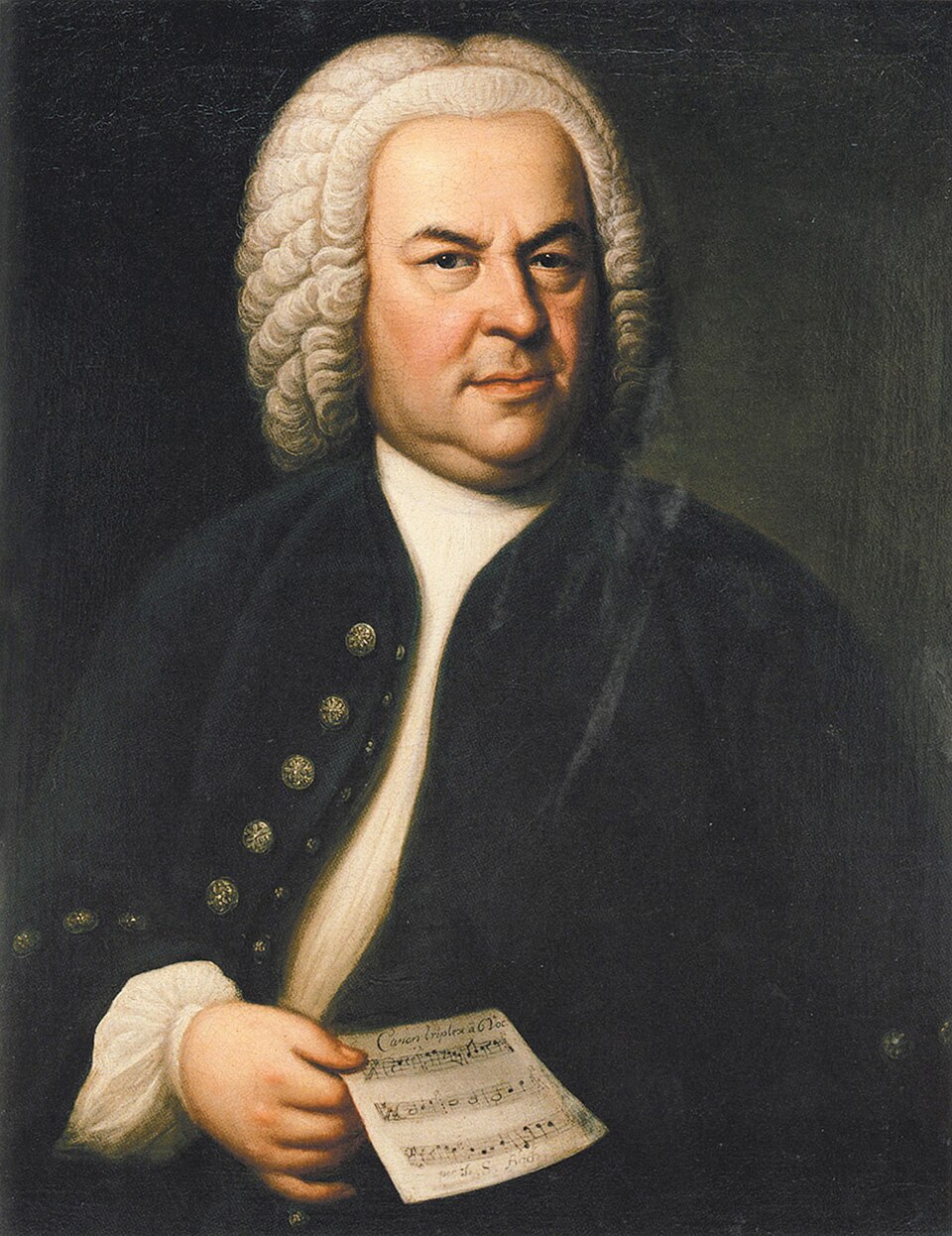
History

J. S. Bach, his wife Maria Barbara, and their several children spent nearly a decade in Weimar, where he served the court of Duke Ernest Augustus I. Though successful in this post, tensions built between the duke and his high-strung music director. Bach attempted to resign several times before the exasperated duke had him arrested and jailed for “obstinacy” in 1717. Upon release from his month-long imprisonment, Bach again submitted his resignation, which the duke, at last, accepted.

Soon after, the Bach family moved north to the city of Köthen, where he remained for about six years before moving to Leipzig. Yet troubles of a different sort followed. Within a few years of their arrival, Maria Barbara died suddenly and unexpectedly. Bach, who had been traveling at the time, learned of her death only upon returning home weeks after the funeral. Less than two years later, the widowed Bach married a young soprano named Anna Magdalena Wilcke. 

It is during these tumultuous years in Köthen that Bach likely composed the six suites for unaccompanied cello, BWV 1007–1012. In this small town of around 3,000 souls, Bach served as Kapellmeister to Leopold, Prince of Anhalt-Köthen. His relationship with the prince was cordial, a far cry from his acrimonious tenure in Weimar.

As a Calvinist, Leopold required only simple church music; with this mandate, Bach turned his attention largely to secular works written for the court’s musicians. The Köthen years yielded some of Bach’s greatest instrumental works, a veritable treasure trove that includes not only the Cello Suites but the Brandenburg Concertos, the Sonatas and Partitas for Solo Violin (BWV 1001–1006), the four orchestral suites BWV 1066–1069, the first of the French Suites, and the first book of The Well-Tempered Clavier

While all of these works are remarkable, special attention must be given to the Sonatas and Partitas for Solo Violin for their similarities to the Cello Suites. Both are collections of six multi-movement works for solo string instruments. The violin partitas, like the cello suites, are comprised of stylized dance movements (Bach used the terms “partita” and “suite” synonymously). Typical of Baroque music, they include a blend of notated and implied ornamentation. As in much of Bach’s music, these pieces are richly polyphonic. Here he uses compound melody to create a sense of one instrument intoning multiple melodies in counterpoint. These compositions also share a similar historical trajectory. Neglected in their youth, both were “rediscovered” in the late nineteenth century by some of the most talented players of their respective instruments (violinist Joseph Joachim was a crucial champion of Bach’s music). Since then, both have come to be regarded as a kind of Mount Everest of their repertoire; for the Sonatas and Partitas, this is particularly true of the intensely emotional Chaconne from the Second Partita in D minor.

Posthumous Reception And The “Bach Revival”

They are the very essence of Bach, and Bach is the essence of music. – Pablo Casals

By the time Bach died following complications from an unsuccessful eye surgery, many already considered his music out of fashion. Though learned musicians turned to Bach as a source of instruction, in ensuing decades his music remained underperformed. Haydn collected Bach scores, as did Mozart; Mozart’s wife, a fervent admirer of fugues by Bach and Handel, scolded him for not writing down fugues of his own. At eleven years old, Beethoven garnered his first published concert review for a performance of The Well-Tempered Clavier.

But of the Cello Suites, the historical record remains almost completely blank for more than a century after the composition. They were first published in 1824 in Paris. This edition, riddled with mistakes and added tempos, fingerings, and dynamics, refers to the suites as “Bach’s études for the violoncello.” Indeed, through much of the nineteenth century this music was widely regarded as “more suitable to the studio than to the concert-room.” As Pablo Casals marveled, “They had been considered academic works, mechanical, without warmth. Imagine that! How could anyone think of them as being cold, when a whole radiance of space and poetry pours forth from them?”

A crucial catalyst for the reassessment of Bach’s music was Felix Mendelssohn’s famed 1829 performance of the St Matthew Passion in Berlin. Mendelssohn helped launch the “Bach revival” that continues to this day. Two decades later, Robert Schumann co-founded the Bach-Gesellschaft, an organization devoted to promoting Bach’s music, in Leipzig. Around this time, in 1854, Peter Cornelius coined the now-ubiquitous expression “the Three Bs” to refer to Bach, Beethoven, and Berlioz (Berlioz has since been supplanted by Johannes Brahms); today, Bach’s primacy within this hierarchy is unquestioned. By the 1860s, the Cello Suites began appearing on concert programs in significant numbers, bolstered by the Bach revival and the rise of renowned touring cellists. German cellist Friedrich Grützmacher, who created his own heavily annotated edition, was one of the first to perform entire suites on his concerts. The end of the nineteenth century ushered in a widespread early music revival that included some of the greatest luminaries of modern music history: Sir Neville Marriner, Nikolaus Harnoncourt, Wanda Landowska (in 1933 she became the first person to record Bach’s Goldberg Variations on harpsichord), and one of the greatest champions of the Cello Suites, Spanish cellist Pablo Casals.

He should not be called Bach (stream), but Meer (sea), because of his infinite, inexhaustible wealth of tone combinations and harmonies. – Ludwig van Beethoven about Johann Sebastian Bach.

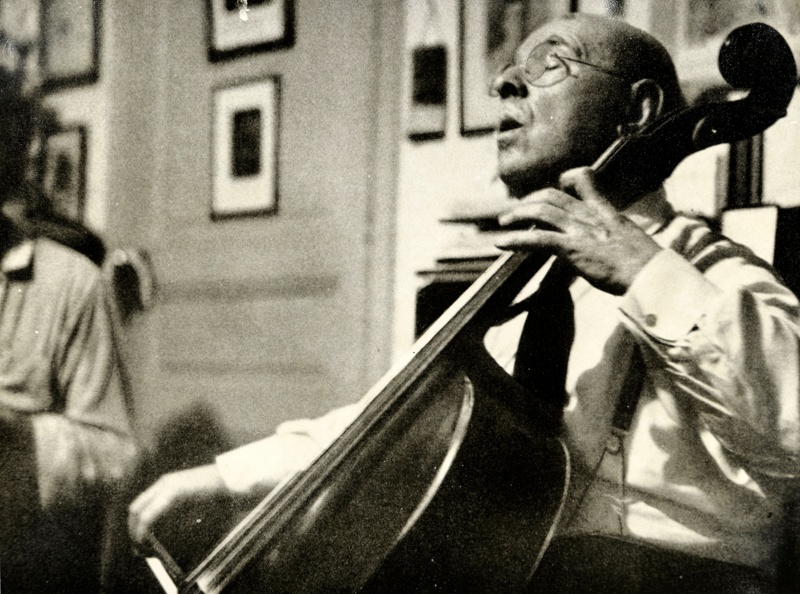
Pablo Casals

Pablo Casals, 1950 © Fundació Pau Casals

Pablo Casals brought Bach’s Cello Suites into the twentieth century. He first discovered a copy of the score (the 1866 Grützmacher edition) in a music store in Barcelona as a young boy. In his memoirs, he recalled, 

“For two reasons I shall never forget that afternoon. First, my father bought me my first full-size cello—how proud I was to have that wonderful instrument! Then we stopped at an old music shop near the harbour. I began browsing through a bundle of musical scores. Suddenly I came upon a sheaf of pages, crumpled and discoloured with age. They were unaccompanied suites by Johann Sebastian Bach—for the cello only! I looked at them with wonder: Six Suites for Violoncello Solo. What magic and mystery, I thought, were hidden in those words? That scene has never grown dim.”

Casals then spent the next twelve years practicing before giving his first public performance of the music in 1901. In the late 1930s, as the Spanish Civil War raged, he became the first cellist to record all six suites (the second and third suites were recorded at London’s famed Abbey Road Studios). Since then more than 300 cellists have recorded the suites, though Casals’ interpretation remains the netplus ultra. Cellist and conductor Mstislav Rostropovich felt that “when Casals played it seemed to me impossible to interpret Bach in any other way, such was the force of his personality and his nature as an artist, his total conviction in what he was doing.” In 2018, the United States Library of Congress added Casals’ added Casals’ recordings to their National Recording Registry, deeming them “culturally, historically, or aesthetically significant.”

Yo-Yo Ma

Bach’s Cello Suites have been my constant musical companions. […] What power does this music possess that even today, after three hundred years, it continues to help us navigate through troubled times? – Yo-Yo Ma

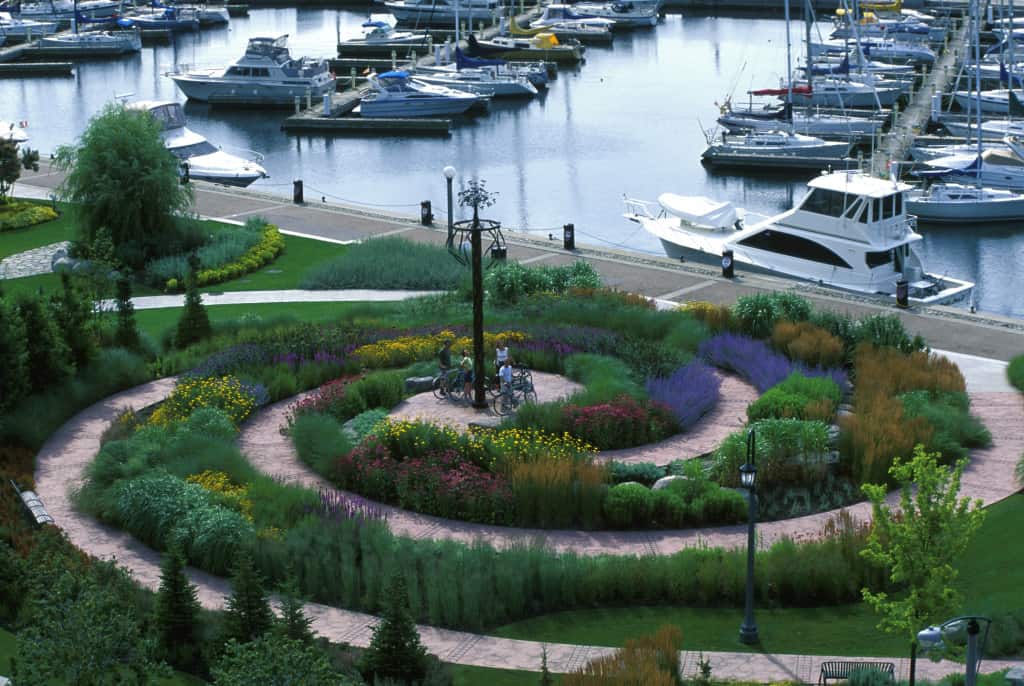
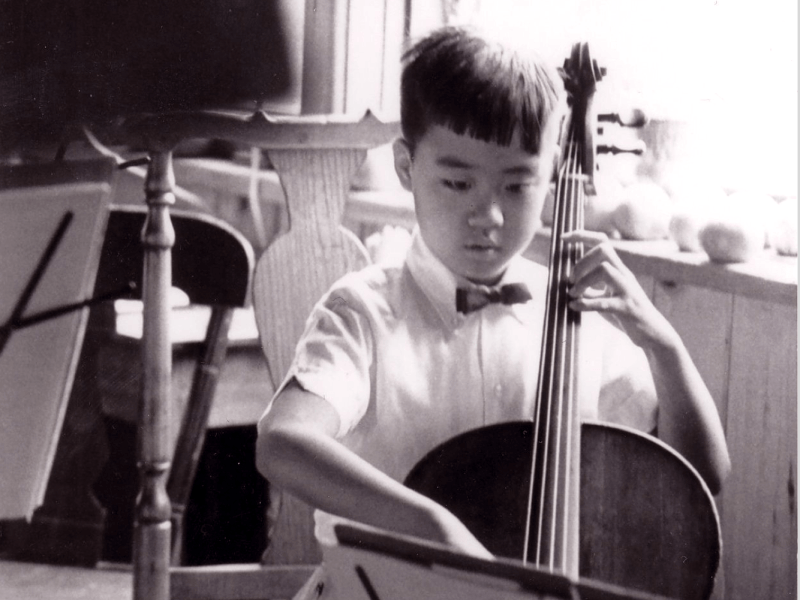
The greatest living ambassador of the Cello Suites—and arguably the most famous living cellist—is Yo-Yo Ma. Now in his seventies, Ma has nurtured this music for over sixty-five years; at the age of four, the Prelude from Suite No. 1 was the first music he played. As a teenager, he performed at the Marlboro Music Festival under the direction of Pablo Casals, one of his childhood heroes. Since then, he has made several recordings of the Suites, one of which won a Grammy Award. In 1997, he released the Emmy Award-winning series Inspired by Bach. Each film in the series presents Ma collaborating with artists across disciplines, from landscape design to kabuki theatre, to interpret the Cello Suites. This project resulted in the creation of the Toronto Music Garden, a multi-sectioned public park representing the six movements of Suite No. 1.

The "Courante" garden, Toronto Music Garden. Photo by Virginia Weiler
Yo-Yo Ma at the Trent School, 1962

Ma has performed the Cello Suites across mediums and continents, including appearances on NPR’s Tiny Desk Concerts series, The West Wing, and Sesame Street. One year after the September 11 attacks, he performed the sarabande from Suite No. 5 at the former site of the World Trade Center. In 2018, Ma began a multi-year journey to perform the suites in dozens of locations around the world, pairing each performance with an act of service. When announcing the Bach Project, Ma said, “Bach’s Cello Suites have been my constant musical companions. For almost six decades, they have given me sustenance, comfort, and joy during times of stress, celebration, and loss. What power does this music possess that even today, after three hundred years, it continues to help us navigate through troubled times?”

Music

The Cello Suites consist of six six-movement dance suites in a mix of major and minor keys. All six of the suites follow the same pattern of movements:

1 – Prelude
2 – Allemande
3 – Courante
4 – Sarabande
5 – Galanteries
6 – Gigue

Unlike the fixed core dance movements—allemande, courante, sarabande, and gigue—the galanteries include a variety of forms; here, Bach inserts pairs of minuets (Suites 1 and 2), bourrées (Suites 3 and 4), and gavottes (Suites 5 and 6).

Though written for a single-line instrument, these pieces are dense in counterpoint and often create a sense of having multiple players. As Yo-Yo Ma has noted, “I’ve learned about trying to make the piece more polyphonic…. My challenge is how to communicate that and have the listener participate in the illusion of four voices.” This tension between the number of written and perceived voices has made the suites a popular choice to arrange for other instruments. Indeed, this music has been transcribed for plucked and bowed strings, woodwinds, brass, keyboard, and arranged for full orchestra.

For many cellists, the Suite No. 1 is their first introduction to Bach. G major is one of the easiest keys for the cello, and the music sits comfortably in the lower and middle ranges of the instruments. The Suites open with their most famous music, the prelude of Suite No. 1. To Yo-Yo Ma, this music “represents the infinitude of what we have in the natural world,” whether rushing water or soaring birds. With this evocation of nature, it’s fitting that the man whose last name literally translates to “brook” has come to represent the mountaintop of music for solo violin and cello.

A contemporary of Bach’s wrote that the allemande “must be composed and likewise danced in a grave and ceremonious manner.” This music seems less of the former than the latter. Double and triple stops and the addition of dotted notes add rhythmic variety. The florid courante that follows lives up to its name.

The sarabandes are, to quote Yo-Yo Ma, “the heart of the Suites.” Bach composed more sarabandes than any other dance type. The dance originated in Latin America and moved to Spain, where it was banned for its obscenity; one Jesuit priest called the sarabande “a dance and song so loose in its words and so ugly in its motions that it is enough to excite bad emotions in even very decent people.” Baroque composers like Bach defanged the sarabande, recasting it as a slow, courtly dance. The tender sarabande of the first suite contains numerous emphatic multiple stops and far more trills than the preceding movements. A descending octave leap, twice repeated in different harmonic progressions, unites the movement. 

Both minuets are in the standard 3/4 time. Like the prelude they move largely in arpeggios, but Bach casts the pair in contrasting G major and G minor keys; this gives the minor-key minuet a somewhat brooding quality. The suite concludes with a lively gigue in 6/8, the most danceable movement of the set.

The first four suites are all written in standard tuning for the cello (C–G–D–A). For the fifth suite, however, Bach tunes the A string down a whole step to G. This deliberate “mistuning” of certain strings, known as scordatura, allows for chords which would otherwise be difficult or impossible with regular tuning. Though Bach’s tuning allows for richer overtones, in some ways it makes the suite more difficult to play; some cellists instead choose to play this suite in standard tuning.

Rostropovich called the sixth and final suite “a symphony for cello.” This notoriously difficult piece is a strange outlier within the set. The cello was a relatively new instrument when Bach composed the Cello Suites. Antonio Stradivari, the famed string instrument-maker, only began constructing “modern” cellos during the first decades of the 1700s. While these cellos became standard by century’s end, Bach’s era was much more transitional.

Nothing in the world is more precious to me than these suites. These compositions always allow you to discover something new. Each day, each hour, each minute you reflect upon them, you reach deeper. You think you know everything about them, but no, next day you discover something new. – Mstislav Rostropovich

The sixth suite, in fact, wasn’t written for a modern cello at all. We don’t know exactly what instrument Bach had in mind, or what it looked or sounded like. Contemporary accounts say that Bach helped invent a slightly smaller, five-string instrument called a viola pomposa, and that the suite was written for this hybrid instrument. It’s also possible that he modified an existing instrument or intended the piece to be played on a violoncello di spalla. Most contemporary players choose to play this suite on a standard four-string cello. This presents numerous challenges for players, who must navigate multiple stops and a high register (this is the only one of the suites that isn’t played entirely in bass clef). Some players re-voice these chords to make them playable, while others omit notes.

Performing The Suites

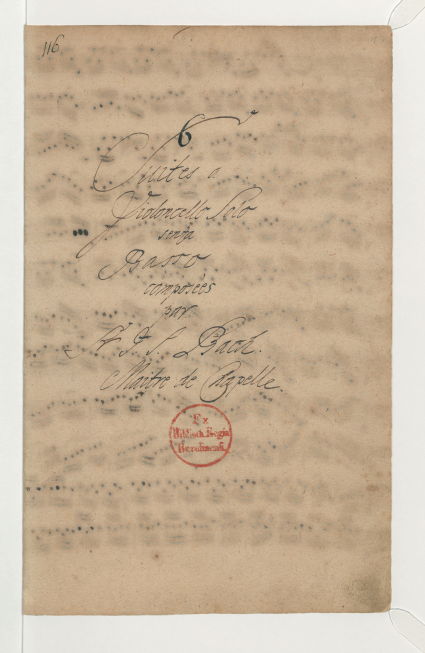
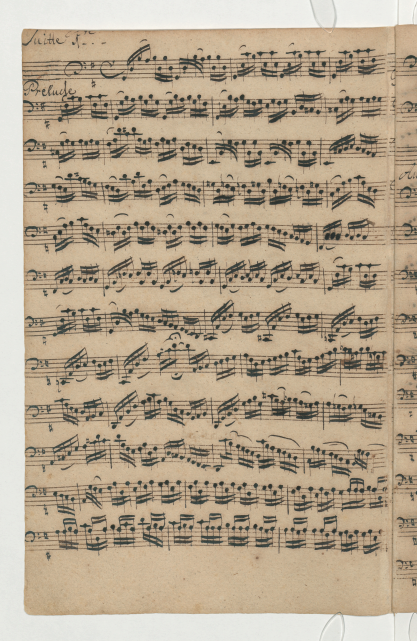
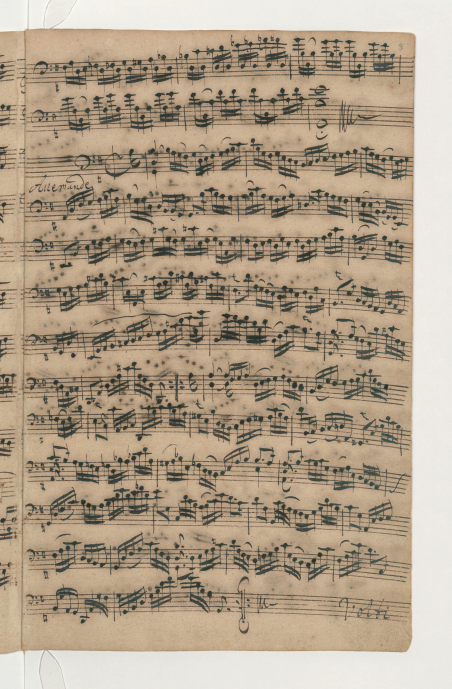
Score of Johann Sebastian Bach’s Six Suites for Unaccompanied Cello, Anna Magdalena manuscript from the Leipzig years.

Over 100 published editions of the Cello Suites exist today. What’s missing, however, is Bach’s own autograph copy. The closest thing we have are several sets of manuscript copies, including one set down by his second wife, Anna Magdalena. Even if an autograph score existed, Baroque composers used less specific notation than in later eras. This provides a double-edged sword to cellists, who are given both the challenge of playing Bach’s music as he intended and the flexibility to make such determinations for themselves. 

Suite No. 1 in G Major, Prelude: Pablo Casals and Mischa Maisky

Casals takes a notably slower, statelier approach to the famous prelude. With a slower tempo and more rubato on fermatas, his recording is nearly 30 seconds longer than Mischa Maisky’s 2023 performance. While Casals applies more bow pressure across all strings, resulting in a heavier or richer sound throughout, Maisky favors a lighter touch that allows for more florid passagework. 

The suites are like a great diamond, with so many different cuts that reflect light in so many different ways. – Mischa Maisky

Suite No. 3 in C Major, Bourrées: Yo-Yo Ma and Mstislav Rostropovich

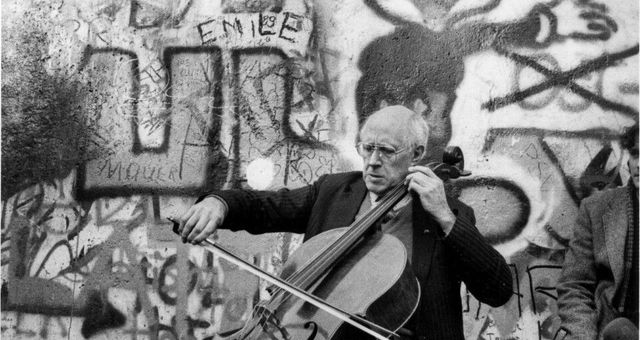
Mstislav Rostropovich famously performed one of the suites in front of the Berlin Wall as it fell in 1989. In this London concert, his playing of the bourrées is more introverted. Yo-Yo Ma’s performance, by contrast, is more outgoing and playful. While Ma imbues these dances with more rhythmic and tempo flexibility, Rostropovich plays them with little to no rubato.

Mstislav Rostropovich performing the Cello Suites during the fall of the Berlin Wall

Suite No. 5 in C Minor, Sarabande: Anner Bylsma and Nicolas Altstaedt

Bylsma’s and Altstaedt’s performances of the somber C minor sarabande share several commonalities. Their tempos are similar, both maintain the integrity of the melodic lines by omitting ornamentation, and both are even performed in German churches. But while Bylsma generally keeps the sound moving between phrases, Altstaedt prefers to allow brief pauses at the end of cadences, almost as if the cello were a singer pausing to breathe. In doing so, Altstaedt allows each phrase more independence.

Suite No. 6 in D Major, Sarabande: Julius Klengel and Sergey Malov

Johann Nikolaus Forkel, one of Bach’s earliest biographers, wrote that in the Cello Suites Bach “has so combined in a single part all the notes required to make the modulation complete that a second part is neither necessary nor possible.” Many later musicians, including Robert Schumann, disagreed. As such, numerous nineteenth-century editions of the suites include added piano accompaniment. In this recording from 1927, Julius Klengel performs from one of these editions. Klengel’s playing is unadorned with little to no added ornamentation; he does, however, use generous portamento between notes.

Malov’s performance on the five-string violoncello di spalla adheres much closer to Baroque performance practice. Though slower than Klengel, Malov plays with greater rhythmic flexibility. His melodic lines are highly ornamented, and the music sits more comfortably within the tessitura of his instrument. 

The Cello Suites In Pop Culture

Today, the Cello Suites are one of the most recognizable works of classical music and arguably the most famous music written for cello. From funerals to figure skating routines, Bach’s music continues to hold the popular imagination. The prelude from Suite No. 1 is particularly ubiquitous (even if some know it only as “that one cello piece”), appearing in numerous films, TV shows, and commercials for goods ranging from fast food and credit cards to luxury cars. Interestingly, when featured in film and TV the prelude is often used diegetically; the characters interact with the music, whether listening to it or playing it. Even for fictional characters, Bach’s music is not mere sonic window dressing but an extension of who they are.

Conclusion

The Cello Suites pose daunting technical and expressive challenges for players. Casals, one of the greatest cellists in history, studied these works for more than a decade before performing them in public. Rostropovich waited until his 60s to record them in their entirety. Yet despite—or because of—their tremendous challenges, these suites have maintained a hold on players and the popular imagination. Hundreds of cellists have recorded this music: Yo-Yo Ma recorded the complete Cello Suites three times, and János Starker recorded them a whopping five times.

It is the enduring miracle of the performing arts that written instructions—whether a piece of music, a play, or choreography—can be shared and enacted across time and space. Art with no existing physical manifestation, reproduced again and again. It is particularly miraculous that this collection of music—a 300-year-old set of suites, passed down in a handful of manuscript copies for a century before their first publication, languishing in obscurity for another 110 years before someone finally made an audio recording of them—continues to offer so much to the world. On a YouTube video of Yo-Yo Ma performing the Prelude to Suite No. 1, a user in 2020 commented, “Who’s watching to remind themselves how beautiful life is during this coronavirus breakout?” Nearly 300 years after Bach’s death, this remains the gift of his Cello Suites: comfort, connection, and even catharsis.

Written by Andrew McIntyre

Writer and concert producer

Andrew McIntyre is an American writer and concert producer living on the East Coast. He studied musicology at Northwestern University, where he specialized in opera and queer popular music. Since 2013, he has written concert program notes for classical music presenters including the Celebrity Series of Boston, UC Santa Barbara Arts & Lectures, and the Los Angeles Philharmonic.

View author's page