
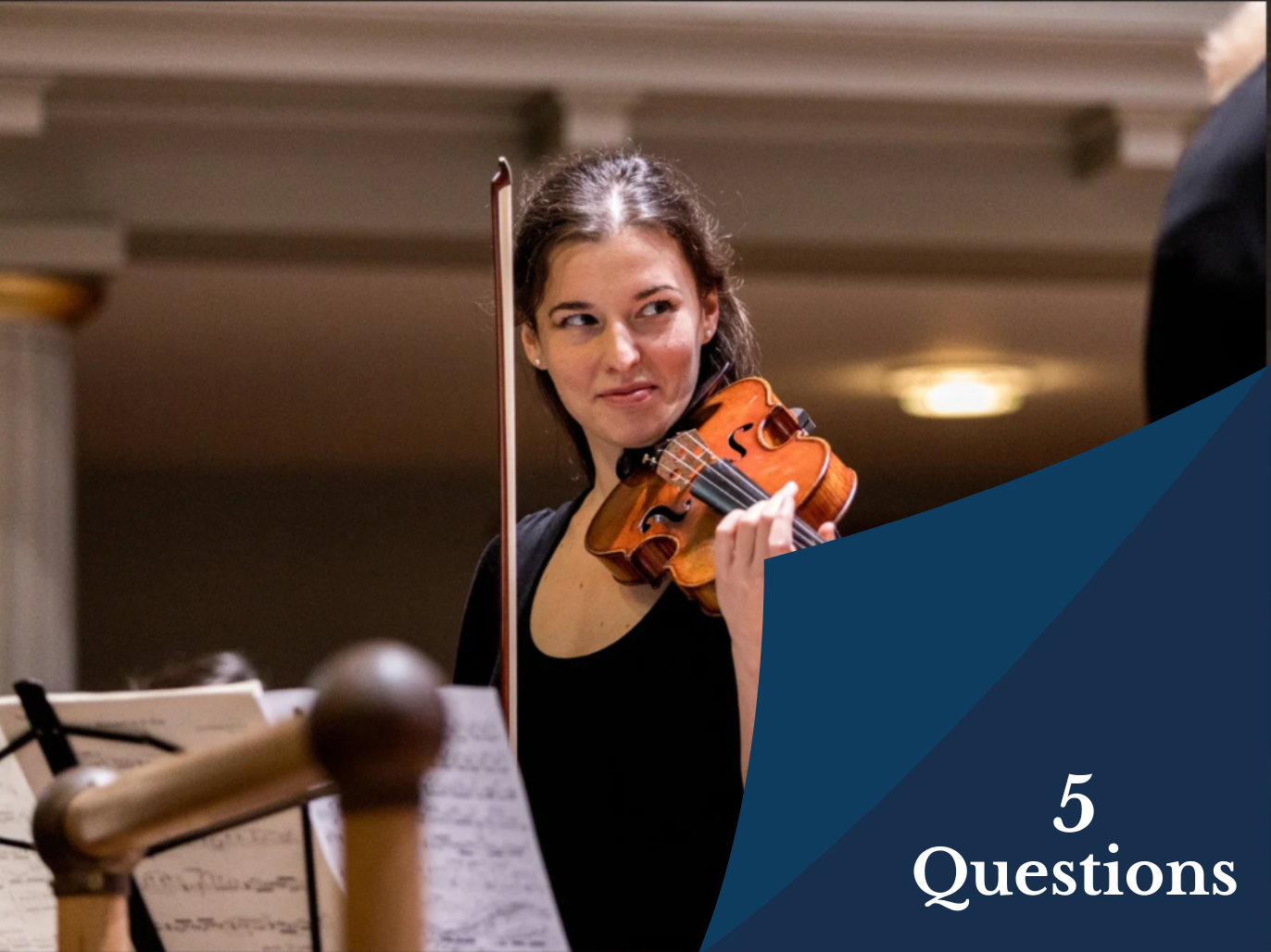
Maria Włoszczowska on Haydn: “A Very Good Cardio Exercise”

In this interview, Maria Włoszczowska reflects on the emotional extremes of Haydn’s “Farewell” Symphony. She also speaks about leading from the violin, shaping sound within a group, and allowing playfulness to become part of artistic expression. 

View author's page

By Editorial Team

Reading time estimated : 5 min

What do you enjoy most about leading from the violin?

What I enjoy most is that it gives the orchestra the responsibility of moving together.

It also places me in a position where I am truly one of them — part of the group — while at the same time encouraging leadership. In a way, when I do it, I try not to make them simply follow me, but rather to help the group find its own way of playing. I think that is very empowering for everyone in the ensemble.

And I really enjoy the process of making that happen from the violin.

Actually, for a long time, I didn’t feel like a leader-type personality. But in this kind of context, I may have discovered that leadership can mean many things. It doesn’t have to be autocratic.

It can be about helping the group find its own way of existing and communicating, and encouraging people to find the courage to speak and move together, and to empathize with one another. That gives me a lot of pleasure.

Which musical quality do you value most in colleagues?

Empathy, selflessness, and big ears.

I think anything is possible if a musician is empathetic and willing to support and listen. A lot of the empowerment I mentioned before actually comes from this sense of empathizing with one another. And in this group, it is particularly apparent that people are chamber musicians, and that they operate from a place of empathy.

That opens up so many possibilities for freedom, because people listen to each other so deeply. So I think that is my favourite quality in a fellow musician.

What is one lesson from your early teachers that still stays with you today?

One that often comes back to me is quite a particular lesson.

It was a lesson on intonation that I once received, and I think about it all the time, because intonation on the violin is a never-ending journey. I remember learning that you can hear a spectrum within a sound, and that intonation is like the note’s home.

That home contains all the overtones of the note. Practising intonation by searching for this home of overtones changed something very fundamental for me in the way I think about intonation. And I feel that the more I focus on finding that home, the easier it becomes to rediscover intonation every day.

What kind of energy does the “Farewell” Symphony require from the conductor?

It requires all sorts of energies.

At the beginning, the first movement is so clearly Sturm und Drang — a Haydn period movement full of anxiety. It is incredibly unsettled, restless, and actually quite violent.

But then we get these almost schizophrenic contrasts of character already in the middle of the first movement, and then again in the famous ending of the symphony, where everybody gradually goes home. There are these very extreme differences.

So it requires the heartbeat to go up and down very quickly. And it is tricky to have the courage, after a chaotic moment, to play something very gentle. But it is a very good cardio exercise, that symphony.

How important is playfulness in your artistry?

It is everything.

Actually, allowing myself to be playful has been a kind of salvation for me. I think my early education perhaps did not entirely encourage that. My violin training was rather serious. But at some point, I suppose, one finds one’s own personality. And it is such a pleasure to allow that personality to flow into the music, into the playing, and into one’s relationship with the instrument.

So I think playfulness is everything. I have also discovered recently that it is a wonderful way of bringing people on board in a group. I believe we all have a child within us, and that everyone can respond to it if they allow themselves to. It is such a powerful way of feeling close to another person and breaking down a wall.

So whenever I have the chance to work with groups, it is often the first thing that breaks the ice: some form of playfulness, whether in the music, in the way we rehearse, or simply in a little joke.

Written by Editorial Team

medici.tv

View author's page