
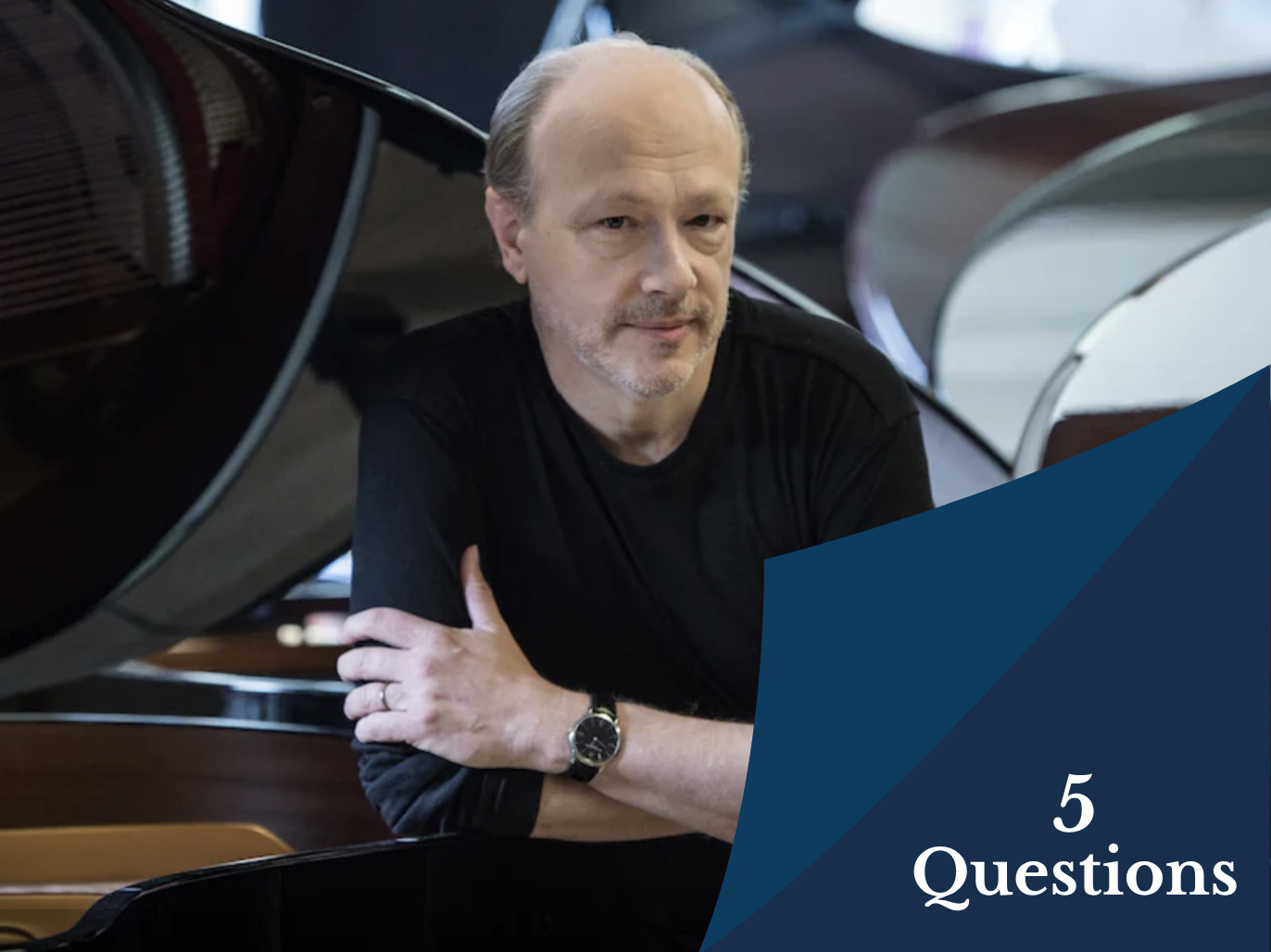
At the eighth edition of the Tsinandali Festival in Georgia, held from September 3 to 13, 2026, Canadian pianist Marc-André Hamelin gave two performances, including a solo program featuring works by Weinberg, Debussy, and Chopin. Known for his virtuosity and his adventurous repertoire choices, he was an ideal person to ask about music, playing, composing, and more. The medici.tv team caught up with him during the festival to ask him five questions…
View author's page
Reading time estimated : 5 min
Chopin, Debussy, and Weinberg’s music might all be described as colorful in different ways. Do you see images or colors in your head when you hear or play their music?
It might seem a little strange, but, for example, in these three different sound worlds, which convey three completely different emotional worlds, I am always inspired first and foremost by pure sound.
To me, the driving force in music is harmony, even over melody, rhythm, and timbre. Harmony is really what guides and inspires me, because it determines form—it determines the narrative of a piece of music.
And all these different worlds allow me to demonstrate variety within a recital.
Hamelin performing Mieczysław Weinberg’s Piano Sonata No. 5 at the 2026 Tsinandali Festival. Composed in 1956, the piece blends stark dissonance with lyrical melodies within a classical structure.
When you compose, does the pianist in you ever argue with the composer in you?
*Laughs* Ça, c’est drôle! Well, you know, it took some time before I started to produce pieces that anyone would even want to listen to—and that took a while because I had been writing since I was 5 or 6 years old, scribbling absolute nonsense since I didn’t have any idea what I was doing back then.
But when things finally started to make sense, I think I wrote whatever I heard, however difficult it might be pianistically. Then, since I was satisfied with what I wrote, I wouldn’t really change it.
Now, I have a little more experience, so even if I think in a rather complex way, both musically and pianistically, I am better at making it simpler.
What is the difference between playing a technically difficult piece and playing a musically difficult one?
I think everything, even the simplest-looking pieces, can be pianistically difficult, because it’s not about proving your finger prowess, but rather about communicating something vital—a mood, or whatever emotional content is in the piece.
In that sense, even the simplest pieces, like Clementi’s sonatinas, can be very difficult. Especially if you really, really want to produce an unforgettable performance.
What do you think pianists worry about too much—and what don’t they worry about enough?
It could take an hour to answer. In my opinion, pianists really need to put themselves in the audience’s shoes, to understand better what audiences expect. Which is to be moved, and to have a memorable experience.
Of course, mechanical pianistic perfection is always better, but even if it’s not, I call that the human touch: showing that you can get things wrong and make mistakes while playing. And usually, if it doesn’t happen too often, audiences can be very forgiving about it.
In the end, worrying too much about the technical pianistic aspect of things sometimes keeps pianists from asking themselves whether what they are producing is really speaking to the public in an essential way.
If you could forget a piece and learn it again from scratch, would you?
That’s a question I’ve never had before… Well, I wouldn’t necessarily erase it, but rather learn it anew—even if I haven’t played it for maybe 20 or 30 years.
So many things have happened in the interim that it feels like starting afresh in a way, because you are also a new version of yourself. You perceive and process things differently, so you play things differently. After a few decades, things tend to become a lot clearer, and you wonder, “How come I didn’t play it like this in the beginning?”
I now find myself moving towards a simpler approach, perhaps, pianistically and musically. So learning it anew is enough, because it would be completely different from how I used to play it anyway, as my life and my musical experience are feeding this new learning.
