
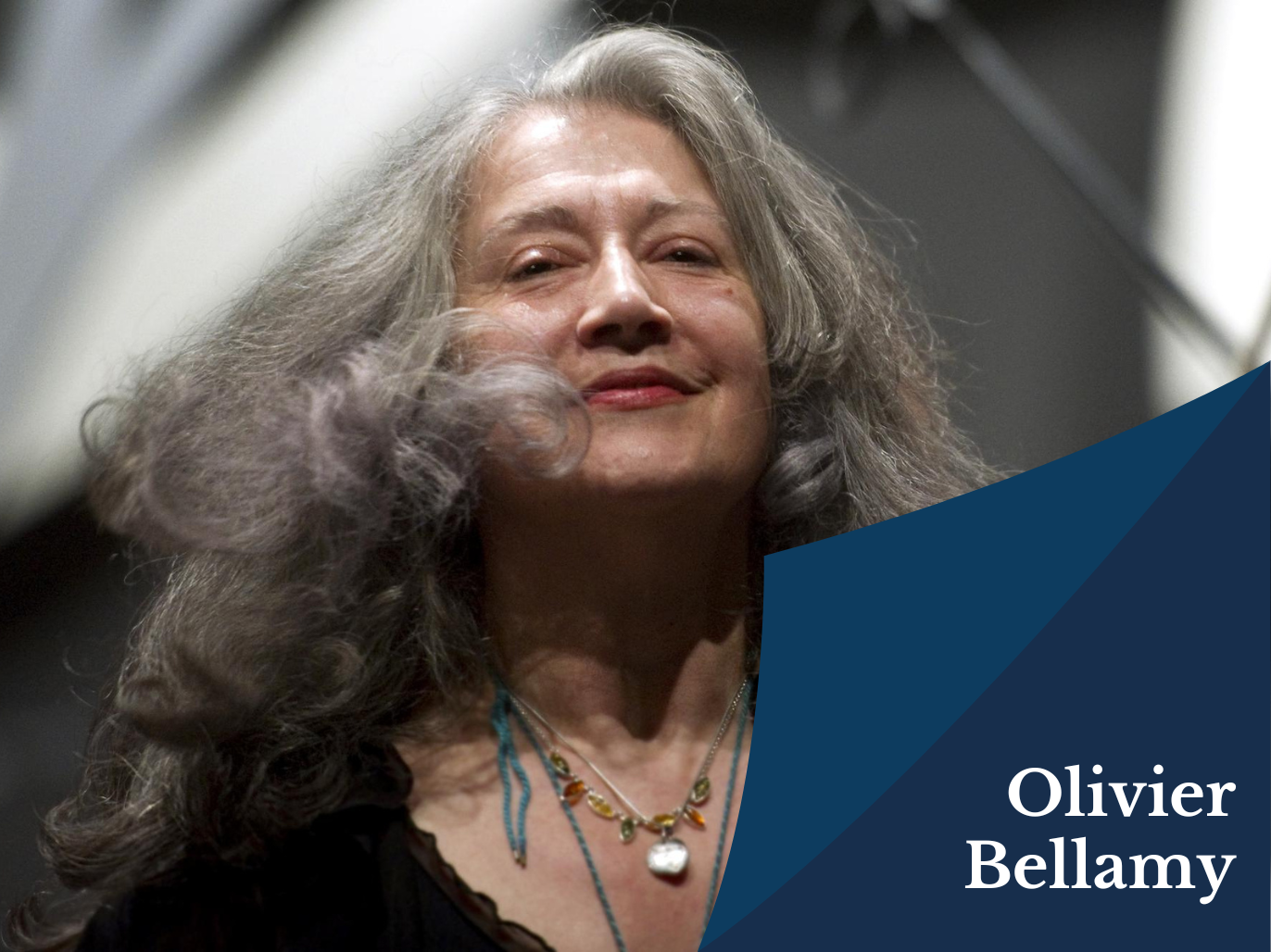
The Martha Argerich Phenomenon: An interview with Olivier Bellamy

On June 5th, 2026, Martha Argerich celebrates her 85th birthday. Her performances have become must-see events that fill concert halls, despite her preference for chamber music and solo piano recitals over orchestral concertos. Olivier Bellamy—author of Argerich’s biography and longtime host of the program “Passion Classique” on Radio Classique—spoke with medici.tv about the extraordinary character of one of the brightest stars in classical music.

View author's page

By Henri Gibier

Reading time estimated : 13 min

What inspired you to write a biography of Martha Argerich sixteen years ago?

It all started with an idea for an interview from my former editor-in-chief at Le Monde de la Musique. She sent me to interview Martha Argerich at the The Festival de La Roque-d’Anthéron. The meeting went well, which is never a given for an artist of her stature, and renowned for her unpredictability and distaste for interviews. I then had the opportunity to conduct a more in-depth interview at her home in Brussels after showing up unannounced, as pianists from all over the world used to do back then. They flocked to her place whenever they passed through the Belgian capital.

She doesn’t go there much anymore, but the house still serves as a home for visitors. They form a small community, which she loves. Martha’s home is on the Rue de Chaillot, in a small apartment she bought because it was next door to her close friend Nelson Freire. The piano takes up most of the living room, and there are two bedrooms. When we first met, I wasn’t a fan. I was interested in other pianists—like Alfred Brendel—but I quickly took a liking to her, just like everyone who is lucky enough to meet her in person. I sought to understand what made her so special.

What drew you to her?

We all have superficial impressions of the artists we follow. I perceived her as a kind of unapproachable panther and above all, a virtuoso. I realized that behind this breathtaking virtuosity lay a subtle world—a deeply personal voice. Martha Argerich is not only a phenomenon. She is a true musician with a humble heart and genuine devotion to the works she performs. But her personality is so strong that it’s not exactly what you see at first glance. As soon as you let yourself be transported by her performance, she brings you right up close to the most intimate roots of a work. She manages to set herself aside almost entirely in order to get to the heart of a work. Martha Argerich has a special gift for listening: she is interested in everything, no matter who is speaking. She doesn’t rank people and she has no filter, which is very rare in this field. 

Martha Agerich has an extensive discography and has played many concerts. Yet one gets the impression that she has always stuck to a relatively limited repertoire.

People sometimes tease her by saying that she’s built a career on four concertos: Ravel’s Concerto in G, Prokofiev’s Concerto No. 3, Beethoven’s Concerto No. 1, and Schumann’s Concerto in A Minor.

This is both true and false. She plays many others, but less often. Martha must have played Rachmaninoff’s Concerto No. 3 once or twice, even though it requires a colossal amount of work. She performs very few Beethoven sonatas—just three or four—and when I asked her if she had sight read any others out of curiosity, she simply replied “no.” Yet that hasn’t stopped her from enjoying performances of them by other musicians. 

However, what truly sets Martha Argerich apart from other pianists of her stature is her chamber music repertoire. Martha has recorded and performed it at all. Piano and violin sonatas, sonatas for piano and cello, trios, quartets, and quintets, all the works by the great composers that belong to a more intimate, personal repertoire. She attaches great importance to this repertoire.

How do you interpret this approach?

Martha Argerich may be a virtuoso, but she doesn’t have the mindset of a virtuoso. She lacks the slightly boastful or self-centered streak found in some of her peers. She loves to share, and now refuses to perform alone. In her personal life, she’s always hated being alone. The life of a great soloist is a grueling one: you travel alone, you’re alone in hotels and airports… As Arcadi Volodos says: “What on earth do you have to say to your piano when you spend your time alone in airports?” In a way, she follows in the footsteps of her glorious predecessors, like Rubinstein. They knew how to live and took the time to do so. They preferred boats to planes, they took their time between concerts, met people, and had the chance to talk with them.

Where does her reputation for being fickle or rebellious come from?

I’d say it’s because she’s lively and human. She’s capable of canceling a concert, for one reason or another, if she doesn’t feel up to giving her best performance. It’s something she hardly ever does anymore as she’s gotten older, except occasionally for perfectly understandable health reasons related to her recurrent cancer. At one point, she was forced to cancel a few concerts because her youngest daughter had hidden her passport, as she didn’t want her to leave! In any case, it’s never a matter of disrespecting her audience. In fact, it’s usually the opposite. She will cancel a concert because she doesn’t feel up to the standard of performance that she owes her audience. Martha also has her own unique sense of how important different commitments are. If it’s a charity concert or a performance meant to convey a message and it’s unpaid, she’ll perform even if she’s incredibly unwell. If it’s for a friend, even one she doesn’t know well, she’ll go all out. But if it’s the Berlin Philharmonic, the most prestigious and one of the highest-paid orchestras, everyone will feel obligated—except her.

What role did the famous 1965 Chopin Competition play in her career?

It was a turning point. Martha was still well known before, but she was plagued by constant doubt. She questioned her standing in the world of classical music. She had even been tempted to give it all up. But her mother never stopped encouraging her and striving to have her immense talent recognized. It’s likely she wouldn’t have become a concert pianist without her. The story goes that the great Russian violin teacher Leopold Auer would ask his gifted pupils: “Is it you who wants to play the violin, or is it your mother?” and if the child said, “it’s me,” he wouldn’t take them on. He only accepted those who answered “my mother.” He believed that a child’s will is fickle, whereas a mother’s is unyielding. It was the same with Martha. Her Russian Jewish mother was entirely devoted to her daughter’s career, attending her lessons and taking notes on everything the teacher said. Beyond her mother, it was Martha’s Polish friend, the pianist and great Chopin specialist Stefan Askenase, who convinced her to enter this competition. It wasn’t a straightforward decision, because she has a complicated relationship with Chopin: she used to say that “he is my impossible love.” She found him very aloof, almost out of reach. Chopin doesn’t intimidate amateur players, who perceive only his outward brilliance. But at Martha Argerich’s level, he appears as someone returning from the abyss. It is music of the highest artistic caliber, capable of stirring something very deep within us. If it is approached with all its stylistic and emotional weight, this music can be overwhelming.

Martha Argerich’s life cannot be summarized without first discussing the people she met, as you mentioned in your biography. The first of these seems to have been Friedrich Gulda, her second piano teacher in Buenos Aires.

Martha Argerich chose this great interpreter of Beethoven when he came to Argentina. And he was the reason she left her country for Europe. Her mother had thought she would pursue a career in America. When Martha was five, she had a very old teacher, Vincenzo Scaramuzza. He was a living legend in Argentina but also very neurotic, capable of beating his students. Gulda was the complete opposite: he was young, funny, iconoclastic, and she loved him. He didn’t take on students, which gave his teaching a very special, unique character. Gulda was exceptionally gifted: “the most gifted I’ve ever met,” Martha once said.

Then there was Nikita Magaloff…

She met him in Geneva. The fact that he was Russian mattered a great deal, as she was fascinated by Russia. He was a prince, he knew Prokofiev, one of Martha’s favorite composers. When he heard her play, he fell in love with her. There is something in this extraordinary pianist’s playing that borders on the miraculous. Everyone who hears her for the first time is immediately captivated. It’s rare to find playing so intelligent, so rich in tone, and so powerful. It’s spectacular, but like Paganini, people only remember the extreme technical virtuosity, whereas Schubert, Chopin, or Rossini considered him as one of the greatest musicians. When Chopin listened to Paganini’s caprices, he wept. It wasn’t just a fireworks display: it was something that moved him deeply. As Albert Einstein said when he heard Yehudi Menuhin play for the first time: “Now I believe in God.” The same is true of Martha Argerich.

She has been criticized, however, for playing too fast.

The best answer is the one given one day by a pianist. He was asked why Martha Argerich played so fast, and he responded: “because she can.” It’s also a form of modesty. Madeleine, Dinu Lippatti’s wife and Martha’s best friend, often told her: “Take your time, don’t play so fast; it sounds like you don’t want people to love you.”

Among the most significant people she has met is, of course, Stephen Kovacevich, the father of her third daughter, whom you describe as the love of her life.

Friends and lovers, they separated but never stopped seeing each other. When they’re together, they’re like two children. Musically, they complement each other perfectly. He’s brilliant in Beethoven, she’s profound in Schumann. They made records together, performing the works of Bartók and Debussy. He explained to me that he couldn’t go a day without practicing on his piano, otherwise it would show, whereas Martha could go a month without touching it and as soon as she picked it up again, she would miraculously regain her touch. It was enough to make anyone jealous! Michel Béroff, another great pianist who lived with her for a period of time, felt the same kind of discouragement in the face of such innate talent.

Her friendship with Nelson Freire was also very important to her.

His death shocked Martha deeply. When he was in the throes of depression, she traveled to see him in Brazil, after Daniel Barenboim had advised her to do so, sensing the worst. He told her: “Do it, or you’ll regret it for the rest of your life.”

She was very grateful to Barenboim for letting her know. Martha stayed for a week—the week before Freire’s death—under very difficult circumstances. They had known each other since their teenage years. For a long time, his career had been less successful than hers, though that changed in the 2000s. This episode brought her much closer to Barenboim, whereas their relationship had been more distant for a long time, with Martha’s true affection being reserved for his wife, the cellist Jacqueline Du Pré.

For the past fifteen years or so, she hasn’t missed a single Verbier Festival. Why this loyalty?

She comes for a rather special event. Martha performs on the birthday of the festival’s founder, Martin T:son Engstroem. It’s become a tradition. She likes to tease him about his star-studded lineup, and he teases her because he feels she doesn’t play often enough with musicians of her own caliber. Engstroem’s the one who arranged for her to play with Lang Lang. She feels almost at home there now. It’s her community that she enjoys returning to every year.

Which musicians does she admire the most?

Evgeny Kissin, without a doubt. She’s said she would have fallen in love with him if it weren’t for the age difference. Vladimir Horowitz captivated her, although she didn’t care much for Tchaikovsky. But she played his Concerto No. 1 magnificently because Horowitz had given the definitive performance. Martha admired his inexhaustible imagination. She also adored Rubinstein.

Which performance has had the biggest impact on you, and which one would you recommend to someone who isn’t very familiar with Martha Argerich?

She has dedicated an album to Bach that I would recommend to anyone who finds the great composer too rigid or lacking in vitality. The way she plays the Toccatas and Partitas is lively, exhilarating, and full of freshness. 

The way she has made Beethoven’s Concertos No. 1 and No. 2 her own has restored these two works—long neglected in favor of the much more famous concertos that followed—to the status of masterpieces. Such an achievement alone is enough to justify a musician’s life and fame. 

Translation: Nadya Miryanova

Written by Henri Gibier

Senior Editorial Advisor

Former Editor-in-Chief of Les Echos and Les Echos Week-End

View author's page