
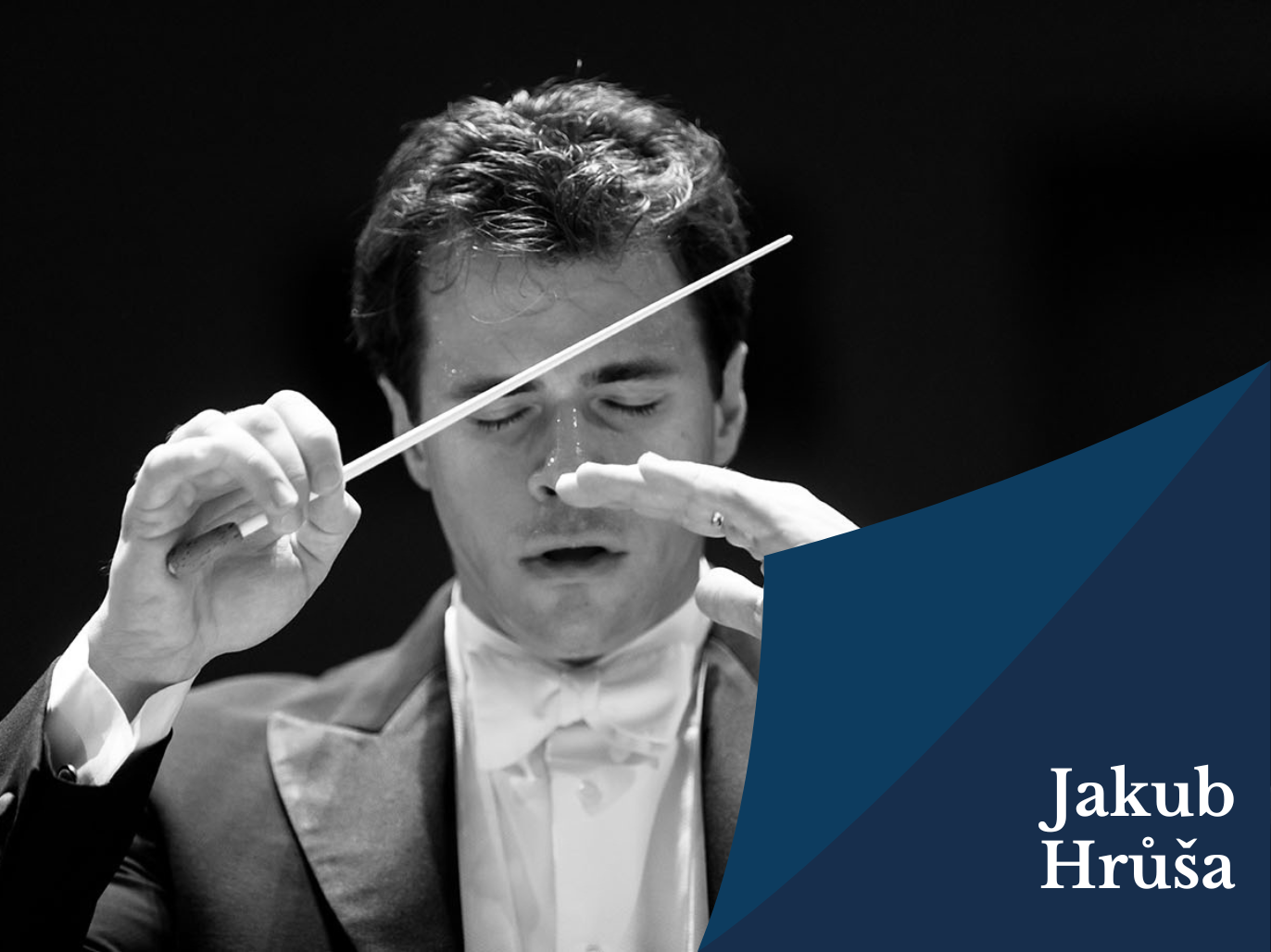
Jakub Hrůša, Chief Conductor of the Bamberg Symphony, Music Director of the Royal Opera House, and Chief Conductor and Music Director-designate of the Czech Philharmonic, has managed his career with great care and intelligence. He now occupies the enviable position of appearing regularly with all the world’s leading orchestras while also heading two top-class institutions. I caught up with him on Zoom in Chicago, where he was rehearsing for a couple of concerts with the city’s great Symphony Orchestra (Schumann, Beethoven and Smetana on the menu), and where he obviously greatly enjoys the shared music-making. Given the range of concerts he conducts on medici.tv – the most recent finding him at the helm of the Vienna Philharmonic (excerpt below)– it seemed a good opportunity to talk with him about the dynamics of the conductor–orchestra relationship, ranging as it can from guest, to principal guest, to music director status. In conversation, he couches his answers (in faultless English) in a measured, almost analytical way, often immediately re-expressing a thought to better convey his intention.
View author's page
Reading time estimated : 9 min
“There’s a huge difference between being a music director and being a guest, even a principal guest,” he suggests. “I would say the difference if you have the official title of principal guest is only formal. There’s not so much difference inside the orchestra rather than for the public and for the general marketing. Let’s say it’s more about what it looks like. And then of course, another difference is if you happen to be a guest conductor without any ‘official’ bond with the orchestra is that if they like you, and you like them, and the calendar allows it, you usually visit every two or three years.” Given Jakub Hrůša’s status in the conducting world, he rarely conducts an orchestra for the first time nowadays. It is more a case of returning to old friends, and among those old friends are the Chicago Symphony and Berlin Philharmonic, ensembles he usually conducts for a couple of weeks every season.
“Of course here in Chicago I don’t interfere at all in the business of – previously – [music director] Riccardo Muti, and now Klaus Mäkelä. Obviously not. But at the same time I also don’t feel like one of the random guests. I feel I participate somehow in the life of the orchestra. And that is especially the case for conductors of my age, where you want the ‘conceptual’ work. I’m not interested in just putting things together in two days and that’s it. I’m interested in something deeper, because it’s so vital for me to develop a trust with the orchestra. You get used to each other, you have mutual trust, and then you always arrive next time with a somewhat deeper connection than before. And that reflects in the music-making, even if it’s very varied and colourful and always something a little bit different.”
He tells me that he has actually programmed his Chicago concert backwards – pointing out that this is how Mahler made 99 per cent of his programmes, so rather than start with excerpts from Smetana’s The Bartered Bride, he would end with them. That was clearly his decision, but he was also very pleased when the CSO’s Vice President of Artistic Administration, Cristina Rocca, asked him a while back to take a look at Shostakovich’s Symphony No. 11 with a view to conducting it in Chicago. “I had done many of the Shostakovich symphonies,” Hrůša recalled, “but I didn’t have a relationship with that one. But it created this inspiration – let’s have a look at it – and I fell in love with it. So I programmed it elsewhere – in London with the BBC Symphony which was an amazing experience. And I was so happy that someone else had implanted the idea in me. That’s another thing about conducting, you know, we have to make decision after decision after decision, so it’s so beautiful sometimes when someone else makes a decision for us!” And in Chicago last year, the performance elicited the verdict from the Chicago Classical Review’s Lawrence Johnson, “not just a highlight of this season, but one of the finest CSO nights of recent years”.
Jakub Hrůša has clearly thought long and hard about the conductor–orchestra relationship, and the subtle nature of the dynamic. “It’s a very specific type of dialogue where I am, as conductor, influencing a lot. I have a lot of power in my hands, but it only reaches some 50 percent of the situation. And the other half is, for me, to be open to what the orchestra brings. But the first half, of course, is important. I can’t stand there – especially as a music director – and wait for what the orchestra is bringing. But it’s also not true that I am there to push everyone where I want them. I think the whole virtue of music making is deeply rooted in freedom. I don’t want to see a technically perfectly equipped orchestra working like a machine. And for the musicians themselves, it’s absolutely incomprehensible why I should cause something like that. I would rather actually bring about a situation where the orchestra has a strong identity and quality kind of independent of me. And then what I do is provide the inspiration, not the forcing. At least that’s my ideal.”
The Vienna Philharmonic concert, filmed late last year in the beautiful Musikverein, found Hrůša on home ground, conducting a programme of Hungarian, Bohemian and Moravian music, works by Kodály, Bartók, Dvořák and Janáček. Some conductors often add something they’re particular champions of to their programmes (for Paavo Järvi, say, it’s Estonian music, or for Marin Alsop music by women composers). Did Hrůša gravitate towards music from this particular neck of the woods? “To be honest, when it comes to Czech music, I usually have more offers, or am asked more often to do it, than I would even suggest myself! But I often take the opportunity to navigate towards less well-known pieces so that it’s not always the same old warhorses, and if it is something very famous, then I like to create the right context for it. I also feel it’s beautiful to provoke a different kind of constellation in my programming.”
One of the composers Hrůša likes to champion is Josef Suk (you can watch him conducting the magnificent Asrael Symphony, A Tale of a Winter’s Eve and Fairy Tale on medici.tv). “Thank you for mentioning Suk because he’s really a passion of mine. But, fortunately, more and more colleagues are playing his music, and I’m really observing it with satisfaction.” And Suk takes us neatly to the Czech Philharmonic, an orchestra Hrůša has had a relationship with for over two decades, and whose Chief Conductor and Music Director he will become at the start of the 2028–29 season. It’s an orchestra with a very distinct personality and character, with a remarkable tradition.
Josef Suk’s Asrael Symphony in C Minor
“I believe one has to be careful not to exaggerate these things with, as you called it, ‘romanticised’ views about identities. But there is something there, and I think it has to do with the authenticity of the roots of the musicians. It’s a matter of fact, and there’s nothing romantic about it, when we say 95 to 99 per cent of the orchestra are Czech people who have been schooled in the country, speak the same language, and are influenced by the same portfolio of repertoire. So maybe the most important thing is what pieces you play most, and in what way, and with whom. So the colour, the approach to sound making, phrasing, structural things – these all radiate into everything the orchestra plays. With music by Mahler, for example, you can say that Mahler was not Czech – of course he wasn’t – but he was born in what is now the Czech Republic or Czechia. He was German speaking, but he was influenced by exactly the same musical culture as a child. And even if it’s so many decades ago, it still is the same landscape, the same traditions, even though it is getting paler and paler by globalisation. But still globalisation, as we call it, is not as heavily present in the Czech Republic as in some other countries. There is still a very strongly sensed cultural identity. So when that orchestra, or any other Czech orchestra, plays Mahler, there is something uniquely connected to the roots of that music.”
We close back in Chicago, where Hrůša tells me – with evident excitement – of his next programme with the CSO when he returns in April. “I’m bringing this amazing programme next time I’m here, occupied by death. So, Janáček’s Overture to From the House of the Dead, Rachmaninov’s The Isle of the Dead, Richard Strauss’s Four Last Songs and Wagner’s Tristan und Isolde Prelude and Liebestod.” Given the more reassuring title ‘Songs of Love and Farewell’, it’s typical Jakub Hrůša – and typically imaginative.
