
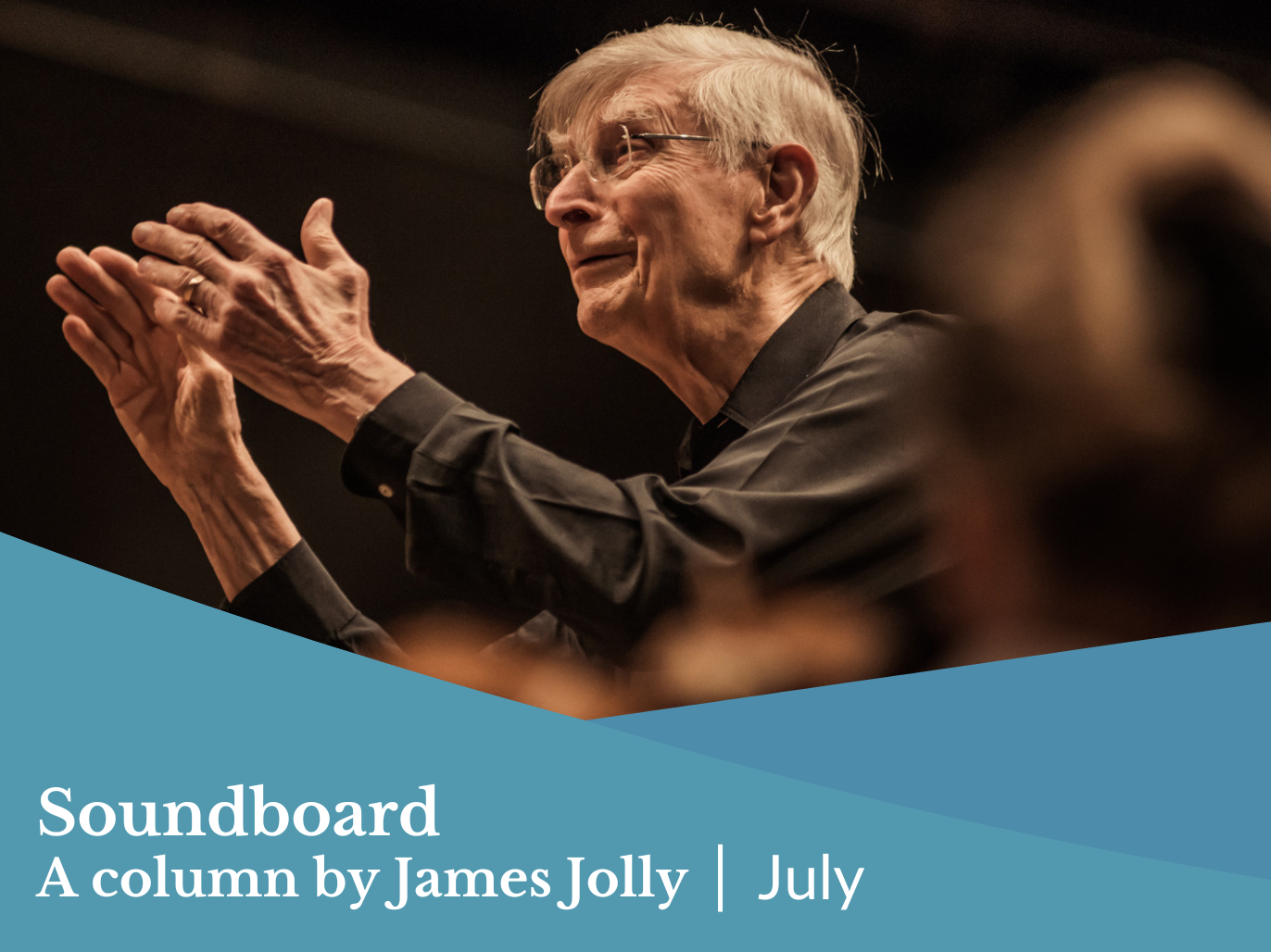
Herbert Blomstedt at 99

At 99, Herbert Blomstedt is still showing the musical world how it’s done — with clarity, humility and an authority that never needs to raise its voice. James Jolly explores how clarity, discipline and respect for the score made him one of today’s most admired conductors.

View author's page

By James Jolly

Reading time estimated : 8 min

On July 11 Herbert Blomstedt celebrates his 99th birthday. In a profession that has often glorified theatrical personalities, imperious egos and podium charisma, Blomstedt stands almost alone. He has spent more than seven decades proving that authority need not be loud, that greatness need not announce itself and that the deepest musical wisdom is often expressed with the simplest of gesture.

Today he is widely regarded as one of the greatest living interpreters of the Austro-German symphonic tradition, while remaining one of the foremost champions of Scandinavian music. Yet this universal admiration came remarkably late. Unlike contemporaries whose reputations were forged through glamour or controversy, Herbert Blomstedt’s was built patiently, honestly and almost imperceptibly, until the musical world suddenly realised it had been in the presence of one of the supreme conductors of the age all along. He is living proof of Shakespeare’s sage suggestion, in King Lear, that “ripeness is all”.

Born in Springfield, Massachusetts, in 1927 to Swedish Seventh-day Adventist parents, Blomstedt returned to Sweden while still a toddler. Music surrounded him from childhood, but so did discipline, scholarship and faith. Those qualities have remained inseparable throughout his life. He studied in Stockholm and Uppsala before refining his craft with Igor Markevitch in Salzburg, Paul Sacher in Basel, Jean Morel at Juilliard, and Leonard Bernstein at Tanglewood. He absorbed lessons from all of them while ultimately becoming unmistakably himself.

Winning the Koussevitzky Conducting Prize in 1953 and the Salzburg Conducting Competition two years later opened professional doors, but Blomstedt’s ascent was steady rather than spectacular. His appointments with the Norrköping Symphony, Oslo Philharmonic, Danish Radio Symphony Orchestra, Swedish Radio Symphony Orchestra and, above all, the Staatskapelle Dresden established him as an exceptional Kapellmeister in the finest European tradition: a conductor whose first loyalty was always to the composer rather than to personal display.

His decade in Dresden, from 1975 until 1985, now appears one of the pivotal chapters of 20th-century conducting. Working with one of Europe’s oldest orchestras, Blomstedt produced performances and recordings of Beethoven, Schubert, Richard Strauss and Bruckner that have aged with astonishing grace. There is an integrity to these interpretations that has only become more apparent with time. They never chase novelty. Tempi arise naturally from the architecture of the score; balances are transparent; climaxes are earned rather than manufactured. Even today, these Dresden recordings remain touchstones for listeners seeking performances in which structural clarity and expressive warmth coexist without compromise.

Yet despite this distinguished European career, Herbert Blomstedt was not then regarded as one of the world’s truly elite conductors. That transformation came after 1985, when he accepted the music directorship of the San Francisco Symphony. The appointment would prove decisive both for the orchestra and for Blomstedt himself.

The San Francisco Symphony had enjoyed notable successes under Edo de Waart, but Blomstedt brought something different: an unmistakable artistic identity. He deepened the orchestra’s sound, expanded its repertory, strengthened its discipline, and transformed it into one of America’s finest orchestras. International tours announced that transformation to Europe and Asia, while an extraordinary series of Decca recordings won Grammy and Gramophone Awards and widespread critical acclaim. Suddenly audiences who had previously regarded Blomstedt as an outstanding Scandinavian conductor recognised him as one of the great international musical figures of his generation.

His San Francisco years also demonstrated a rare balance between intellectual seriousness and communicative warmth. Blomstedt’s Beethoven possessed nobility without heaviness. His Brahms sang without indulgence. His Nielsen retained its rugged individuality while becoming more accessible to international audiences. Even his rehearsals acquired legendary status among musicians – not because of authoritarian demands but because every remark illuminated the score. Players frequently speak of how Blomstedt never wastes words. Every rehearsal begins from complete preparation. Every gesture has meaning. Every correction serves the music rather than the conductor’s ego.

Blomstedt told me a wonderful story about a youthful musical encounter when I interviewed him in 1993 ahead of a European tour. “I remember the Vienna Philharmonic coming to Stockholm during the war. I was living in Sweden then and was only about 13 or 14. I was a great fan of Furtwängler – I even had an autograph, the only one I have ever solicited – and he conducted the Bruckner Seventh. At the end of the concert the applause was courteous but no more. Furtwängler was furious. I was standing at the door and he came out and was still very cross. He was talking loudly to someone with him. ‘Nie mehr Bruckner in Stockholm. Nie mehr Bruckner!’ I recall the orchestra played their hearts out, but for the Stockholm public it was perhaps a little bit long. That’s similar to the attitude of American audiences, though the San Francisco Symphony, as an orchestra, has grown to love Bruckner. He’s not so close to the American sentiment; the lines are too long. They prefer Mahler where you have a major psychological explosion in every bar.” (And if you want to sample Blomstedt’s Bruckner, there’s a wonderful Eighth Symphony, recorded in 2020, and a very fine Fourth, from 2022, both with the Bamberg Symphony.)

After leaving San Francisco in 1995, Blomstedt embarked upon what has become one of the most extraordinary late careers in musical history. His subsequent leadership of the NDR Symphony Orchestra and, especially, the Leipzig Gewandhaus Orchestra further deepened his association with the central German repertoire. Conducting the Gewandhaus meant inheriting traditions stretching directly back to Mendelssohn, Nikisch, Furtwängler and Kurt Masur. Blomstedt proved an ideal custodian: scholarly without pedantry, traditional without routine, reverent without becoming museum-like.

Then something remarkable happened. As many conductors begin to lose physical stamina, Herbert Blomstedt seemed almost to grow artistically younger. From his late eighties onwards, invitations from the world’s greatest orchestras multiplied rather than diminished. The Berlin Philharmonic, Vienna Philharmonic, Leipzig Gewandhaus Orchestra, Bavarian Radio Symphony Orchestra, Concertgebouw Orchestra, Cleveland Orchestra, Boston Symphony, Chicago Symphony, New York Philharmonic, Philharmonia and countless others all sought him out, not as an honoured veteran but as a conductor capable of producing performances of exceptional freshness and authority. Critics increasingly spoke of concerts that felt revelatory: interpretations that combined a lifetime’s experience with an almost youthful curiosity.

Watching Blomstedt conduct today is unlike watching almost anyone else. The physical gestures have become smaller. Often seated, without a baton, his hands barely seem to impose themselves upon the orchestra. Yet musicians respond with extraordinary concentration. There is no sense of manipulation. Rather, the performance appears to unfold organically, as though conductor and orchestra are jointly discovering the score at that very moment. The effect is especially overwhelming in Bruckner, Schubert, Beethoven and Brahms, where immense architectural spans emerge with complete naturalness while every phrase retains its expressive life.

Perhaps that explains why Blomstedt inspires such affection among orchestral musicians. They recognise not merely technical mastery but moral seriousness. Throughout his career his deep religious faith has remained quietly constant. He famously avoids rehearsing on the Sabbath while considering public performance itself an act of spiritual expression. Yet he has never worn belief as a public badge. Instead it manifests through humility, generosity and an unwavering conviction that music exists to illuminate something greater than ourselves.

In an era increasingly fascinated by celebrity, Herbert Blomstedt reminds us of an older ideal: the conductor as servant of the score, guardian of tradition and lifelong student. His performances never seek to astonish through eccentricity. They astonish because they reveal familiar masterpieces with such honesty that listeners often feel they are hearing them anew.

There are conductors whose reputations burn brilliantly before fading. There are others whose fame depends upon recordings, publicity or mythology. Herbert Blomstedt belongs to a rarer category altogether. His reputation has grown because musicians themselves have recognised something exceptional. Each decade has seemed not an epilogue but another chapter of artistic enrichment.

As he celebrates his 99th birthday, his career offers a powerful reminder that wisdom in music cannot be hurried. It is accumulated through decades of study, listening, self-criticism, and reverence for the composer’s intentions. Few conductors have embodied those virtues so completely. Fewer still have continued to deepen them into their tenth decade.

Happy 99th birthday, Herbert Blomstedt – a musician’s musician, a conductor’s conductor and one of the enduring giants of our musical civilization.

Written by James Jolly

Editor Emeritus of Gramophone

James is Editor Emeritus of Gramophone, having previously been Editor. For 25 years he organised and hosted the Gramophone Classical Music Awards which in 2021 reached an audience of over 300,000 via its live stream. He makes a weekly interview podcast for Gramophone, talking to the leading classical musicians of our day. For many years a regular voice on BBC Radio 3, he has twice presented the Tchaikovsky Competition from Moscow and St Petersburg for medici.tv; in 2019, hosting all the piano rounds and the three gala concerts. He filmed a series of in-depth interviews for medici.tv with 12 of music’s movers and shakers,…

View author's page