
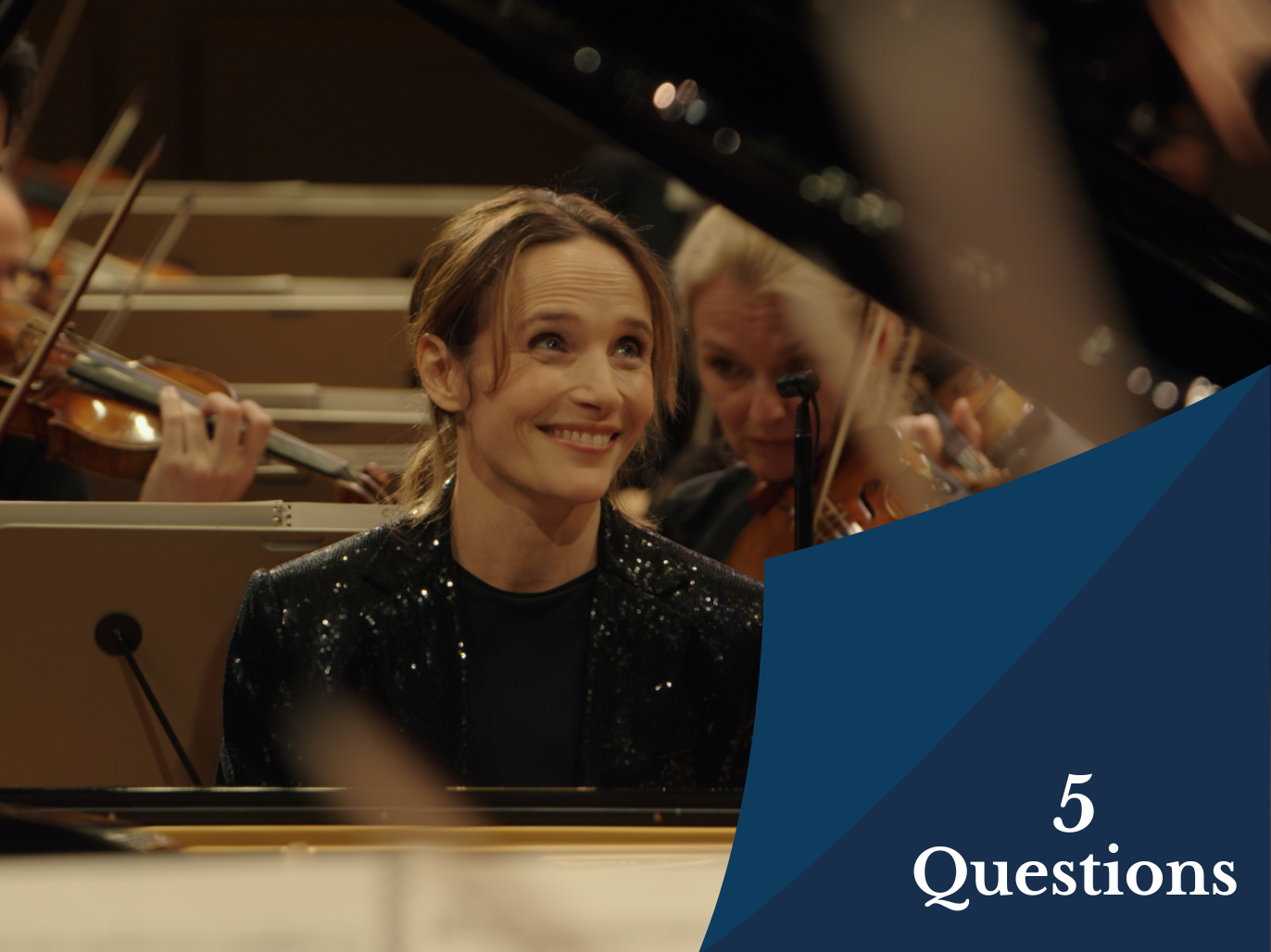
Hélène Grimaud: Gershwin, Synesthesia, and Letting Go

“You give everything—and the rest is out of your hands.” In Zurich, Hélène Grimaud reflects on surrender, synesthesia, and Gershwin’s “feral energy” as a force of transformation.

View author's page

By Editorial Team

Reading time estimated : 6 min

Do you have a ritual before going on stage?

You have to remain flexible. If you become dependent on a ritual, something will inevitably get in the way—travel, circumstances, even something as simple as sleep quality.

What matters most is learning to quiet the mind, rather than relying on a fixed sequence of actions. Breathing always helps: slower, deeper breathing can bring a sense of inner calm.

But beyond that, there is something mysterious about the energy between people—what actually happens, especially when you are not alone on stage. It is no longer just between you, the audience, and the composer, which is already a daunting equation. When you share the stage with many colleagues, everything has to flow. There must be a shared sense of freedom—giving, receiving, responding.

It can be one of the most beautiful processes. Ultimately, all you can do is increase your chances of being ready for whatever might happen.

The most important moment is when you begin to play. There needs to be a sense of liberation: you give everything you have in that instant, with generosity and honesty. The rest is out of your hands.

You experience synesthesia. What do you visualize in terms of colors and forms?

Yes—although I didn’t realize it had a name until much later. I first experienced it as a child while practicing The Well-Tempered Clavier by Johann Sebastian Bach. Suddenly, I saw an orange shape moving in front of me. As a child, you are naturally open to these kinds of manifestations.

Over time, it became something that appears intermittently—not systematically, and still not today. For me, it is quite simple: it relates to tonality. It doesn’t matter whether it is Bach, Sergei Rachmaninov, or any other composer—each key is associated with a color.

C minor is black, D minor is blue, F is red. In the case of George Gershwin’s Piano Concerto, I see a lot of red and gold. Those are the dominant colors, shifting with the modulations.

When those colors are present, I know that nothing has interfered—that I am fully focused. It is a very good sign.

If they are not there, other things can happen: a sense of observing from above, or an inner voice commenting on everything. I am not sure whether that is good or bad—it probably depends.

But ideally, you want to be so fully in the moment that it becomes indivisible, with no distance or fragmentation. In that sense, synesthesia is something I welcome.

What is your earliest memory of hearing the Gershwin’s Piano Concerto in F?

I first heard a recording by Sviatoslav Richter—and you might wonder why that version of all versions. But I was completely transfixed.

To me, the piece felt a little like Beethoven’s Choral Fantasy: both awkward and transcendent at the same time. I was struck by the extraordinary earnestness of Richter’s approach, and I immediately wanted to learn the piece.

I also recall a wonderful anecdote. A conductor I worked with in the United States told me about a European tour he had done with Rudolf Buchbinder. Buchbinder had previously performed the concerto with Lorin Maazel, who had a very specific idea for the program: Gershwin’s Concerto in F in the first half, followed by Schubert’s final symphony.

Maazel would address the audience before each concert, explaining that Gershwin—and this concerto in particular—was greatly underrated, and deserved to stand alongside Schubert’s last symphony. Apparently, this made quite an impression on audiences across Europe.

And there is truth in that. The piece is disarming in its honesty and seriousness. The orchestration is remarkable—not always flattering for the piano, but undeniably powerful. It also contains beautiful lyrical moments, alongside a kind of feral drive that gives the music an irresistible energy in the most literal sense.

How does your work in conservation or writing influence your musical thinking?

It is a reconciliation of opposites—different worlds existing in parallel, yet deeply connected. Together, they form a kind of mosaic, a texture of the soul.

In terms of conservation and working with animals, the purpose is essential—not only for our physical health, but also for our psychological and emotional well-being, and for future generations.

But in terms of discipline, there are strong parallels with music. You have to be completely present, 100% in the moment. That is very similar to what is required when practicing a piece.

It is also liberating, because it puts things into perspective. It reminds you not to lose sight of what truly matters: there must be joy, and it must be shared. That is far more important than obsessing over details which, in the end, do not determine whether a concert is meaningful.

As for writing, it is about the desire to share, to communicate. But for me, that is perhaps the least essential aspect.

What would you wish for the audience to take home after this concert?

I would hope that people feel revitalized by this—what I can only describe as a kind of feral energy. It is something that comes from very deep within.

At the same time, there is also a sense of nostalgia, something akin to what you feel in Rachmaninov’s music—a feeling of exile. Even if it is not geographical, there is a sense of something lost, something you long to reconnect with.

This touches both the audience and the performers. It reconnects you not only with the way things are, but with how they could be, in an ideal sense.

It is both humbling and incredibly stimulating. That is what I hope people will carry with them.

Written by Editorial Team

medici.tv

View author's page