
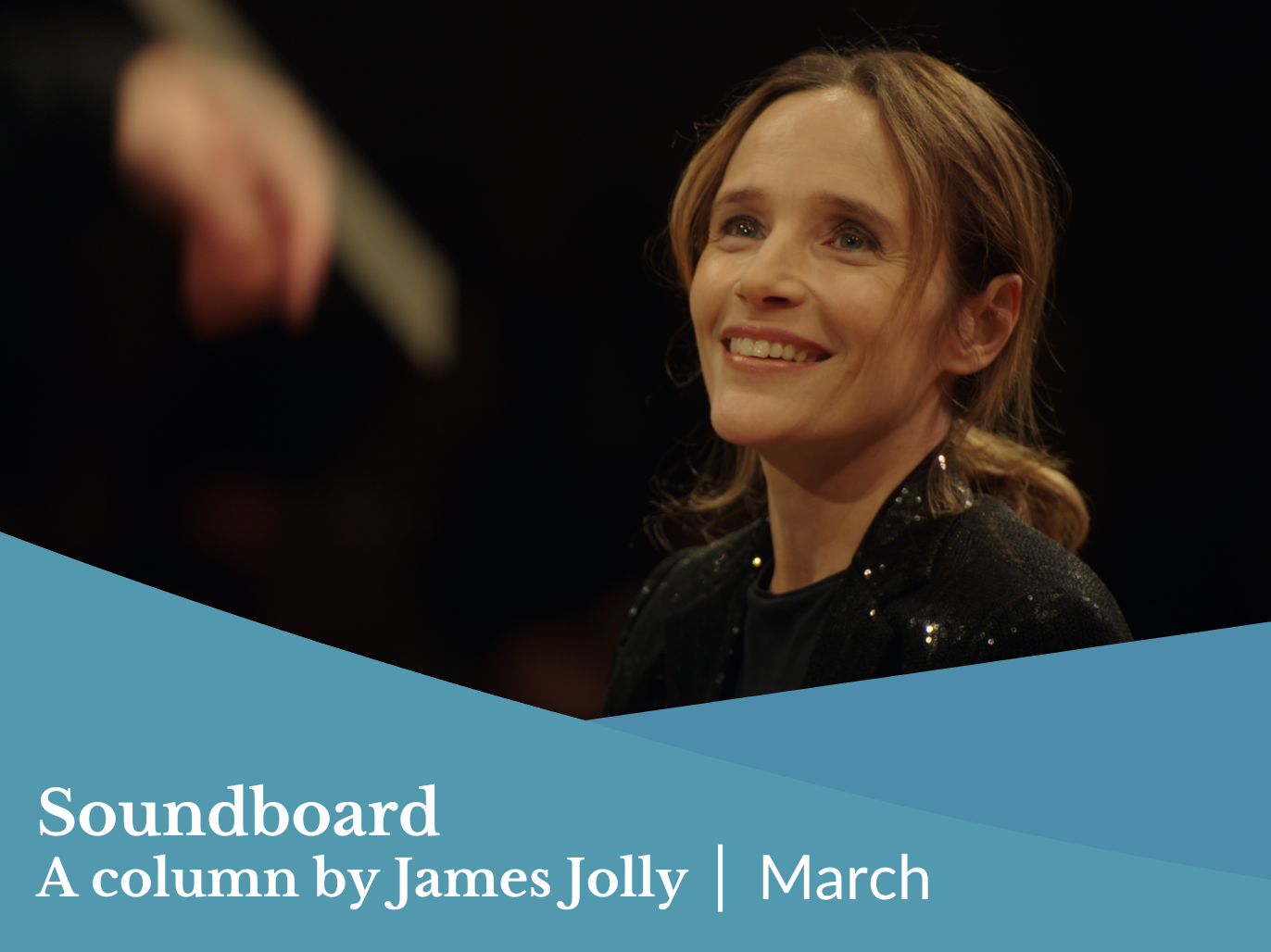
There are pianists who go way beyond just playing the notes, they seem to inhabit them. Hélène Grimaud is a performer who disarms audiences before winning them over with her command of classical and Romantic piano works – and she has been doing so since she was barely a teenager. Hers is an intoxicating blend of drama and lyricism. This month, Grimaud can be heard on medici.tv in the company of Zurich’s Tonhalle-Orchester and its Music Director, Paavo Järvi, in Gershwin’s Piano Concerto in F Major (available this Sunday here). Its rhythmic drive and punch need a very special approach, but when it comes off it’s always a crowd-pleaser. No worries here…
View author's page
Reading time estimated : 6 min
Born in Aix-en-Provence, Grimaud began her piano studies at an early age at the local conservatory with Jacqueline Courtin, before going on to work with Pierre Barbizet in Marseille. She was accepted into the Paris Conservatoire at 13 and won first prize in piano performance three years later. An impatient and often rebellious student, she insisted on learning repertoire at a faster pace than the conservatory would allow, and arranged on her own to play the Chopin F minor Concerto (No. 2) with the orchestra at the Aix conservatory where she had begun her studies. A recording of the concert reached a producer at Denon, and the rest is history. Her first recording – of music by Rachmaninov, including the ferociously challenging Second Piano Sonata – had Gramophone’s reviewer riveted: ‘This is playing with a masterly authority, an expansive technical command and a real feeling for Rachmaninov’s dark harmonic world. Hélène Grimaud has the keenest possible ear for finished phrasing, with none of that self-conscious lingering that one often associates with “romantic” piano playing. She is 15 years old.’ It was the album that launched Grimaud’s career – and at such a young age. (And, all these years later, it still sounds very impressive!)
She continued her studies with György Sándor and Leon Fleisher – both pianists with formidable techniques – until, in 1987, she gave a well-received debut recital in Tokyo. That same year, Daniel Barenboim invited her to perform with the Orchestre de Paris. The great pianist and conductor’s endorsement was a signal to the wider world that this was not an ordinary prodigy. She debuted with the Berliner Philharmoniker under Claudio Abbado in 1995, and with the New York Philharmonic under Kurt Masur in 1999 – two milestones that confirmed her standing at the summit of the profession.
From early in her career, Grimaud has been associated above all with the Austro-German repertoire. She defies easy categorisation, favouring the muscular repertory of Brahms, Beethoven, Rachmaninov, Schumann and Liszt, and her lush sound and sweeping interpretations have drawn comparisons to Martha Argerich and Jorge Bolet. Her fans have called her a ‘powerhouse prodigy’ with sweep, vehemence, introspection, electrifying technique and lush sound, particularly in left-hand voicings that slightly anticipate the right.
It is in Brahms that many critics have found her most completely herself. His two piano concertos were, for many years, considered beyond the physical reach for many women pianists, and are still not tackled by so many, but they have always sat central to Grimaud’s repertoire. Her Brahms is big, epic and muscular – bringing out detail often buried in other performances, and capturing an elusive Brahmsian Romanticism that reveals a more human and more sensual side to the composer. In concert, this translates into something viscerally compelling: reviewing her performance of the Brahms First Piano Concerto with the Philadelphia Orchestra, one critic observed that in the exposed solo passages, Grimaud drew out her phrases with great freedom and a rhythmic flexibility that would have been self-indulgent under lesser hands – deeply poetic and thoughtful playing, as much a tribute to her artistry as to the music’s own rich expressivity when interpreted with such daring.
Her own words illuminate the philosophy behind this approach. In liner notes for the anthology ‘Portrait of the Artist’, Grimaud describes her ‘quest for spontaneity’ and her willingness to take risks: ‘It’s not comfortable, but being comfortable was never the idea. You’re there to generate emotion and to produce something that, ideally, should sound as if it’s being written while you hear it.’
medici.tv also offers two different, but equally fascinating, performances of Ravel’s Piano Concerto in G – one conducted by Riccardo Chailly, the other by Vladimir Jurowski. It’s work that demonstrates not only Grimaud’s natural sympathy with repertoire from the country of her birth, but also the sparkle and allure of her playing in music that needs the lightest of touches, but also calls for a twinkle in the eye.
Her discography – since 2022 for Deutsche Grammophon – is wide-ranging, stretching from core Romanticism to contemporary composers, notably her sustained championing of the Ukrainian composer Valentin Silvestrov, whose quiet, luminous world has become a natural counterpart to the grand architectures of Brahms and Beethoven. Her 2023 recording ‘Silent Songs’, a live performance with baritone Konstantin Krimmel of selections from Silvestrov’s monumental song cycle, received significant praise for its poised and unaffected account of the composer’s dreamlike music.
Grimaud is famously more than a pianist. Her love for wolves was sparked by a chance encounter with one in northern Florida, which led to her founding the Wolf Conservation Center in South Salem, New York, in the late 1990s. She is also a published author and a member of Musicians for Human Rights. Yet this breadth of engagement has never diluted her musical focus. Describing herself as a mere vehicle for music rather than a public icon, she speaks of concert settings that work so well they advance from musical to spiritual events, and has confided: ‘The more you grow, the more difficult you realise it all is, the more risky you realise it all is, and the more humbling it is.’
Now in her mid-fifties, Grimaud – once known as something of an enfant terrible – has settled into maturity without surrendering her independent spirit or interpretative élan. After four decades at the keyboard, hers remains one of the most distinctive musical voices before the public today.
