
From Stadium to Stage: The Shared Language of Music and Sport

What links football clubs, opera houses, marathon runners and conductors? More than metaphor: music and sport have a shared pursuit of excellence, discipline and physical freedom.

View author's page

By Andrew Mellor

Reading time estimated : 12 min

Sweden’s most successful football team, Malmö FF, plays in a smart stadium on the edge of the city’s Pildamms Park. If you turned up there for a match in 2019, you might have seen a message ticking along the pitch-side hoardings referring to ‘our friends at Malmö Opera’. If you’d sensed the crowd’s singing in the stands was better than normal, it might have been because Malmö Opera’s entire chorus and orchestra were watching the match. 

The relationship between Malmö FF and Malmö Opera – whose theatre sits on the other side of the park – was born when the two institutions realized they had a lot in common. They were both established at a similar time and both had passionate supporters – exactly the same number of season ticket holders (‘subscribers’ as theatres are more likely to call them), in fact. It was a partnership based not just on marketing and communications, but also on the acknowledgement that both institutions employed elite teams of highly-trained performers who might be able to learn from one another. 

The arrangement was not an isolated case. In the 2010s the Bundesliga football team Red Bull Leipzig called upon its distinguished orchestral counterpart, the Leipzig Gewandhaus Orchestra, for tips on excellence and image-creation. At the turn of the decade, Queensland Ballet in Australia entered into a relationship with Brisbane Lions, an Aussie Rules football team that was described to me at the time by the ballet company’s Head of Strategic Engagement as ‘a relationship focused…on excellence – on what it takes to become an elite level performer.’

‘The Inner Game of Tennis’

Two decades ago, those sorts of partnerships would have been considered bizarre. Much has changed since then – including a global pandemic that united organizations reliant on gathering people together in the same space, and a newly personal liberalism that has normalized the idea of individuals having a range of interests and lifestyles – and that they might even be better off for it.

Besides, curious and intelligent human beings will always be interested in the full breadth of the world around them. One such human being is Marie Jacquot, who as a tennis player made it to the French Open but is better known today as Principal Conductor of the Royal Danish Theatre and incoming Music Director of the WDR Symphony Orchestra in Cologne.

Jacquot’s job in Copenhagen means I’ve been lucky enough to interview her a few times (I’m also in no doubt that she is one of the great emerging conductors of the decade – if you haven’t seen her in action, you should). Each time we’ve met, it has proved too tempting to ask her about her sporting background. 

Her response has been both positive and negative. She saw the synergies between the disciplines of sport and music early on – ‘you “play” tennis like you “play” music, it’s the same verb,’ she told me in 2024. But soon the competitive element in tennis got her down; she was tired of playing ‘against’ people, and she turned to music. 

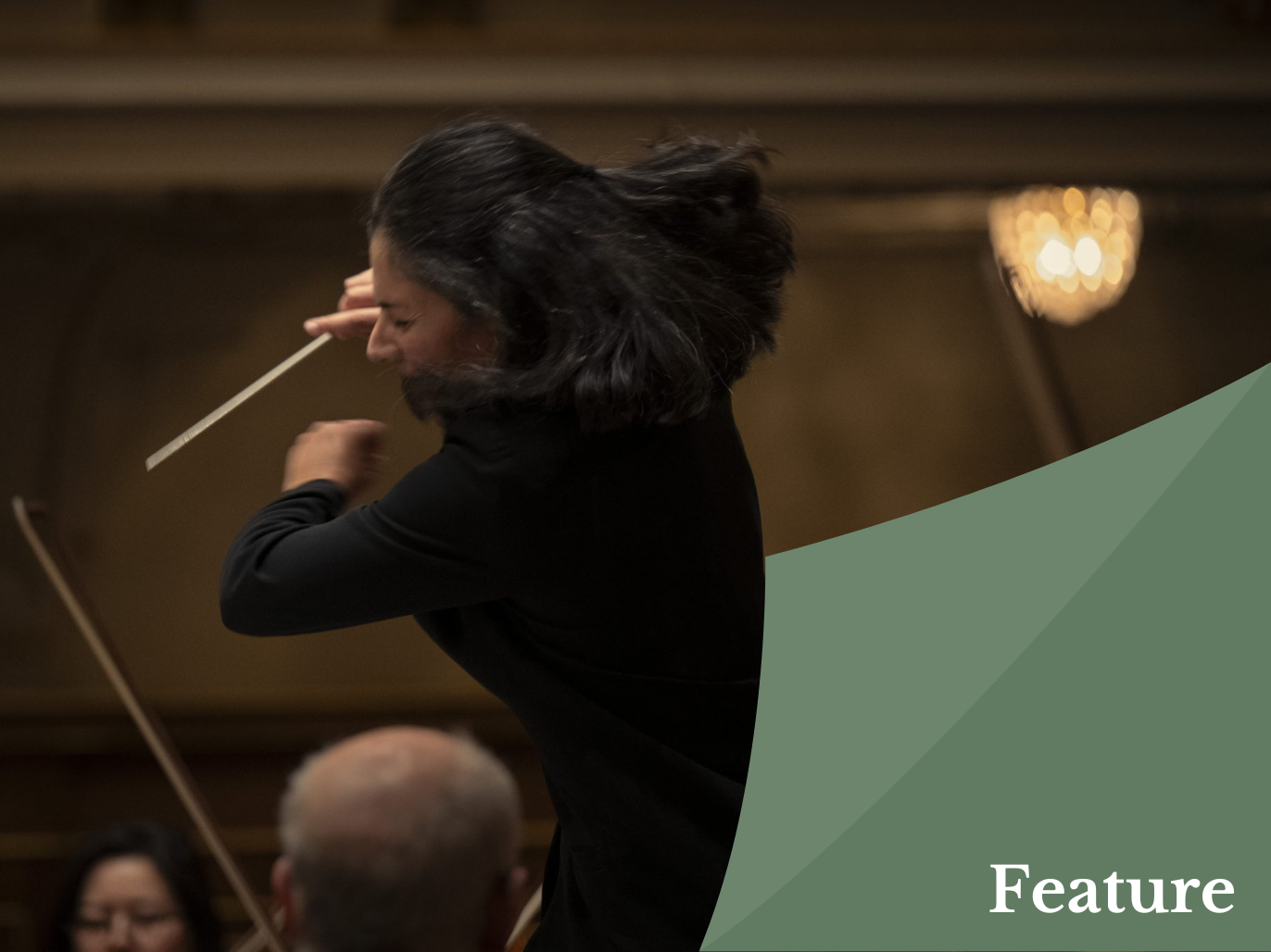
Watch Jacquot conduct, and you can sense the poise of a tennis player – literally in her ankles and her arms, more broadly and her sense of physical freedom and spontaneous anticipation. I cannot think of another conductor who smiles so much – the sort of smiles that come from playing sports with friends, perhaps, rather than professional opponents. 

Way back in 1974, Timothy Gallwey’s book The Inner Game of Tennis was first published. The book used tennis as a metaphor for how to overcome nerves and deliver brilliance in the moment (among other themes). It became remarkably popular with musicians of all sorts. 

Asbjørn Nørgaard, violist of the Danish String Quartet, talked to me in an interview a few years ago about one of the book’s central lessons: to have the creative discipline to not rejoice in overt success, nor be frustrated by overt failure, but observe all with equal openness. It is ‘literally easier to nail those hard shifts [in a Beethoven string quartet] when you are not constantly evaluating your performance,’ said Nørgaard.

Fit for Music

‘Mens sana in corpore sano’ said the Ancient Romans: a healthy mind in a healthy body. Sportspeople have long turned to music to help not just with mental preparation but mental strength and relaxation. 

When England’s women won the European Championships in football last summer, plenty wanted to know the secret behind the team’s success. One of the revelations caught the media’s attention: that England forward Michelle Agyemang had taken her piano to the championships. 

Then we had Erling Haaland’s Beats Solo 4 Playlist on Apple Music – ‘the classical tracks that inspire Erling Haaland to take his intense workouts beyond the ordinary.’ The Manchester City striker chose a very Norway-heavy lineup including lots of Grieg (including two movements from Peer Gynt, Last Spring and the composer’s Piano Concerto) and Halvorsen.

Elite athletes might use orchestral, choral and chamber music to focus the mind. But as Nørgaard’s comments suggest, sport is relied on more and more by musicians to help analogize what they do in performance – or, conversely to those sportspeople, to help them physically prepare for a performance. 

Just Ask Lisette 

Playing an instrument is a physical activity. Singing, where the voice is the instrument, is even more so. There was one obvious singer to call for a chat about that – the American soprano Lisette Oropesa, who as well as appearing on the world’s leading opera stages has also completed six marathons (including one, in Pittsburgh, the morning after a performance on stage).

‘I’m not a natural athlete,’ Oropesa tells me on the phone from New York, where she’s starring in a new production of Bellini’s I Puritani that recently opened at the Metropolitan Opera, ‘but running teaches you that your mind is strong. When you’ve experienced a breakthrough with distance, or you’ve gone faster than you’ve ever thought you could, you realize that you might be able to do things even if your body is saying you can’t.’ The lessons Oropesa has learned from running have helped her when feeling nerves on big nights; the effect, she says, is of ‘knowing I’m going to be okay and that I’m going to do my best’. 

For evidence of how the physical benefits of running support Oropesa’s career, take a look at this production of Donizetti’s Maria Stuarda from the 2025 Salzburg Festival (below). Director Ulriche Rasche’s staging of the opera, in which Oropesa took the title role, used a giant disc that was rotating for the entirety of the opera. 

‘I had to be in constant motion the entire time,’ says Oropesa, ‘and was never allowed to stop because the wheel never stopped. That was a tremendous challenge because sometimes, as a singer, you just want to stop and sing on your own two feet.’ Opposite Oropesa, singing Queen Elizabeth I, was her fellow American and Met young artist graduate Kate Lindsey. ‘Kate is an exemplary athlete and singer. We’re both fit but it was a challenge for us both, as this bel canto music requires you to exhale these long vocal lines which is difficult enough on the breath even if you’re not moving as well.’

Breathing is where the crossover between running and singing gets technical. Oropesa talks in detail about breath patterns that can be used when doing both. On a simpler level, she observes that ‘running helps you breathe deeper in a state of high stress’, either through employing those patterns or because the physical fitness it induces helps keep the heart rate low when the body is under pressure. 

So could she do what she does, the way she does it, if she wasn’t an avid runner? ‘Not with as much ease,’ she replies. ‘I don’t know what I would be like [as an artist] without it, but I know the cardiovascular benefits contribute to my ability to run around a stage and up and down stairs and not get winded from it.’

Or dance? Have a look at Oropesa’s performance in this 2016 fully choreographed production of Les Indes Galantes by Rameau from the Bavarian State Opera. Oropesa had to show her moves in the big dance number towards the end of the opera (chapter VI:6 if you want to skip to it) and then sing an aria. ‘It was even a modified version of the dance, even so I was still so out of breath,’ she recalls, ‘but I managed it. It was an example of a production where demands are placed on the singers that go beyond singing.’

Those sorts of productions are far more common. Is that because artists are more likely to be able to cope with extra physical work these days? ‘I think all this started because directors wanted singers who looked a certain way – thinking of when Kaufmann, Netrebko, Garanča and Hvorostovsky all emerged at a time when productions started to be filmed, and they were all gorgeous. But now we think of it in more healthy terms – that you’re a better singer the more fit you are. Your voice is a function of your health: it’s a reflection of how you’re eating, how you’re sleeping and your emotional state of mind. After a certain point your voice will start to reflect it if you’re making poor choices.’

As a species, we are running faster, jumping higher and kicking harder than ever. We are also singing and playing better. The two, surely, are not unconnected – a reason those football teams and opera and ballet companies have been making alliances. 

Witness a great performance from a great artist who looks like they’re in shape, and the chances are, they’ll have put the training hours in. ‘I can tell you that far more of my colleagues exercise than don’t – far more,’ says Oropesa. ‘Among us artists, it’s a thing, and we are only better for it.’  


Written by Andrew Mellor

Journalist and critic

Andrew Mellor is a British writer, critic, and broadcaster based in Copenhagen. After studying music at the University of Liverpool, he began his career with the Manchester Camerata and the London Philharmonic Orchestra before training as a journalist at Classic FM magazine and Gramophone. Since moving to Denmark in 2015, he has become a leading voice on Nordic music and culture, contributing regularly to Opera and Opera Now.

A regular critic for the Financial Times and a presenter for medici.tv and the Danish Broadcasting Corporation, Andrew Mellor also writes extensively for orchestras, festivals, and record labels around…

View author's page