
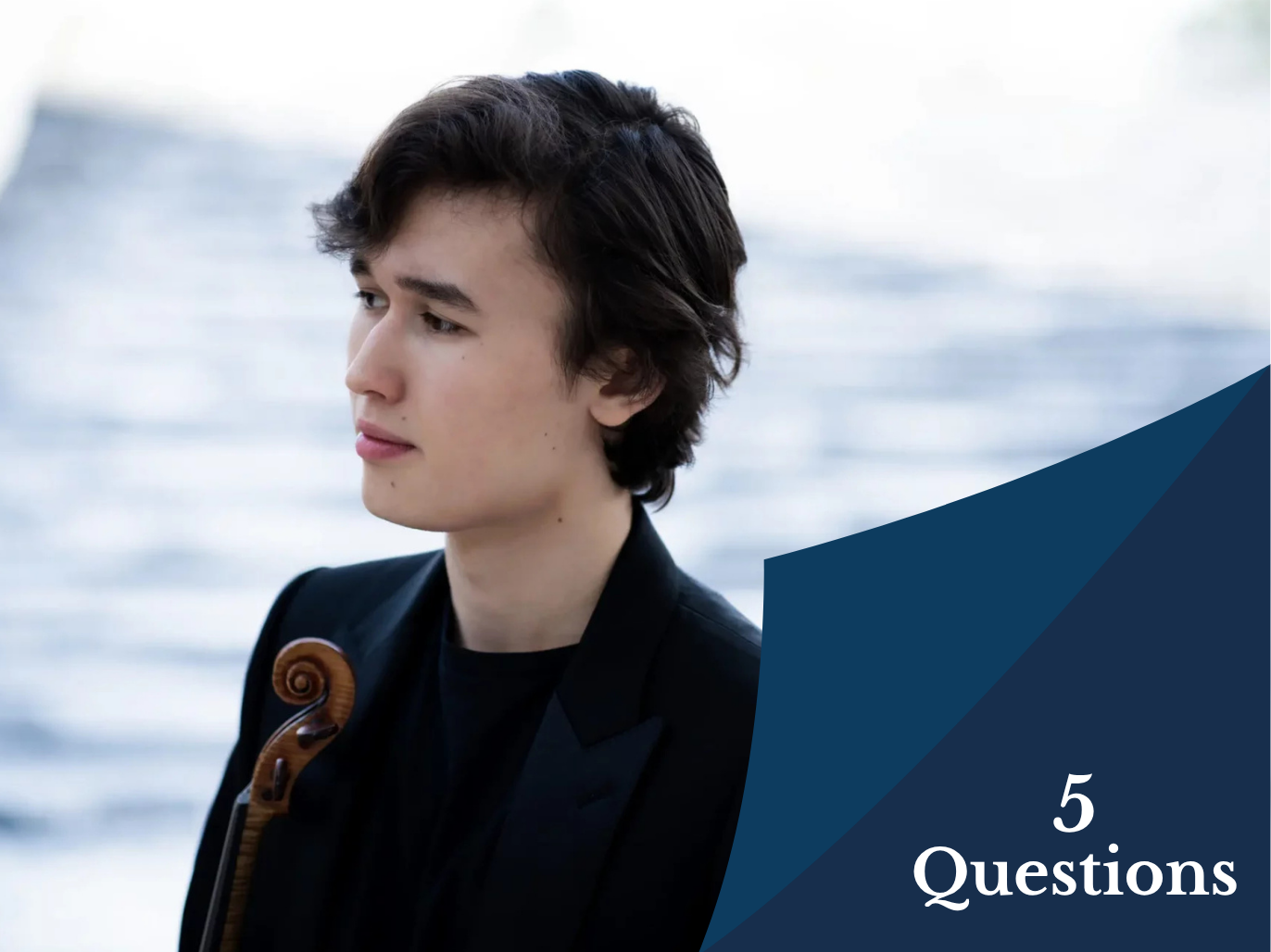
Daniel Lozakovich: “Music Makes Us Believe in Other Worlds”

At Verbier, violinist Daniel Lozakovich reflects on the power of collaboration, the music that shaped him, and the sense of wonder that great teachers awaken. From Tchaikovsky and Jeff Buckley to breath, silence and nature, he describes music as a search for sincerity, truth and something beyond the visible world. 

View author's page

By Editorial Team

Reading time estimated : 7 min

How do collaborations at Verbier shape your playing?

Collaborations at Verbier shape my playing in many ways. I’ve been coming here for many years, and it really expands your openness — your openness to ideas, to different characters, to strong personalities.

It also deepens your understanding of listening. For me, Verbier is not only about the place itself, even though of course there are the mountains and this extraordinary natural setting.

But above all, it is about the musicians — that is the most important thing. We could be anywhere. There could be a Verbier Festival in a cave.

What is so special about Verbier is that it brings all these musicians together in one place. There is no other festival that does this in quite the same way. It shapes you because you have the luxury of being able to speak with people, to go to concerts, to encounter different kinds of artists up close.

Sometimes you only know them through recordings or videos, but to see them in real life is something that shapes you deeply as a musician.

So yes, I would say the greatest quality of this experience is that you listen more. Your ears evolve when you collaborate with so many great musicians.

What kind of music did you grow up with?

All kinds, actually. Many old Russian songs, folk songs. Classical music was always present in our home.

My family loves classical music. They are not musicians, but there was a certain education in it. They were both brought up with classical music. They come from the Soviet Union, where it was a very important part of the culture.

And beyond that, I’ve always listened to many kinds of music. Now it goes in all sorts of different directions. I love Goldfrapp, I love Hendrix. Radiohead is extraordinary. And of course jazz — Chet Baker, for example.

I could name countless musicians. I really do find inspiration in all these different kinds of music. For example, when I was working on a piece by Dusapin, the French composer, I was struck by how specific and raw his writing is.

Sometimes, with certain singers or in opera, things can feel too trained, too polished, too elevated. But I keep searching for that rawness, that sincerity of expression.

One of my strongest inspirations was Jeff Buckley singing Dido’s Lament. He was not an operatic singer, he was a rock singer. But the rawness, the sincerity, the pain — I drew inspiration from that.

In every kind of music, you can find something for yourself. And I think more classical musicians should listen to other things. Of course, there is still an infinity to discover in classical music. I still believe it is the greatest and richest world there is. But there are so many forms of expression outside it that can also inspire you.

How do you recover after a particularly intense performance or festival experience?

Outside of music, I still always need music with me. Or I go for walks, visit a museum, watch films I’ve been wanting to see, read poetry.

Sometimes, when you are tired, you lack inspiration. You think words will not give you that impulse. And then suddenly you read a poem, and it strikes you that people can turn such simple words into something like a song of the heart.

That inspires you. We are more than just animals. And when you are exhausted, you can feel a little lost, caught in an existential state.

That is exactly when you have to go and look for things that nourish your inner world. Nature, of course, is part of that as well.

And yes, sometimes it is just about lying in bed and dying a little. But that is not a very good solution. I’ve tried to move away from that phase.

What role does breathing play in violin playing?

Everything.

Everything. The breath of silence, the breath that brings you into a state, the breath that makes a note sound like a breath — it is everything.

We are born with that first impulse, and that is what music is. Expression itself is a breath of what you carry inside.

There are all kinds of breaths. It can also be an inner breath, something entirely inward.

We learn to breathe differently. We begin to discover different senses of breath, different speeds. For a musician, this is something we all need to feel deeply, to carry in our senses.

What did your greatest teachers give you beyond technique?

They gave me the understanding that music exists in other dimensions. It is not just about notes, or even only about emotions.

Those are the simple things. What matters is opening a door to a magical world — a magic that makes you believe in other worlds.

Composers were not simply inspired in a passing moment. They were striving toward another kind of truth, something vast, almost cosmic. It is not about saying, “This composer was intelligent, this is well written.” No — they make us believe in stars. And that is what a teacher should do.

A teacher should awaken that other side of music. We should not remain trapped in only one way of thinking about it.

I think many people lose interest in music because they come to believe it is only notes, or only emotion. But when you encounter its magical side — this limitless world of strings that touches you and opens your understanding — then you begin to believe in something more.

That is what my teachers gave me, and what I believe all the greatest teachers give their students. They give them the understanding that music has a purpose, that it is a necessity.

Beyond the visible wall, there is something much greater. And it is limitless. Once you begin to feel that, once you have been inspired by that sense, you will keep loving music.

I had always felt that there was something there. But when a teacher opens that world to you in a way you had never imagined before, that is something for which I am deeply grateful.

Written by Editorial Team

medici.tv

View author's page