
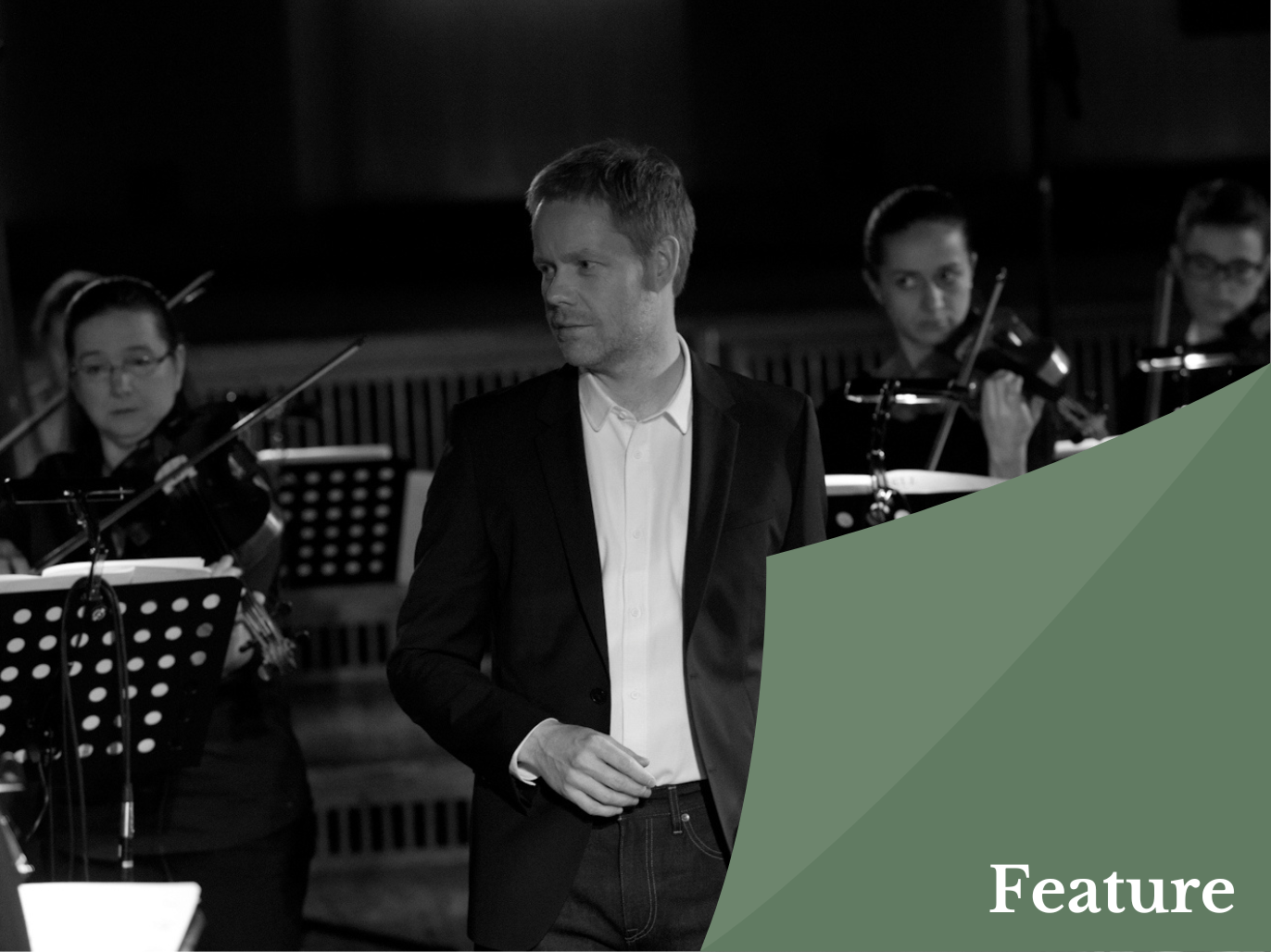
Type the word ‘recomposed’ into Google, and the results are dominated by Max Richter’s 2012 ‘recomposition’ of Vivaldi’s The Four Seasons. This concept piece secured Richter’s global status when it was issued as an album, just as the music it was based on had made Vivaldi’s name three centuries earlier. As Richter celebrates his 60th birthday this Spring, he certainly has reasons to thank his Italian forbear who died 285 years ago.
View author's page
Reading time estimated : 13 min
Richter’s revisiting of Vivaldi’s famous set of seasonal violin concertos was prompted by the record label Deutsche Grammophon, which had asked a series of musicians including Matthew Herbert and Victor Le Masne to rework existing DG albums recorded long before. The results of those commissions are what you would probably call a ‘remix’.
But Richter’s piece went a step further. It returned to the base material and recomposed it, on paper. It became a different piece of music – the opening up of an electronic, ambient space in which refracted or edited versions of Vivaldi’s violin solos play out acoustically. Sometimes, it’s recognizable as Vivaldi. Sometimes, it isn’t.
Unsurprisingly, the idea of Richter ‘borrowing’ Vivaldi was met with controversy in some quarters when it was first heard. But Richter had a compelling defense up his sleeve: in Vivaldi’s time, everyone re-wrote music by everyone else. Once a tune was in the public domain, it was open to use or re-use by anyone.
Recomposition, Baroque-Style
It’s odd that Google believes the word ‘recomposed’ is so strongly linked to Richter, given the practice has always been with us. In official terms, it really got going in the Renaissance and flowered in the Baroque.
In the sixteenth and seventeenth-centuries, it was de rigeur to write polyphonic masses over the popular Burgundian folk tune known as L’homme armé (The Armed Man). Over fifty settings of the Mass that use the tune have survived, including examples by Josquin, Palestrina and Morales (the latter two composers wrote more than one).
The most obvious example of a ‘common melody’ from the Baroque is La Folia, the dance theme that composers of the era were more-or-less obliged to compose ‘over’. La Folia is thought to have emerged in Portugal in the 1400s as a frantic dance associated with a party so good it starts to spin out of control. In the eighteenth-century, it slowed down and became less a head-spinning chord sequence than a dignified melody. In the decade to 1710 alone, some twenty composers wrote works based on the theme, including Bach and Corelli. You can hear Vivaldi’s own version of it at the end of this concert from Apollo’s Fire.
Later in the Baroque era, it became perfectly acceptable for composers not just to use commonly-owned folk music, but to borrow from each other. Bach re-wrote works by Vivaldi (while the latter was still alive) and Handel, famously, re-rewrote a lot of works by himself. Bits of Messiah originated decades earlier in Italian-language cantatas while the aria we know as ‘Lascia ch’io pianga’ appeared as an instrumental piece in the opera Armida in 1705 and as ‘Lascia la spina’ in the oratorio I trionfo del Tempo e del Disinganno in 1707 before turning up in the form we know it, in 1711, in the opera Rinaldo.
The Allure of the Baroque
Richter is not the first composer from a later era to look back at the Baroque and notice plenty of material ripe for re-use.
Sometimes, it was just about the tunes. Benjamin Britten’s The Young Person’s Guide to the Orchestra proves that a tiny but brilliant little melody used in a little corner of Henry Purcell’s little-known work Abdelazer could stand up to twenty minutes of examination by an entire modern symphony orchestra (in 1995, the Danish composer Poul Ruders marked both Britten’s and Purcell’s jubilees with his Concerto in Pieces, another work that takes a fragment of Purcell – the witch’s chorus from Dido & Aeneas – and expands it in all directions).
There are plenty more examples of taking a ‘theme’ from the Baroque era and using it for a more modern variation form – Rachmaninoff’s Paganini Rhapsody among them. Sometimes, the process has run a little deeper. In 1920, Igor Stravinsky began work on a new ballet score for Serge Diaghilev’s dance company which would consciously ‘borrow’ music by the Italian Baroque composer Giovanni Battista Pergolesi (though it later transpired that Stravinsky had unknowingly used music by more than one composer).
In Pulcinella (excerpt below), Stravinsky sought to actively highlight the inherent qualities of Pergolesi’s music, which he believed could inspire his generation to greater craft, purity and discipline. The structures, melodies and stylized dances are obviously from Baroque Italy, but are spiced with Stravinsky’s distinctive accents, harmonies and instrumental colours – very close, in process, to Richter’s take on The Four Seasons. A similar example is found in Puccini’s re-writing of a cantata by Giovanni Paisiello to form the ‘pure’ musical backdrop to grubby manipulation and torture in Act II of his opera Tosca (the title character, usually off-stage, sings the cantata – supposedly for the Queen, who never appears in the opera).
It’s often said that Johann Sebastian Bach’s music is so robust, so perfect, so well-engineered that it can function on any instrument – that’s one reason you can hear The Art of Fugue or the Goldberg Variations on marimbas, accordions, saxophone quartets or on two guitars.
It would be impossible even to summarize the breadth of modern ‘rearrangements’ of Bach’s music, but among the most famous are Leopold Stokowski’s orchestrations of the composer’s organ works. The arrangements were initially greeted as ‘imperious’ and ‘magnificent’ but modern sensibilities tend to recognize that they are more Stokowski than Bach. The most famous example, his orchestration of Bach’s Toccata and Fugue in D minor BWV 565 was used to open Disney’s animated film Fantasia:
A Helping Hand
Gustav Mahler claimed he was acting out of love when he re-orchestrated the four symphonies of Robert Schumann. A curious strain of thought emerged in Mahler’ s time (persisting until very recently) that decreed Schumann a poor orchestrator who had no idea how to handle a large ensemble of instruments.
Unlike the other examples mentioned so far, this was a case of a composer offering one of his forebears ‘help’. Mahler believed Schumann’s symphonies would benefit from ‘re-touching’ for the sake of their own clarity and dexterity. The Austrian composer adjusted dynamic markings, bolstered brass and percussion and switched instruments around. The musical structure remains exactly as Schumann wrote it.
Was Mahler’s intervention necessary? In a sense, you can appreciate where he was coming from: orchestras and concert halls had become bigger, and Mahler believed he was simply letting Schumann’s music sound its best in the context of these new physical conditions. I remember hearing Mahler’s re-orchestrations in a concert some years ago. My conclusion? They were far less successful than the original Schumann scores played on period instruments – or by an orchestra of the appropriate size with a historically-minded conductor – which suggests Schumann was right all along.
In 2007, the contemporary composer Bent Sørensen lent a helping hand to his French-Flemish colleague from six centuries earlier, Johannes Ockeghem (c 1410-1497). Ockeghem had failed to finish his own setting of the Requiem Mass in the middle of the fifteenth century, so Sørensen finished it for him – writing a ‘collaborative’ choral work that is haunting and beautiful in its union of contemporary and medieval styles, both rooted by the twisting threads of plainchant. It sounds some way between Stravinsky’s Pulcinella and Richter’s The Four Seasons. Of the three, though, I have to admit it’s my favourite.
Fanboying/Fangirling
The Norwegian composer Edvard Grieg claimed that in everything he did, he owed a debt to Mozart. In 1876 – that momentous year in music history that fell exactly 150 years ago – Grieg took four piano sonatas by his favourite composer and reinvented them by adding a second piano part. The results sound a little like piano concertos played on a single piano.
Grieg’s Mozart ‘collaboration’ is one of the more unusual re-writes in musical history, and raises the obvious question: why? Perhaps Grieg, in a Norway without an orchestral infrastructure at the time, simply thought it would be fun to ‘upscale’ this music he admired. In that, he wasn’t alone: Beethoven, Liszt and Johann Christian Bach all made their own more expansive arrangements of piano works by Mozart.
Perhaps, putting it more simply, Grieg the creative musician simply wanted to play around with music that fascinated him – a little like Richter riffing on Vivaldi.
If there’s a trend for retouching, re-orchestrating, re-composing or wholesale re-imagining these days, it seems clear that it has come from musicians who want to salute music they admire or music that somehow forms part of their own sonic and creative DNA.
In 2015, the Icelandic composer Ólafur Arnalds paid tribute to the music by Chopin that he remembered his grandmother playing to him as a boy; Arnalds wanted to re-hear Chopin away from the ‘perfectionist’ traditions of the classical concert hall. In collaboration with the pianist Alice Sara Ott, he made a recording in which microphones, acoustics and domestic-sounding pianos are as much a part of the performance as the pianist’s fingers are. Arnalds then supplemented some of Chopin’s works with his own – including an introductory piece that has the effect of opening a door onto the enchanting, distant world conjured up on the resulting album, The Chopin Project.
A few years after Richter’s Vivaldi Recomposed, cellist Peter Gregson took to music that is considered far more hallowed and untouchable than Vivaldi’s – Bach’s Cello Suites.
Gregson’s version of the Suites imagines Bach’s original as if it were a sculpture; it picks it up, turns it around, sees it from different angles and ‘shines the light on it in a different way’. The result is, the cellist says, like a suite of ‘fantasias’ on the original themes of each movement. It is performed by five cellists in addition to Gregson himself, who also plays synthesizers.
More than anything, Gregson’s The Cello Suites – Recomposed feels like a love-letter to Bach’s original. And perhaps, from Bach arranging Vivaldi to Mahler ‘helping’ Schumann – that’s what any revisiting of one composer’s music by another is: a most sincere form of affection for a great piece of art.
