
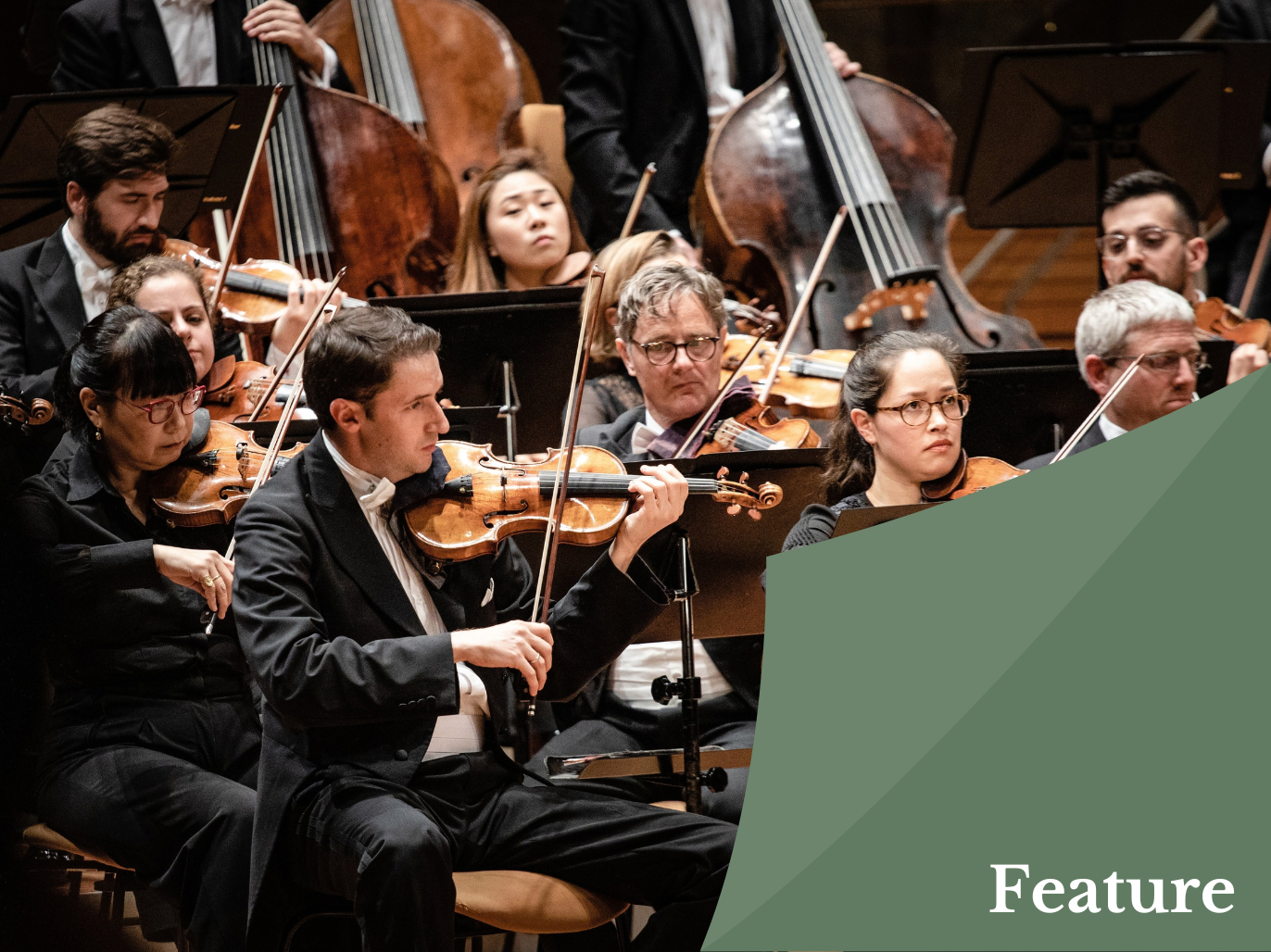
Are These Still the Six Best Orchestras in Europe?

Almost two decades after Gramophone published its infamous list of the “world’s best orchestras,” would the picture look the same today? Andrew Mellor questions old assumptions, spots the new breakthroughs and, of course, revisits what makes each orchestra unique, from sound to character.

View author's page

By Andrew Mellor

Reading time estimated : 11 min

It’s 18 years since Gramophone magazine published its infamous list of the “world’s best orchestras”—a controversial if fascinating poll of critics that placed Amsterdam’s Royal Concertgebouw Orchestra in the Number One spot.

I remember being intrigued by the list, but also somehow disillusioned with it. 

The nerd in me was desperate to see which orchestras had made the cut (and even more, to read why). But the citizen in me considered the whole exercise a little disingenuous and chauvinist—equivalent to telling people in Glasgow, Toulouse or Zagreb that their orchestra wasn’t up to scratch. 

At the risk of sounding like a broken record, the best orchestra in the world is your local orchestra, on a good night, with an inspired and capable conductor. 

And yet…isn’t it fascinating (and fun) to talk about who’s doing really well, and whose lost their shine—like we do when talking about football teams? It’s also healthy to examine our preconceptions and challenge accepted pecking-orders when it comes to often venerable, historic institutions like symphony orchestras.  

About a year ago I asked ‘Do the “Big Five” US orchestras still reign supreme?’ Should we direct the same question towards their European counterparts, where the great philharmonics of Berlin and Vienna, the RCO and the London Symphony Orchestra have traditionally reigned supreme? 

Those four, plus the Bavarian Radio Symphony and the Budapest Festival Orchestra, constituted the six European orchestras in Gramophone’s Top Ten.

What Makes a “Great” Orchestra?

However easy it is to fall in love with an orchestra after a knockout performance or some deeply sensitive playing, there is more to being a top orchestra than sounding good. We looked at this when asking the same question of America’s Big Five. 

Can an orchestra that makes a magnificent sound be discounted as “great” because it isn’t cherished by its home city, it doesn’t communicate its qualities particularly well, its audience isn’t actively listening, or it hasn’t developed the more stylistically flexible approach that many conductors, soloists and audiences expect?

The answer, I would suggest, is “yes.” In the third decade of this still-new century, orchestras need to say something that feels appropriate and meaningful in our world, and they need to say it to a wide range of people. 

The Berliner Philharmoniker was Gramophone’s runner-up. Since 2010, it has transformed itself institutionally and musically. Its repertoire is recognizably wider, its stylistic capabilities far broader and its week-to-week reach has increased exponentially given the development of its own streaming platform, the Digital Concert Hall. 

The Berliner Philharmoniker has become, simply, the model of the modern European orchestra—a counterpart to the Los Angeles Philharmonic across the Atlantic. 

If you need reminding how good the Berliner Philharmoniker can sound, have a listen to it playing Mahler under former chief conductor Claudio Abbado in these performances from the Philharmonie. 

Long acclaimed for sensational interpretations of Mahler’s œuvre, Abbado and the Berliner Philharmoniker commemorated the 100th anniversary of the composer’s death on May 18, 1911 with a program featuring his unfinished 10th Symphony.

As for its current chief Kirill Petrenko, I have never heard any conductor sculpt a musical phrase quite like he does. Nor have I heard critics go quite so mad for a performance at the BBC Proms as my former colleagues did for the Berliner Philharmoniker’s appearance at the festival some weeks ago.

The New Model?

I describe the Berliner Philharmoniker as a model, but isn’t that reductive? The more I think about it, the orchestras that interest me most are the orchestras that are truly distinctive—as well as being technically superb, emotionally engaged, artistically broad-minded and so on.

The second German orchestra on Gramophone’s Top 10 was the Bavarian Radio Symphony Orchestra—a broadcasting orchestra that has different operational and artistic goals to a civic institution like the Berliner Philharmoniker. Still, on its day, the BRSO can easily rival Petrenko’s players in Berlin.

Berg’s Concerto for violin, an intense work shaped by grief, performed by violinist Gidon Kremer and the Bavarian Radio Symphony Orchestra under Sir Colin Davis.

You can see history repeating itself in Munich. As in Birmingham and Berlin, Simon Rattle has put the BRSO on a diet of Webern and Schoenberg, drilling into some of the most fundamental details of sound and ensemble. If anything, it’s making the orchestra’s Wagner and Bruckner sound even more out-of-this-world. 

On musicianship alone, I’d probably put the BRSO at the top of my list. But there are mitigating factors when considering its place more broadly. It plays in a cramped concert hall with poor sightlines and has the sort of recherché artistic profile that excites obsessives like me rather more than the general public.

The Old Guard

The third German orchestra on Gramophone’s list, the Dresden Staatskapelle, poses some difficult questions. This remains one of the few orchestras in the world instantly recognizable from its sound.

We’ve covered this before—the glow with which the Dresden orchestra seeps into your ears, its woody strings and throbbing horns. I love an orchestra I can identify within a few bars. But while it might be unbeatable in Bruckner, there are orchestras from Bournemouth to Bochum would arguably play Rossini and Ravel with more style than this venerable orchestra would. 

Does that count against Dresden—and orchestras like it (looking at you, Leipzig Gewandhaus)—when we come to assess which orchestras are ‘best’ in the twenty-first century?

In a way, yes it does—orchestras these days are expected to be stylistically flexible, mostly because it makes linguistic sense of music written in different traditions by individuals with different temperaments. One the other hand, I tend to seek Dresden out because it offers a listening experience like no other orchestra—just as long as the repertoire fits. 

Few orchestras can get away with resting so heavily on their traditions as the Dresden Staatskapelle does, but one that can is the Vienna Philharmonic. 

The orchestra cleaves unashamedly to the ‘Wiener Klangstil’ that harks back to the era of Beethoven, and still uses plenty of instrument-types that have long been obsolete elsewhere (so does Dresden, as it happens). 

It’s the same argument: can an unwavering insistence on tradition sustain an orchestra in the twenty-first century? Perhaps it can, when the resulting sound is as magnificent as the Vienna Philharmonic’s. This is an ensemble whose smoothness and coffee-rich darkness can be mesmerizing.

Superstar conductor Yannick Nézet-Séguin brings his panache and precision to the Wiener Musikverein to lead the storied Vienna Philharmonic in Beethoven’s Piano Concerto No. 3 in C minor, with the mighty Yefim Bronfman in the solo role.

Still, you don’t have to go long down the list of Viennese music critics to encounter dissent. There are some who claim the city’s flagship orchestra can sound dull or even “brutal” and that it too frequently works with unsympathetic conductors. That’s hardly an accusation that can be levied at its counterpart in Berlin.

Fresh Energies

Nor could it be levied at the Budapest Festival Orchestra. Here’s an orchestra that sounds distinctive not because it’s preserving some longstanding sound culture, but because it’s actively going against one.

The Budapest Festival Orchestra and gold-standard conductor Iván Fischer performing Schubert’s Symphony No. 9 in C Major, nicknamed “The Great” for its length, its grandeur, and the paradigm-shifting scope of its ambition.

The BFO is known for its hyperactive enthusiasm for musical conversation. There is, arguably, no more reactive and flexible symphony-sized orchestra than the BFO. The levels of excitement it brings to performances trump those of the Berliner Philharmoniker and the most enthusiastic youth orchestra combined.  

Like the Harlem Globetrotters, the BFO has no fixed home and unashamedly cultivates a soloistic playing style among its members—the very opposite to orthodox orchestral thinking. Perhaps the BFO is best compared to an improv-comedy troupe in the way its players spontaneously react to one another, finding the fun in almost everything they play. 

The BFO was founded in defiance of the Berliner and Vienna Philharmoniker models. It’s worth considering this when we think about just which European orchestras are the most interesting, progressive, surprising and engaging—as well as the best-sounding—in 2026. 

The BFO was the only “project” orchestra in Gramophone’s Top Ten. Originally, it wasn’t full time. ‘Festival’ orchestras like the Lucerne FO and Verbier FO and the Sinfonia of London have started to achieve a sense of fluidity, unity and distinction that many regular orchestras never even get year. 

This performance by the LFO, for example, is the sort that you simply can’t imagine being conjured-up in a subscription concert. The question is whether festival orchestras like these can be judged alongside institutional orchestras with fixed memberships that serve a particular community. 

Then we have to consider orchestras that have broken the mold entirely: the likes of Aurora Orchestra that can perform entirely from memory; the Norwegian Chamber Orchestra that can act, dance and play at the same time; and The Knights, that can segue from Bach to Sibelius to klezmer to soul and whose whole approach returns to the basics of improvisation—the original DNA of orchestral music-making.

My Top Six

So here’s a list of my Top Six European orchestras:

Only kidding…as you may have guessed, I think it’s a little more complicated and nuanced than that. 

Gramophone’s list was an astute one for 2010 but the world has changed. Some orchestras have changed with it, others not so much. 

The Budapest Festival Orchestra would certainly be on my shortlist for the distinctive, gregarious, joyful nature of its playing and the Bavarian Radio Symphony Orchestra might just sneak in there for on pure finesse.

For sound culture, I couldn’t live without the glow of the Dresden Staatskappelle, the fizz of Czech Phil and Bamberg Symphony Orchestras or even the soft attack and deep lyricism of the orchestra world’s best-kept-secret, the Royal Danish Orchestra (the oldest in the world, and one of the most distinctive-sounding).

Then there are all those orchestras that have very specific capacities to excite right now because of their home venues, their current chief conductors or a sudden generational change—the Orchestra National du Capitole de Toulouse, the Borusan Istanbul Philharmonic, the Flanders Symphony Orchestra and NDR Elbphilharmonie Orchestra.

If we see the symphony orchestra in the round as a contemporary arts institution—the flag-bearer for the notion that any great tradition needs to stay ahead of the curve—then we would have to acknowledge the leading status of the Royal Concertgebouw Orchestra for flair, the LSO for leadership, the Dresdner Sinfoniker for ‘outside the box’ thinking and the Finnish Radio Symphony for the trust it has built with its audience, programming whacky music while still selling every single ticket. 

And what orchestra best combines all those things? Predictable, I know, but it’s our old friend the Berliner Philharmoniker. Somehow, its status seems so much more deserved now that it has a demure, attention-shy chief conductor who makes the whole enterprise seem somehow more genuine by also being so amazingly good. 

Don’t take my word for it. You can access recent performances from almost all these orchestras via medici.tv, so there’s no excuse for not listening critically and making up your own mind. 

And remember, the orchestra you consider best of all can legitimately be the one you have the closest relationship with—including the one down the road. If the stars align right, any decent orchestra can make the earth move under your feet.

Written by Andrew Mellor

Journalist and critic

Andrew Mellor is a British writer, critic, and broadcaster based in Copenhagen. After studying music at the University of Liverpool, he began his career with the Manchester Camerata and the London Philharmonic Orchestra before training as a journalist at Classic FM magazine and Gramophone. Since moving to Denmark in 2015, he has become a leading voice on Nordic music and culture, contributing regularly to Opera and Opera Now.

A regular critic for the Financial Times and a presenter for medici.tv and the Danish Broadcasting Corporation, Andrew Mellor also writes extensively for orchestras, festivals, and record labels around…

View author's page