
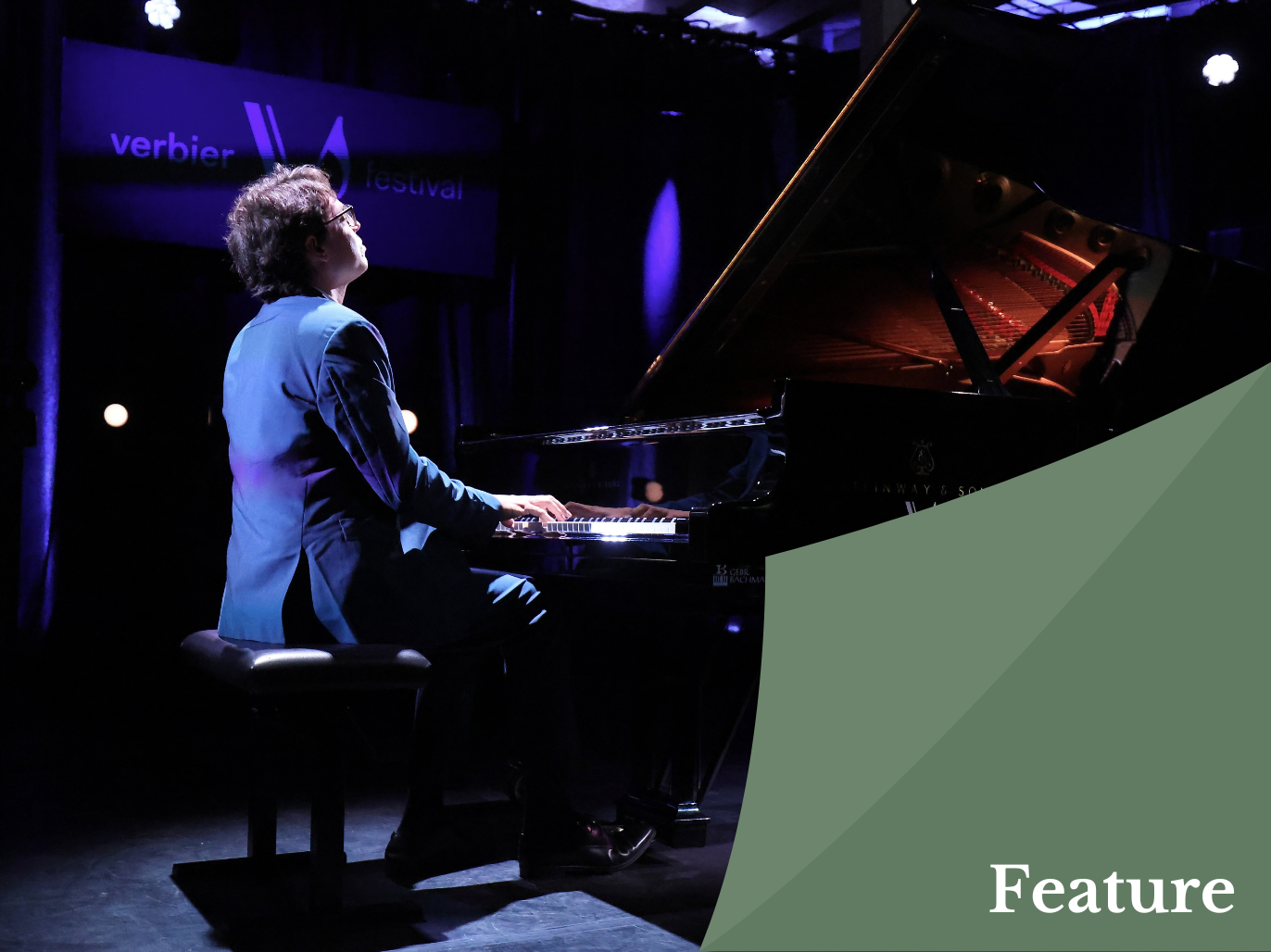
A Morning in Verbier: Behind the Scenes of the Recording of Lucas Debargue’s Recital

A pianist improvises unexpectedly, a sound engineer questions what’s happening, and a music consultant realizes what’s going on within seconds. In the medici.tv control room in Verbier, every concert is simultaneously an exercise in precision and a live adventure. Discover more in this behind-the-scenes report on the recording of Lucas Debargue’s recital.

View author's page

By Henri Gibier

Reading time estimated : 10 min

“But that’s not it—that’s not Beethoven,” the sound engineer turns to the music consultant, who confirms, “no, that’s not it!”.

We’re in the control room set up by medici.tv in the basement of the Verbier Church. Some of the 60 concerts of the Verbier Festival—the prestigious annual event dedicated to classical music—take place in this venue. Between July 16 and August 2, the festival attracts some of the most celebrated performers in the world—including conductors, pianists, and other renowned soloists—to the Swiss resort, united for this one-time event as part of Rencontres inédites, a series focused on chamber music programs. Twenty-six of these concerts (nearly half) are broadcasted live or with a slight delay on the medici.tv website, where they are available for free for ninety days. The medici.tv teams also handle recordings for the Verbier Festival.

On Monday, July 20, 2026, Lucas Debargue took the crew of fourteen recording members by surprise. The young French pianist, one of the most captivating of his generation, had planned a rich program: four Scarlatti sonatas, the best-known Beethoven “Moonlight” Sonata, followed by Liszt’s Ballade No. 2, and twenty Concert Variations on George Gershwin’s “Summertime,” composed by Debargue himself. Debargue believes that a contemporary concert pianist should enable his audience to break free from the routine of traditional interpretation. He likes to incorporate his own compositions and improvisations into performances. So, without prior notice, he prefaced his magnificent performance of Beethoven’s Sonata No. 14 with an original introduction, causing a brief moment of uncertainty among the small, highly specialized group that was recording him.

Lucas Debargue improvises before Beethoven’s “Moonlight” Sonata

Who are these specialists, and what do they do? Why are there so many of them involved in recording and broadcasting a soloist? Fourteen on the day, but forty six for the entire festival. The equipment set up by producer Pierre-François Decouflé in the church’s basement is strikingly extensive: half a dozen different devices, each equipped with at least one monitor. This is complemented by five cameras and just as many microphones in the hall: a number that can rise to thirty or forty for the broadcast of a symphonic concert. The conductor of the entire operation—overseeing the equipment and technicians alike—is the director. In this case, it’s Sebastien Glass, who has extensive experience filming live performances, a field he’s been working in for about fifteen years. This year, there are four directors—two women and two men—covering the Verbier Festival for medici.tv. This is the bare minimum needed to produce so many broadcasts in such a short timeframe, sometimes at a pace of two concerts a day. Camera placement in the church was complicated this year by roof reinforcement work carried out in the spring, which altered the layout of the hall and made framing the shots more challenging.

The first port of call for broadcasting a concert is the sound engineer. On the morning of July 20, two women are at the mixing console: the sound engineer and the music consultant. They are musicians first and sound engineers second, capable of following the concert’s progression via the score. Some of these specialists are graduates of the Paris National Conservatory of Music and Dance’s masters program in sound engineering. Their role is to manage the sound levels of all the microphones on stage, adjust them to the score, and identify any off-key notes. These can be corrected using “patches”—recordings of the same passage made during rehearsals, which are retrieved and overlaid during post-production.

The sound is sorted, but what about the visuals? The harmonious connection between sound and image brings a concert broadcast to life. Since its emergence in the 1960s and 1970s, classical music recording—often done using a single camera for late-night television broadcasts—has advanced significantly. Cameramen control five robotic cameras using a joystick—like in video gaming—rooted in technology known as PTZ: P stands for Pan, which refers to lateral movement; T for Tilt, which refers to vertical movement; and Z for Zoom. This constantly gives the director a choice between several different shots: wide shot, full-body shot (also known as an “American” shot), chest shot, close-up of the hands… In a slow movement, a close-up of the face will convey more expression; in a faster movement, a close-up of the hands will highlight the performer’s virtuosity. During a pause, the shot will shift to a wide shot. In the church, there is no cameraman on stage, as this would distract the audience. However, in the large tent at Les Combins, where the symphonic concerts take place, a cameraman resides in the hall. This offers the director a wider range of interesting options. In fact, the hall cameraman shoots an estimated third of the footage. 

In any case, all of the camera feeds are displayed on a large screen mounted on the director’s desk, and the director decides which camera to prioritize on the screen at any given moment. To do this, he’s in constant communication with the camera operators, calling out the numbers of the cameras he’ll bring up on screen, occasionally accompanied by comments on a particular shot. Next to him, the music consultant, with an annotated score in hand, signals two or three seconds in advance which key element of the piece he should pay attention to. “I’m like the driver of a car and Karine is my co-pilot. Without her, I’d crash into a tree,” says Sebastien Glass with a smile, referring to the woman who is his script supervisor on this particular day. One could just as easily call her his assistant director, given how seamlessly they work together. Trained in Strasbourg as a musician and sound engineer, Karine is a pianist herself. She pored over the program, jotted down her notes on the scores after listening to the works several times, and followed the rehearsals. This allowed her to notice that Lucas Debargue had concocted a very personal introduction to the first of the four Scarlatti sonatas he was going to perform, but the artful pianist had given nothing away in the “Moonlight” sonata.

During the concert, the technicians keep their headphones on: the music plays in the background of the church basement, creating an atmosphere of reverence from which the incessant whispers of the music consultant to her neighbor, the director, emerge: “left hand in the high register,” “reprise,” “progression,” “elaborated theme,” “trill then descent,” “chromatic ascending scale,” “down, right hand,” “breath and then waves,” “descent to the low register,” “escapade,” “suspension,” etc. Sometimes, Karine goes so far as to describe a passage as “jazzy.” Inspired by Lucas Debargue’s superb performance of Beethoven’s sonata—which she admits she rediscovered and heard in a whole new light after the concert, even though she has heard and played it so many times herself—she sometimes uses imagery to alert Sebastien Glass: “A storm is about to roll in, punctuated by two lightning-like chords.” For Karine, these subjective ideas help the camera operators and director to “add character to the image,” but they remain rare: “You have to find the balance between saying enough without taking up lots of time. If there’s a long passage, I just point out that it’s a long development, and that’s it!” This is something she can’t do as much with symphonic work. The music consultant has to be less descriptive, and constantly points out the instruments that the score emphasizes successively or alternatively.

Lucas Debargue playing variations on George Gershwin’s “Summertime” at Verbier 2026

Not far from the production booth, a third person is at work, recognizable by her screen. She has the largest and most precise one in the control room: Stephanie is the color grader. Her role is to ensure that the camera colors and lighting are consistent across all feeds. “The role requires an exceptional eye for detail and quick reflexes,” explains Théau Fourrier, production manager at medici.tv. “As soon as a camera is out of sync, she has to correct it quickly.” At the end of the chain is the equipment manager, “the technical control tower of the broadcast,” as Théau emphasizes. In other words, the position is responsible for receiving and distributing video feeds, stylizing them, and integrating the on-screen graphics that show concertgoers the composition titles as they’re played. This is also the place where malfunctions or breakdowns can be detected, since the equipment isn’t infallible and the conditions of a live performance leave very little room for error. That’s why the stream always consists of both a main feed, which sends data to the platform, and a backup feed that kicks in if the main feed fails. This backup feed is lower in quality because it contains less data, so as to use less bandwidth.

Ultimately, post-production—which is restricted by a tightly packed concert schedule at Verbier—will harmonize and synchronize the video and audio. But we cannot leave the recording center without mentioning the role of one final participant, who is the most important one: the performer himself. Many musicians want to review the recording of their performance and, depending on their own standards, work with the sound engineers to make the adjustments they deem essential. Even a live performance can be edited, since it is intended to remain available for a long time on medici.tv. Deeply engaged in reflecting on his art, Lucas Debargue is one of those perfectionist musicians who doesn’t hesitate to have a preliminary discussion with the director to understand his overall philosophy regarding the recording. Other musicians are also very mindful of their image: they offer input on the framing, refuse close-ups of their face, or—because they’re unhappy with their haircut—ask that chest shots be avoided!

This is not the case with Lucas Debargue. He is content to introduce certain pieces—such as his “Moonlight” Sonata on July 20—or his encores with improvisations that can take even the best technical managers by surprise. It’s an elegant way to become, for a brief moment, the composer, performer, and producer of his own concert: all at the same time.

Translation: Nadya Miryanova 

Written by Henri Gibier

Senior Editorial Advisor

Former Editor-in-Chief of Les Echos and Les Echos Week-End

View author's page