
I, like many young girls, enjoyed a few years of ballet lessons as a child. With scraped-back hair, pink leotards, and matching ballet pumps, we learned — to some extent — the basics of classical dance, from pliés and echappés to pas-de-bourées and other entrechats. Far from the lights of the stage and the real stakes of professional ballet, I had no idea of the great difficulties of the art, especially since my biggest challenge was getting through each class in one piece, without being reprimanded by my teachers! Though I have since hung up my pointe shoes, I’m still expanding my knowledge of the world of ballet through watching documentaries and social media content about the challenges of some of the most famous roles in ballet. I could list dozens of classic ballets featuring daring, virtuosic sections of choreography, like the legendary 32 fouettés in Tchaikovsky’s Swan Lake, but I’d like to turn your attention towards some of the roles whose challenges extend beyond that of just(!) technical difficulty.
View author's page
Reading time estimated : 5 min
As if the role of principal ballerina wasn’t difficult enough already — what with the astounding technique and strength required for each performance — a rare few ballets require the principal to perform a dual role, doubling the challenge. In Swan Lake, the principal dancer must embody not only Odette, the white swan, but also Odile, the black swan who attempts to seduce Odette’s lover, prince Siegfried. Playing multiple characters in one ballet is nothing out of the ordinary for secondary roles, but a lot rarer for a principal dancer. In a dual role, the principal not only has very minimal time off-stage to breath and rest, but is also expected to accurately emote, express, and interpret — on top of executing flawless technique — to portray two radically opposed characters.
Amandine Albisson (Odette) and Mathieu Ganio (Siegfried)
Amandine Albisson (Odile) with Mathieu Ganio and François Alu (Rothbart)
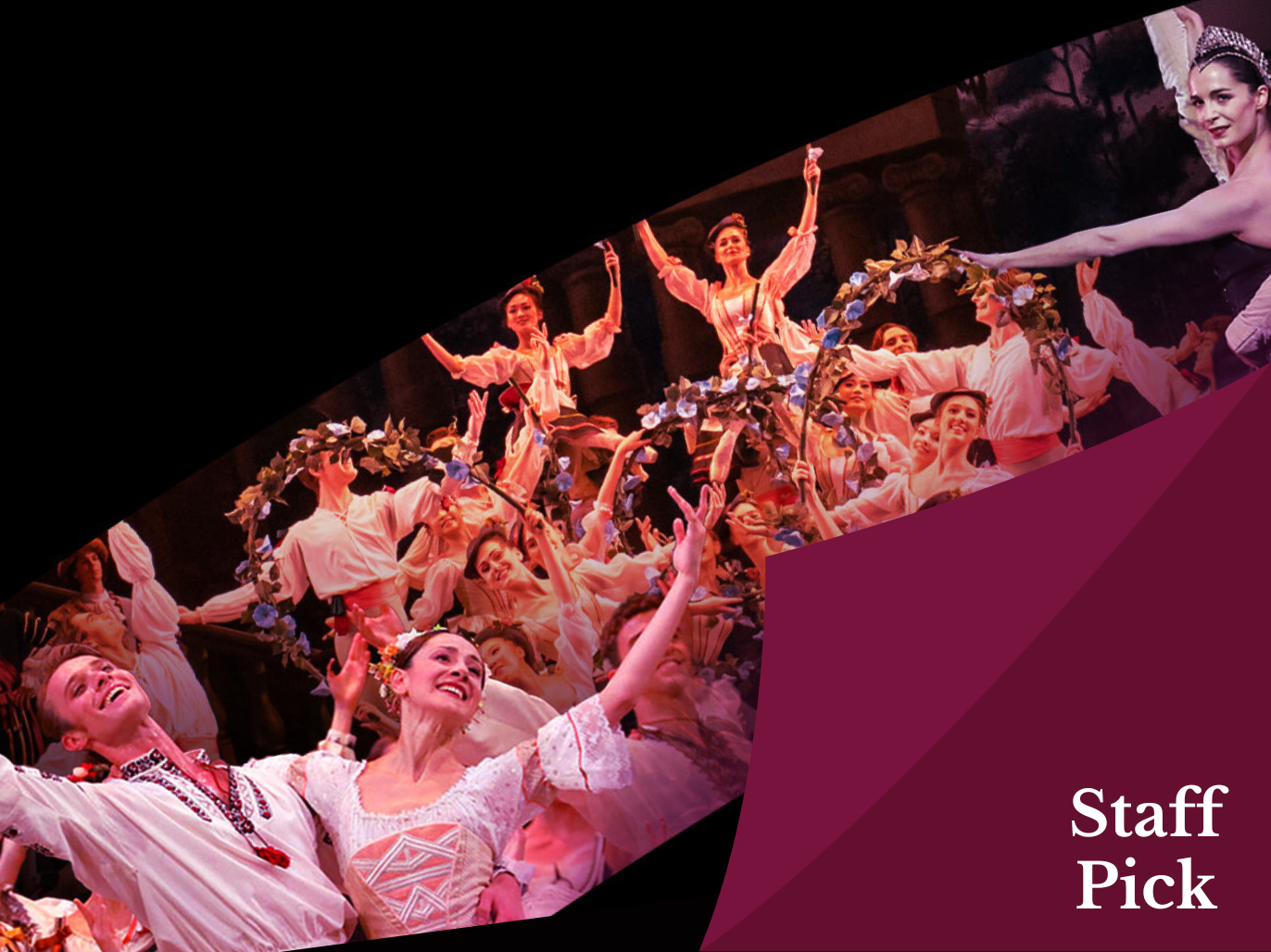
Another fiendishly (yet perhaps less visibly) difficult double role is that of Swanilda in Delibes’s Coppélia. For context, Swanilda is in love with Frantz, but Frantz is infatuated with the beautiful Coppélia that he sees through old Coppélius’s workshop window, not realizing that Coppélia is in fact an (eerily lifelike) doll. Jealous, Swanilda breaks into Coppélius’s workshop and, upon discovering the trickery, disguises herself as Coppélia. The dancer undertaking the role is required to do preparatory pantomime work in order to remove all fluidity from her movements — the direct opposite of how ballet dancers are expected to move — while retaining the character’s comical gestures.
Nicoletta Manni (Swanilda/Coppélia) and Christian Fagetti (Coppélius)
When you start ballet lessons, the classes are divided into two disciplines: barre exercises and “milieu” (center) exercises. The barre is the equivalent to scales for pianists or vocal exercises for singers; whether you’re a leotard-clad beginner or a principal in the Royal Ballet, you can’t skip these essential steps. Next comes the “milieu,” practiced in the center of the classroom. Here, students learn variations, solo choreography, and pas-de-deux (dances for duo). The pas-de-deux is one of the most demanding — and feared — ballet dances, as it requires dancers to work closely with someone else, and every partner is different. A successful pas-de-deux calls for excellent communication between dancers, in order to get used to each other’s body and how it works with their own.
This brings us to the subject of Tchaikovsky’s The Sleeping Beauty, a ballet whose reputation for technical difficulty is well established among professional dancers. The “Rose Adagio” is one of the most complex dances in the ballet as the ballerina starring as Princess Aurora must execute technical feats of extraordinary balance and poise while dancing with not one, not two, not even three, but four different partners!
Yasmine Naghdi as Princess Aurora in the Rose Adagio
Behind the delicate, oftentimes rigid image we typically associate with a ballet dancer lies, in fact, an incredibly demanding, rigorous discipline in which technical virtuosity only comes into its own when it is accompanied by character interpretation, communication, and mental endurance. Whether she embodies a black or a white swan, a mischievous young woman, or a coveted princess, the principal dancer is never just dancing; she is storytelling, transforming, delivering herself wholly to her audience, body and soul.
Discover the playlist here.
