Seventeen Minutes to Fall in Love with Gershwin

From its iconic clarinet opening to its full-orchestra surges, Rhapsody in Blue remains a thrilling feat of musical imagination. Gustavo Dudamel and Yuja Wang bring Gershwin’s restless, exuberant vision to life with irresistible energy.

View author's page

By Viviana Freyer

Reading time estimated : 5 min

Do you have roughly seventeen minutes?

Rhapsody in Blue is a musical Rube Goldberg Machine. Each section  bursts with its own surprises, but together they form a chain reaction that should merit George Gershwin some sort of honorary physics degree. It just keeps moving. It’s the sound of creative exploration, of “being in the zone,” of trying out everything at the same time to see what works (and in Gerswhin’s case, it all works).

Rhapsody in Blue has character. Even the title of the work speaks to its singular nature: type “Symphony No.” or “Concerto for” into Google and you’ll get loads of different results, but “Rhapsody in” yields just one result.

Though I don’t personally play any instrument, whenever I listen to Rhapsody in Blue, I imagine it is a work any musician feels lucky to be a part of. That opening clarinet solo never fails to give me chills; beyond those smooth-as-butter sweeps and trills — barely one minute of music that I reckon takes a lifetime of mastery —, I most of all enjoy when we can hear the twinkle in the eye of the soloist who knows that the ride starts with them. We get a variety of piano solos ranging from lyrical to jazzy to downright frantic, but every orchestra part gets a chance to shine. We’re swept away by the strings, blown away by the brass, won over by the woodwinds, but when those full orchestra moments hit, we are engulfed in a musical togetherness that demonstrates the power of collective effort and talent.

A larger-than-life musical work demands larger-than-life performers, and to me, there are few contemporary classical artists who make performing look as fun as Gustavo Dudamel and Yuja Wang. It goes without saying that Dudamel is a conductor at the top of his game and that Wang is a pianist without peer, and it’s a pleasure watching them together for the  2019 edition of the Vienna Philharmonic’s annual Summer Night Concert not just because it’s two generational musicians playing one of my favorite works, but because they just seem so happy doing it. Under the blue lights (what else?) of the Philharmonic, Dudamel and Wang have a big grin every time the camera pans to them, and even the other members of the orchestra can’t help but crack a smile. Dudamel’s enthusiasm is contagious, and Wang is playing, in every sense of the word.

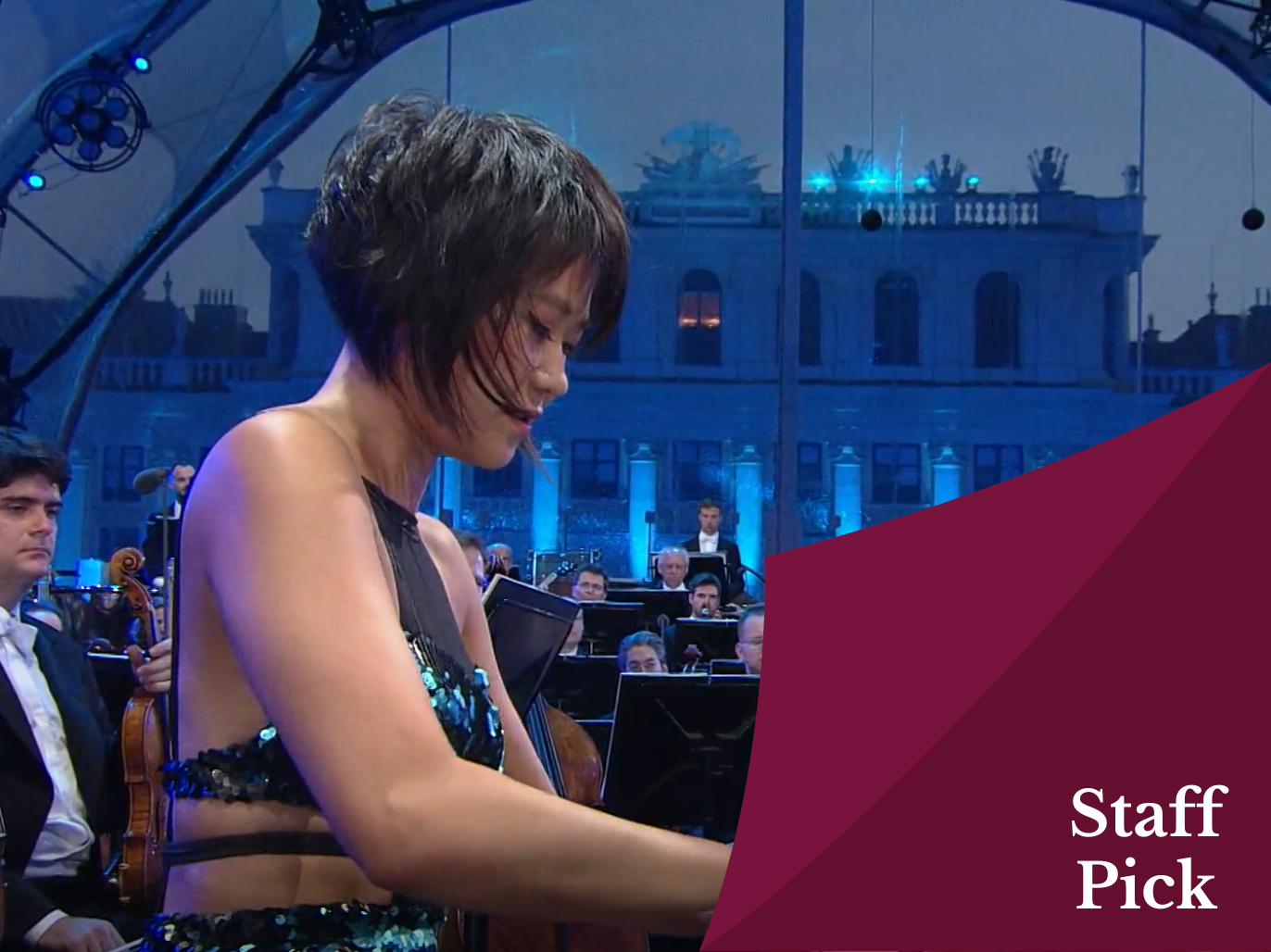
The opening minutes of Rhapsody in Blue by George Gershwin performed in 2019 by the Vienna Philharmonic, featuring Yuja Wang and conducted by Gustavo Dudamel 

It has been almost a year since I’ve been an American abroad, and in the case of music and art, it appears that distance makes the heart grow fonder. Like me, Gershwin was the child of immigrants who couldn’t get enough of the art that surrounded him and was inspired by the different communities who came from far and wide to add that art to the American cultural tapestry. Many have come to associate the blend of classical music, jazz and ragtime of Rhapsody in Blue with the sound of a modern America — particularly New York City thanks to films like Woody Allen’s Manhattan or Disney’s Fantasia 2000 —, and that association is in no small part thanks to Gershwin’s musical transcription of that famous melting pot.

It is also not lost on me that Gustavo Dudamel and Yuja Wang themselves immigrated to the United States to continue growing as musicians and honing their craft, with Wang arriving by herself at just 15 years old.  Dudamel also fiercely advocates for the power of music to bring cultures together, so what better conductor and pianist to bring to life a work so rich in references and history? To have these two particular musicians play Rhapsody in Blue on an international stage feels like the appropriate evolution of the work, and a performance I’d like to think would make Gershwin proud.

Countless inspirations and dozens of musicians coming together for one singular piece exemplifying the millions of stories that make up a singular country. I don’t know what the sound of the United States will be in 250 years from now, but I bet that future generations are in for quite the concert.

Written by Viviana Freyer

Editorial Assistant at medici.tv

View author's page