
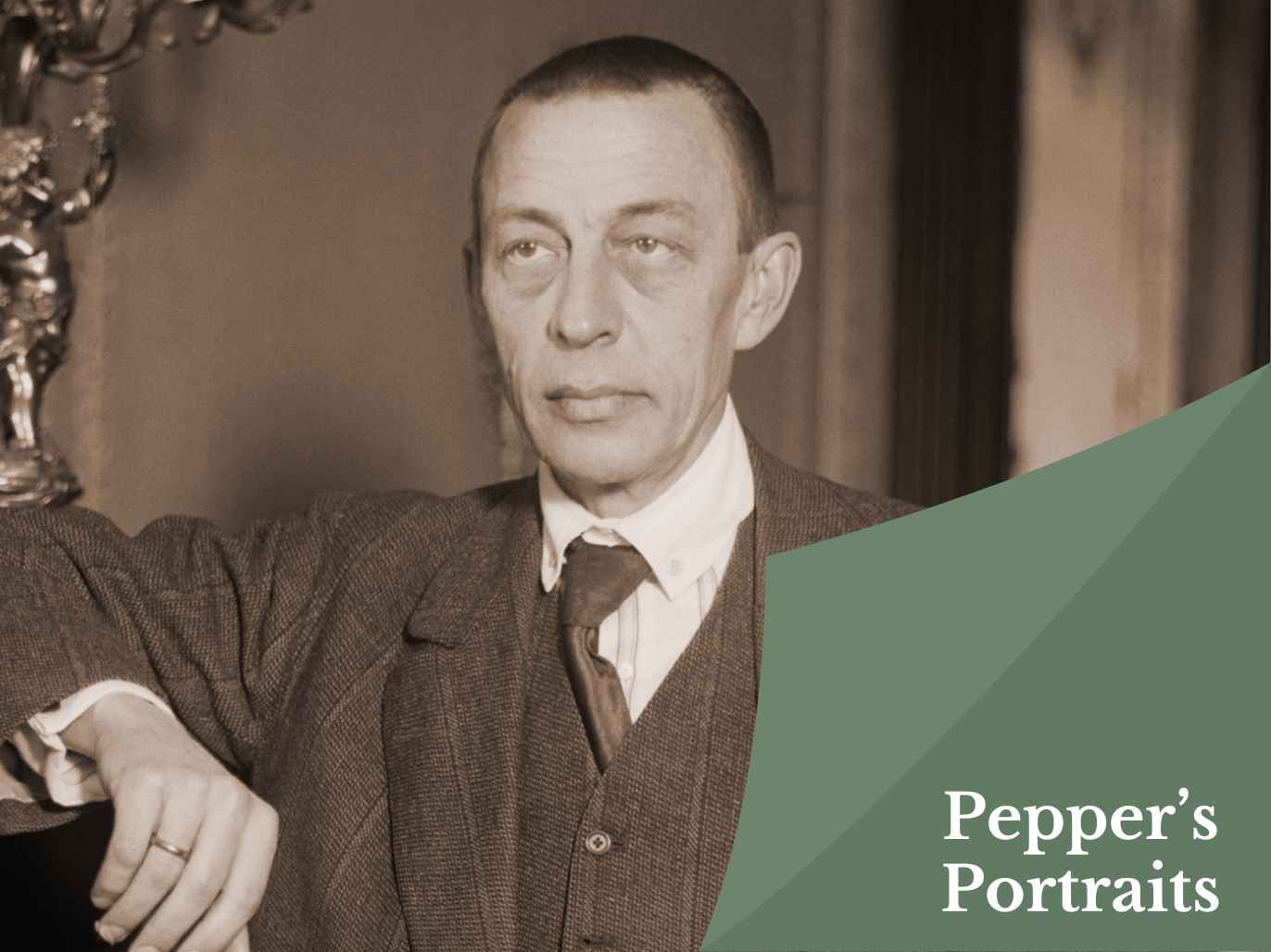
Serguei Rachmaninov: The Scowl, the Spell, and the Comeback Concerto

Serguei Rachmaninov had the hands, the nerve, and the glare—until one disastrous premiere broke him. What followed was silence, hypnosis, exile, and a concerto that conquered the world.

View author's page

By Jack Pepper

Reading time estimated : 13 min

It feels fitting that one of the great pianist-composers was born just days after what would later be celebrated as World Piano Day. Since Nils Frahm created the celebration in 2015 – marked on the 88th day of the year to reflect the 88 keys of the piano – the music of Rachmaninov has surely played a key (pun intended) part. Born April 1, 1873, he was arguably more famous as a pianist than as a composer in his lifetime.

Asked in an interview who was the greatest living pianist, Rachmaninov replied with trademark seriousness: “there’s Hofmann. And there’s me.” Try coming back with a follow-on question to that, interviewer!… His massive hand span covered twelve notes – about twelve inches! – explaining the frequent widely-stretched chords and expanses in his writing; one of the few equivalent hands in music history was Franz Liszt, who likewise enjoyed a thirteen-note stretch. Equally remarkable was Rachmaninov’s memory; after many years he could play back note for note a piece he had heard just once before, and he was known to memorize the most challenging repertoire in as little as two days.

He was an important pianist in shaping how we approach playing, too. Rachmaninov followed the composer’s instructions much more closely than his counterparts and predecessors, at a time when outright vanity and flourish ruled many a piano performance; through the nineteenth century, the soloist had mostly been the star – but Rachmaninov helped shift the emphasis back to the composer. With Rachmaninov, rubato was modest and precision was the name of the game, leading to his nickname: “the Puritan of Pianists”. It can’t be a coincidence that Boris Giltburg chose to pair Rachmaninov with Chopin in his 2025 Bourgie Hall recital. Chopin, too, noted for his classical restraint and rubato – but whose own compositions have perhaps been misinterpreted over the years as romantic elastic. Do we have the wrong image of Rachmaninov, too?

Bright young spark

Rachmaninov came from quite a family. Descended from wealthy landowners and the grand dukes of Moscow, both his father and grandfather had been in the Imperial Guard. However, his dad was a notorious alcoholic and somehow lost all five of his family’s huge estates; he then abandoned his wife to raise their six children on her own. 

Rachmaninov himself asked to have piano lessons aged just four, and entered the St Petersburg Conservatory at nine (later transferring to Moscow). Hilariously, it’s said that the boy was more interested in ice skating than music studies; he doctored his report cards so that his mother never knew how poor his grades were. Natural talent! Laxness would not be tolerated by his severe piano tutor Nicolai Zverev, though. His pupils had to be awake at 6am and worked for sixteen hours daily, including at least three hours of piano practice; they even boarded and wore specific uniforms for his classes. 

Success came young. Rachmaninov was just nineteen when he wrote his famous Prelude in C# Minor, winning him fame (much to his irritation). Even as a teenage composer, you can detect elements of his trademark style: a sense of resonant spaciousness, with huge chords spanning the entire range of the piano, evoking tolling bells.  

Soon he received the Great Gold Medal for his opera Aleko, written for his graduation (watch here in Fanny Ardant’s production with Greek National Opera); it was published and staged by no less than the Imperial Opera. Indeed, he was himself soon conducting operas at the Imperial Theatre and in 1904 became conductor of the prestigious Bolshoi Theater. Later, in 1918, he was given the chance to conduct the Boston Symphony for 110 concerts but turned it down; likewise, an opportunity to lead the Cincinnati Symphony. His experience as conductor gave him intimate knowledge of how to write for orchestras; his sumptuous and sparkling orchestration doubtless shaped many a later movie score (the legendary Max Steiner and co). Rachmaninov and his influence prove so much more than a one-trick pony.

But it was all to go very wrong with a disastrous premiere…

A symphony of silence

The success of his 1892 piano prelude led to great anticipation for this bright young composer’s first symphony. He wrote it through 1895 for a premiere in 1897… an event that goes down in history for all the wrong reasons. 

His conductor (and fellow composer) Alexander Glazunov allegedly turned up drunk and “led” a scrappy performance that proved so painful, young Rachmaninov grabbed his manuscript score and immediately locked it in a bottom drawer back home; it was abandoned in Russia when later he fled into exile, and the score was long thought lost. Thankfully, Rachmaninov had been so desperate to get out of the hall that day, all the orchestral parts remained on the stands – saving the individual parts for the future, leading to their rediscovery in Leningrad in 1944 (a year after Rachmaninov’s death). So, its second-ever performance took place fifty years after the premiere, in 1945. Perhaps just as well the composer wasn’t around to hear it…

Despite it inducing a nervous breakdown in its composer, there are many Rachmaninov trademarks in the First Symphony (sample the 2025 Lucerne Festival reading given under Riccardo Chailly here). Listen for the medieval funeral, Dies Irae chants through the first movement, Rachmaninov long holding a morbid fascination with death and a deep-held faith. Indeed, there can be a chorale-like quality to his orchestral writing, with Russian Orthodox chants suggested by huge homophonic granite blocks of sound; think more monumental cathedral than little Russian doll. Power, drama and expanse exist in his writing from the very start.

The turbulence of its premiere, however, led Rachmaninov to a crushing compositional silence. He dubbed the piece “weak, childish, strained and bombastic” and took a whopping twelve years to write a follow-on symphony. Indeed, he wrote nothing at all for three years and said: “I felt like a man who had suffered a stroke and had lost the use of his head and hands.” 

It was only therapy with the hypnotist Nikolai Dahl that led him back to composition; in their sessions, the phrase “you will write your concerto” was repeated endlessly. His Second Piano Concerto, first performed in 1901, was dedicated to the doctor (watch Yuja Wang and the London Symphony Orchestra under Michael Tilson Thomas, 2021). It remains his most popular work, a fact that perhaps belies a bizarre quality of its gorgeous first movement: at no point does the piano take up the main theme, this remaining in the hands of the orchestra throughout. It’s a remarkable act of self-denial for a world-famous concert pianist – the piano doesn’t get all the action.

The exile

Events beyond his control soon shaped his life and career forever. Come the Russian Revolution in 1917, Rachmaninov’s aristocratic heritage could prove fatal; they needed to escape. He used a piano tour of Scandinavia as a cover to get his family out of Russia, fleeing across the border in an open sleigh in the middle of a snowstorm with just a suitcase of manuscript scores as luggage. 

The couple spent their final 25 years in Europe and America, heading to the US in 1918 and settling in LA, where Rachmaninov expressed his desperate homesickness through a bizarre home setup: the layout of his last American house mimicked his earlier Russian residence exactly, down to the furniture, floorplan, food and drink. They hired Russian staff and mostly befriended fellow Russian exiles. Critics would argue he was stuck in the past and that it could be heard in his compositional style. Throughout his exile, Rachmaninov hoped that they would be able to return to their true home; this nostalgia and sense of longing arguably seeped into his writing.

The composer who didn’t compose

Many scholars believe it was homesickness that led to a sparse later compositional output. He wrote nothing for a whopping fifteen years. It took him twelve years to finish his Fourth Piano Concerto (1914-26), while his later Rhapsody on a Theme of Paganini took another eight. Hear this on medici.tv with Alexandre Kantorow and the Verbier Festival Orchestra under Teodor Currentzis in 2025, and play a musical game of Where’s Wally in spotting the famous Paganini melody woven throughout. Despite the long breaks in writing, there is a remarkable continuity of style; but most of Rachmaninov’s output had been written before 1917.

Perhaps his self-doubt also stemmed from an awareness of how much musical style had changed over his lifetime. As Rachmaninov once commented: “I cannot cast out the old way of writing and I cannot acquire the new.” 

His music was for decades dismissed as predictable, hackneyed, and over-Romantic. As Schoenberg and friends were championing twelve-tone writing through the 1920s, Rachmaninov’s richly tonal language struck many as an anachronism; likewise, as composers turned to the slimmed-down resources of Neoclassicism, Rachmaninov was writing lush and thickly scored rhapsodies for huge orchestras. The same apparent disconnect continued after his death, with Boulez pointing to “flabby… overblown and fat” late Romantic music, with Rachmaninov surely in mind as that era’s greatest symbol. 

Interestingly, while critical opinion had for decades been against Rachmaninov, the public has always loved him. His compositions have almost never left the repertoire, even when the 1954 Grove Dictionary predicted his “monotonous” and “artificial” music would be forgotten within decades. Ouch.

The Rachmaninov sound 

Rachmaninov’s style demands great virtuosity, not least by stretching their hands like a gymnast. Moreover, his music requires an expressive sensibility that finds a sweet spot between sublime tenderness and the saccharine; it is, therefore, music of balance and control. The line between enough and too much is very fine indeed; it’s handy to remember that Rachmaninov as a pianist was sober and restrained, even if his compositions are not always perceived that way.

Here is a master of long-lined melody, endless ribbons of a theme that so often evoke a long-spun singing voice; he was an undoubted tunesmith, leading Eric Carmen to adapt the second movement of the Second Piano Concerto for his hit song “All By Myself” in 1975. 

Rachmaninov is also a master of orchestral colour, underlining his many years as an in-demand conductor; his Third Symphony (from 1936) pairs harp with horn in an exquisite opening to its second movement, while its finale captures some of the dancing energy of his new American home (while also incorporating his trademark Dies Irae motif again). 

Similar qualities are found in his last composition, the Symphonic Dances (written in 1940, you can watch the  Wiener Symphoniker under Lahav Shani in 2020 here); the Dies Irae returns, likewise arching melodic lines and colourful orchestration featuring alto saxophone and piano. It was his only piece written in its entirety in America, and there’s a certain knowingness and finality as if Rachmaninov knew he had just three years to live. He quotes his own First Symphony – where so much of his story and anxieties began – and the chant “Blessed Art Thou” from his 1915 All-Night Vigil (often cited as one of his proudest works). It ends with a movement titled “Midnight”. 


Conclusion

Rachmaninov is in some ways a study of contradictions. His puritan pianist approach contrasts with the popular image of romantic compositions; described as a “six and a half-foot-tall scowl,” his music often radiates warmth, glowing with longing; he lived a third of his life in America while retaining deep roots in Russian chants and customs, resisting integration or drastic expansion socially or musically. Contrary to the image of a man out of place, Rachmaninov knew exactly who he was and how he wanted to speak: surely something to be lauded. 

Although public interest has rarely wavered, it’s reassuring to see critical favour returning to this much-maligned composer. Just with Rossini, Lehár, the Strausses or today, Lloyd Webber, popularity and commercial success seem to make critics wary. Perhaps Rachmaninov’s growing critical acceptance is a recognition of the growing freedom enjoyed by composers today; gone is the avant-garde oligarchy that dismissed any music that wasn’t new and “original” (whatever that means). Today, there is a new flourishing of tonality and melody, not to mention a booming interest in all things piano; all this suddenly feels thoroughly modern, even “cool, again. Surely much of this traces back to Sergei Rachmaninov.

Written by Jack Pepper

Composer, Broadcaster and Writer

Jack Pepper (b. 1999) is one of the UK’s youngest commissioned composers and youngest-ever national radio presenter. He spent his teens composing for the Royal Opera House, Classic FM and Royal Liverpool Philharmonic Orchestra, and now has a major stage musical in development. Most recently, he premiered his song ‘Harmony’ for HM King Charles III, for whom the piece was written; Jack has been named one of The King’s Foundation’s 35 Under 35, recognising young ‘makers and change makers’ who represent the changes His Majesty wants to see in the world. As a broadcaster, aged 19, Jack helped to create Scala…

View author's page