Prima della Scala: Inside Italy’s Most Iconic Season Opening

From its 1778 inauguration to today, La Scala has defined Italian opera. This year’s Prima featured Shostakovich’s Lady Macbeth, uniting music, politics, and Milanese pride in a single unforgettable night.

View author's page

By Andrew Mellor

Reading time estimated : 11 min

First Nights in an opera house always carry a weight of expectation – whether it’s the launch of a new season, or just the opening of a new production. 

Everyone invested in the performance is waiting in anticipation. Journalists are present to report on what’s seen and heard. And the most passionate sector of the public is there too – those who would never consider waiting to see the show later in the run, after reviews have been published and excitement has died down. 

As for the start of a new annual cycle of productions, there are season openings…and then there’s the Prima della Scala – the opening of the season at the Teatro alla Scala in Milan, Italy. 

Perhaps you caught 2025’s Prima della Scala a few weeks ago, as broadcast on medici.tv: a new production of Shostakovich’s gripping satirical thriller Lady Macbeth of the Mtsensk District, conducted by Riccardo Chailly in a new staging by Vasily Barkhatov, starring Sara Jakubiak in the title role. 

Even from the TV broadcast, you can sense the atmosphere of the season opening at the legendary theatre that is La Scala. It is an event like none other in the operatic or any other calendar. Italy’s leading opera house, which is also probably the most iconic opera house in the world, doesn’t do things by halves. 

More on that later. First, we need to unravel a little of the history of La Scala… 

Up The Staircase

In Italian, ‘La Scala’ literally means ‘the staircase’. That has nothing to do with methods of travelling between the opera house’s various floors. It actually refers to the church that previously occupied the same site – the church of Santa Maria della Scala (Saint Mary of the Staircase), a place associated with various miracles and visions long before opera came along.

The theatres that took the church’s place have always had a special significance for Milan, for Italy and for the global opera scene. The present building was designed by the Italian architect Giuseppe Piermarini and replacing the previous Teatro Regio Ducale which had burned down in February 1776 after a Carnival party. 

When the new theatre was inaugurated on 3 August 1778 it was initially known as Il Nuovo Regio Ducale Teatro alla Scala (The New Royal Ducal Theatre at the Staircase). The first production was a performance of Antonio Salieri’s opera Europa riconosciuta. When the Teatro alla Scala re-opened in 2004 after a two-year renovation, it was with a performance of the same opera. The conductor was Riccardo Muti, who served as La Scala’s Music Director 1986-2005. This 2001 performance (below) of Verdi’s Un ballo in Maschera comes from the peak of Muti’s tenure. 

One of the most notable ‘First Times’ at La Scala was when Niccolò Paganini made his debut at the theatre in 1813, in a concert that is said to have been his big break. 

Since then, La Scala has been known as Italian classical music’s centre of gravity. It will always be associated with the likes of Verdi and Puccini, but has also introduced works by Rossini, Donizetti, Poulenc and Stockhausen to the world. It also has a renowned academy, profiled in this film by Roberto Minini Merot. 

Among composers, Verdi looms largest. In December 2024, the Primo della Scala presented a new production from Leo Muscato of the composer’s opera La Forza del Destino under Chailly – a performance you can watch in its entirety here

There are numerous reasons this was a resonant choice to open the season. The performance was of the 1869 version of the opera – an edit made by Verdi especially for La Scala, that marked his reconciliation with the theatre after a long boycott. The row had been prompted by Verdi’s claim that the orchestra’s amending of some of his writing constituted a ‘corruption’ of his work. 

Forza is also a quintessentially Italian opera – a story of fate and tragedy that is considered by some a ‘cursed’ opera, one that frequently induces mishaps and odd events, like an operatic equivalent to Shakespeare’s Macbeth. That makes it a bold choice for the one night of the year when all eyes are on La Scala. 

Arturo Toscanini’s two stints as La Scala’s Music Director did much to cement the house’s strong bond with Italian music, notably Verdi and Puccini. But La Scala has never lost its reputation as the premiere location for Verdi opera. In Medici TV’s catalogue are exemplary performances from La Scala of well-known operas by the composer including Nabucco and Il Trovatore but also of rarities like Il Masnadieri

Verdi’s La forza del destino: La Scala 2024-25 season opener

The Primo della Scala

No other opera house opens its season quite like La Scala does. 

The theatre’s season used to open on Boxing Day – 26 December. It was Victor de Sabata, Toscanini’s successor and Music Director from 1929-1953, who introduced the tradition of opening the season on 7 December – the Feast of Saint Ambrose, the patron saint of Milan. 

So it has been ever since – a season opening in the middle of winter that also marks the beginning of the Lombardian city’s winter social calendar. Yes, the Primo della Scala has long been about more than opera. It is described by the Italian culture magazine The Ambassador as ‘a fiercely guarded ritual that is equal parts high art, power summit, and dazzling social spectacle.’

Part of that is bound up in the foundation of La Scala and its famous architecture. Its four tiers of boxes (the top two tiers are standard seating known as ‘loggia’) were once owned by the most powerful families and corporations in Italy – to the extent that the British writer Mary Shelley observed in the early 1800s that it was difficult to hear the opera being played in the theatre over the noise of all the trading. 

These boxes are still frequently populated by the city’s power-brokers. With the Primo della Scala carried live on Italian television, there is almost as much interest in who his occupying them on opening night as in what’s happening on stage. 

Traditionally, the Italian President and Prime Minister attend the Primo della Scala, though neither were in attendance this year – the theatre had to make do with the Culture Minister and the Mayor of Milan. But still, the traditional political engagement often brings politics to the door of the theatre, where paparazzi and media gather to see who is arriving and when. That, in turn, makes the Piazza della Scala a perfect place to protest on Primo night, meaning the issues of the day are often voiced outside the theatre just as they might be played-out on its stage. 

That was certainly the case in 2025, with the performance of Shostakovich’s Lady Macbeth – a satire on Soviet cruelty and incompetence that is loaded with added meaning today. 

The choice of work for the Primo della Scala is significant. It may have been a controversial idea to open the 2025 season with a Russian opera. But it also looks like a progressive one in the context of the previous year, when such an idiosyncratically Italian opera was chosen.   

In fact, it hadn’t been long since a Russian opera had also been presented at the Primo della Scala. In 2022, the season opened with Mussorgsky’s Boris Godunov. It caused an outcry among some given Russia’s ongoing war in Ukraine, even though the production by Kasper Holten was well reviewed.  

In 2025, Shostakovich’s opera received a 12-minute standing ovation and appeared to express solidarity with the people of Ukraine – it ended with a Soviet truck torpedoing a wedding party and killing two guests. Director Vasily Barkhatov, however, claimed his staging, set in Soviet times, was not about politics but concerned ‘a personal tragedy.’

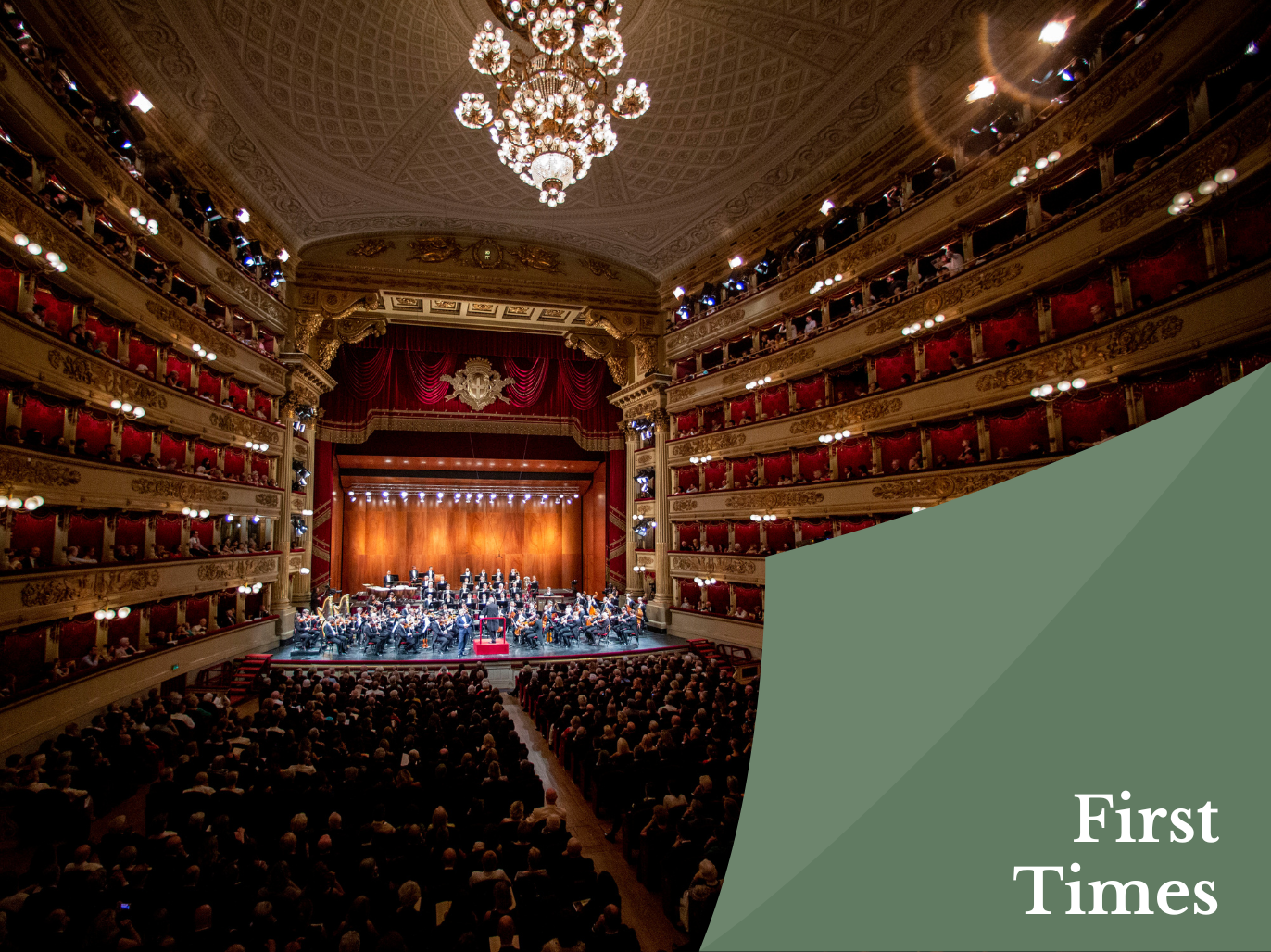
Watching 2024’s Primo della Scala on medici.tv, you see much of what’s distinctive about the event. First, the orchestra launches the evening not with Verdi, but with Michele Novarro – specifically, the Italian national anthem, Il Canto degli Italiani. 

Nor is the audience exactly quiet as the show continues. At one point early in the first act, there is an audible heckle. The ‘loggionista’ – the hardcore opera fans who occupy La Scala’s upper galleries – are known for their high level of engagement and vocal critiques of performances in real time. It helps keep standards at the opera company high and creates an unmistakable atmosphere and tension during performances. 

All Eyes on Italy

The Primo della Scala is, in a sense, a celebration of Italian and Milanese pride. Plenty of opera happens in Italy, in opera houses of all sizes and architectural styles. But a prestige sticks to La Scala, and it is one that both the opera house, and wider Italy, needs to cultivate. 

Some commentators point to the economic value of the event to Milan – that so many visitors from Italy, Europe and the world are drawn here for the occasion. 2025’s guests included Sarah Rogers, US Secretary of State for Public Diplomacy, which underlines the ‘soft power’ significance of the occasion. 

The Primo della Scala may be a little ostentatious for some tastes – all about fashion, fame, power and money. It has been described as ‘a multi-million-euro advertisement for Italian excellence.’

But behind that, it also emphasizes how significant the art form of opera remains in Italy – how deep into the Italian psyche its roots extend. In that sense, it’s undeniably about music too.

And all that goes back to Verdi. The composer was a member of the Italian parliament. He was not just a passionate supporter of the Risorgimento revolutionaries who argued for a united and free Italy; he became a symbol of the movement and, for many, a symbol of the new Italy. No wonder La Scala, the one theatre associated with Verdi more than any other, means so much to this country. 

Written by Andrew Mellor

Journalist and critic

Andrew Mellor is a British writer, critic, and broadcaster based in Copenhagen. After studying music at the University of Liverpool, he began his career with the Manchester Camerata and the London Philharmonic Orchestra before training as a journalist at Classic FM magazine and Gramophone. Since moving to Denmark in 2015, he has become a leading voice on Nordic music and culture, contributing regularly to Opera and Opera Now.

A regular critic for the Financial Times and a presenter for medici.tv and the Danish Broadcasting Corporation, Andrew Mellor also writes extensively for orchestras, festivals, and record labels around…

View author's page