
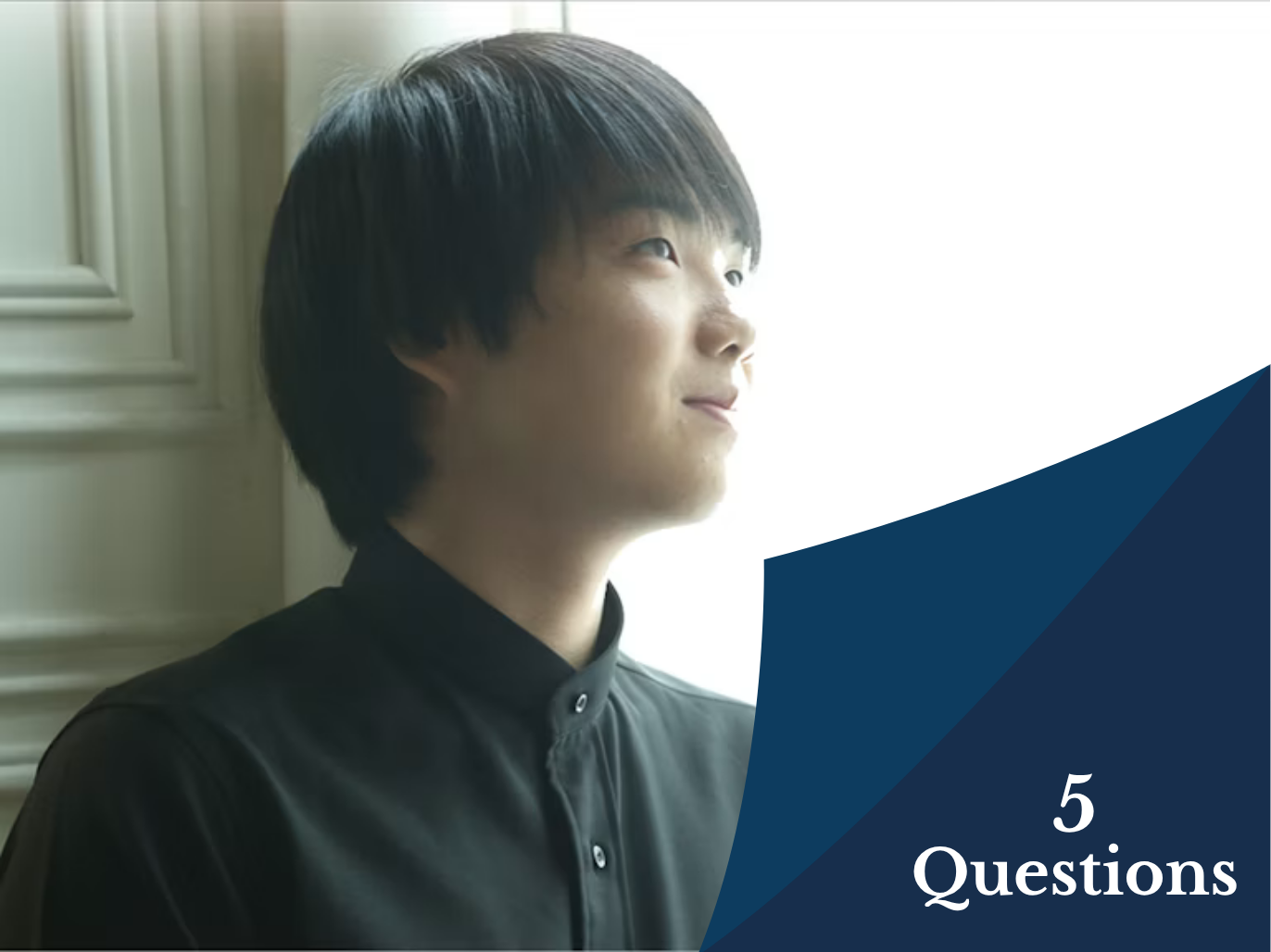
Mao Fujita: “My Sound Expresses What Words Cannot”

For Mao Fujita, music says what words cannot. At Verbier, he speaks about memory, form, practice, exhaustion and the importance of making space to concentrate fully on music.

View author's page

By Editorial Team

Reading time estimated : 4 min

Is there a concert here at Verbier that has stayed especially vivid in your memory — one you remember particularly well?

Yes. When I was an Academy student in 2018, I listened to many concerts, as I mentioned, but one in particular has stayed with me: the Berg Concerto played by Leonidas Kavakos.

I still remember it very clearly. Leonidas played incredibly. And also Daniil Trifonov playing Prokofiev’s Second Concerto with Noseda — for me, that was one of the best performances of Prokofiev’s Second Concerto.

Does the piano give you something that words can’t?

Yes. My sound expresses many things that I do not say in words — love, happiness, sadness, everything. My sound expresses all of that.

When you are playing a piece for the first time, what do you look for?

I always begin with the same process. If the piece is, for example, a sonata, then first of all you have to look at the form.

If it is in sonata form, you look at where the exposition is, where the development is. Then you look at the first theme and the second theme, at the harmony, at the key. And then also at the phrasing.

So I go into the smallest possible details, step by step. Only then do I begin to practise. Before I start working at the piano, I study the score, I make notes, and I prepare everything in that way.

What gives you joy outside of music?

It is very difficult to say, because music is everything. It is my everything.

Travel is a little boring. Since I am Japanese, I go back to Japan quite often, and every time it is a flight of 14 or 15 hours. Once a year is fine, but three or four times is a disaster.

I always wish Japan were located a little above or below Finland — that would be wonderful, because then it would only take two or three hours to get there, and I could see my family, my cats and my pets much more easily.

So those 14 or 15 hours are terrible.

Apart from travel, Japanese food gives me joy. I cook for myself. Here in Europe, you can easily find aubergines, and in Japan too. If you cut them into small pieces, bake them, and add soy sauce and ginger, it is a very simple dish — but I can happily eat it again and again.

Are you good at doing nothing?

Sometimes, yes. In Japan, we have the wonderful tradition of Onsen — hot springs. When I have a holiday in Japan, I go to Onsen, take a bath, and do nothing. Although of course, even then, I am still taking a bath.

But in reality, it is difficult nowadays. There are always emails — about schedules, concerts, hotels, flights — every single day. When I was a student, I imagined that being a pianist would only mean playing the piano. I did not expect all of that.

That is why nature is so important. Here in Verbier, it helps a lot. This season, I also realised that an overly intense schedule does not suit me. Travelling constantly while preparing different concertos at the same time was very hard.

So from next season onwards, I will have a much freer schedule, and I will be able to concentrate properly on my music.

Written by Editorial Team

medici.tv

View author's page