
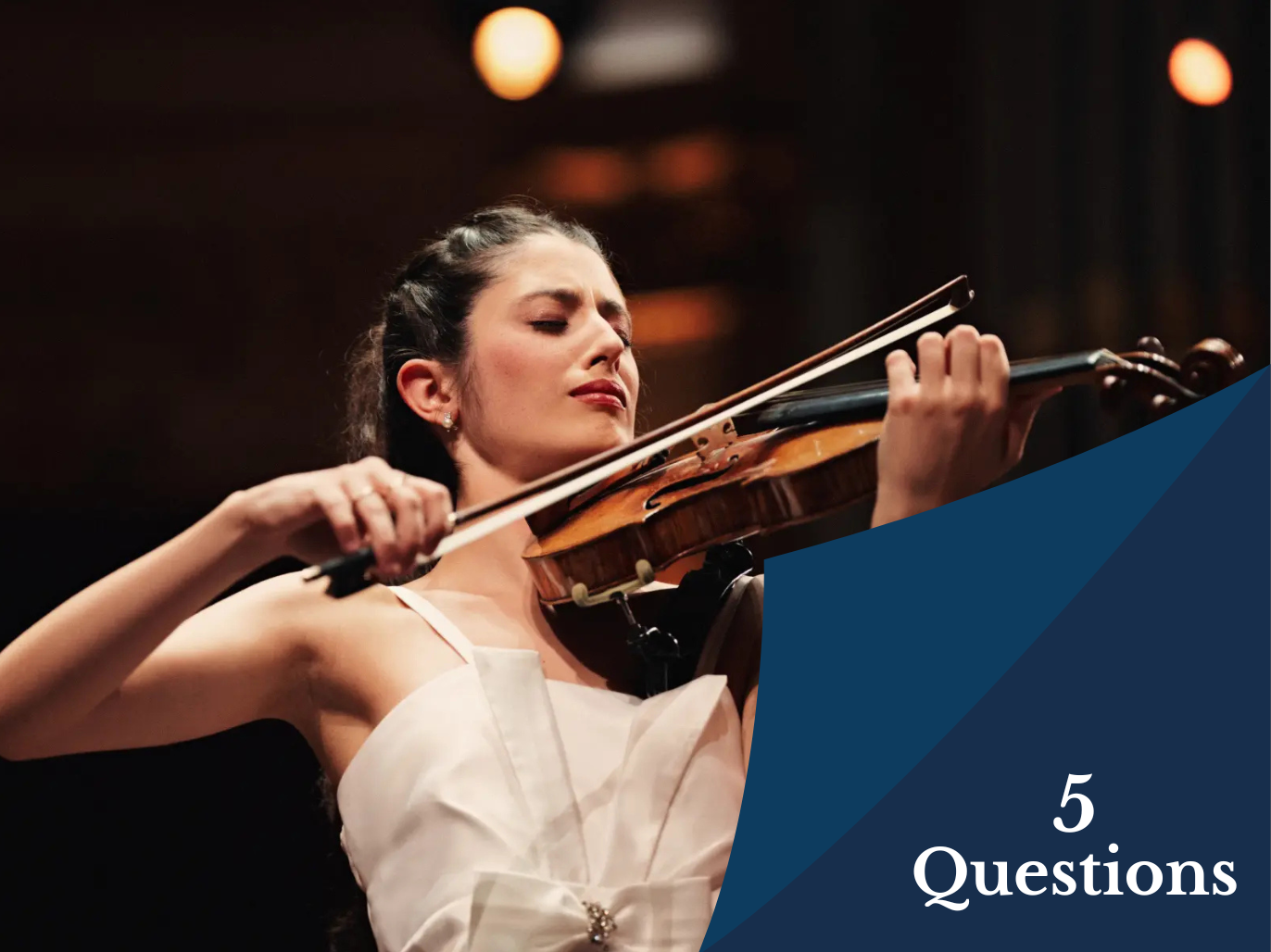
“I Imagine Brahms as a Symphony” — Maria Dueñas in Évian

At the 2026 Rencontres Musicales d’Évian, violinist Maria Dueñas reflects on Brahms, sound, and the need to seek inspiration beyond music. On the occasion of her performance with Denis Kozhukhin, she speaks about maturity in interpretation, the influence of nature, and the value of spontaneity on stage.

View author's page

By Editorial Team

Reading time estimated : 4 min

What kind of sound does Brahms ask from the violin?

I imagine Brahms as a symphony.

For example, in the Violin Concerto, the violin is not simply a solo instrument in a concerto—it feels like a symphony. The writing is so vast, and the orchestra, or the piano in this case, has such importance. It is not really a violin sonata: he actually writes a sonata for piano and violin.

So I feel that, although it is difficult, it is necessary to hold back the emotions a little and to play in a more mature way. I think it should have a great deal of weight.

I was listening to a lot of Brahms played by Christian Ferras. He did not record much—he died very young—but I think he really had that mixture of emotional playing and, at the same time, a very cool head. His recording of the Brahms sonatas, in this case, was very inspiring to hear.

And when you hear another musician playing this sonata (Brahms’s Third Violin Sonata), what do you pay attention to first?

Well, to the sound. But when I listen, I try not to concentrate too much on details. I like to take in the whole and simply listen to the whole.

After that, I can form a good impression. But as I said, I imagine it from the first note to the last like a symphony, so it is hard to take a passage out of context and analyse it.

That does not really work in Brahms.

Does nature influence the way you perform?

Of course—and especially here in Évian. I remember being here, I think, three years ago or something like that, and opening the window of my hotel room and seeing nothing but nature. I think that is very inspiring, especially for us as musicians.

I feel that we have to find inspiration outside music, and nature is often the closest source—hopefully not in every city, but most of the time. There are so many composers who were not only inspired by nature, but also painted nature and wrote about it.

So I feel it is a very immediate source of inspiration.

How much time do you allow yourself on holiday without touching your instrument?

Without touching my instrument—not too much. Normally, if I have been on tour, I might spend a day without practising at all. But on a real vacation, I usually take the violin with me, though I do not practise.

I just play. I take any score and play it. So for me, that does not count as practice, because I am just playing some random piece that I like.

It is not practice; it is just making music for half an hour, maybe, or something like that.

I still do not know my abilities completely. I am still young, and I feel that I am still learning about the body and everything. So for now, I feel more secure if I simply have the violin with me, even if it is just there next to me.

What is the best advice you have received as a musician?

I once received very good advice from a singer. He said that he would never get nervous, because if you get nervous, you are making the concert about yourself.

But the concert, and the music, should be about the composer. If you are nervous, it means that you are putting yourself at the centre of attention, and that is not the goal. I thought that was very beautiful advice.

I also remember another piece of advice, though I cannot recall exactly who said it—perhaps Haydn, perhaps a violinist: if you practise all day, what can you possibly express through your music? You need to go outside, visit museums, and experience life. Only then can you make music with something meaningful to say. 

Interview conducted by Pauline Lambert.

Written by Editorial Team

medici.tv

View author's page